

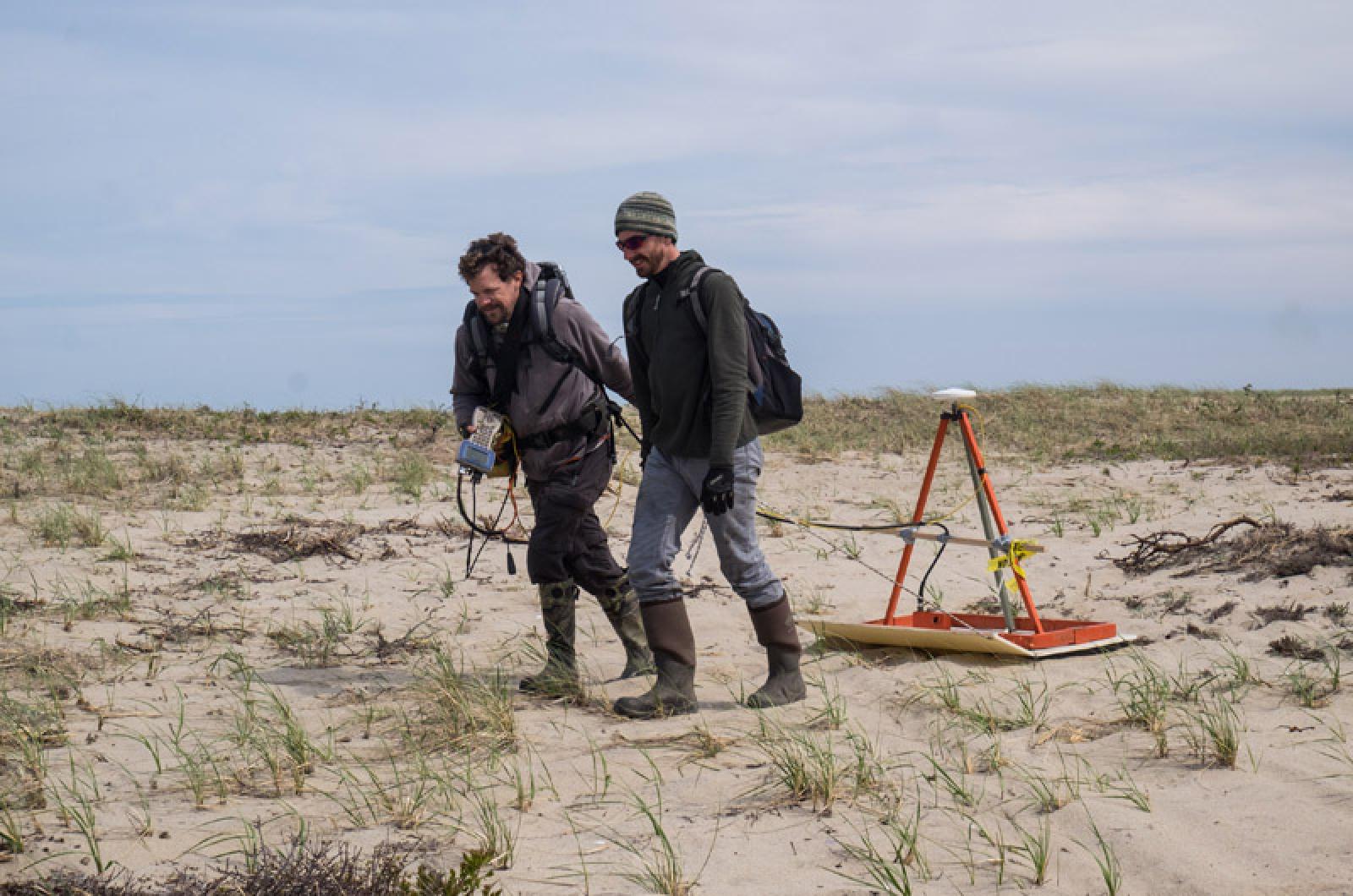
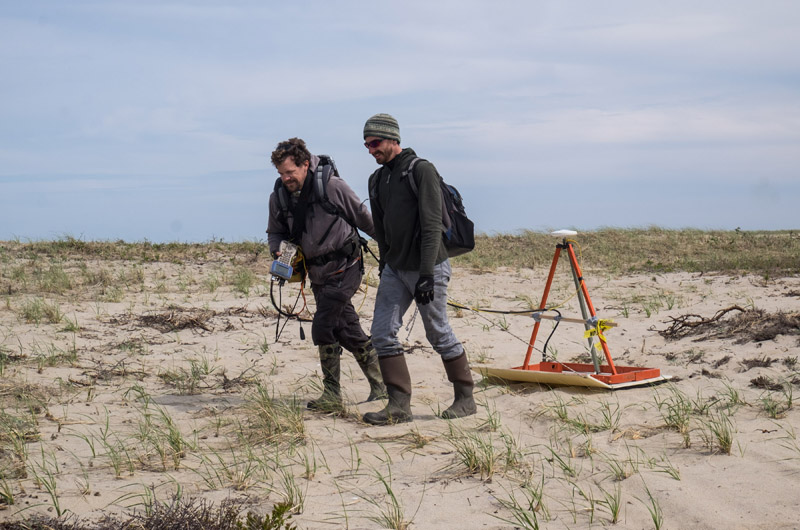
<p>The remote northern end of Chappaquiddick has been bustling with activity this spring as cleanup of World War II-era practice bombs begins.</p>
The remote northern end of Chappaquiddick has been bustling with activity this spring as the Army Corps of Engineers begins a lengthy cleanup project of World War II-era practice bombs.

Vast area around Shear Pen Pond has been cleared of vegetation.
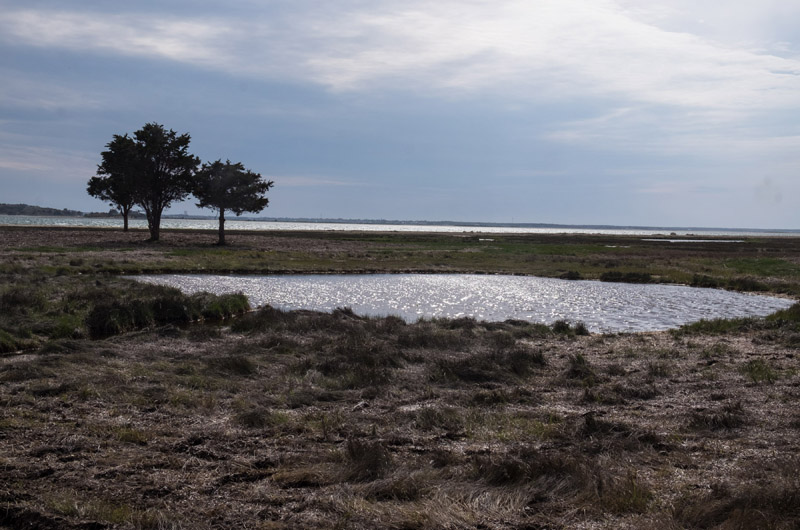
Vast area around Shear Pen Pond has been cleared of vegetation.
The $8.1 million project involves clearing 234 acres in the Little Neck area at Cape Pogue Wildlife Refuge of munitions and munitions debris that have littered the site for more than 70 years. The project will include an underwater element too, with munitions clearing extending to parts of Cape Pogue Bay.
Little Neck was used as a dive bombing target spot by the U.S. Navy at the end of World War II, beginning in July 1944 and continuing for about two years. Pilots from the U.S. Navy airfields on Martha’s Vineyard and at Quonset Point, R.I. practiced at Little Neck and other parts of the Island’s south shore.
According to the Army Corps, munitions and explosives of concern include three-pound practice bombs, 100-pound practice bombs, and flares.
Project manager Carol Charette said last week that the crew mobilized on the site on March 13 and field work is expected to be completed by December 2016.
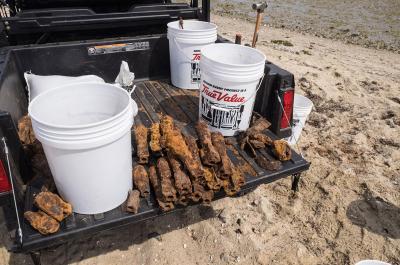
Some bombs are detonated; others deemed safe are taken away for eventual disposal.
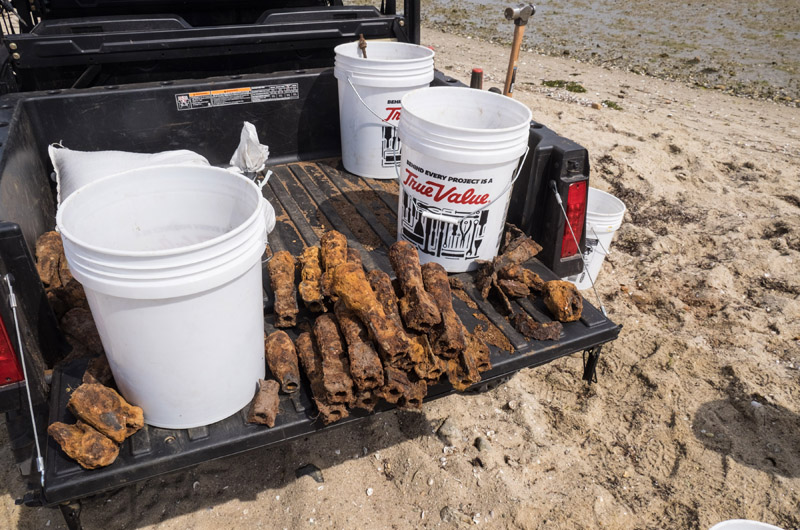
Some bombs are detonated; others deemed safe are taken away for eventual disposal.
Underwater cleanup is expected to begin at the end of June on the inland water areas, she said.
Frequented mostly by fishermen and birdwatchers, the remote stretch of barrier beach is owned by The Trustees of Reservations and has been closed to the public for a number of years for safety reasons because of the munitions. This spring the entire area has been cleared of vegetation, and specially-trained personnel are at work carrying geophysical sensors over the land to find buried munitions.
The sensors emit a signal when objects are detected. Ms. Charette said when items are discovered a map is created and analyzed by a geophysicist, who creates a “dig list.” When the list is approved and items are confirmed as ordnance, they are removed.
Munitions are detonated at Cape Pogue at least once a day and usually a few times each day, Ms. Charette said.
“Once we find these things and uncover them we don’t want to leave them lying around in a pile,” she said. “The safest thing to do is just to detonate them.”
Army Corps of Engineers project runs through end of the year and will cost $8.1 million.
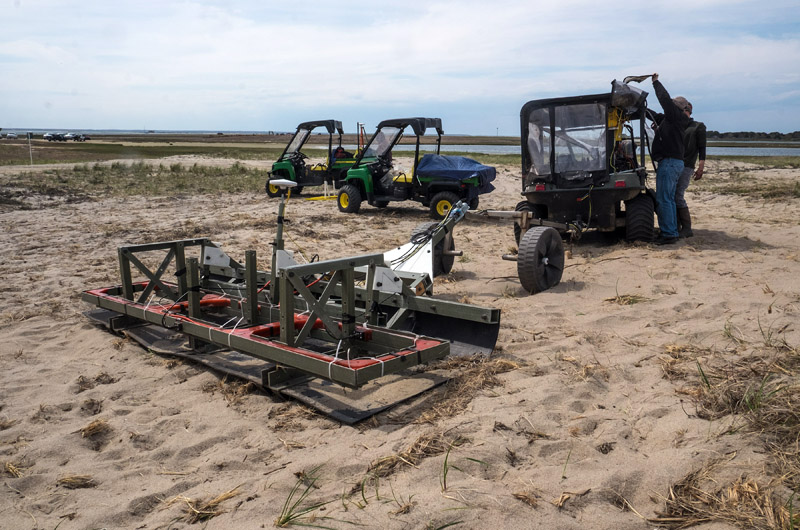
Army Corps of Engineers project runs through end of the year and will cost $8.1 million.
From May 9 through May 14, the crews unearthed and dealt with 60 munitions or explosives of concern, and another 445 pieces of munitions debris. To date 291 munitions of concern had been found, and 1,453 pieces of debris.
Through May 14, 8,529 pounds of material documented as safe, like practice bombs with no energetic material in them, had been found.
Material considered safe is placed in secure storage at the Chappy fire station until there is a full load, Ms. Charette said, at which point the debris is taken off-Island to be recycled.
A crew of about 34 people will be involved in the project, including a team of 20 with GSI Pacific, the prime contractor performing digs and demolition of munitions or explosives. All personnel performing intrusive work are certified unexploded ordnance technicians.
Naeva Geophysics Inc. has a staff of four working on land geophysics, and a staff of three from 3D Geophysics is doing underwater geophysics work.

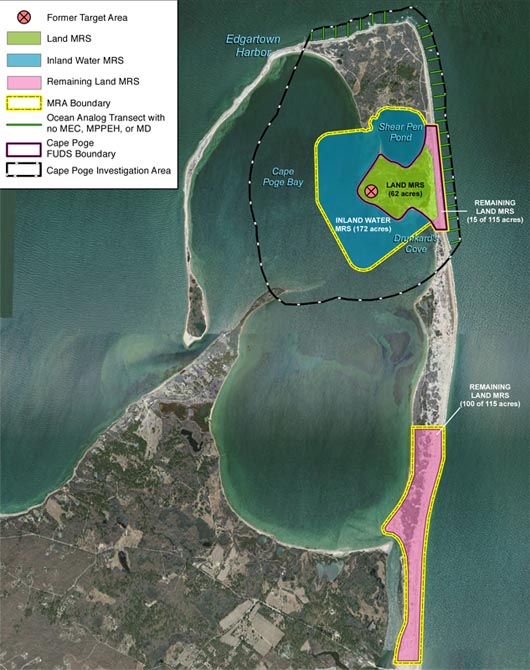
Starting at the end of May, a crew of about seven unexploded ordnance technicians and certified divers will arrive to start dives to perform underwater digs, Ms. Charette said.
Personnel are staying on Chappy for the duration of the project.
The Trustees of Reservations is providing biologists to help the crews avoid disturbing nesting shorebirds. The Trustees has supported the work being done at Little Neck and hope to reopen the area to visitors in early 2017, when the work is done.
Cedars, alders, bayberry shrubs and beach grass have been cut down at the site. The area will later be replanted with native grasses and shrubs.
The munitions removal at Little Neck is the first of several remediation projects in the works for the Vineyard, where the Army Corps has conducted surveys of sites over the past several years. Last summer the Corps held public hearings on the Island for a $9.8 million proposal to remove munitions at the Tisbury Great Pond. A $622,000 public education and monitoring program is also planned for South Beach in Edgartown.
Comments
Your tax dollars at waste
Slater MVYour tax dollars at waste
Really? Many of the young
Islander ChappaquiddickReally? Many of the young men who trained at Little Neck and the Martha's Vineyard Naval Air Station went on to serve in the Pacific and European theaters of war. Some never came home but most did. I would like to think that the lucky ones learned something while training on the Vineyard that served them well in war. A waste of tax dollars? Not to their families. And, if the federal government does the right thing 70 years later by cleaning up the training grounds to allow it to be used again by all of us? To me, that's money well spent. Slater, there is a time and a place for tax dollars to be used. Training our service men and women is the right thing to do and to return their training grounds for public use is money well spent.
Thank you! I should clarify.
Slater MVThank you! I should clarify. I said nothing in reference to the actual training being a waste of tax dollars. But thanks for jumping on that. However, stripping vegetation from dunes, essentially strip mining areas of beach for 70 year old munitions, many of which were so deeply buried or decomposed that they would never see the light of day, seems a ridiculous waste. So, there is what? A one in a million chance that one could maybe one day hurt someone? I would be willing to venture a bet that there are better odds of being run over biking in VH than being injured from one of these bombs.
Slater, I'll tell you what:
Aron Levy WTSlater, I'll tell you what:
Let's leave the UXO in place, and you can pay for the lawsuit when someone inevitably comes into contact with said UXO. This stuff is not like the snap-pops you buy at the Locker Room. 100 pound bombs had approximately 25 pounds of amatol.
Please don't make me describe what that would do to a birder or Fisher, even after seventy years of degradation.
Slater,
BFSlater,
Let's hope that if and when that one in a million explodes, it will not be your loved one who who suffers the consequences.
All lives matter!!
My husband is there working
WifeOfUxo HawaiiMy husband is there working as a UXO tech, away from his family for months at a time, its dangerous work. And regardless of how old it is...a live explosive is a live explosive with deadly results if not removed carefully and properly.
I walk katama bay regularly
MITCH REITER Demarest, NJI walk katama bay regularly from Quammox towards Wasque and often see a lot of munition debris. Is this area on the clean-up radar as well?
The other areas on the
Editor Vineyard GazetteThe other areas on the Vineyard being considered for remediation are South Beach and Tisbury Great Pond. The plan for a three-mile stretch on South Beach is a public information campaign; there is more information available at this address: http://www.nae.usace.army.mil/Portals/74/docs/Topics/MarthasVineyard/So…
Judging by the way the two
Steve FalmouthJudging by the way the two men in the picture are trudging across the sand with a sled, the unexploded ordinance buried there must be very hazardous. Thank God they are doing this for us
A beach environment changes
Ryan DenverA beach environment changes so much that if you leave a bomb buried there 2 feet down, next year it could be on the surface. This environment does render many of the bombs useless over the years with breaches of water, but far from all. These munitions in the ground indeed are very hazardous. Also, it is ridiculous to call this strip mining for bombs. They are doing a non-destructive geophysical survey to determine exact locations of possible targets. This dramatically cuts down on the environmental impact of cleaning up the beach by giving exact targets.
Add new comment