

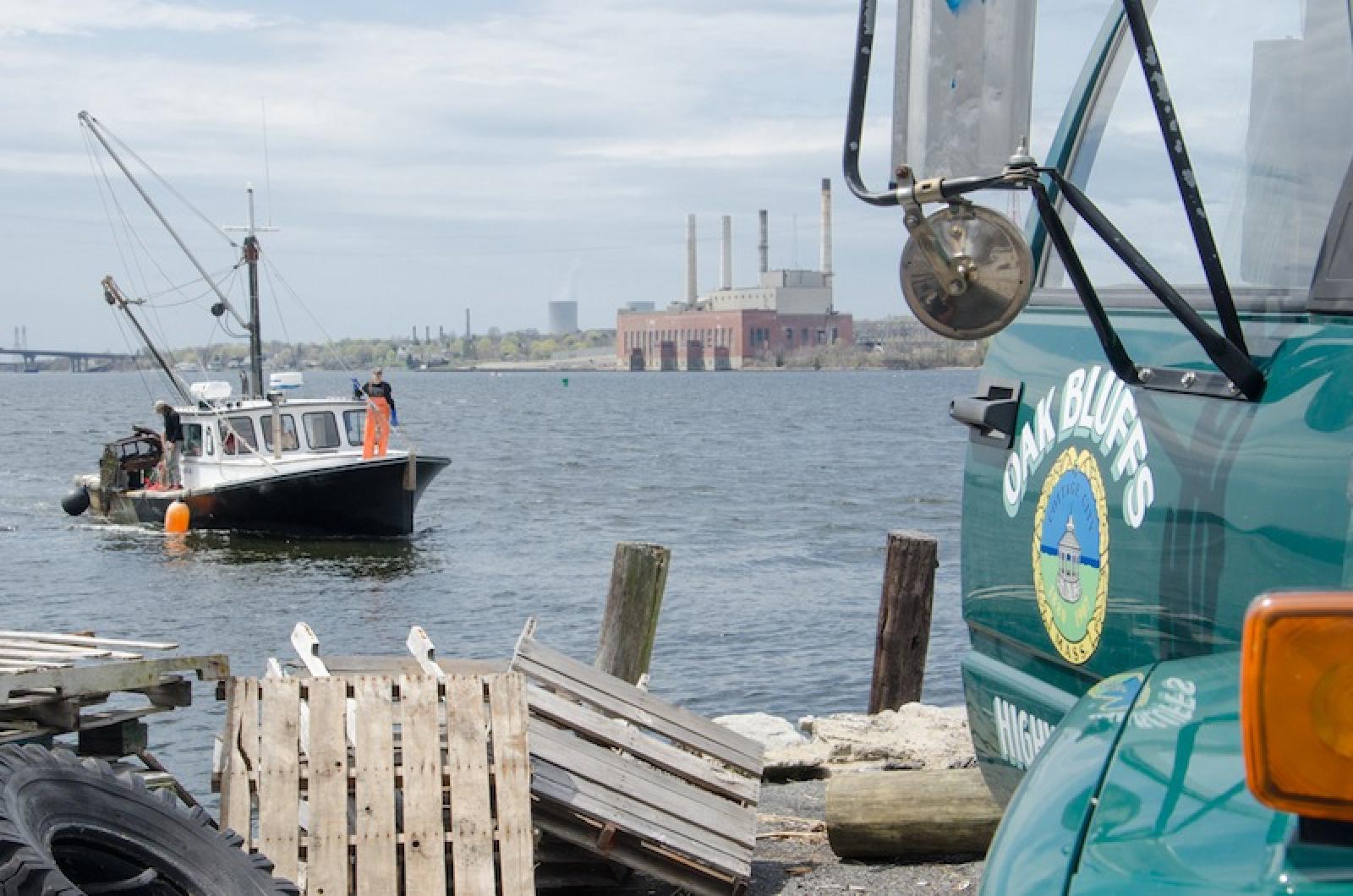
Traveling from polluted Taunton River to Sengekontacket Pond, quahaugs cleanse themselves as nature intended.
Quahaug relay. It sounds like a track meet for mollusks.
Journey begins at Taunton River, which has been closed to shellfishing for decades.
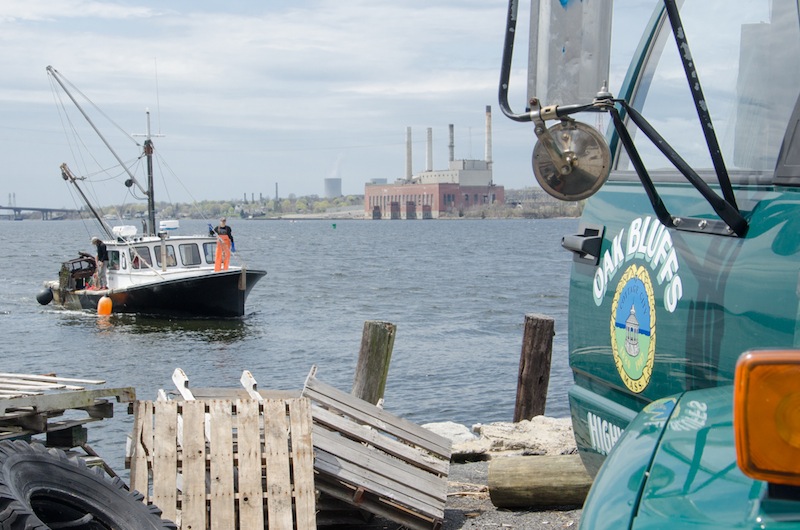
Journey begins at Taunton River, which has been closed to shellfishing for decades.
Oak Bluffs deputy shellfish constable Jason Mallory sits patiently in a highway department dump truck on the Fall River waterfront. All morning, the well-worn fishing boat Skipjack has been dredging quahaugs out of the Taunton River, by special permit from the Massachusetts Division of Marine Fisheries.
The setting couldn’t be more industrial. There is an abandoned factory building on the opposite shore, high tension power lines spanning the waterway, and a coal plant in the distance. The Taunton River has been closed to shellfishing for decades. It is far too polluted to produce quahaugs that are safe to eat.
With Skipjack tied up at the dock, the captain and crew use the boat’s lift to swing bag after bag of clams up to the bed of the dump truck. Each bag weighs about 75 pounds. Once the truck is full, permits signed and payment squared away, the Oak Bluffs crew gets on the road, with just enough time to make the 3:45 p.m. ferry back to Martha’s Vineyard.
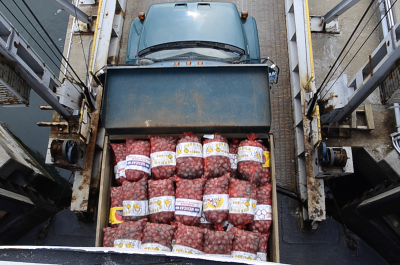
Over the course of five days 600 bushels of clams will have new homes.
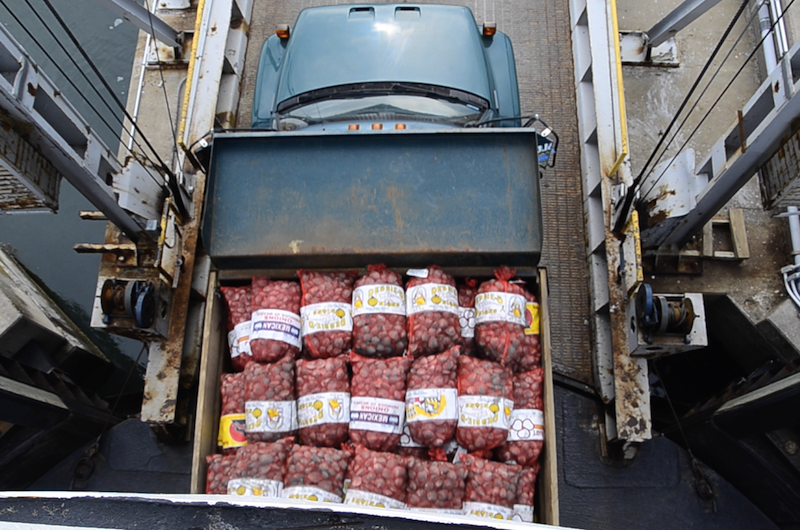
Over the course of five days 600 bushels of clams will have new homes.
Once back on the Island, the truck makes the short drive to Sengekontacket Pond, where a bucket loader and a crew of hearty volunteers waits. Each bag gets loaded into the bucket, driven down to the beach and transferred onto a skiff.
Shellfish warden David Grunden steers the heavy cargo about 30 yards off the beach, and the volunteers scatter the quahaugs in the water.
The relay from the Taunton River to Sengekontacket Pond will play out for five successive days. About 600 bushels of clams have found a new home.
After three months of cycling the clean water through their shells, the quahaugs will have purged every molecule of pollution out of their systems. State regulators will test them to be sure they are safe to eat, but they have never found them otherwise. Nature always does its thing.
To be extra safe, the shellfish department won’t open the area to harvesting until the summer of 2017.
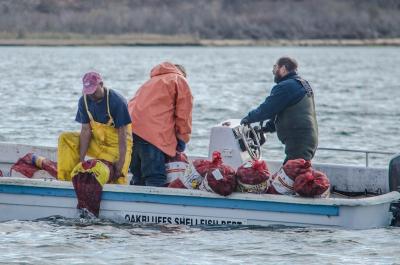
Quahaugs from Taunton River are released in Sengekontacket Pond.
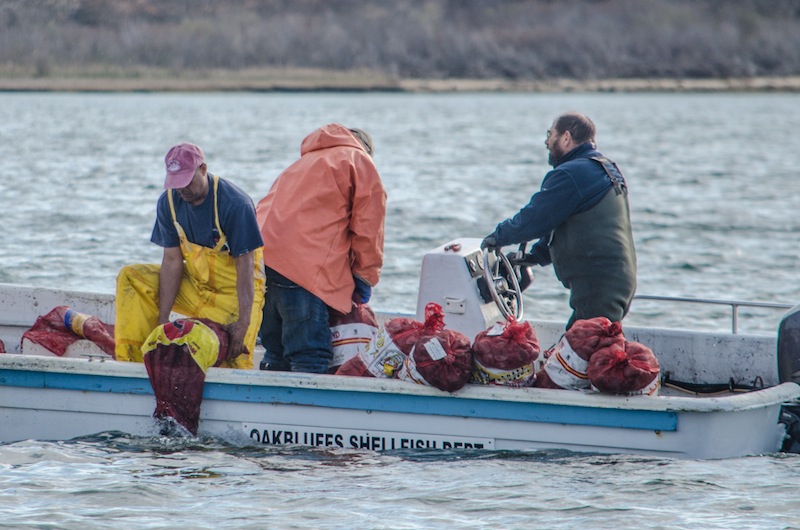
Quahaugs from Taunton River are released in Sengekontacket Pond.
It’s hard but rewarding work.
“It’s fun, it’s a chance to get off the Island,” said Mr. Mallory.
Vineyarders and visitors will wade in to gather the bounty for chowder, stuffed quahaugs and other delicacies. It’s a cherished summer ritual.
“They’re having more fun than anybody,” Mr. Mallory said. “That’s the reward.”
Ray Moreis is one of the volunteers hefting the heavy bags onto the boat, and dumping them in the pond. The bags are heavy and awkward, but he says the perks of the job make it worthwhile. Next summer, he’ll be back out here digging them up.
“I know exactly where to find them.”
Video by Steve Myrick.
Comments
What a great idea, bring
Concerned islander EdgartownWhat a great idea, bring polluted quahogs here to foul up our waters.
Did you know we never had vibrio here until 6 months after the first batch of clams (which were not tested for vibrio) from polluted waterways were dumped in Katama Bay?
Did you further know that the clams NEVER clear any heavy metals that they have picked up in the polluted waters where they began their lives?
I agree this does not sound
Bob EdgartownI agree this does not sound good. Where due the toxins go that come out of the clams? I hope they stay in OB only and keep out of Edgartown.
What is the major pollutant
deshandra brown mvWhat is the major pollutant in that river? PCP? Mercury? Chromium? Industrial sites polluted rivers with carcinogens that never go away. That's a big difference from the fecal coliform attributed to bird droppings. I'd prefer a 'second opinion' on the health of these shellfish.
seriously?!?!?
Slater Edgartownseriously?!?!?
Get off my lawn!
Bill ObGet off my lawn!
Why do we do this?
GeorgeWhy do we do this?
I'd love to know how much
Steve FalmouthI'd love to know how much this program costs... Why not leave the quahogs where they are to help clean the taunton river... Sounds like a case of "we are from the government, we are here to help"
If they leave them in the
Dave Edg.If they leave them in the Taunton River people will dig them at night because there is so many and people will get sick. It's the governments way of taking care of a problem. The solution to pollution is delusion.
And you folks are shocked the
Jim CotuitAnd you folks are shocked the our "scientists" would do something this shortsighted?
After reading this article I
Edward Pachico Washington, DCAfter reading this article I was also concerned regarding the transfer of contaminants from the Taunton River to MV. Apparently there are also concerned groups on the Cape who have also received quahogs from the Taunton River.
http://www.southcoasttoday.com/article/20120418/News/204180338#ReaderRe…
While pursuing my BS degree in Environmental Sciences at UMASS Amherst I worked on a project that focused on sampling and testing for heavy metals at electroplating factories in Westfield, primarily Smith & Wesson and Savage. What we found was that although the liquid effluent met the NPDES standards for wastewater discharge all the metals were ending up in the sludge which was being sent to the landfill and was not being tested. I don't remember the exact numbers now since this was several decades ago but it was dozens of times higher than allowed for solids being put onto soils for the metals we tested namely chromium, copper, zinc and nickel.
Doing a quick Google search I came across some studies done by DEP in 2003 and it appears that the primary concern are fecal coliforms caused by septic tank effluent and combined sewer overflows (CSO) from wastewater treatment plants. Both the Taunton WWTP and Fall River WWTP are authorized to discharge CSOs into the Taunton River. The report states the Taunton River receives discharges from four major municipals, one major industrial, and two minor facilities. Certainly fecal coliforms will not be a problem once the quahogs have a chance to cleanse themselves.
I love quahogs but also have concerns since we don't know exactly where the quahogs were collected and don't know what pollution sources are being emitted upstream from the collection area. I believe that before we accept any more quahogs from the Taunton River that our government officials should provide detailed information regarding the collection locations and potential pollution sources so that we the citizens can investigate and decide for ourselves about importing any more potentially hazardous shellfish. I also recommend that the quahogs brought in already be sampled for heavy metals just to see if there are any problems.
You only need to look back at the Minamata Bay issue in Japan where people along the bay were collecting fish and shellfish believing they were safe to consume until methyl mercury bioaccumulation in the fish and shellfish being harvested caused severe poisoning and birth defects.
Add new comment