



Massachusetts state legislators are strongly backing a bill that would require insurance companies to cover the long-term treatment of Lyme disease, which occurs in high rates on Martha's Vineyard.
State legislators are strongly backing a bill that would require insurance companies to cover the long-term treatment of Lyme disease. Filed by Rep. David Linsky, a Democrat from Natick, and Sen. Anne Gobi, a Democrat from Spencer, the bill is now working its way through committee and may land on the house and senate floors by July.
The 140 cosponsors of the bill represent about 70 per cent of all state legislators, including Rep. Tim Madden and Sen. Dan Wolf, who represent the Cape and Islands. The joint committee on financial services, which includes many of the cosponsors, gave the bill a green light on Wednesday.
“This bill has been a long time coming,” Mr. Linsky told the Gazette on Tuesday, recalling his efforts several years ago to form a commission to look at Lyme disease treatment in the state. Among other things, the commission recommended in 2013 that Lyme disease insurance coverage should be mandated in the state.

Bill would mandate insurance coverage for treatment of chronic Lyme disease.
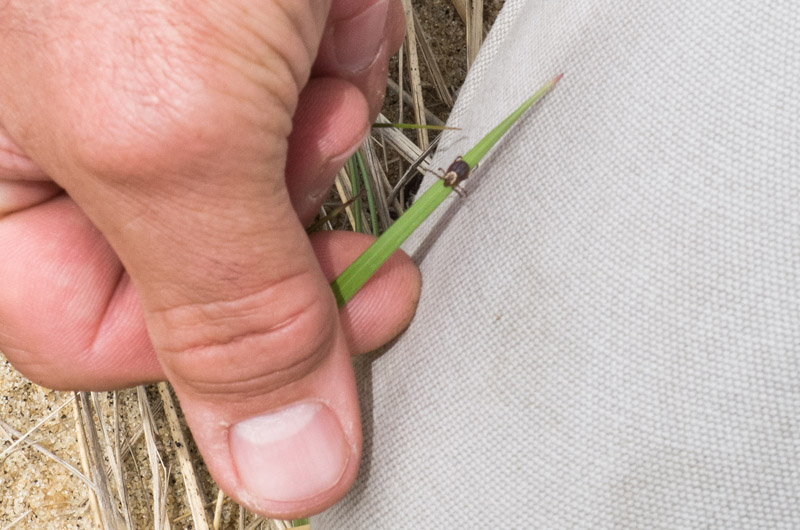
Bill would mandate insurance coverage for treatment of chronic Lyme disease.
Chronic Lyme disease, also called post-treatment Lyme disease syndrome, has been the subject of much debate in the medical community. In the last decade, two camps have emerged, one recommending that treatment should be based on symptoms for however long they last, and the other arguing that long-term antibiotic treatment is ineffective and unproven to work. House bill 901, an act relative to Lyme disease treatment coverage, would build on an existing law that allows doctors to prescribe long-term treatment without censure.
“It basically says doctors, not insurers, should decide medical care,” said Michelle Treseler, a chronic Lyme patient and co-founder of the Massachusetts Lyme Coalition, who helped rewrite the bill after it died in committee last year. “Unfortunately, there are many people with Lyme in Massachusetts who are not only battling for their lives against Lyme disease, but also for access to their doctor-prescribed medications.”
The version of the bill approved on Wednesday includes a provision that the bill will expire in November 2021. “The logic behind that is that the science around this and the research is changing so rapidly that it will make sense to revisit it at that time,” Mr. Madden told the Gazette. In general, though, he felt the bill had a better chance of passing this year than last year, in part because of a growing awareness of the issue.
Massachusetts has among the highest incidence of Lyme disease in the country, with 5,600 cases (more than ever before) reported or suspected in 2014. Chilmark has had more cases of Lyme disease than anywhere else in the state, followed by Nantucket, Aquinnah and Tisbury. Edgartown and West Tisbury are also high on the list.
The state Department of Public Health estimates that reported cases could be underestimated by a factor of 10, possibly raising the figure to more than 50,000 cases in the state last year, and more than 3,000 in Dukes County. A study by the University of Massachusetts in 2010 found that more than 1,000 antibiotic prescriptions had been filled for Lyme disease on the Island, despite only 25 reported cases in Dukes County.
Medical experts have struggled to get a handle on Lyme disease diagnoses, and chronic Lyme in particular. The Center for Health Information Analysis noted last year that between 10 and 20 per cent of all Lyme patients remain sick for months or years after initial treatment, but that a clear way to detect the long-term presence of the disease does not exist. The Centers for Disease Control and Prevention is among the groups that see long-term treatment as working more as a placebo than as a result of antibiotics.
Opponents of the new bill point to the lack of consensus around long-term treatment, although Mr. Linsky disputed that the bill was not backed by medical evidence. “There have been many patients that have been successfully treated with this type of treatment,” he said, adding that insurance premiums would increase only up to 13 cents per patient, and possibly not at all. The 2013 report noted that chronic illness accounted for 84 per cent of Lyme healthcare costs, due mostly to lost productivity.
Chilmark has highest rate of Lyme disease in the state.
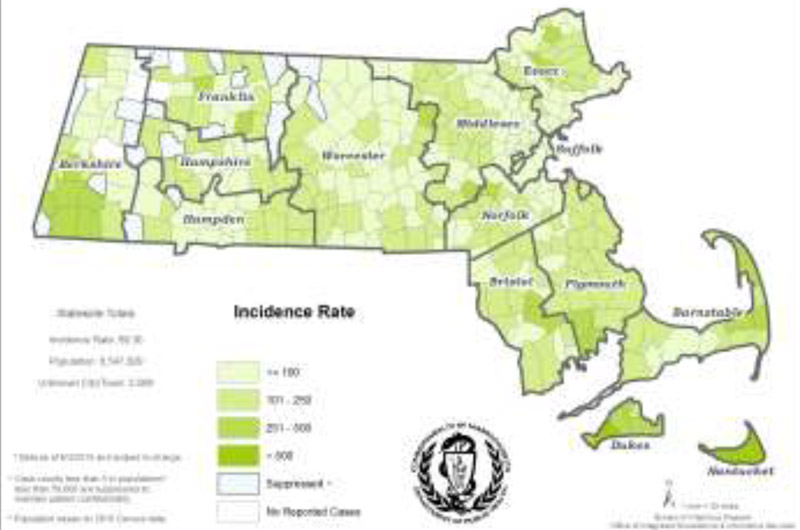
Chilmark has highest rate of Lyme disease in the state.
The Massachusetts Association of Healthcare Plans, which spent almost $400,000 last year on lobbying efforts in the state, has pressed hard against the bill, which it argues will disadvantage small businesses that are forced to offer the new benefits.
“I think what we’ve seen in the past, when the state mandates specific services and it’s not consistent with medical evidence or later turns out to be inconsistent with scientific research, that’s ultimately bad for consumers,” association vice president Eric Linzer told the Gazette. “As the state continues to impose new mandates on health insurance, it disproportionately affects small businesses because larger businesses are able to self-insure and in turn don’t have to cover those mandated benefits.”
Mr. Linsky said fears over yet another healthcare mandate were overblown. “It’s hard to dispute a mandate that costs no more than 13 cents a year,” he said. He added that while some still question the science, “this is really a patient-choice bill, where it doesn’t require any type of particular treatment but it gives patients the option.”
Many insurers deny long-term coverage based on guidelines developed by the Infectious Diseases Society of America, which Ms. Treseler said were themselves a source of controversy. An investigation by the state of Connecticut in 2008 found that the society had excluded contradictory evidence and opinion in developing its guidelines. And the National Guidelines Clearing House, a federal database, recently delisted the society guidelines, which did not comply with its revised standards.
Despite the efforts of lobbyists, Ms. Treseler said there were few opponents of the bill. “To be honest, we haven’t heard much at all, and we are in pretty much constant contact with the legislators,” she said. About 200 people, many of them Lyme patients, attended a public hearing on Oct. 20 and many voiced support for the bill.
“We’ve engaged up to 7,000 people on a weekly basis through Facebook alone,” Ms. Treseler added. “There has been incredible grassroots support for this bill.”
But misperceptions about chronic Lyme are still an obstacle, Ms. Treseler said. Her own illness, which she contracted as a graduate student in public health in 2009, was a personal education and a call to action. As with many others, she still struggles with chronic symptoms and has faced limited insurance coverage.
“It’s been a real battle,” she said.
Comments
Can we work to truly,
Mr. B ChilmarkCan we work to truly, significantly reduce the island's deer population? Can someone take a moment and give me the reasons not to go this way? I do not propose eliminating deer, just much reducing their population on the island, reducing it far beyond what the hunting seasons do.
I don't think reducing the
cheryl Tobichuk MassachusettsI don't think reducing the deer population is the answer. No killing these beautiful animals is not the answer, especially since Lyme has shown it's ability to find different hosts. I wish I had the answer and I am sorry for the suffering where you are. I live on the Cape and we have similar situations here.
Deer do not carry the Lyme
Steve ObDeer do not carry the Lyme disease pathogen. The white footed mouse is the animal responsible for hosting the Lyme disease pathogen and spreading it to the ticks.
Sadly, it's not just the deer
Shantiann MaineSadly, it's not just the deer. Birds travel much further and if you look at the University of Connecticut's website, they "collected" some birds for a research project. The students stopped counting at 224 +/- and that was only what they counted from the neck up! There is now some evidence that mosquitoes, some biting flies, spiders, moles, voles, mice (white-footed) and numerous others are now being discovered. Wish there was a better answer for you but the killing of the deer will help some, but not to the extent that most would wish.
It's not just the deer that
Patricia White MassIt's not just the deer that are carrying the ticks with Lyme and co's, birds, rabbits, mice, etc. are also carriers
That's all good for folks in
Dee Ouchman Isles of LangerhansThat's all good for folks in MA. But many visit form all over the USofA and take Lyme disease home with them.
From someone who has been
cheryl tobichuk MassachusettsFrom someone who has been suffering with Lyme disease for a long time, I can assure you chronic lyme disease exists. I have been treated by the most knowledgeable physician on the planet. When I am on antibiotic treatment my symptoms improve dramatically. When I come off treatment it takes about 3-4 months and my symptoms return. I am sorry the medicine isn't a placebo effect, to me this is an obvious chronic infection. I am a fighter its in my nature. I have been fighting this thing for 10+ years and it's not going away. I am a home owner and work 2 jobs to support myself and in the midst of everything haven't given up. I consider myself one of the lucky ones because I was living with my family when my disease was at it's worst. I couldn't have come this far without my family and doctor. My heart goes out to the people that don't have anyone and are too sick to work. This political battle as to if Lyme disease really exists is really getting old people. Lets try putting more effort and dollars into finding a cure. There are people out there that are praying they can just get thru another day. No human being should have to suffer like that. Treatment should be available to everyone who needs it!!! Lets get this thing going and help the sick!
Thank you for your well
mike Roy Southern VermontThank you for your well written comments. I couldn't have said it better
Thank you for highlighting
Diane Stewart Oak Bluffs MAThank you for highlighting chronic LD treatment and please continue following bill 901 through committees.. Everyone needs to be aware of the public health crisis we have in Massachusetts, especially on the Cape and Islands, and the needless suffering of so many people because of political interests. I spoke with Tim Madden yesterday and was encouraged by his support. I would urge all MA residents to become educated into this disease which, along with its co-infection babesiosis, is endemic in our state.
NOPE......NOT GONNA WORK...no
CashNOPE......NOT GONNA WORK...no...NO...It's all a WASTE of time... First off I have to comment on the idiots with the KILLING of deer or the such...you might as well Kill the mice, all the animals that are Victims to ticks and other insects...heck you gonna kill your pets and your children too? COME ON!!!!???? REALLY??? Look Ticks and now many other insects are looking for a blood meal.....perhaps you should thank the deer for takin' the brunt of being the Victim...you do know each tick lays 3-30 thousand eggs right!!!??? Wake up and think again...
On the subject of Insurance and doctors.....FORGET that too! I went Sept 22 2016 to a Doctor asking him if he would treat me as a patient and use the National Guidelines, once he noticed they changed he REFUSED! Insurance REFUSES TOO....ohh and if I try to go to the LLMD...I have to pay out of pocket with money I don't have..Insurance raised the deductable knowing this..so by the time I pay it the year is over...and Insurance had to cover NOTHING!
Please...write about something that's gonna work! All a waste of time and reading and hoping..."They" make it clear...just go on disability...become a suffering nobody.....sad part is CDC is happy with this...they just keep reporting the numbers going up...lol...close to 1000 each week, each year WILL be INFECTED...gotta love it right?
Wilhelm "Willy" Burgdorfer
don earthWilhelm "Willy" Burgdorfer Phd. is credited with the discovery of the "lyme" bacteria. Burgdorfer gained worldwide recognition for his 1982 discovery of a tick-borne spirochete as the long-sought cause of Lyme disease. However another pathogen was not seen by Dr.Burgdorfer because it was too small to be detected by his equipment. This nanobacteria is the actual dominant pathogen in Lyme disease and is approximately 300x smaller than the borrelia spirochete, it is the genus Bartonella. Bartonella is one of only two bacteria known to science to be able to transfer DNA into the human cellular genome.
http://www.ncbi.nlm.nih.gov/pubmed/23090599
“we actually never had antibiotics capable of eradicating an infection. All pathogens produce a small subpopulation of dormant persister cells that are highly tolerant to killing by antibiotics. Once an antibiotic concentration drops, surviving persisters re-establish the population, causing a relapsing chronic infection. “
The real cure for Lyme is here.
www.lyme-morgellons.com
I have been dealing with lyme
Brenda OBI have been dealing with lyme for 28 years. I test positive for it every time and I have been dealing with other medical issues from this on and off ever since. It has been difficult to get help. Scheduling appointments I have to wait months before I can be seen making what I'm dealing with at that time hard and it gets depressing.
My 16 year old son has
scott sturbridgeMy 16 year old son has chronic lyme, he has been on antibiotics for a year now and he still is no better, the Dr. we bring him to is a LLMD in Ct. I don't know if insurance would be possible to use since he is out of state. We tried to find a Dr. around here but no one could help. We paid over $5000 in extra costs and we have good insurance. Luckily the insurance is paying for meds.but not the treatment..unfortunately we are now going to take him to a Holistic clinic in Morristown, NJ. to hopefully help him, but it will all be out of pocket.
I have chronic lyme and I
Jane R. MAI have chronic lyme and I know of many people who were able to completely regain their health and are back to their "normal" lives after going on extended antibiotic treatment for Lyme disease. I also know of people with Lyme disease who have had to struggle to afford their doctor-recommended care due to insurance denial. This has left some people in a really bad spot financially and physically.
I am getting better, and without extended antibiotic therapy, I honestly would not be alive. I greatly appreciate that the Vineyard Gazette is covering this very important issue.
Add new comment