


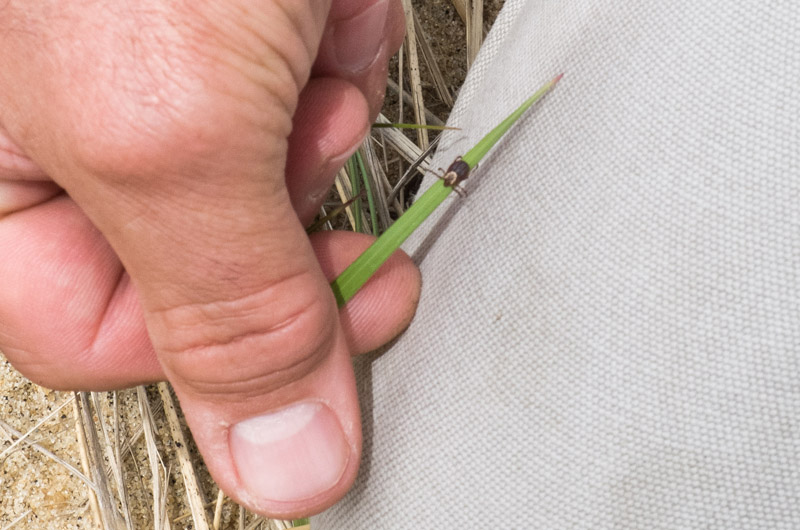
<p>With tick-borne illness on the rise, health agencies are turning their attention to babesiosis, a disease carried by deer ticks.</p>
With tick-borne illness on the rise, federal and state health agencies are turning their attention to babesiosis, a lesser known but potentially life-threatening disease carried by deer ticks that is transmissible through blood transfusions.
The Rhode Island chapter of the American Red Cross, which handles most of the blood supply for Massachusetts, began screening its blood samples for babesia some time ago. It also has been sharing data from the program with the federal Food and Drug Administration, which is expected to require the screening of all blood samples in certain areas of the country.
Babesiosis and other tick-borne diseases, including Lyme, are endemic to New England, which spurred the Red Cross into piloting the screening program. The Rhode Island Blood Center, one of the few independent centers of its kind in the area, drew attention last year when it also began screening, laying off 37 workers in the process to cover the costs.
Incidence rates for confirmed babesiosis in Massachusetts: 2009-2013.
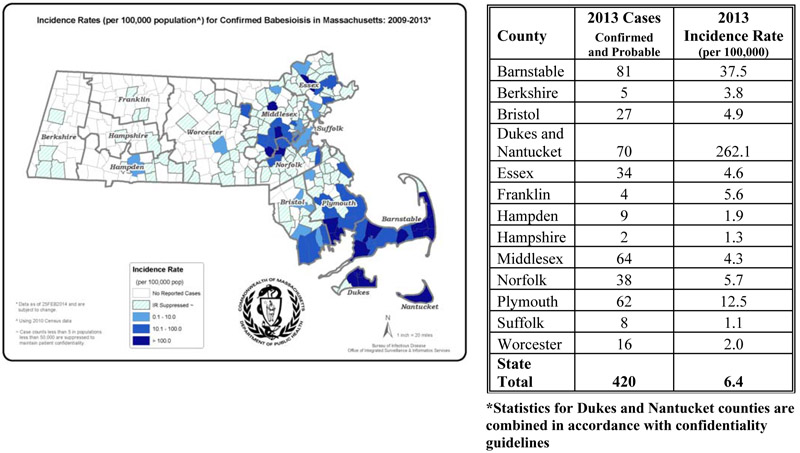
Incidence rates for confirmed babesiosis in Massachusetts: 2009-2013.
“Right now the focus is on babesia because that is causing multiple infections every year due to blood transfusion,” Dr. Catherine Brown, deputy epidemiologist at the Massachusetts Department of Public Health, told the Gazette this week.
Several hundred cases are reported annually in the state, with the numbers increasing dramatically. Between two and five of those cases each year result from transfusions, Dr. Brown said.
Nationwide, babesiosis is the number one infectious disease caused by transfusions, although other complications, such as abnormal reactions to blood, are more common.
The disease causes Lyme-like symptoms, with fatigue and aches, but usually not the characteristic bull’s-eye rash at the point of infection. Lyme, babesia and anaplasma are all carried by deer ticks. A small percentage of Lyme patients also contract babesiosis.
Usually, when a patient has indistinct symptoms, a physician will order tests for all tick-borne illnesses, including tularemia and Rocky Mountain spotted fever. Lyme tests are routinely performed on the Island, but in other cases, blood samples are sent to the Mayo Clinic in Minnesota for testing.
Last year the Martha’s Vineyard Hospital reported 25 cases of babesiosis on the Island, down from 36 the year before but up from 20 in 2013. Lab director Lynn Mercer told the Gazette that the figures were likely even higher, since Island visitors may not experience the symptoms until after they return home. Cases of both Lyme and babesiosis spike in the summer.
Vineyard Medical Center in Tisbury, which also tests for tick-borne illness, reports between six and 15 cases of babesiosis per year. Lab director Dr. Lena Prisco said the numbers tend to fluctuate from year to year, but have not increased dramatically.
She estimated that up to 600 samples in all, including those taken at the hospital, are sent off-Island for testing each year.
The illness is more prevalent on Nantucket than the Vineyard, but has been on the rise throughout the region. It also has a significant presence in the Midwest. Dr. Brown said a combination of factors, including increased habitat resulting from development, were to blame for the explosion of deer ticks in New England.
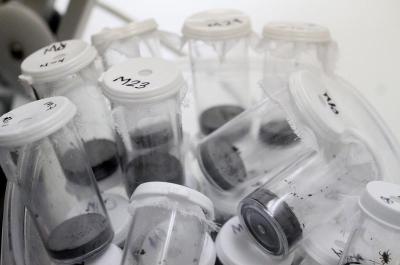
Vineyard Medical Center reports between six and 15 cases of babesiosis a year.
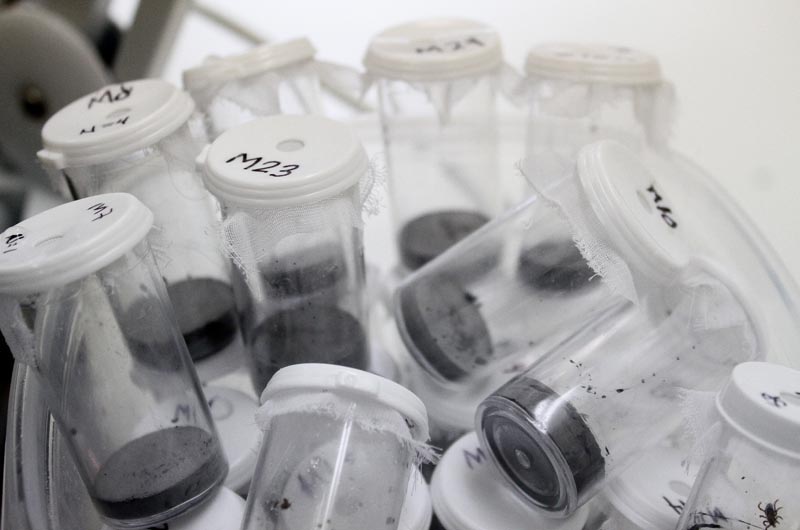
Vineyard Medical Center reports between six and 15 cases of babesiosis a year.
“The suburban areas that we have developed over the last several decades have created the perfect type of environment to increase populations of small rodents like chipmunks and mice — and deer,” Dr. Brown said. While rodents are the initial carriers of the diseases, deer provide food and a way for the ticks to get around.
On the Vineyard, discussions have occasionally turned to the resident deer population, which exceeds the density of most areas in the state — and whether culling the herd could help reduce the number of deer ticks on the Island.
Blood screening is another form of prevention, but would not directly affect cases of Lyme or other tick-borne illness, since only babesiosis is transmitted through blood transfusions. “That was the whole reason behind working on this babesia screening policy,” Dr. Brown said. “Babesia is the one that’s the risk.”
Dr. Prisco said she believed that a federal mandate would have little affect on the ability to give or receive blood on the Island. But the increased costs could potentially trickle down to the hospital.
“The discussion has been around the fact that anytime you add a screening process to the blood, it’s going to increase the cost of it,” Dr. Brown said. “The balance is that we need to protect public health, and yet the hospitals are also going to probably see an increased cost for that blood supply.”
The state Department of Public Health reported 420 cases of babesiosis in 2013, an increase of 40 per cent from 2012. And for the first time in 2013, all counties in the state reported cases. The highest incidences were in Barnstable, Plymouth, Dukes and Nantucket counties. One out of three patients were hospitalized, and five cases were associated with recent blood transfusions.
Rhode Island reported 142 cases of the disease in 2013.
Comments
What is the "small percentage
Alexandra Blackman ConnecticutWhat is the "small percentage" of Lyme patients that also contract babesiosis? From the data I've seen it's at least 10% (in New England); that's not exactly small, but perhaps I'm sensitive as I contracted both.
More like half of all Lyme
Wendy ChicagoMore like half of all Lyme patients also have Babesia. And Babesia Microti and Babesia Duncani are not exclusive to one coast or the other, or anywhere in between. That's why it's imperative that the CDC screen some donor blood in every state for Babesia, to get an idea of just how many cases there really are in the US. www.facebook.com/BabesiaBlows
Right Wendy, it seems to me
Alexandra Blackman ConnecticutRight Wendy, it seems to me that the concurrent infection rate must be much higher. I am thrilled that this article is creating more awareness, but curious about the author's source, as this is an already under-diagnosed community & there is misinformation everywhere.
In my neck of the woods, MOST
Karen CAIn my neck of the woods, MOST tick-borne disease patients have Babesia duncani. In fact, in 1995 a population study was done in my county where 18% of the people in a small community tested positive for Babesia duncani. Furthermore, the control group from a blood bank in Sacramento CA had 20% positive (and presumably asymptomatic). Yet our blood banks still do not test for Babesia in donated blood.
I also had both....babesiosis
Elisabeth Houle Andover, CTI also had both....babesiosis was much worse....in hospital (Hawaii) for 4 days. I was told not to donate blood.
Unfortunately Babesia is a
Helen Munroe RN New HampshireUnfortunately Babesia is a protozoa not a bacteria.
Babesia are parasitic and reproduce within mammalian red blood cells.
They may be able to identify Babesia through a blood smear on a slide. "May be able".
Identifying and diagnosing are two separate things.
There are two dozen known strains of Babesia.
Of those twenty-four strains of Babesia, there are only tests to identify TWO of them, Babesia Microti and Babesia Duncani.
Those tests are very specific, Babesia Fish Assay and Babesia IGG/IGM IFA. These tests should ideally be done by a specialty lab.
So how exactly are they screening?
I had negative fish 2 yrs
Carrie Redding, caI had negative fish 2 yrs after tick. Then 5 yrs after tick I had 2 positive babesiosis smears. Then the hematology doctor sent me to infectious disease who of course ran only a one stran generic some sort and said I was negative. Infectious disease doctors are worthless. UC Davis said because I was treated with antibiotics up there's nothing more they can do for me. Now I am crippled , neuro horrible, brain fog, deep deep dark depression. Never suffered depression like this before tick. We need lyme doctors to take insurance. They are just letting us die
This is such terrific news!
Liisa Cary, North CarolinaThis is such terrific news! As someone who has chronic Lyme Disease and Babesia infection (which I acquired on MV), I am in pain daily due to these bugs, even having been through treatment. I wish the CDC and the country in general would also start taking Lyme Disease more seriously. Thank you for publishing this article.
I Babesia Ducani strain.
patty preston NHI Babesia Ducani strain. Nearly made me go blind among a multitude of sx. About 10 monrh ago, i started BVT aka bee venom therapy which has been a total game changer. I feel 90% better and am regained my quality of life back thanks to honeybees. The most effective treatment I've tried and if I follow the BVT protocol for Lyme, I can achieve full recovery. Well on my way :)
Thank you for this article
Carla Gervasio New York CityThank you for this article and everyone's comments. My 12 year old son is suffering with Autoimmune Encephalopathy due to the chronic lyme infection and currently gets IV IG treatments every two weeks which have truly helped him. The IV IG serum is culled from thousands of people and supposedly 'tested' but does anyone know if serum tested for Babesiosis? I need to check with neurologist. Thank you in advance for your responses.
Carls, I'm curious....how did
Annie San DiegoCarls, I'm curious....how did you get your insurance to cover IVIG for Lyme?? OR are you paying out of pocket??
Did the insurance cover the
Andrea Jackson CODid the insurance cover the IVIG, who did you get to do it, and did it help? Hope you are able to see this so long after your posting and that the Lyme/babesia etc. is much better now.
I've had Babesiosis, Lyme
David WhitmonI've had Babesiosis, Lyme (twice) and Tularemia. All very nasty.
Babesiosis is passed by a deer tick when it is in the nymph stage of it's development and is smaller than the period at the end of this sentence. Babesiosis is a parasitic disease. The parasites invade the red blood cells causing them to burst en mass. These ruptured cells are passed from the body through ones urine, turning your urine reddish brown. The fatigue and racing of ones heart at the slightest physical effort is from the lack of red blood cells in your system. The red blood cells are what carries oxygen to every cell of the body. Your cells are starving for oxygen and your heart is trying to compensate much in the way your body would respond to hugh altitude. I'm a cyclist. I went from riding a couple of hundred miles a week to just about passing out from washing a sink full of dishes.
Henry Nieder diagnosed the Babesiosis and gave me two prescriptions. One drug to kill the parasite and another to boost red blood cell production.
Within days I was feeling like I could leap over a tall building.
David, what two drugs helped
TeriDavid, what two drugs helped you so much?
Teri. I wish that I could
David Whitmon Oak BluffsTeri. I wish that I could remember. This was 8 to 10 years ago. I could call my doctor, Henry Nieder here at the MV Hospital next week. As I said, it was one drug that killed the parasite and a second drug to boost red blood cell production. Within a week I was feeling like Superman
I had Tularemia Summer of 1999 and Henry Nieder took care of me then also. I was in the ICU for a full week and an out patient for 10 days afterwards. I was unable to walk for two weeks and was off the bicycle for four months.
When I went in to see Henry for what turned out to be Babesiosis, he tested me for 5 different tick born diseases.
Yes would be great to know
Andrew OregonYes would be great to know what worked for you! Thanks
Andrew. The MV Hospital
David Whitmon Oak BluffsAndrew. The MV Hospital should have be able to tell me what meds Henry Nieder prescribed for me when I had Babesiosis. I will call them next week.
My daughter had Babesiosis,
Cherwyn Ambuter Vernon, NJMy daughter had Babesiosis, and was administered an anti-malarial drug, which I believe was Atovoquone. She was quickly healed, within a few weeks, and has not had a recurrence in the 11 years since.
This drug would have been $650 without insurance. We were so blessed to have prescription insurance.
Which drugs did you use?
JanetWhich drugs did you use?
A friend mentioned that
Catherine Fox VirginiaA friend mentioned that Nantucket residents have been told they cannot donate blood period, because Lyme is so prevalent. I was about the share that on my blog, LifeloveLyme.com; can you tell us about the status of Lyme? Thanks.
This tick- borne problem gets
Robert Munsey Winnetka (Los Angeles) CAThis tick- borne problem gets bigger with each day of my study. My thanks to all who write as I am then able to share my new information with my various associates. This information will be shared with well over a few thousand others (no exaggeration).
I gave blood yesterday and
Rebecca Kizer New MexicoI gave blood yesterday and the question on there asked about babesiosis and I put I don't know BC I don't! I tested positive for Lyme through Igenex but do not know the strain. The girl told me it's from another country not to worry about it and changed my answer! I'm concerned now. I definitely do not want to give anyone my Lyme.
Please contact the place
B.Hardy Ft. Worth, TXPlease contact the place where you gave blood and tell them you tested positive. Even if someone has already received your blood, they could be treated and spared misery. Perhaps your blood saved their life and now information about your infection could allow them to have a better quality of life. God bless your efforts.
Add new comment