

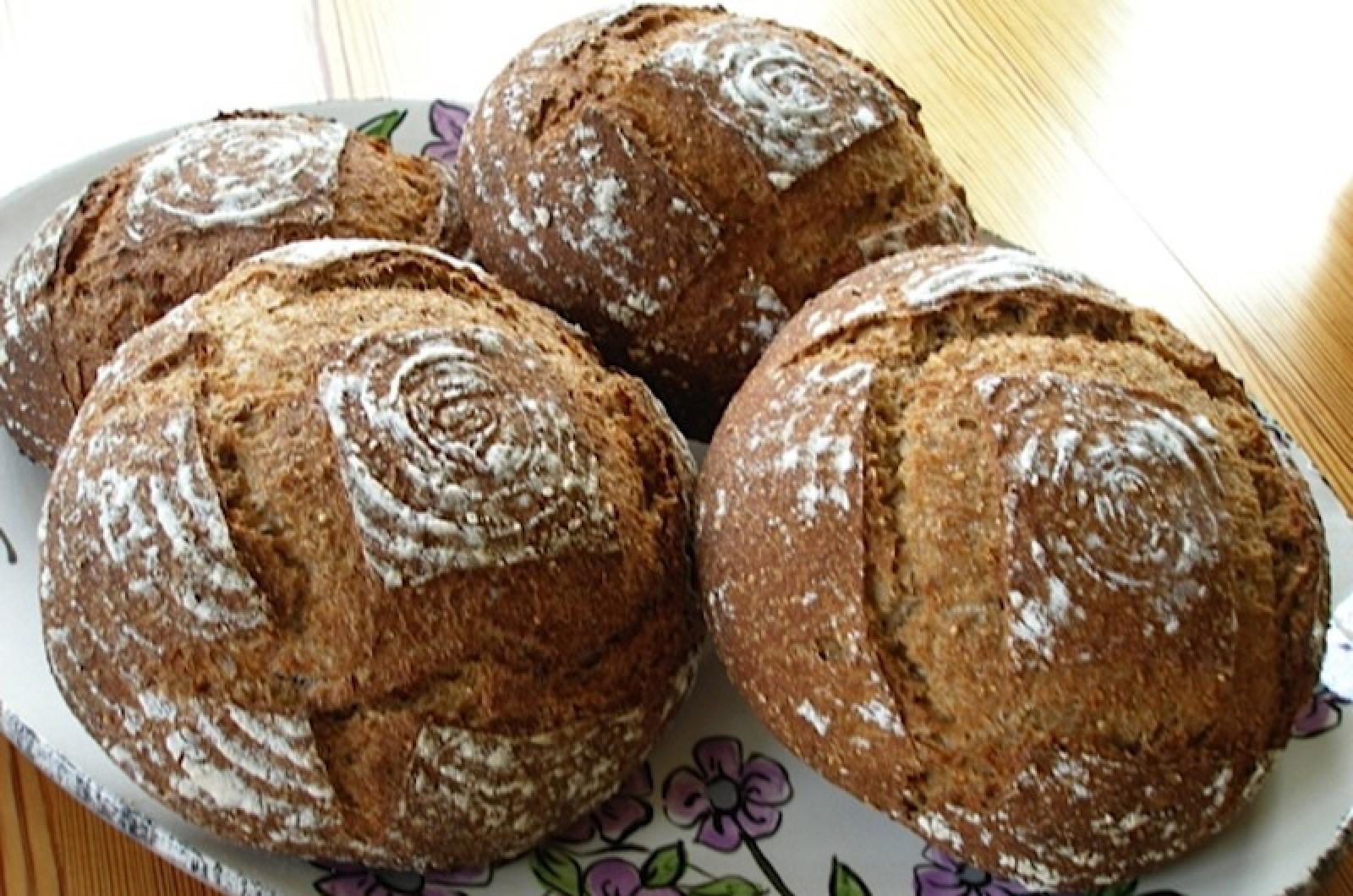
A quiet revolution has been slowly taking place on the Vineyard, something that is perhaps of great importance and could do exciting things for the Island.
A quiet revolution has been slowly taking place on the Vineyard, something that is perhaps of great importance and could do exciting things for the Island. It involves the introduction of locally-grown Red Fife wheat into our Island food stream. Grown by Allen Healy and Dan Sternbach in West Tisbury, it represents a turn back to New England of the 1800s and the possibility of more nutrient-rich wheat, grown in ways that are more sustaining of soil for the Island.
Along with some other Island bakers, I have begun to work with Red Fife wheat in my community-supported bread business. Like any new flour, there is a learning curve involved in order to make good bread, but many of my bread eaters have been enthusiastic about it.
I have always been told in baking classes that the hard red winter wheat grown in the Grain Belt (North and South Dakota, Nebraska, Kansas, Oklahoma and Texas) is best for bread, and that in order to grow it successfully, you need to plant it in the fall, have it winter over with snow cover, let it grow more in the spring and then harvest it. This is the wheat used for most of the bread we eat. It is true that hard red winter wheat makes for very good bread and allows bakers to make a consistently good product.
What I was interested to learn over the last year or two is that different varieties of wheat were grown in New England and other parts of the East before hard red winter wheat was introduced. In the 1840s there was one grist mill per 700 Americans. Wheat was grown and stone ground locally. The flour had a shorter shelf life because when you stone grind, the germ is crushed and the oils in the germ will make the flour go rancid over time. But since the wheat was being grown and consumed locally, spoilage was not such a big issue. The flour made from this wheat was not as consistent as the flour we use today, but people adjusted their doughs accordingly so as to make good bread.
Things began to change when the Erie Canal opened in 1825 and the railroads were extended. This opened up the Midwest where the topsoil was much deeper and there were bigger spaces to grow grain. Prairie topsoil was 12 feet deep, as opposed to our topsoil being six inches deep!
Further inventions moved us toward where we are today. In 1830 the combine was invented to harvest, thresh and clean wheat kernels, and in 1837 John Deere invented a plow that could cut through deep prairie grass roots.
Most significant of all was the invention of the steel roller mill in the late 1800s. Unlike the stone-ground method, this mill was able to separate the endosperm (what white flour is made of) from the germ and the bran and thus was able to make white flour. Because it does not have the germ, white flour has a much longer shelf life and can be transported over long distances. Finally, because the climate of the Grain Belt is different from that of New England — harsher weather and less rain — hard red winter wheat was introduced in the 1870s, a variety better suited to that climate.
Today there are 60 million acres of farmland devoted to growing wheat in the Grain Belt. It is grown primarily as a monoculture, whether conventionally or organically, which is efficient from the point of view of big agricultural businesses but not so healthy for the soil or perhaps humans. Wes Jackson, founder and president of the Land Institute, said: “We didn’t just replace the deep root system of perennials with puny annuals. We replaced the prairie’s ecosystem, one of the most diverse in the world, with 56 million acres of monoculture.” The Dust Bowl was one of the consequences of this mistreatment of soil.
Parallel to the development of more efficient ways to grow wheat has been the streamlining of bread production. Greater amounts of yeast and decreased production time have led to our eating less nutrient-dense bread. Milling processes by some companies include separating the germ and bran from the endosperm and then only putting a portion of those back, even for flour labeled as whole wheat. These are just a couple of the issues that have changed the way we experience leavened bread, a staple of our diets for the last 6,000 years.
The artisan bread movement has begun to change the way we eat and think about bread. Breads using natural leaveners or smaller amounts of yeast — both of which require longer rising times — are now available. Dan and Allen’s flour increases our opportunity to eat good bread by giving us the chance to eat bread from flour that was grown locally by more sustainable methods.
So where do we go from here? First would be to support the local wheat movement. Buy the flour or wheat berries at Mermaid Dairy to try them yourself, or buy bread from local bakers who are using the Vineyard Red Fife flour.
A next step might be to follow in the footsteps of the Greenmarket’s Regional Grains Project, a part of the nonprofit GrowNYC. Greenmarket now requires bakers to use a minimum of 15 per cent local grain — grown and milled in the region — in baked goods sold at one of the 54 New York City farmer’s markets. This action has supported and spurred on the efforts of farmers and millers in upstate New York to grow and find markets for local wheat.
A third step might be to support Dan and Allen by establishing a local mill on the Vineyard. Through community efforts, Skowhegan, Me., has converted a three-story brick jail into the Somerset Grist Mill and related businesses, again encouraging the local wheat production slowly taking hold in that region.
Finally, supporting sustainable soil practices will make both the soil and our food more healthy, and also helps in the effort to combat climate change. I was interested to learn that when good land management is practiced, it creates carbon in the soil and also removes CO2 from the atmosphere. This process absorbs CO2 molecules that would otherwise be in the atmosphere for 100 years. In concert with renewable energy and energy efficiency practices which help reduce the amount of CO2 we add into the atmosphere, we thus work at climate change from both angles. What an exciting thing!
I do not claim to be an expert on any of the above and recommend the following books for further reading: The Third Plate by Dan Barber, The Soil Will Save Us by Kristin Ohlson, Cooked by Michael Pollan, The New Bread Basket by Amy Halloran, and Bread is Broken (New York Times, Oct. 29, 2015).
Kate Warner is a West Tisbury architect and founder of the Vineyard Energy Project and the Vineyard Bread Project, vineyardbreadproject.com.
Comments
What a wonderful project in
Aela Vineyard HavenWhat a wonderful project in the works! I hadn't yet heard about this, and am delighted to know this exists on our special Island. Where can I go to get more info on the Vineyard Bread Project and/or get updates on progress?
www.vineyardbreadproject.com
Kate Warner West Tisbury MAwww.vineyardbreadproject.com for information about my community supported bread business.
Thanks! I see the website has
Aela VHThanks! I see the website has been added to the article - very helpful.
Great article, Kate. I've
Liz Bomze West TisburyGreat article. I've wanted to try your bread for a long time, but only get to the island periodically. If and when you sell retail at all (including this weekend), I'd love to know. Thanks!
Our mill has been in
Paul Drumm Kenyon's Grist Mill Usquepaugh, RIOur mill has been in operation since 1886. That's when our new mill was built. Grinding on the property since 1696. Old school. Westerly granite stones. Have been educating the public for 30 plus years about this very same subject. Would love to join forces to make America and our soil healthy again. [email protected]
Don't the parts for the mill
TOM HODGSON WTDon't the parts for the mill in North Tisbury still exist? I remember hearing that Harold Rogers had put them out of harm's way.
I am a educator, love history
Toni Kauffman Burlington NJI am a educator, love history and a huge bread fan! The article was very informative! I will look forward to finding and tasting the bread from this project during our summer visit.
This is a wonderful
Martha MageeThis is a wonderful development. Thank you, Kate Warner, for this informative and encouraging article. Most people don't realize what happened to the "amber waves of grain" in America. By no coincidence is the Standard American Diet known as S.A.D. I am heartened by the steady return of the small family farm and the conscious, sustainable food growing that is gaining momentum in this country. Let's hear it for Mermaid Dairy!
Might this grain be better
Deborah Reese South Strafford, VTMight this grain be better for those of us who are gluten intolerant?
If you don't have celiacs
Kate Warner West Tisbury MAIf you don't have celiacs disease but instead have a gluten intolerance it is possible that you would do better with this wheat: particularly if it is used in a naturally leavened dough (sourdough is one such dough) where the fermentation times are considerably longer than with a yeast bread.
This is fascinating! You've
Carol Fox Baltimore MDThis is fascinating! You've really done your homework. Thank you and all the best to everyone involved in these remarkable endeavors!
It is so exciting to learn
Lyn Bugbee Crystal River FloridaIt is so exciting to learn that the Vineyard is developing old world sustainable agriculture...Especially one that promotes the growth of other local businesses. As a bread baker it is heart warming to see my old home ground doing something that is self appealing. It's a win win win!
Thank you for this wonderful
Adam Sacks Lexington, MAThank you for this wonderful article. Local is truly the way to go, and you're right on target with your comment on capturing carbon from the atmosphere with good land management practices. Biodiversity for a Livable Climate, http://bio4climate.org, is a non-profit dedicated to such practices and you'll find a good deal more on our website and in the videos from our conferences. We believe that it is entirely possible to reverse global warming by restoring over 12 billion degraded and desertified acres around the world.
I think many people, beyond the Islands, will be interested in your story and we will post it on our Facebook page.
Give us this day our daily
Dee Ouchman Isles of LangerhansGive us this day our daily bread. Or let us know where we can buy it.
Only problem I see is that
Mr. B ChilmarkOnly problem I see is that Kate will now have so many folks signing up for her bread that I won't be able to get in the door!!!
Are you considering shipping
Virginia Hotchkiss Cincinnati, OhioAre you considering shipping the breads off island? I'm sure you've heard of Wolferman's. They ship all over out of Oregon, with muffins and such, and have a thriving business nationwide. You could do this! I could put in my order now or as soon as you let the world know you are shipping.Will spread the word in Cincinnati, OH.
Virginia-- while it is
Kate Warner West Tisbury MAVirginia-- while it is flattering that you think I should ship elsewhere, the point is to promote local. Maybe you could see what is happening in terms of local wheat production in Ohio. My father, who is an historian, told me that at the time that wheat production was moving westward, that Ohio was the producer of soft wheat flour (which is used for pies etc...)
Kate's article was helpful at
Rebecca Haag ChilmarkKate's article was helpful at so many levels. It gave us the historical background for how wheat production has changed but also made the case for why locally grown foods are critically important to maintaining the sustainability of the island on agricultural, economic and health issues. As someone who is a member of Kate's Bread project, I have enjoyed the fruits of her labor and can attest to the tastiness of the local red wheat. It would be great if each of us committed to regularly preparing meals made with only locally grown produce. We can help to ensure the viability of our local farmers who produce not only vegetables, but great cheeses, milk, yogurts, honey, meats, etc if we buy the locally owned goods and promote them with our friends and neighbors. The Gazette should start a weekly column on sustainable production here on the island and better educate all of us on how to contribute to the local efforts. Thanks Kate for starting to raise these issues around the island.
Add new comment