


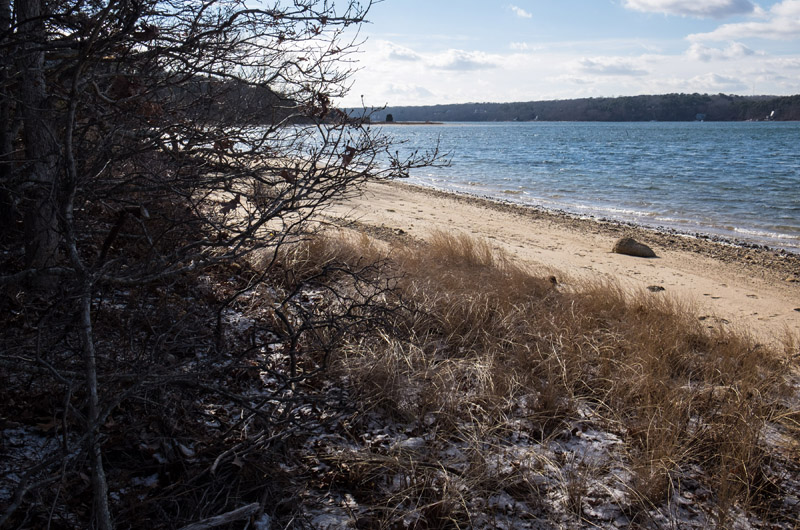
<p>The MVC is racing to apply for a major federal grant to fund the installation of permeable reactive barriers, a strategy never before used on the Vineyard.</p>
In an effort to protect water quality in Lagoon Pond, the Martha’s Vineyard Commission is racing to apply for a major federal grant to fund the installation of permeable reactive barriers, a nitrogen removal strategy never before used on the Vineyard.
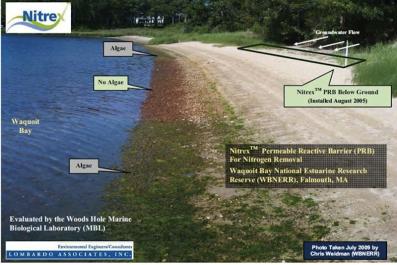
Permeable reactive barriers have nitrogen removal rates averaging about 95 per cent.
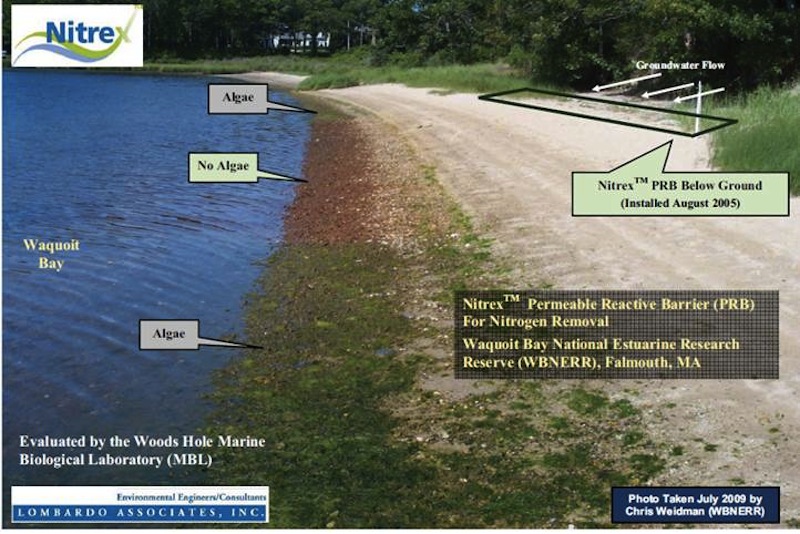
Permeable reactive barriers have nitrogen removal rates averaging about 95 per cent.
The Environmental Protection Agency plans to award about $7 million dollars this year for coastal watershed restoration in southeastern New England, with grants ranging from around $250,000 to $1 million. It is the first opportunity of its kind under the EPA’s Southeast New England Program. The deadline for initial proposals is next Friday.
On Wednesday, a joint watershed planning committee made up of Tisbury and Oak Bluffs officials met with commission director Adam Turner and Pio Lombardo, owner of Lombardo Associates in Newton, who has pioneered the use of permeable reactive barriers on the mainland.
Nearly all of the major estuaries on the Vineyard are impaired by nitrogen, a nutrient found in wastewater and fertilizers. Too much nitrogen can lead to algae blooms that choke out other species, including eelgrass and shellfish. Most of the nitrogen in Island ponds comes from septic tanks that discharge into groundwater after treatment.
In a whirlwind presentation at the Olde Stone Building in Oak Bluffs, Mr. Lombardo explained how permeable reactive barriers have been effective elsewhere and could be “a major component of a solution” on the Vineyard.
The process would involve digging shallow trenches close to the shoreline and filling them with wood chips. As groundwater moves through the barrier, nitrogen is converted to nitrogen gas through a natural process and released to the atmosphere.
A company document lists 15 permeable reactive barrier sites around the country, including two on the Cape, with nitrogen removal rates averaging around 95 per cent. “This is hardball,” Mr. Lombardo said. “We take these things pretty seriously.”

Joint watershed management committee heard about barrier use from Pio Lombardo of Lombardo Associates.

Joint watershed management committee heard about barrier use from Pio Lombardo of Lombardo Associates.
For the Vineyard, Mr. Lombardo envisioned a 700-foot barrier on the Oak Bluffs side of Lagoon Pond, one of the most impaired Vineyard estuaries, at a cost of about $600,000, including design and permitting. Committee members agreed that the Tisbury side would be too steep for the project.
The Massachusetts Estuaries Project has set a nitrogen threshold of 74 kilograms per day for the Lagoon, which would require a reduction of about 35 per cent. A feasibility study is underway to determine the best location for a barrier around the Lagoon and identify a clear reduction goal for the project.
The barriers are most cost-effective close to the shore, Mr. Lombardo said, since that is where the water table is closest to the surface. He believed a three-to-five-foot trench, covered in sand or vegetation, would be adequate for the area.
Committee members mentioned the public shoreline near Sailing Camp Park on Barnes Road as a likely candidate, but further study was needed to identify a site.
Mr. Lombardo estimated capital costs of about $9,000 per affected property, which would be cheaper than sewering, in terms of the amount of nitrogen removed. He also noted the possibility of a user charge to distribute the cost more evenly. Property lines, utilities and shoreline structures could add to the cost of installation.
The first step will be applying for grant funding. Among other things, the EPA grant program is looking for innovative approaches, especially as they relate to nutrient management and climate change. Criteria for funding also include collaboration among stakeholders, and integrating habitat restoration and water quality improvement, especially in terms of nutrient mitigation.
Mr. Lombardo pointed to the collaborative and innovative aspects of the Vineyard proposal as key advantages. But because the project was still in the planning phase, Mr. Turner emphasized the need to make a solid case. He hoped to have a draft ready by Tuesday.
“We are going to spend quite a bit of money,” said Oak Bluffs selectman and joint committee member Gail Barmakian. “But it needs to take out a significant amount.”
Comments
Dig up the beach to protect
tom hodgson wtDig up the beach to protect the beach? Is anyone else hearing echoes from the Vietnam war, when we heard things like "In order to save the village we had to destroy it...."
This is an interesting short
gary VHThis is an interesting short term approach to nitrogen overload, where we already have many years of a proven solution from other areas of the country; sewers. This real solution is not rocket science or "hard ball". Let's not be so quick to dismiss municipal sewers because of costs.
Sewers don't solve the
John FoleySewers don't solve the problem of nitrogen used in lawn fertilizers or bird guano, though. This might be worth a try. If the system should fail, the wood chips are biodegradable...
Learn about Nitrates. http:/
Donald Muckerheide Oak BluffsLearn about Nitrates. http://nadp.isws.illinois.edu/lib/brochures/nitrogen.pdf, Title is: "Nitrogen in the Nations Rain". The ponds can be restored with an intelligent aeration program. It is done all over the country and around the world. A newly patented invention makes aeration dramatically more effective and affordable. See Varacorp or Toring turbine. This is a waste of money that will have almost no effect. The last thing the DEP wants is to save the ponds. It is their ticket to your pocket for decades to come while the ponds will continue to decline.
. They want $9,000 dollars
Donald Muckerheide Oak Bluffs. They want $9,000 dollars per lot affected. They can retrofit their septic system to an aerobic system for $1,000. Google "Aerobic Septic System." They have been used out west for 60 years.
I strongly suggest you all start educating yourselves on this issue. http://nadp.isws.illinois.edu/lib/brochures/nitrogen.pdf, You are being fed a lot of BS about the cause of the death of our ponds and estuaries. It is going to cost you dearly and the ponds will continue to decline. The ponds can be saved with properly done aeration with measurable annual results for one thousandth the cost of failure.
The two controlable sources
Robert EdgartownThe two controlable sources of N are run off from use and over use of lawn chemicals and Septic Systems. The first can be addressed with use restriction like those of several Cape towns. It just takes guts. The Septic issue is best addressed, as most problems, at the source. A retro-fit bubbler in the septic tank will work wonders. Our sandy soil precludes plants from up taking the N as it would in a better soil environment. The wood chip idea may only work where the ditch is located. Restriction of lawn chemicals and man dated bubblers would work on every inch of the pond.
$857.14 per foot of wood
Ted$857.14 per foot of wood chips, think about that for a minute.
Both wood chips and sewering
Murray Vineyard HavenBoth wood chips and sewering could reduce the nitrogen loading in the ponds. I would also suggest
that steps be taken to reduce the numbers of cormorants and Canada geese. As long as there are no deterrents to keep them off nearby lawns and beaches, they will continue to impact the quality of the ponds.
Add new comment