


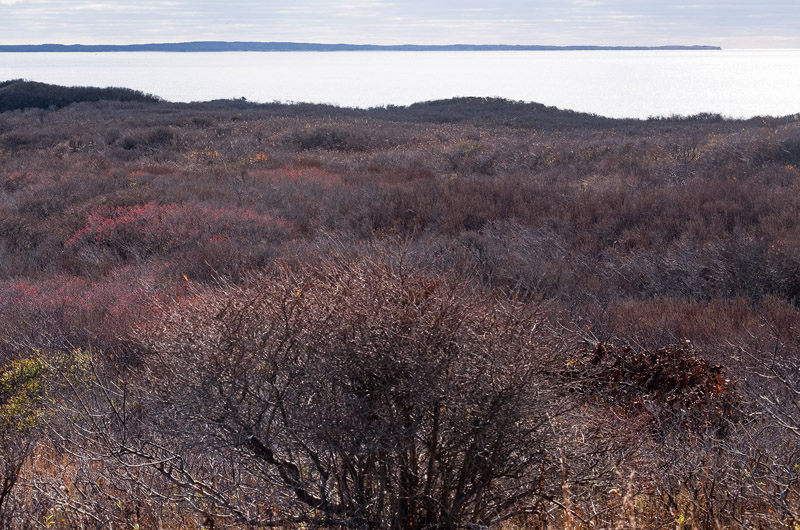
The Massachusetts Supreme Judicial Court heard arguments this week in a widely-watched case that will decide whether rare coastal heathland along Moshup Trail will be opened up for development.
The state’s highest court heard arguments this week in a widely-watched land use case that will ultimately decide whether a swath of rare coastal heathland along Moshup Trail in Aquinnah will remain forever wild or be opened up for development.
The complicated 18-year-old case involves arcane issues of law and is the first of its kind to be heard by the Massachusetts Supreme Judicial Court. The outcome could potentially have far-reaching effects on land titles throughout the town of Aquinnah.
Lead plaintiffs in the case are Aquinnah landowners James Decoulos and Maria Kitras, who want to establish their right of legal access to two landlocked parcels off Moshup Trail totaling about 30 acres. To reach their land from the public road, they are seeking an easement through conservation land. Without legal access to a public road, a property cannot be developed. They are joined by another plaintiff group that includes Aquinnah landowners Mark and Charles Harding.
Defendants include the town of Aquinnah, the Vineyard Conservation Society, the Martha’s Vineyard Land Bank, the state of Massachusetts and several private property owners, among them Caroline Kennedy and her husband Edwin Schlossberg Jr.
For many years the town, VCS, land bank and state environmental affairs office have been involved in a conservation project aimed at protecting the heathlands surrounding Moshup Trail. At the same time, Mr. Decoulos and Ms. Kitras have been battling the town on numerous legal fronts over their development plans around the trail.
The case argued this week, which has bounced back and forth between the land court and the state appeals court since it was first filed in 1997, is a window into the history of the town. Until the late 19th century, much of the land in what is now Aquinnah was held in common by members of the Wampanoag tribe. In the late 1800s the Massachusetts legislature took steps to provide tribal members with the same rights as other citizens in part by incorporating the town of Gay Head. In 1871 and 1878, in a process called partition, commissioners appointed by a probate judge divided the entire town into 700 setoff lots, deeding them to tribal members. The commissioners made provisions for access to peat bogs and to Menemsha Pond for fishing, but no other access provisions were included.
The landlocked lots owned by Mr. Decoulos and Ms. Kitras are old setoff lots. The question before the court is whether the lots have an implied access through a legal doctrine known as easement by necessity. The defendants argue, among other things, that many of the 700 setoff lots changed ownership after they were first given to tribal members, and that easement rights should and could have been negotiated as part of the purchase.
An earlier ruling by the land court found there is no easement by necessity since the lots were originally held in common. This year the state appeals court overturned that decision, finding that the long custom of sharing access had the effect of establishing an equivalent chain of title on the lots.
The state Supreme Judicial Court later granted further appellate review.
On Tuesday morning this week, seven justices for the SJC, led by Chief Justice Ralph D. Gants, heard arguments from five attorneys involved in the case.
The hourlong court proceeding was broadcast live on the internet by the Suffolk School of Law.
Peppered by questions from the justices, the attorneys strayed into an array of intricate legal issues and struggled to stay within the brief time allowed for arguments.
“Easement by implication . . . it’s a rare animal . . . and difficult to prove,” said Jennifer Roberts, the longtime environmental attorney for VCS.
‘This was part of an entire town — 700 lots,” said Diane Tillotson, representing the land bank. “Necessity was extinguished at the time of the original conveyance.”
“But isn’t that a matter of dispute?” asked Justice Barbara A. Lenk. “There is some question about what the practice actually was.”
Ronald H. Rappaport, representing the town of Aquinnah, recounted history. “We’ve had more than 100 years of real estate transactions [since the setoff lots were created,] and this never came up,” he said. He pointed to the Indian land claims settlement approved in 1983 and ratified by the state legislature and Congress a few years later. The settlement cleared titles on all land in Gay Head, which had been under a cloud for nine years following a lawsuit filed by the Wampanoag tribe in 1974. The lawsuit had challenged the validity of the setoff lots under another, older federal law, the 1790 Nonintercourse Act. Mr. Rappaport said when the settlement agreement was approved, any aboriginal rights on the setoff lots were extinguished. “If you don’t recognize the land court . . . . every lot in town will be subject to [an implied] easement over their land. That is completely not acceptable,” he said.
Wendy Sibbison, representing the lead plaintiffs in the case, said the setoff lots created by the probate court in the 1800s were clearly intended to convey inalienable property rights to the tribal people. “This statutory scheme was part of a historic effort to restore them to the status of humans,” she said. “The purpose of this was to allow Native American people to alienate land.”
But Justice Geraldine S. Hines returned to the question of whether the common use presumption ran with the setoff lots. “Is this the equivalent of a chain of title?” she asked.
Ms. Sibbison appeared to downplay any broader implications, focusing squarely on the two lots owned by her clients. The lots are separated from Moshup Trail by two other lots, one owned by the town, one owned by VCS, both of them conservation land. “We only need access to one of them to gain total access to our lots,” Ms. Sibbison said.
Comments
Briefs, docket and law posted
James J. Decoulos Cambridge, MABriefs, docket and law posted at http://www.decoulos.com/kitrasSJC11885.htm Oral arguments can be viewed at Suffolk Law's web site http://www.suffolk.edu/sjc/archive/2015/SJC_11885.html
After our land on the Moshup
Brenda Warshaw ChilmarkAfter our land on the Moshup trail was taken by eminant domain for reasons that were absurd we will be interested to hear the outcome of this case.
I'm guessing that the town is
Milke M BourneI'm guessing that the town is more than happy to collect taxes on the inaccessible property.
Of course the town is
James J. DecoulosOf course the town is charging us taxes as though it is accessible. And you would also be correct if you guessed that the plaintiffs use of their land would not "open up" a "swath of rare coastal heathland." The photo shown in the article is 180 degrees opposite of our land and we own 18 acres, not 30 acres. The allegations of rare coastal heathland that formed the basis of taking the Warshaw family's land has no scientific substance.
When you assumed access
William expba NycWhen you assumed access without checking the legal status you made a big error and now your trying to use the court to correct your mistake.
You should be taxed at the mkt rate until the value is established through this legal challenge.
There was no error William.
James J. DecoulosThere was no error William. There was significant work completed to check on the legal status before we purchased the property, including research at the Land Court, meetings with the Selectmen and VCS, and advice from the Aquinnah Building Inspector. See http://www.decoulos.com/Decoulos_Aff_042011.pdf You should also know that VCS initiated the lengthy and costly legal process in Dukes County Superior Court in 1997. See Exhibit P of the Affidavit.
Add new comment