



The Vineyard Conservation Society has begun floating a proposal to ban most single-use plastic bags on the Island, citing the danger the bags pose to marine animals and birds.
The Vineyard Conservation Society has begun floating a proposal to ban most single-use plastic bags on the Island. As of this week, selectmen in Aquinnah, West Tisbury and Edgartown have agreed to add it to their town meeting warrants in the spring. Selectmen in Oak Bluffs, Tisbury and Chilmark have yet to address the proposal.
Hundreds of towns and cities around the country have adopted similar bans, including at least 10 in Massachusetts. Nantucket got on board with the regulations around 1990. The ban would allow stores to offer only recyclable paper bags or reusable bags in their checkout lines. To qualify as reusable, a bag would need to have handles and be at least four one-thousandths of an inch thick. That would rule out the white carry-out bags used by many businesses around the Island.
The ban would not apply to the thin plastic bags available at many stores for produce and unpackaged items.
One goal of the ban is to encourage the use of reusable bags. Stores could charge a fee for their recyclable or reusable bags they provide, or offer credits to customers who bring their own.
According to the Worldwatch Institute, tens of thousands of birds, whales and other marine animals die every year after they ingest or get tangled in plastic bags. And as the bags break down, microscopic particles make their way up the food chain, accumulating in large predators like tuna and osprey. The particles have also ended up in products such as sea salt and cotton.
Hundreds of towns and cities around the country have adopted similar bans.
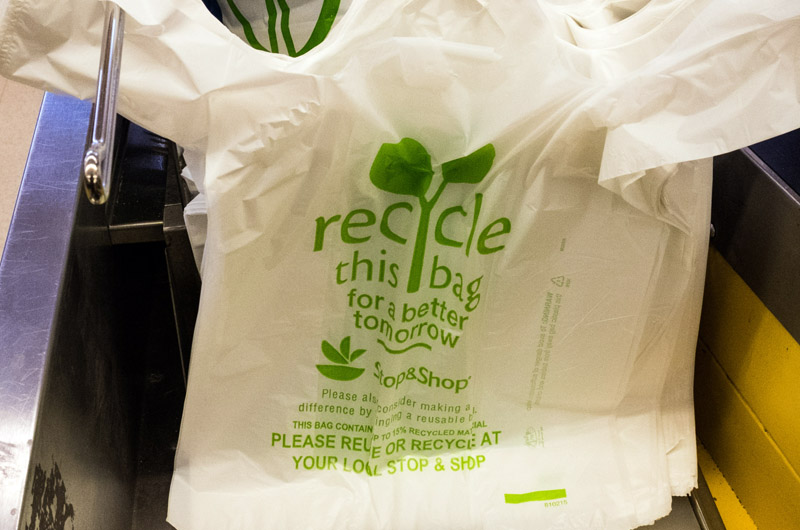
Hundreds of towns and cities around the country have adopted similar bans.
VCS began drafting its proposal last year. The ban would go into effect in January 2017, giving time for local businesses to deplete their existing plastic bag stocks and adjust to the changes.
“As far as marine plastics, there are other things we could have picked on,” said VCS staff member Samantha Look, who has been working with Island high school students to develop the ban and present it to the public. “But this is also really important because it’s getting each of us as consumers to think about the choices that we’re making every day.”
The Aquinnah and West Tisbury selectmen unanimously backed the proposal in November. But down-Island towns, where commercial activity is more intense, may be less receptive. “Those are the towns that we are just beginning to get to, and I think that is where the conversation is going to be a lot more complicated,” Ms. Look said. On Monday, the Edgartown selectmen agreed to present the proposal to voters in the spring, but stopped short of endorsing the ban.
“Of course there are people who are skeptical of it, but I’m surprised by how many people support it or already know about plastic bag bans,” said Astrid Tilton, a charter school student involved in the efforts. She added that she was also skeptical in the beginning, but came to the conclusion that alternative products were both feasible and better for the environment.
“From any angle you look at it it makes sense,” she said of the ban.
VCS plans to arrange public hearings, along with casual information sessions, in the new year. Some aspects of the ban, such as whether each town would adopt it as a bylaw or as a board of health regulation, were still unclear, although Island boards of health have indicated a preference for a bylaw, which would require town meeting approval.
Neither of the two waste districts on the Island can recycle plastic bags.
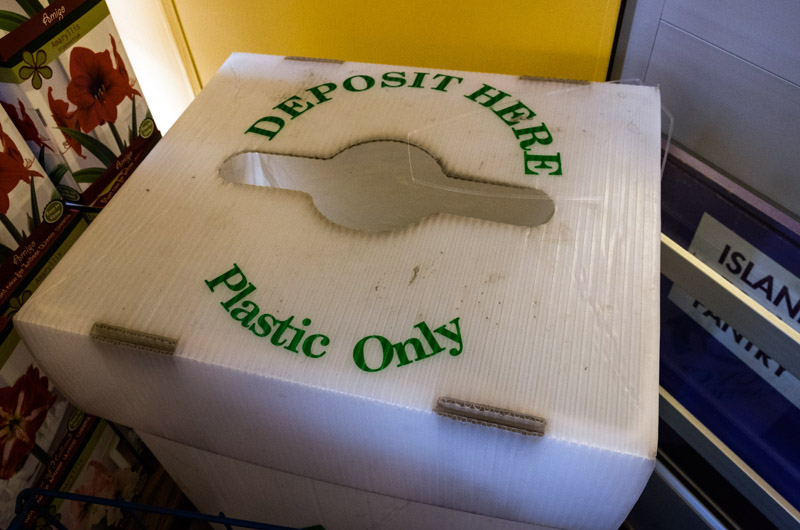
Neither of the two waste districts on the Island can recycle plastic bags.
Violators would receive a written warning, with a $50 fine for a second offense and subsequent fines of $100.
Ms. Look agreed that businesses could still find loopholes in the ban, such as offering single-use bags at the entrance rather than in the checkout lines. “But I would like to think that wouldn’t happen,” especially if the ban had strong public support, she said.
Andy Krickl, manager of Granite Ace Hardware in Edgartown, said he would support a sensible alternative to plastic bags as long as it had public support. But he also believed that customers would end up paying the difference. “No retailer is going to pay for it,” he said of the increased cost of paper bags. “It’s going to get passed along.”
As with many stores, Granite uses paper bags for small items like nuts and bolts, and plastic bags for almost everything else.
“I wish we used the paper bags because they are biodegradable,” Mr. Krickl said. “We got away from that because of the convenience of plastic. I’ve seen them in the trees just as much as you have. But unfortunately [plastic] is what everyone is use to.”
The Stop & Shop supermarket in Edgartown offers both paper and plastic, but the Tisbury store no longer offers paper in all of its checkout lines. Both stores also sell reusable plastic bags. Customers can occasionally return their single-use bags to the stores for recycling, but collection times have been inconsistent, Ms. Look said.
Some people reuse their bags as trash can liners, but Ms. Look said that was the exception and not the rule.
The most common way to recycle the bags is to return them to the manufacturer, where they can be turned into decking, fencing and other products. “But again, it’s not happening enough of the time,” Ms. Look said. She added that the process was extremely expensive — about $4,000 per ton — compared to the end product.
Making matters worse, neither of the two waste districts on the Island — Bruno’s Rolloff Inc. and the Martha’s Vineyard Refuse District — can recycle plastic bags. “That’s probably one of the biggest contaminants we have in recycling,” Bruno’s manager Bob Goulart said this week. In many cases, garbage collectors can catch the problem at the curb and leave a note for the customer. But some bags inevitably go unnoticed.
MVRD manager Don Hatch agreed that improper disposal of plastic bags was a major problem. “It’s causing a lot of trouble with the recycling separation facility,” he said. The refuse district ships its recycling to two off-Island locations in the state. “It just jams up their equipment. It gets tied up in the wheels.” Both Island services get charged for contaminating the stream.
“It’s a national issue,” Mr. Hatch said. “The cleaner you can get it the better.”
Some people who question the ban have pointed out that reusable bags require more energy to produce than plastic bags. But a study by the U.K. Environment Agency in 2011 found that low-density polyethylene bags required only four uses (in place of single-use bags) to make up for the effects of production, transport and disposal. Non-woven polypropylene bags required 11 uses. Cotton bags required 131 uses.
“Whatever type of bag is used, the key to reducing the impacts is to reuse it as many times as possible,” the report states.
Paper bags also take more energy to produce, but they are easier to recycle and less harmful to wildlife if disposed of improperly.
Ms. Look noted that single-use plastic bags have only been widely available since around the 1980s. “We did very well without them before,” she said. “As we evolve as a community and culture, we learn things that point us towards making a better decision,” she added. “And I feel like this is sort of deciding collectively to make a better decision.”
Comments
Thank you, thank you VCS for
Constance Messmer ChilmarkThank you, thank you VCS for all of your work on this. When stores and people aren't conscious enough to change for the better, we need the ban. It's a sensible solution to a careless convenience. Especially as a coastal community, we need to take this departure from old ways that do such harm. I am constantly picking up plastic bags and other litter along our roads and shorelines. This step is in the right direction. Thanks VCS for leading us out of the dark ages of plastic pollution.
This is a great initiative. I
Geraldine Brooks West TisburyThis is a great initiative. I hope we can widen it to include the sale of balloons, which are a real scourge with their entangling strings. I am constantly picking them up off our shoreline.
I'll join you, Geraldine, in
Ebba Hierta West TisburyI'll join you, Geraldine, in a campaign to ban helium balloons. They are deadly to wildlife.
Go for it! Have the courage
Nicky McG ScotlandGo for it! Have the courage of your convictions. Sadly voluntary schemes don't work because folk tend to be lazy. We soon learn to carry bags when we know stores won't provide them. The planet matters more than our shot-term convenience!
I like what Nicky McG said...
Ruth Perry southern MII like what Nicky McG said.... "The planet matters more than our short-term convenience!"
Change is difficult for the majority, but I do believe that everyone would get used to carrying their own bags. Change is usually for the good. I applaud you for this plan, and, yes, it is a national issue!
Hawai‘i Island banned single
Sharon B Hawai‘i Island aka Big IslandHawai‘i Island banned single use plastic bags January 13, 2013. It was hard at first remembering to bring the reusable bags into the stores, but it is automatic now. I encourage you to adopt this ban and help our planet recover from out of control plastic use. A lot of businesses here offer free reusable bags at events like health fairs, conventions, and business expo's to encourage people to be part of the solution. Many of our grocery and retail stores will give a "bag credit", usually 5 cents per bag, as an incentive to remember your bags.
I sincerely hope we do adopt
Ali U Edgartown, MA.I sincerely hope we do adopt this ban, don't all our plastic bags end up on the Hawaiian islands carried by the water?
I agree with the problem. My
Laurie Welch Oak BluffsI agree with the problem. My unanswered question has been "How much pollution is created during the paper producing process that is 'not in my back yard'"? Wanting to be considerate of pollution no matter where it occurs I wondered if plastic was the lesser of two evils bc it was theoretically recyclable? As accumulation of plastic bags, local or otherwise, will be an ongoing issue for the public and is admittedly gumming up the current recycling system, why not require the recyc centers to have place to recycle them? The problem will likely still persist on some level and a downstream solution seems equally important.
Ps. And then there is the
Laurie Welch Oak BluffsPs. And then there is the tourist trade. They are unlikely to bring their own bags...easier for those who live here. But we could switch to paper and tell them why it matters.
But can anyone with a depth of knowledge weigh in on plastic pollution vs paper pollution and which is more polluting when the totality of the process is taken into account?
The manufacture and disposal
Edgartown Resident EdgartownThe manufacture and disposal of paper bags and the heavier plastic bags that people will buy is far worse than the thin bags. We also need to look at what happened in other places like Austin, TX where they banned these types of bags (Austin, TX is a good example).
There are ways to achieve the goal of reducing trash and the problems these bags cause, bans on them have proven to be counterproductive.
I keep bags in the trunk of
Truthteller CAI keep bags in the trunk of my car, some for meat, which are heavy plastic and have had for years, many washable-in-the machine canvas bags and I have used them for years. I have lived on sailboats and have a respect for my environment which carries through to my daily life on terra firma. There is a learning curve for this discipline, but when learned, it is easy and automatic. I agree with Ms Brooks re the balloons, when I see a release of balloons into the air in memory of someone or something I cringe....where do these balloons end up?
They often end up in Vineyard
Steve FalmouthThey often end up in Vineyard Sound!!
I applaud VCS for this
Lynne Fraker Vineyard HavenI applaud VCS for this proposed ban on single use plastic bags, although it may not go far enough. The reusable heavier plastic bags also have a large carbon footprint. I think an educational component about all types of plastic bags should be part of this movement.
Anybody interested in taking
Sakiko West TisburyAnybody interested in taking a trip off-island to visit one of the recycling center, or rather a sorting place with me?
The plastic bag scam. Did
Tom west tisburyThe plastic bag scam. Did you know you can still use the banned bag, as long as you buy it by the box. The stores will now sell you a paper or thicker plastic bag. The reusable bag has it's own set of problems. You have to wash them, remember them and they pile up in the pantry each time you buy another. They can only go to trash and can't be recycled. The plastic bag has the smallest footprint. Most people reuse them. Now they will just buy thicker prepackaged plastic to replace the free bag. Nothing goes to help the environment but corporations stand to make millions in not supplying bags and selling them. Remember it is set up to start at a dime, with no limit.
Add new comment