

<p>When Kathy Rose was evicted last June, she found herself in a likely predicament. She had read about tiny houses, a growing trend across the country, and when she saw an ad for one in Tisbury she decided to take a chance.</p>
When Kathy Rose was evicted last June from the house where she had lived for 35 years, she found herself in a likely predicament.
“I looked for housing for three or four months, and there was just none that I could afford,” she said in a conversation with the Gazette this week. “There was a list of 200 people for elderly housing. I knew I wasn’t going to get right in there.”
She had read about tiny houses, a growing trend across the country, and when she saw an ad for one in Tisbury she decided to take a chance.
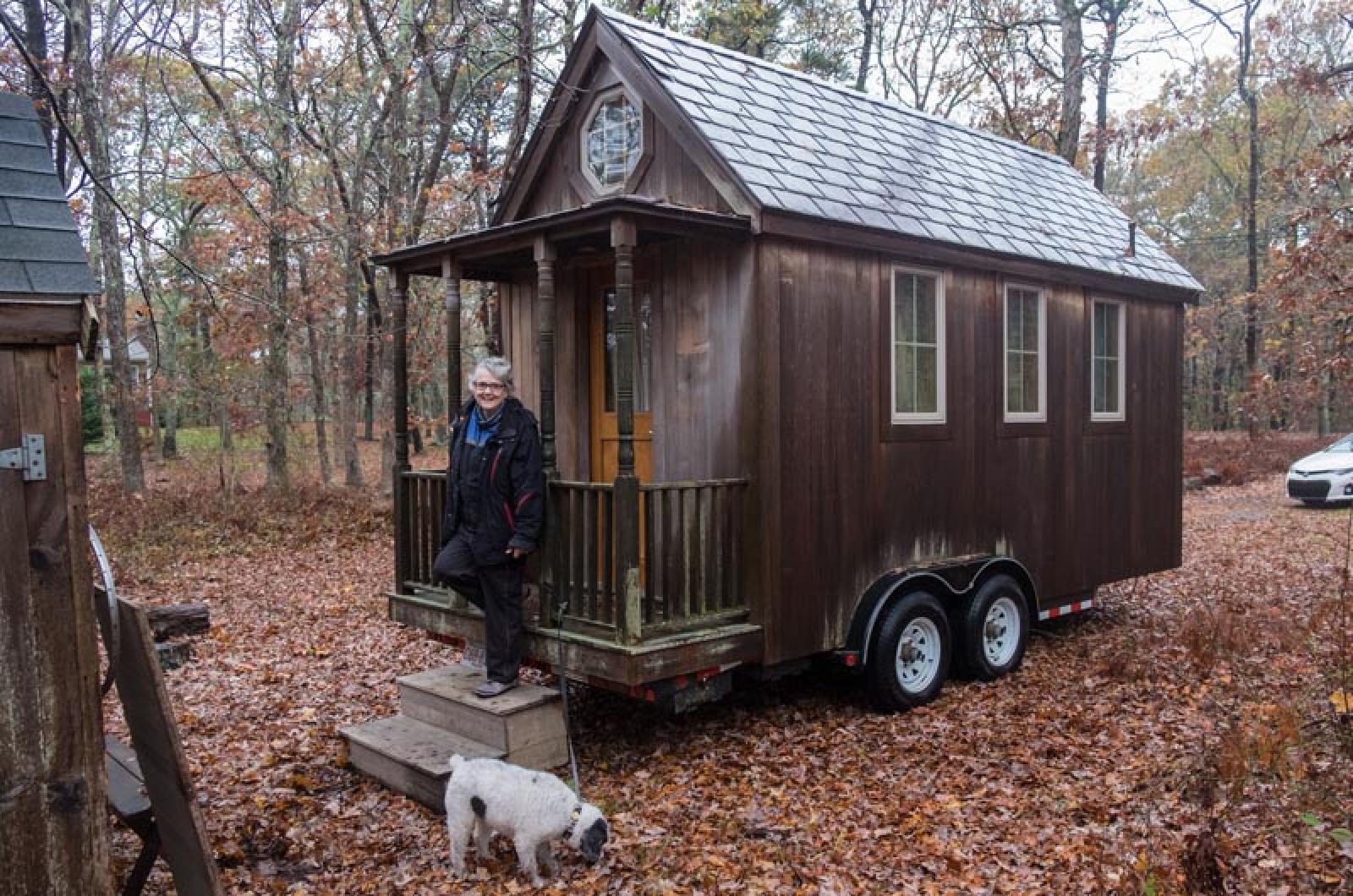
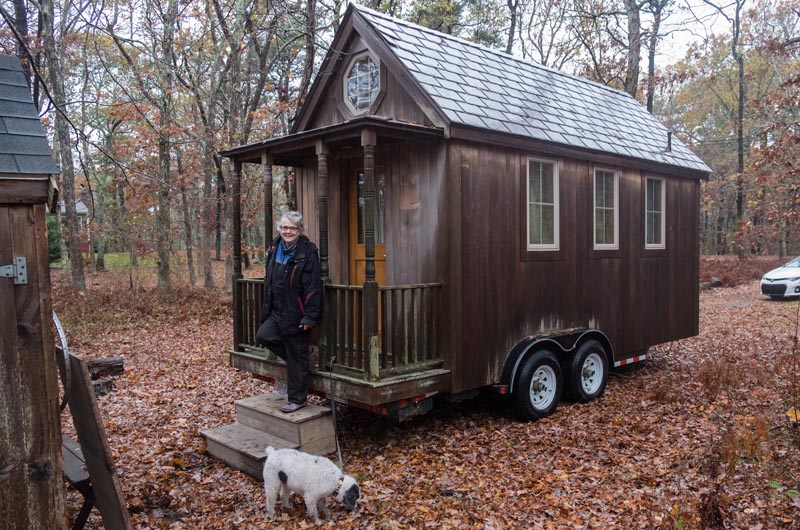
With its wooden porch and single gable roof, the house looks like something from the Camp Ground in Oak Bluffs. But at only 144 square feet, and on wheels, it violates building and zoning regulations across the Island, so it has been sitting unused on a trailer in Tisbury since March.
Kathy Rose said she looked for housing for three or four months, and there was none she could afford.
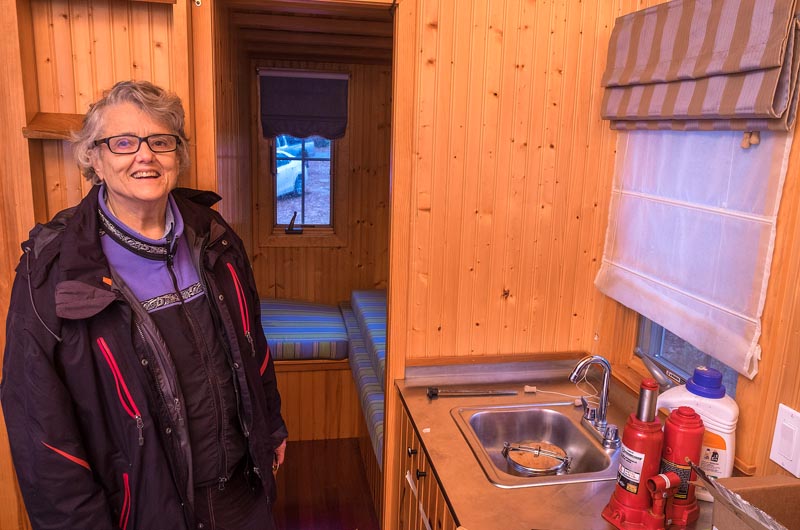
Kathy Rose said she looked for housing for three or four months, and there was none she could afford.
“I didn’t realize there were so many restrictions,” Ms. Rose said. “It seems like the only option I have is putting it back where it was.”
Tiny houses are usually smaller than 400 square feet and often easy to move around on a trailer. On the Vineyard, the lifestyle is catching on, at least in principle. A new Island Coalition for Tiny Houses is working to lower some of the regulatory hurdles.
In August, the coalition displayed Ms. Rose’s house at the Agricultural Fair in West Tisbury, where long lines extended out the door throughout much of the weekend. More than 750 people signed a statement in support of tiny houses on the Vineyard.
People here are committed, said Chilmark health agent and coalition founder Marina Lent, but zoning presents a major roadblock. Among other things, the coalition is working with Island towns on options for tiny house owners to share land and septic systems.
In some states, people can certify their mobile tiny houses as recreational vehicles and get around some of the legal issues. But Massachusetts does not allow year-round occupancy in RVs. Another option would be to set up in a mobile home park, but that would designate the house as a manufactured home, and subject it to a whole new set of regulations.
Size is another limiting factor, with layers of regulation, including the International Building Code, state amendments and town zoning bylaws.
The 2009 International Building Code (IBC) requires that one room be at least 120 square feet and that others be at least 70 square feet, not including kitchens. In some cases, that would still exceed the footprint of a tiny house.
“You can get pretty close, but the zoning is a no-go,” Ms. Lent said. The updated IBC for 2015 would do away with the 120-square-foot room requirement, she added, but the commonwealth has yet to adopt it.
In addition to the IBC, Edgartown requires a minimum house size of 400 square feet, along with a minimum lot size of 10,000 square feet; minimum lot sizes increase with distance from the town center. Other Island towns also have minimum lot sizes, but no bylaws prohibiting tiny houses.
Edgartown building inspector Lenny Jason said he believes it would be possible to build a house smaller than 400 square feet in Edgartown, although he had yet to see it happen. “I’ve seen people living in sheds that are a lot smaller,” he said.
He recalled a 2.5-acre undeveloped parcel on Jenny Way that was divided into 10 lots in the early 2000s for affordable housing, making use of the town’s open-space cluster bylaw. “Those are literally small homes,” he said. “If that worked in downtown Edgartown I’m sure they could find a way to do it where the houses are even smaller.”
Ms. Rose knows of only two other tiny houses on the Island, both in Vineyard Haven, where the owners pay rent for the land. Ms. Lent said a number of houses under 200 square feet on the Island are “basically beautiful tiny houses.”
“It’s not a new idea here,” said Ms. Rose, noting the miniature cottages in the Camp Ground that predate the age of zoning.
Boatbuilders have been quick to catch on to the trend, said Ms. Lent: “They get it right away when I say tiny house.”
Some people may eventually push back against the movement, worried that the visual and cultural aspects could lower their property values. Although the coalition is still young, Mr. Jason said he has heard “rumbles from both sides” of the issue.
But Ms. Lent said people’s concerns over property values were unfounded.
“People have this image of a run-down trailer in the back woods where they really don’t want to live,” she said. “It’s a perception problem, and it’s also a definition problem.” The coalition plans to facilitate public discussions about tiny houses in the future.
Ms. Lent was quick to point out the benefits of small living spaces, which include affordability and a smaller environmental footprint.
“For us on the Vineyard, the housing shortage is intense,” she said, noting the effect on employers who depend on year-round staff. Tiny houses run between $15,000 and $80,000, depending on size and materials, with land costs often paid in rent.
A housing needs assessment in 2013 reported that most households on the Vineyard have only one or two occupants, while less than a quarter of the dwellings here have four rooms or less.
“It wasn’t that long ago that families lived in under 1,000 square feet,” Ms. Lent said. “The expectation of space has grown so fast.” But she noted that the Vineyard has always been defined by its rural character. “We never were a big suburb with wide roads and big parking lots,” she said. “So in a way the tiny house could be a natural.”
Philippe Jordi, executive director of the Island Housing Trust, said a house on wheels could make things easier for Island churches that work to provide housing in emergencies. “Because it’s not long-term, it can be located in a parking lot next to the church or even a parishioner’s house,” he said. “It’s kind of an elegant and interesting way of addressing a temporary housing need.”
He distinguished between tiny houses and accessory apartments, which are allowed in West Tisbury and Chilmark, but are typically larger than 400 square feet. In Chilmark, accessory apartments are restricted to family members and caregivers. But tiny house owners would likely include young people with student debt and retirees looking to benefit from scaled-down living.
The coalition envisions a tiny-house neighborhood down-Island, where high density already exists. The houses could share a septic system or even hook up to a town sewer. Ms. Lent said one goal is to include nitrogen mitigation techniques from the start to help protect water resources.
Island boards of health add another level of regulation by limiting the number of bedrooms in houses near town wells and nitrogen-sensitive areas. Mr. Jason suggested that a parcel that accommodates four bedrooms, for example, could accommodate four tiny houses instead.
“It’s a matter of people catching up,” Ms. Rose said of the efforts to rethink local regulations. “And I think the Vineyard is ready.”
Changes may also come at the state level. At a recent meeting of the all-Island planning board that addressed a proposed overhaul of the state zoning act, Tisbury planning board chairman and coalition member Dan Seidman drew attention to tiny houses, which he said reflect a major shift in how people were choosing to live. “It’s not a fad,” he said. “People are going to live in smaller spaces, and we need to figure out how to accommodate it.”
Comments
I think there's a lot of fear
Careful EdgartownI think there's a lot of fear that these tiny houses will become run down and then left to degrade like so many pieces of furniture, tvs and the like are nowadays. No one wants to live next to a run-down trailer park.
However, a well-regulated environment like the Campground Association should be a possible.
If it doesn't work the nice things about those homes is that they're on wheels and could be moved to someplace where they're allowed.
The feature of its mobility
George Stein EdgartownThe feature of its mobility enables those that become unsightful or have code issues can be readily moved. Working people with jobs simply have not enough options for housing. The seasonal jobs are not even in the conversation. When you have the school system trying to ask the their employed teachers how are things out there, at least they have a clue.
My one-bedroom apartment in
Jennifer Vineyard havenMy one-bedroom apartment in Boston was 400 square feet and didnt feel tiny. We have lived on our boat for months in a space much smaller than that and loved it! Tiny houses are a wonderful idea, why is there so much regulation against them? Tiny government would be a good idea, too.
so true about tiny government
Bob Edgartownso true about tiny government....but then again the government knows what is best for us!!
They're mobile homes made of
Paul Oak BluffsThey're mobile homes made of wood. If you open the door to allowing these, what's to stop you from bringing in the others? Trailer parks, just what the island needs, huh ?
There seems to be an
Antone LimaThere seems to be an irrational fear of tiny homes on Martha's Vineyard and New England in general. During my studies at the University of New Hampshire I have focused on Environmental Conservation and Sustainability. I have seen first hand the quality and true usability of these structures. Because of their very small footprint builders often use the absolute best building practices and materials for construction. When not building at a residential scale most can afford the very top tier products. I have seen tiny homes built using beautiful glass countertops, local hardwood floors, high efficiency windows, and more. These structures are not the tin and fiberglass shells most people associate with a mobile home. They are genuine structures built better than most 70s-80s houses on the vineyard. How many structures on the vineyard would survive being towed down the highway at 65mph? They are also far superior when it comes to efficiency. One winter ready home we visited was heated using a mini gasifying wood stove. One load of wood heated the house for 8 hours. It was almost unbearably hot in there. While it is more convenient for most to build on a trailer these structures would have no problem sitting on true foundations. I understand where the public concern is coming from and do believe that proper planning, sitting, and permitting are required. The issues needs to be addressed instead of feared. There will never be and end all solution to the island housing crisis, but this is a piece of the puzzle that needs to be taken seriously. As a soon to be graduate, I like many others worry about our ability to return to the island. The cost of living is one of the main reasons many of my friends haven’t or don’t return home. This could be one small step to keeping life long islanders here and prospering.
Actually Paul. A trailer park
Beth West TisburyActually Paul. A trailer park might be exactly what we need. There are beautiful trailers available that can be used on the island seasonally then brought back off to another location. They would put much less strain on the housing market and many using them have consciously chosen to live alternatively to our large scale consumption market. I had a Tab travel trailer which was adorable and would have loved to use it every summer onisland but alas there was no place to put it, like a trailer park.
This article is so
Laurie NewtonThis article is so encouraging - people working to find solutions! People have built tiny homes on wheels only to get around zoning, not because they really want to live in a trailer park, so I could imagine that most tiny house people would be delighted to put down roots. These are real houses that simply are smaller so that people can afford them.
Tiny homes are a great
Kim Fuson Oak BluffsTiny homes are a great alternative to the abysmal affordable housing situation on the island. That these homes can be moved on wheels should not be an issue. They can be placed on foundations. The homes I've seen are made well, are energy efficient, and many have beautiful upgraded building materials and finishes. These homes can be built in sizes to accommodate singles, couples, and small families. Wouldn't it be wonderful to be able to stop the annual summer eviction of island residents from their rented homes? Tiny houses can give these island residents real homes so they don't have to turn to friends' back yard sheds and tents.
Add new comment