

<p>In a change of direction on the Beach Road Project, Tisbury selectmen Tuesday to support a so called “hybrid-hybrid” plan with both a shared-use path and a symmetrical design. Last week selectmen had voted for a completely symmetrical plan.</p>
In a change of direction on the Beach Road Project, Tisbury selectmen voted two to one on Tuesday to support a so called “hybrid-hybrid” plan with both a shared-use path and a symmetrical design. Last week the selectmen had voted two to one for a completely symmetrical plan.
Chairman Tristan Israel, who had been advocating for the symmetrical plan, reversed his decision saying that after speaking with Benjamin Robinson from the planning board following last week’s three hour meeting he supported a compromise.
Current proposed "hybrid-hybrid" plan incorporates a sidewalk and a shared-use path.
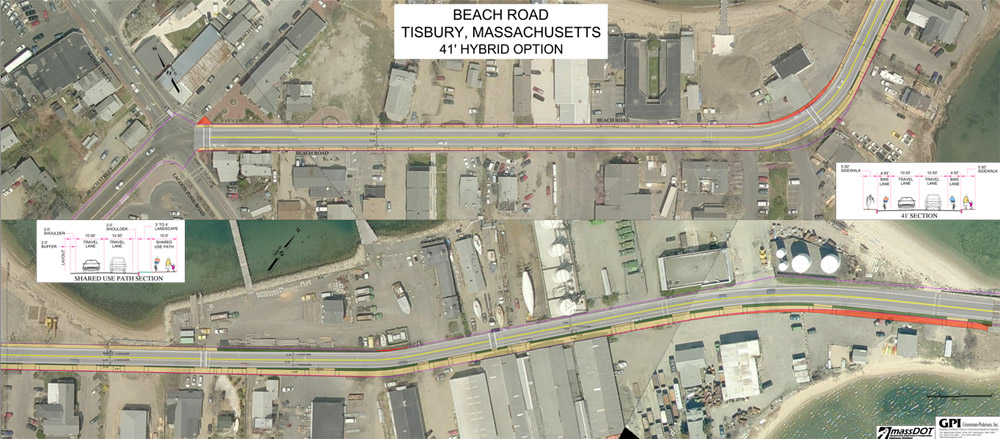
Current proposed "hybrid-hybrid" plan incorporates a sidewalk and a shared-use path.
The symmetrical design path called for sidewalks and bike lanes along the road from Five Corners to Wind’s Up. While approved by the state, this design did not meet the regional goal of an Island network of shared-use paths for off-road bicycle accommodation.
Mr. Israel had voted with Larry Gomez for the symmetrical design, while Melinda Loberg favored a hybrid plan that incorporates sidewalks and a shared-use path beginning at Tisbury Marketplace and running to Wind’s Up, where it would connect to the existing shared-use path that runs to the Lagoon Pond bridge. The bridge project also includes a shared-use path.
Planning board members and a seniorplanner from the Martha’s Vineyard Commission also favored a hybrid design. The “hybrid-hybrid” design tried to meet the desires for a north side sidewalk and off-road bicycle accommodations by running a sidewalk parallel to a shared-use path from Tisbury Marketplace to just before Packer’s Wharf. All of the designs required a one foot taking of land along the roadway.
“I would be willing to support a version of hybrid-hybrid where we work to move that [north side] sidewalk a little further toward the bridge,” said Mr. Israel, regarding his decision to change sides.
He said that at the last meeting he did not realize Mrs. Loberg would support either the hybrid or hybrid-hybrid design.
“I had been prepared earlier when the group went to talk to Mr. Packer [for a voluntary taking] to support a version that would run a sidewalk to approximately Mone’s real estate, and SUP [shared use path] on the other side,” he said.
Mr. Packer had declined voluntarily giving land for the project, and the north side sidewalk stopped short, too soon for Mr. Israel’s preferences. Mr. Israe l said his personal preference is still for a symmetrical design, but acknowledged the decision was for the town. He said he hoped through the design phase, the shared-use path could be made as safe as possible by reducing curb cuts.
Mr. Gomez continued to vote against the plan, and said he spoke for the silent majority who supported the symmetrical plan, while at the same time noting that the audience at the meeting primarily supported a shared-use path.
“I think last week we should have stayed with the two to one vote and passed that on to the state,” he said. “I’m sorry that we decided to think about this for town meeting because it’s nothing but the same arguments over and over and over again. It took us 20 years to put a sewer system in. It will take us 20 years to figure out what to do with Beach Road. I think we’re making a big mistake.”
Ms. Loberg had long been the lone voice of the selectmen advocating for a shared-use path. She said the town must continue working with the state to make the roadway as safe as possible for the different users.
“I’m in favor of whatever this new hybrid is that we’re going to evolve, because I know it will be safest,” she said.
In response to Mr. Gomez’s comment about a silent majority favoring the symmetrical plan, Ms. Loberg acknowledged the small crowd at the back of the Katharine Cornell Theatre. “I think the government is done by the people who show up, and these are the people who have taken the time to devote themselves to the issues,” she said.
Now MassDOT can begin the next steps to draw up the design and get it into biddable shape, but time is definitely a factor.
Town administrator John (Jay) Grande said the funding for the project is still in place, but the project start date has in all likelihood slipped a year.
“I don’t think this is a surprise to anyone, this decision has been pending, the town, planning board and selectmen were aware this project had a tight timeline,” he said. “The funding is still in place and should not be a significant concern, as long as the input of the town is done in a timely manner, which is to say very soon.”
Mr. Grande said perhaps through some fast tracking the project can still squeeze into fiscal year 2017.
Comments
Last month, a young woman was
Frank Brunelle Beach Road, Vineyard HavenLast month, a young woman was jogging along the popular new Katy Trail in Dallas, Texas, wearing headphones. She turned left and was struck by a woman on a bicycle. The jogger’s head hit the pavement. Several days later, she died.
This study will focus on the question of whether Shared Use Paths (SUP) are either safer than other transportation options, or less safe than other transportation options. … Shared Use Paths … “ as transportation corridors, rather than parks, is being pushed increasingly at a local level, and even promoted by the feds, including in a recent interview with U.S. Department of Transportation” The article goes on to state that “It should be no surprise that these paths see a high collision and injury rate. A 2009 literature review of traffic safety studies looked at bicycle crashes and discovered that multi-use paths are more dangerous to ride on than even major roads.” However, Priscilla LeClerc from the Martha’s Vineyard Commission counters this view and says that the data is old and that there are new numbers out there to suggest that they are safer.
She states the FARS study which is the Fatality Analysis Reporting System of the NHTSA (National Highway Traffic Safety Administration). This study the Commission asserts, proves that SUPs are safer because recent studies show that the ratio of deaths in SUPs are less than those on major roads. However, this reasoning is flawed. The databases actually do not tally any deaths or injuries within SUPs but only those occurring when a motor vehicle hits a cyclist, and pedestrians are not counted in this study. This is only for deaths caused by motor vehicles to cyclists. In another disturbing note in how the Martha’s Vineyard Commission allows numbers to be bandied about without apples to apples comparison, Ms. LeClerc is using as her reference point SUPs that are protected by adequate space and or barriers. In the instance of the proposed SUP on Beach Road between Winds Up and the Tisbury Marketplace the protection is provided only by a 3 to 4 foot grass strip which is allowed by MassDOT providing “waivers”.
“Shared trails are being heavily funded on the federal level, with politicians and advocates claiming major bike-friendliness points.” And certainly this is the case on Martha’s Vineyard. … “many of these paths would not be adequate for bicycle traffic. Sight lines are not good, there is often no lane to pass slower riders, and the number of users keeps going up, up, and up.”
We should focus on this point for a moment because it is key; “there is often no lane to pass slower riders”. How apropos. There is often no lane to pass slower riders. Slower riders. Could they be referring to those who the Planning Board and the MV Commission call “inexperienced riders”? Ah, so there is a problem with “slower riders”. We find this to be of great interest.
“A few weeks ago, just outside of Washington, D.C., a woman was hit and killed by a man on a bicycle while walking on a paved multi-use trail, aka a “bike path.” It was a tragic accident.” … “When various news sites reported the story online, the comments were predictably absurd. There were all sorts of attacks on bikes that reflected more on anti-bike sentiment than on the incident in question. “The path is for everyone not a bunch of spandex wearing Armstrong wannabes,” wrote one commenter. A member of the Fairfax Underground forum posted a story about the incident under this headline: “Bicyclist Mows Down Old Lady and Kills Her.” “Kill all cyclists,” replied a second member, “problem solved.”
“A little more attention to the specifics, and the authors of these remarks would have known how off-base they were. The bike rider in this incident was a man in his early 60s. He was riding an $88 department store bike, a NEXT Power Climber. I doubt that he was training for a race. He claims he gave both a ring of his bell and an audible, “on your left,” to the elderly pedestrian. But apparently the alert caused her to step in front of him rather than out of his way. The collision knocked her backward onto the pavement, according to the police report, where she struck her head.”
These stories serve to illustrate that bicycle/pedestrian accidents do happen. They are often fatal. And it serves to show us that Shared Use Paths are not the panacea to slow riders that the Commission would have us believe.
To be continued…
The Shining Sea bicycle path
David ClaffeyThe Shining Sea bicycle path in Falmouth is very much a shared use path. On crowded summer days bicyclists and pedestrians shared the path. And it is very crowded in the summer. The shared use path from Oak Bluffs to Edgartown is similar. It gets very crowded with pedestrians, strollers and even many first time bicycle riders in the summer. I would not expect the proposed Beach Road shared use path to be much different.
Add new comment