

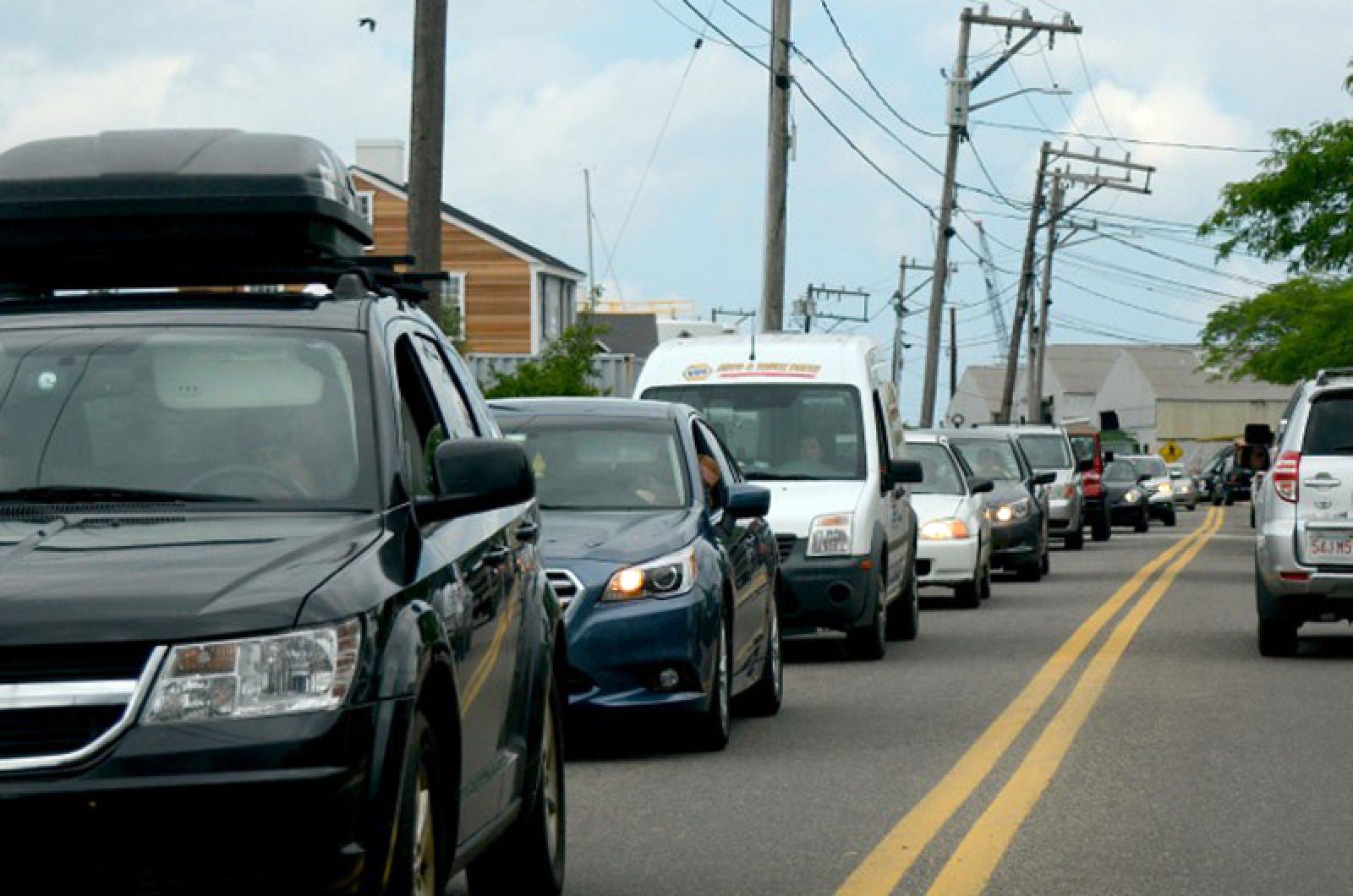
During the summer season about 14,000 cars travel Beach Road each day. Tisbury selectmen will address plans to make the area safer and more user friendly for bicyclists and pedestrians at their meeting Tuesday.
During the summer season approximately 14,000 cars a day travel Beach Road, the main thoroughfare connecting Vineyard Haven to Oak Bluffs, along with numerous cyclists and pedestrians. State ownership of the road dates back to the 1950s, and it hosts a variety of businesses, including Tisbury Marketplace, two gas stations and a working wharf. And yet, in the last half century, Beach Road has undergone no major renovations, except for the drawbridge project over Lagoon Pond.
That may soon change, at least for a portion of the road, where plans are being reviewed to make the area more user friendly and safe for bicyclists and pedestrians.
On Tuesday, Sept. 22, at 5:45 p.m. at the Tisbury town hall, town officials will review the most recent design from MassDOT, prior to taking a final position on Sept. 29.
In August 2013, MassDOT hired Greenman-Pedersen, Inc. to design improvements for pedestrians and cyclists along the road. MassDOT met with town representatives and the area was inspected in a site walk. Preliminary concept plans were then created and presented to the public. Since then, negotiations about the road have been ongoing.
Parts of the plan include creating a shared-use path for pedestrians and bicyclists beginning after Tisbury Marketplace and continuing to Wind’s Up, building a sidewalk running along the harbor from Five Corners to just past Vineyard Scripts, and widening the sidewalks and making travel lanes for cars narrower to benefit non-car travel.
An initial design concept called for the sidewalk on the north side of the road to continue past Tisbury Wharf, so that there could be a sidewalk on one side of the road and a path for bicyclists on the south side of the road. The road around Tisbury Wharf is much narrower, though, and the plan required an additional 3.5 feet of land from the Tisbury Wharf property, owned by Ralph Packer.
Mr. Packer declined to give the land and so the project had to be restructured to focus on a shared-use path on the south side of the road.
Planning board member Ben Robinson said he never expected the process to go quickly. He added that discussions were mired in debate over the original intent of the project. A study completed in 2009 by the Martha’s Vineyard Commission looked at the feasibility of an Islandwide network of shared-use paths. It identified 2,500 feet of Beach Road in Vineyard Haven as a missing link. This project began in response to that study.
Selectmen Tristan Israel and Larry Gomez have voiced their concerns about the project, citing aesthetics and safety issues.
Mr. Robinson said the three potential negative aspects of a shared-use path are multi-use issues, two way traffic for cyclists and pedestrians and frequent curb cuts — sections of sidewalk that dip down to allow cars to enter and exit parking lots and businesses. Frequent and poorly maintained curb cuts make paths bumpy and uneven, thus difficult to navigate by bicycle.
Curb cut issues can be mitigated, Mr. Robinson said, through consolidating and decreasing the size of the cuts as the path is built. Two-way pedestrian and bicycle traffic can also be dealt with by painting a dashed line down the middle of the path, indicating lanes, he said. And as for multi-use, Mr. Robinson feels that mixing bicycles with pedestrians is not as bad as leaving the road as the only option for cyclists.
“The primary use [of a path] will be bikes,” he added. “Not many people are walking to Oak Bluffs.”
Utility poles and transformers interrupting the narrow sidewalks can also make Beach Road difficult to navigate. As far back as 2012, discussions of putting the utilities underground along the street piqued the interest of the town and private business owners. Mr. Packer wrote a letter to the director of public works at the time agreeing to easements for the purpose. In talks surrounding the state-funded improvements to Beach Road, the issue of utilities has surfaced again.
“Placing utilities underground would be such a benefit visually and would make pedestrian access better,” said town administrator, John (Jay) Grande.
Mr. Grande said he has heard prices ranging from $1.5 million to $4 million to put the utilities underground, however it would not be funded through this project. The alternative would be for the utility poles to be removed from the sidewalks and placed on easements on private property.
The town also hopes to reduce the speed limit on the road. “If we’re trying to promote and support bicycle and pedestrian traffic, you don’t design a 40 mph roadway,” said Mr. Grande. The narrower travel lanes (10.5 feet compared to 12 feet) in the new designs would discourage speeding.
Though the current road is less than pristine, Mr. Robinson suspects the maintenance will improve as the road improves.
“If something is new, there is a better likelihood that it is maintained because the maintenance is more clear,” Mr. Robinson said. “It’s when things degrade to a point where it’s like, what are we maintaining?”
Comments
The issue with curb cuts is
David Whitmon Oak BluffsThe issue with curb cuts is not the bumpy uneven condition of the path but rather the flow of motor vehicle traffic crossing such a path. Motorists crossing the path with out looking out for pedestrians and cyclists.
Such curb cuts can be best described as a game of Russian Roulette with a multi ton bullet. A game we subject cyclist too when we build such path ways.
Amen to that. The entire
Frank BrunelleAmen to that. The entire concept of the SUP is so deeply flawed it should not even be discussed.
We need real bike paths for
Frank BrunelleWe need real bike paths for real bike transportation
By Elly Blue on 8 Nov 2010 106 comments
ShareTweet
Bikers must yield to pedestrians signShared-use paths result in inevitable conflict between cyclists and pedestrians.Photo: Bryan GoebelLast month, a young woman was jogging along the popular new Katy Trail in Dallas, Texas, wearing headphones. She turned left and was struck by a woman on a bicycle. The jogger’s head hit the pavement. Several days later, she died.
The Katy Trail is not a trail in the woods, but a multi-use path, or, in planning-speak, a “MUP.” These paved byways are varyingly called trails, paths, rail trails, bike trails, or linear parks. The mix of terminology reflects the current confusion about what exactly they are for.
The original concept is that of the linear park — a destination in the city or suburbs where locals of all ages can go get fresh air and exercise in a natural setting. Mellow recreation was the idea. The bicycle has always been part of this mix. But MUPs aren’t always simply about recreation. The use of these paths as transportation corridors, rather than parks, is being pushed increasingly at a local level, and even promoted by the feds, including in a recent interview with U.S. Department of Transportation Secretary Ray LaHood on this site.
But there’s a disconnect between the speedy reality of bicycle transportation and the slow, recreational uses these trails are designed for. Multi-use paths are only required to be eight feet wide. That’s fine for a stroll in the park, but when you factor in two lanes for bikes as well as joggers, skaters, and roving families, it’s alarmingly narrow.
Most planning guidelines acknowledge that a 10-foot trail width is better, and recommend 12 for areas with heavy bicycle traffic. Even that — as we learned on the Katy Trail, which is still being built to these state-of-the-art standards and even includes a narrower, supplemental trail for walking — isn’t enough when bikes are in the mix.
It should be no surprise that these paths see a high collision and injury rate. A 2009 literature review of traffic safety studies looked at bicycle crashes and discovered that multi-use paths are more dangerous to ride on than even major roads.
Most attempts to address the danger focus on educating users to “share the path.” This has been the gist of the most levelheaded responses to the tragic incident on the Katy Trail.
In effect, this is a way to blame the users. This becomes more clear when you brave the comment section on any story about the tragedy. The vitriolic finger-pointing starts immediately. Some blame bicyclists who ride fast and don’t use their bells when passing. Others blame walkers and joggers who stop suddenly, don’t hold their line, and let their kids and dogs run freely. Everyone blames people wearing headphones. Some simply blame everyone.
Meanwhile, few are looking to the real culprit: the increasingly common practice of building transportation facilities that cannot safely or comfortably carry the planned types of traffic, promoting them heavily, and then accepting easy credit for providing bike routes without having to take the political risks of encroaching on the vast amounts of roadways reserved for cars.
We also have to remember that
David Whitmon Oak BluffsWe also have to remember that even if these insufficient and substandard facilities are built, the travel lane will still be an option for cyclists to use and very possibly far safer to ride in than such multi use paths that are being purposed.
A 10.5' travel lane is considered to be substandard for both a motor vehicle and bicycle to occupy the same space and as such, the safe place for a cyclist to ride is right down the middle of the travel lane. Motorists by law will be required to pass any cyclist they encounter by passing completely outside the travel lane as they would any other vehicle. If it is not safe to pass, the Vehicle Code requires motorists to "WAIT" until it is safe to do so.
I will be looking for Sharrows in the middle of the travel lanes and "Share The Road" signs along any such MUPs.
Political statement of the
Frank BrunellePolitical statement of the evening.
When asked whether there should be sidewalks on the north side of Beach Road the chair of the Planning Board, Daniel Seidman, stated "There aren't many people who use the north side anyway and there are no sidewalks there now, and by not putting in sidewalks there is the advantage that no maintenance will be needed to be done."
Seriously?
Near the end of the meeting --- from Bill Veno - head engineer at the Commission.
"The SUP or wide sidewalk at the beginning of the Tisbury Marketplace was narrowed somewhat and this is the busiest part of the SUP and perhaps should be made as wide as the other parts."
Really?
Already the design intrudes on the Shell station. If there is an SUP there will be a small shoulder - 2 feet - and a small buffer zone - 2 feet which in the plan shows that it will end up at the end of the canopy where cars drive in for gas and diesel. So there will be no curbstone, no sidewalk, no nothing to prevent vehicles wandering. The road will shift north, that means it goes over the sand more, that means a steeper incline to deal with for the revetment that will be surely needed, and the road should also be raised. So what is he thinking? This is all okay in the interest of his beloved SUP. Maybe Bill and the SUP should get married and move to Nantucket.
Just kidding. She's already married to Mark London.
Harriet Barlow had a good comment - maybe MassDOT is leading us astray and the legal liability will fall on the town. Amen to that Harriet.
Outside the meeting.
Doris and some of us had a small meeting and I wanted to be clear on what she wanted. Ben Robinson led her into a statement saying that she would use the SUP if it was there. I tried interrupting him when he did this (at a previous meeting) because he was leading her into it. Kind of like leading a witness. Well, she is adamantly against the SUP and fully supports the symmetrical design.
This just goes on and on.
Carol suggested a bridge at the Shell Station to relieve congestion with pedestrians and cyclists. Imagination is something that you either have or do not have. But it is key as is instinct. She is right, and an SUP would make this very clear. We will have Five Corners, the Shell Station, and possibly some minor problems at Cromwell Lane from time to time if this hybrid ever gets built.
Add new comment