


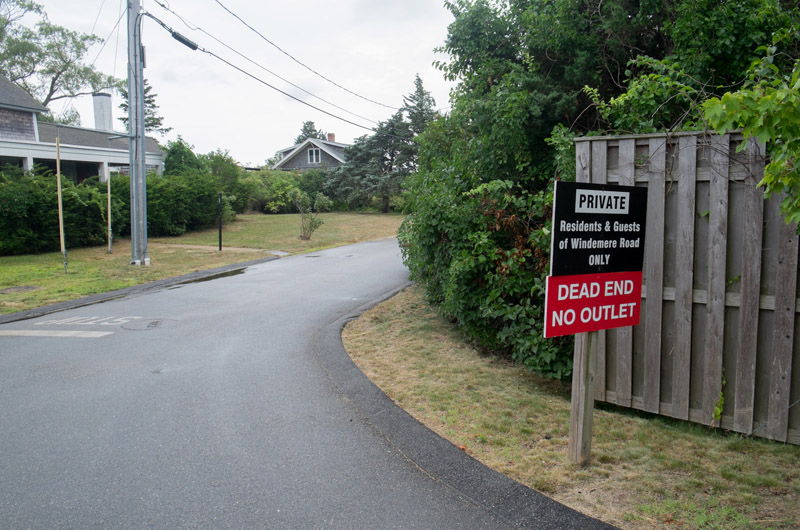
<p>Responding to oversights in a major expansion project that broke ground eight years ago, the Martha’s Vineyard Hospital is taking steps to restore public access to Windemere Road. The road issue has been a longstanding sore point with neighbors.</p>
Responding to oversights in a major expansion project that broke ground eight years ago, the Martha’s Vineyard Hospital is taking steps to restore public access to Windemere Road.
The road issue has been a longstanding sore point with neighbors.
The $52 million hospital expansion project, which began in 2007, left the dead-end road without access to other town roads except over hospital property.
“We are making our best efforts,” hospital attorney Sean Murphy told the Oak Bluffs planning board at a meeting Thursday that was attended by selectmen and several Windemere Road residents. The hospital proposal still requires a public hearing, approval by selectmen and a town meeting vote to accept the road.
Homeowners have argued that without public access, they are unable to obtain bank financing on their properties or sell them.
A civil complaint filed in federal court last week by homeowner Patrick King argues that town and hospital officials and members of the Martha’s Vineyard Commission failed to meet their responsibility to preserve the public way.
Previously, Windemere Road connected to Beach Road to the north by way of Hospital Road, which was owned by the town. As part of the expansion project, Hospital Road was moved south, but was never formally incorporated as a town road.
Mr. Murphy said Thursday that the town issue should have been resolved years ago. He said the new road’s curb cut was already in compliance with Massachusetts Department of Transportation standards and he did not anticipate any major obstacles in preparing for the town vote.
But Mr. King does not believe that Hospital Road would meet the requirements for a public way, and has called instead for a new road altogether, to be built and paid for by the hospital. He was deeply skeptical of the hospital’s plans and urged the town not to accept the transfer.
Mr. King’s lawyer, Mary Sullivan, who was also present at the meeting, said when the new road was built, the subcontractor, Columbia Construction Company, needed only a driveway permit, which would entail a different transfer process.
“As it exists now [Hospital Road] doesn’t meet DOT standards to be a legitimate road,” she said.
The civil complaint names 15 individuals that Ms. Sullivan and Mr. King argue have failed to meet their responsibility to preserve the public way.
The MVC reviewed the project as a development of regional impact (DRI) in 2006, but did not identify any negative impacts on abutters, beyond the short-term effects of construction, an increase in traffic and the visibility of the new building.
Hospital facilities director John Murray told the Gazette that the plan originally included two roads, one for the hospital and one to access Windemere Road. But the MVC would not allow two curb cuts, he said, and in response, the hospital chose to reposition the existing road.
Mr. King contends that the hospital did not go through the proper state and local permitting procedures, including compliance with a state requirement to replace a greenway that had acted as a buffer for stormwater runoff.
In another formal complaint, Ms. Sullivan had asked the MVC to declare that its DRI conditions were not met. She said the commission had sent a letter to the hospital but had taken no further action.
Other efforts to force the hospital to address the issue have also failed. A private nuisance complaint that Ms. Sullivan filed against Partners HealthCare, which owns the hospital, and Columbia Construction Company was rejected since it revolved around a public road. And a town meeting warrant article this year directing the hospital to build a new road failed to demonstrate the required support of petitioners and never came to a vote.
Mr. Murphy seemed unaware of the civil complaint when Mr. King brought it up on Thursday. (Mr. King had referred to it as a “criminal investigation,” a term that Ms. Sullivan later corrected. He had also accused officials of exploiting the financial resources of elders by not restoring the public way.)
“If we are one of the 15 people named in the criminal complaint, we’re done,” Mr. Murphy said at the meeting. “We will not speak here and have him charge us.”
Other residents seemed more supportive of the hospital’s plans, but also raised concerns about traffic safety and ongoing drainage problems.
At the request of the planning board, the hospital hired engineer John Lolley of Vineyard Haven to review the drainage system this spring. Mr. Lolley said Thursday that he had made some improvements to the drainage basin at the top of the road but that the area needed to be regraded.
Ms. Sullivan claimed the hospital had violated a contract with the Oak Bluffs conservation commission that requires annual inspections to make sure the stormwater system is functioning correctly.
“You can’t state that the hospital has been a good player in this,” she said, noting that even after repairs the system failed to function as designed. Planning board chairman Brian Packish assured Ms. Sullivan that the conservation commission was “much more aware” of the need for better management and “will be looking for that report on a yearly basis.”
Meanwhile, the hospital is planning to develop an additional 21 parking spaces and to convert part of the original hospital building into a walk-in clinic. Some Windemere Road residents worry that the changes will only worsen the drainage issue.
“What they really need is some greenery in there,” Marcia Graham, president of the Windemere Road homeowners association, told the Gazette in an interview this summer. “They took all the greenery out and so it’s just plain tar.”
The MVC voted in April not to require a new DRI review for the proposal.
According to a DRI modification request, the town had asked the hospital to obtain state approval for the new curb cut, provide new signs for Windemere Road and to provide either a new road altogether or a “softening of the entrance to Windemere Road.”
The hospital agreed to modify some exterior lighting and install the new signs but flatly rejected the possibility of building a new road.
“The applicant will attempt to ‘soften’ the entrance, but a separate entrance road to Windemere Road cannot be achieved,” the request states. Lighting poles were lowered this year in response to homeowner concerns.
Planning board member Ewell Hopkins said Thursday he had asked the hospital repeatedly how the road transfer would fit into its longer-term plans. He hoped the problem would be solved all at once. “I don’t want the hospital to come back to this board incrementally,” he said.
But Mr. Murphy said the hospital has no formal long-term plans beyond five years and called the road transfer an isolated issue. “It has nothing to do with the operation of the hospital,” he said. “It should have been resolved in 2005 or six or whenever it was.”
Mr. Packish urged the hospital to be ready for a special town meeting in November, although the vote might not happen until the annual town meeting in April. He said the delay in transferring the road was largely a result of the desire to do it correctly.
“We’ve made tremendous strides in this process,” he said. “We’ve engaged the public, we’ve engaged the hospital, the town is here. Everyone is on board in moving this forward.”
Comments
If the town excepts the
Bruce EdgartownIf the town excepts the Hospital Road as a town road will the hospital be willing to enter into an agreement for "payment in lieu of taxes" or does the town end up on the hook for all the costs of maintenance and repair to what, in reality, is the entrance to the hospital?
"accepts" not "excepts"
Bruce Edgartown"accepts" not "excepts"
Ex post facto acceptance and
Katherine Scott TisburyEx post facto acceptance and designation of a substandard way as a town road is, IMO, not acceptable for the town or the residents. I know of another case where, in the course of an aggressive school expansion, a good town road was replaced by a glorified driveway, with unacceptably sharp curves, improper incline, etc. The current substandard replacement thoroughfare is actually dangerous and is avoided by many.
IN the case of the hospital, my understanding is that the creation of a replacement for Windemere Road that meets DOT standards was one of the conditionalities the MVC set for the original expansion project, but it was not observed. If that is so, then it seems like a no-brainer that the Hospital must pay for the creation of the access that meets the town and state standards. It also seems like a no-brainer that the MVC must enforce the conditionalities they set. Otherwise the conditionalities end up looking like a nudge-nudge-wink-wink affair that are not meant to be taken seriously.
Is this comparable to the bowling alley situation, where the bowling alley was approved with a conditionality regarding I believe on-site sewage treatment, construction got under way, and then the conditionality ended up being set aside?
What is the point, then, of MVC conditionalities?
In 1990, the MVC allowed a
Kristy TisburyIn 1990, the MVC allowed a DRI to be built on a substandard lot abutting my parents' property in Tisbury. With its decision, the MVC listed a number of very specific conditions, most of which have been ignored. The MVC has done nothing to ensure or enforce compliance, nor has it pressured Tisbury's enforcement agencies to do so. Kate is spot-on when she astutely observes that the conditions set by the MVC, "...end up looking like a nudge-nudge-wink-wink affair that are not meant to be taken seriously." Well put, Kate!!!
MVH paved over the original
Deborah Oak BluffsMVH paved over the original town owned Hospital Road, which is under the parking lot, without OB voters approval. Perhaps this led MVH to believe they had the greater authority then the Town Planning Bd or OB voters to rearrange the town's roads. Somebody was sleeping.
Add new comment