


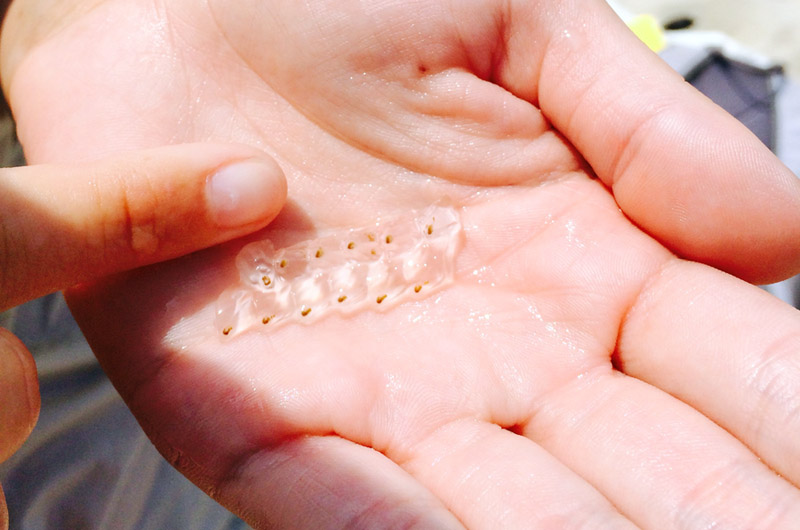
<p>Last Sunday, State Beach was invaded by millions of jelly-like organisms, and folks wanted to know what they were.</p>
Inquiring minds want to know.
My phone rings and buzzes with many curious inquiries. There are quite a variety of questions coming over the lines, from those struggling with bird identification to others perplexing over a plant or just ruminating over a run-of-the-mill marine mystery.
Last Sunday, it was the last on that list. State Beach was invaded by millions of jelly-like organisms, and folks wanted to know what they were, whether they could safely be touched, and why they were there.
Though the critter in question resembled a very small jellyfish, it had no tentacles and was found in chains of identical individuals. It could also be touched with no ill effects. This was an easy one as I had seen it before. It was not a jellyfish or egg sac as folks postulated, but a sea salp, or just salp.
Salps are amazing creatures of the open ocean. They are planktonic (free-floating) tunicates, and even more intriguing is the fact that they are more closely related to fish and humans than they are to jellyfish. Thus, looks can be deceiving!
Salps are in the phylum Chordata (with humans) because they possess a “notochord” during their larval stage. A notochord is a rudimentary or primitive nerve cord (and a precursor to the backbone), which puts them in much more evolutionarily-advanced company.
The ones that were seen on Island beaches were adult salps and they were numerous. Salps have a unique and interesting method of reproduction. In fact, they use two methods, sexual and asexual, both of which will produce offspring.
On State Beach last week, observers spoke of both linear chains of these animals and single creatures. The chains were created through asexual reproduction. One organism, the parent, is called an oozoid, and will clone itself, making a replica that will adjoin the original. This can continue, forming a chain, until the successions of salps reach over 30 feet! It sounds incredible, and it is.
To reproduce sexually, the aggregation of salps, called blastozooids, mate with each other. And to make it even more complicated, these animals are sequential hermaphrodites, starting off female and, later, changing to males. The offspring of these pairings, which are borne from the adult’s body (similar to the live birthing of mammals), are of the oozoid form. Then, the cycle can repeat.
So it is easy to see why there can be so many salps, what with all of that reproduction going on. Why they came to wash up on the shores of State Beach in such numbers has to do with the tides, currents and food supply.
The right winds and currents can blow these tunicates onto our shores, however, their large numbers are more likely the result of an algae bloom. Since salps eat phytoplankton (free-floating plants), when there are significant amounts of algae that provide an increase in their food supply, salp populations can boom. Just as quickly, salp numbers can bust if their nourishing planktonic algae supply dries up.
One benefit of all of this booming is that it was recently discovered that the large populations of salps sequester carbon in their waste products. These pellets sink to the bottom and get bound up in the sediments, helping mitigate climate change impacts.
It is possible, then, to see this booming bloom as beneficial, even if it caused such a stir on State Beach. Perhaps these little gems could be seen as diamonds in the rough, if not for their role in climate change, then for all their glistening glory, peculiar procreation process and quirky life history.
Suzan Bellincampi is director of the Felix Neck Wildlife Sanctuary in Edgartown, and author of Martha’s Vineyard: A Field Guide to Island Nature.
Comments
Thank you for this article!
Aela Vineyard HavenThank you for this article! My wife and I stopped at State Beach last Sunday for a quick couple of hours for sunshine and swimming before rebooting for the workweek. I'm so glad the day took us to there, because it was fascinating to swim with these incredible creatures - and it's even better now knowing what they are. Truly, wow.
Cape pouge is loaded with
Colin floyd ChappyCape pouge is loaded with these little gems. Went to the beach today and was amazed at how many were there sitting on the tide line pulsing in the sunlight. Glad to know my kiddo's r safe. Thanks for the article.
The Salps were the talk of
Susan Oak BluffsThe Salps were the talk of Moshup Beach today! There were so many that daughter said it was like, "Swimming with Orbeez!"
Does this outbreak of Salp
Roy Cuddahy Brewster , MaDoes this outbreak of Salp have any effect on the Stripers & other fisheries . Seems their presence affected the fish " bite " over the last couple of days ?
any connection to the bloom
Steve Lakatos Marshfieldany connection to the bloom of these creatures and the food supply for the right whales seen this year ?
I swim every other day in
Jim Walsh Nahant MaI swim every other day in Nahant Bay,Ive never seen anything like this.They came in on Saturday afternoon.On the surface they were in string form,at 8 feet down they were in larger balloons of jelly.What a sight!
Thanks Ms. Bellincampi! We
Brian Beasley oak bluffsThanks Ms. Bellincampi! We ran across them crossing from Menemsha to Cuttyhunk a couple days ago and were awfully curious!
These are all over the beach
Elena Bianchi Crescent cityThese are all over the beach right now. They were covering my surfboard. They are so beautiful. The inner part is bright blue
Add new comment