

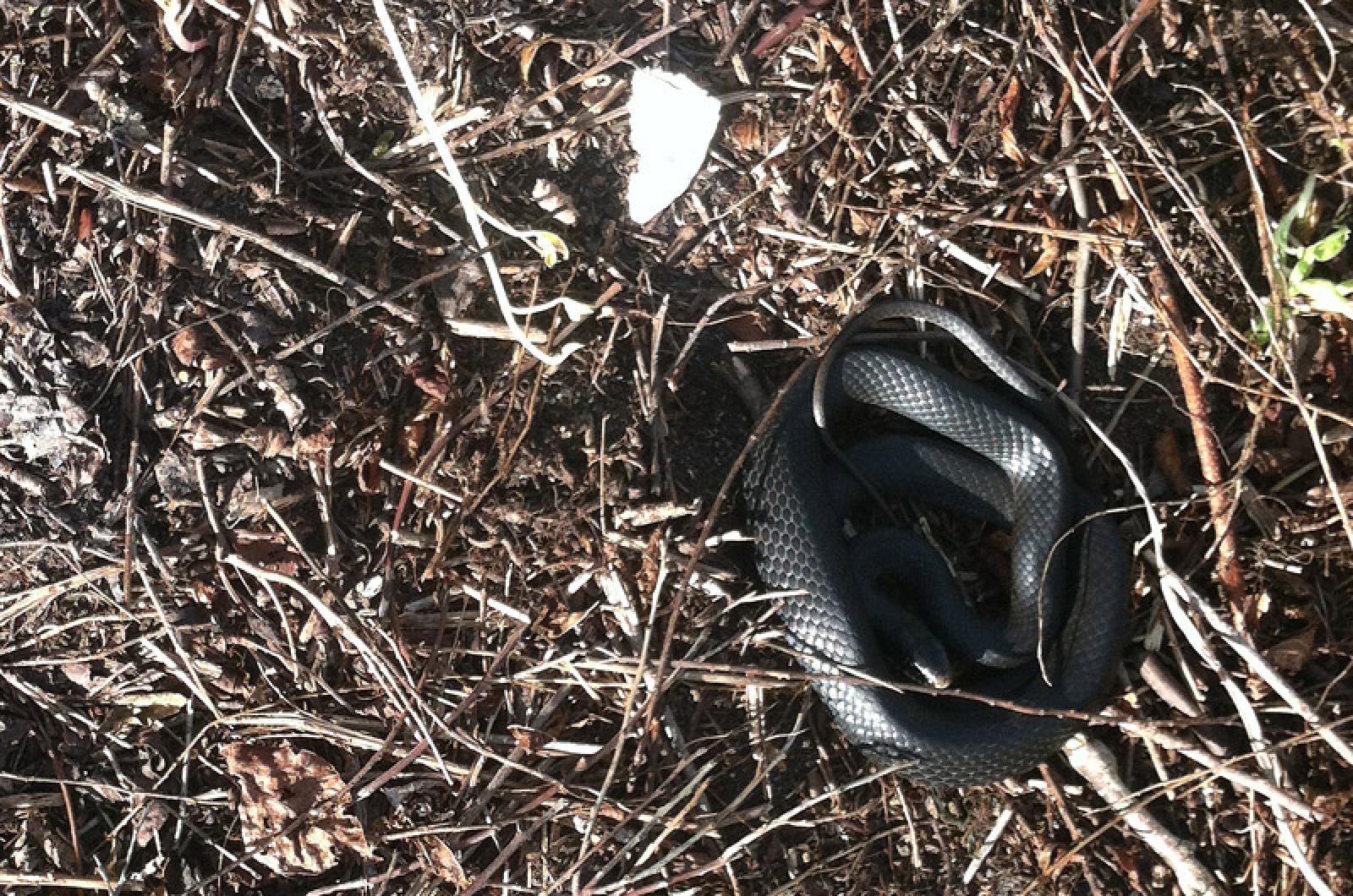
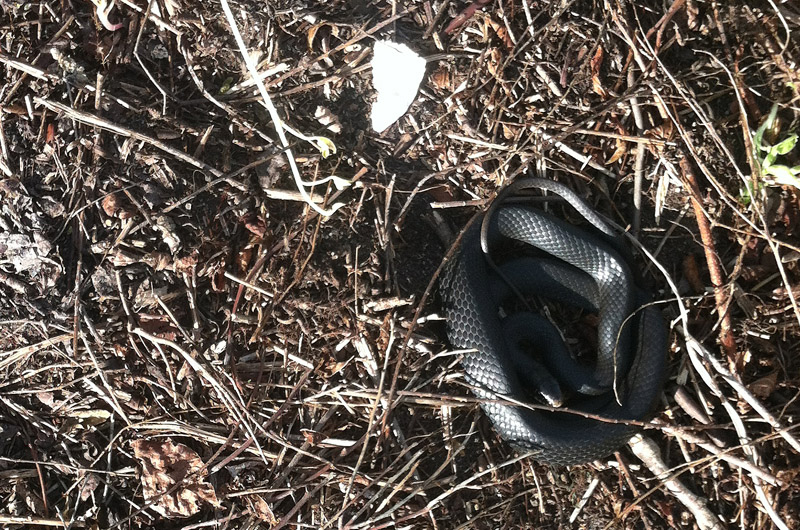
<p>Carefully lifting up a panel of plywood near Oyster Pond in Edgartown on Monday, Liz Baldwin uncovered a rare sight: a black racer, the Island’s largest and least common snake species. It was her first encounter with the species, which has been in decline here since the 1970s.</p>
Carefully lifting up a panel of plywood near Oyster Pond in Edgartown on Monday, Liz Baldwin uncovered a rare sight: a black racer, the Island’s largest and least common snake species. It was her first encounter with the species, which has been in decline here since the 1970s.
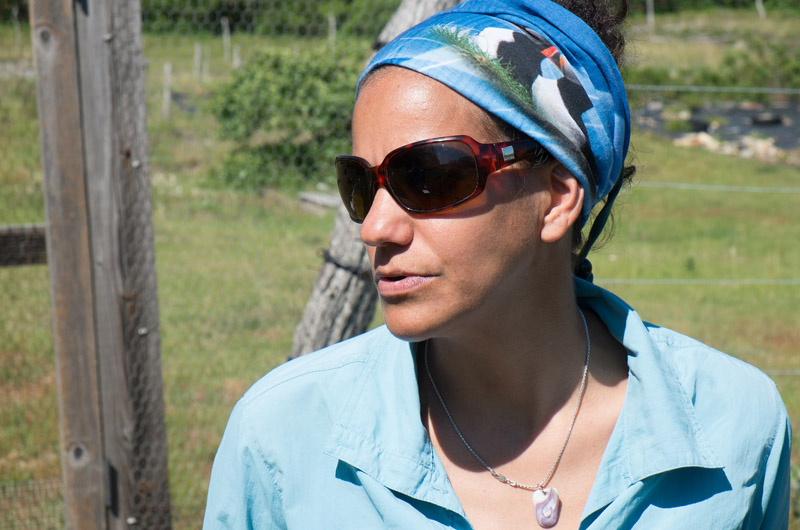
Ms. Baldwin monitors about 40 sites around the Island — in meadows, farms and backyards — for BiodiversityWorks, a research center in Vineyard Haven. She has found mostly garter snakes this year but with a growing network of sites, she hopes to collect data on all seven of the Island’s snake species.
The monitoring program began last year with funding from the Edey Foundation, with a focus on black racers. After collecting information on recent sightings last year, BiodiversityWorks placed several wooden boards at strategic spots around the Island.

Liz Baldwin found a black racer snake in Edgartown.
Liz Baldwin found a black racer snake in Edgartown.
Island naturalist Gus Ben David, who is also involved in the monitoring efforts, remembers when black racers were common on the Vineyard. When he was 12, he caught one that measured six feet three inches, which he said is still a record for the Island. But he can’t remember the last time he saw one. Recent sightings are concentrated along the south shore, where there are fewer roads and more habitat.
Black racers feed on mice, insects and other small animals and typically grow to around four feet. Adults are black with smooth scales and a light-colored belly. They move quickly, often chasing down their prey and swallowing it whole.
None of the seven snake species here are venomous, but the black racer often evokes fear with its size and aggressiveness. Most snakes will simply slither away when approached, Mr. Ben David said, but a black racer will sometimes defend its territory, coiling up and vibrating the tip of its tail.
“All snakes can vibrate their tails at a rapid, incredible rate,” he said. And when a snake happens to be lying in dry leaves or grass, the vibration can sound like a rattle. People often mistake milk snakes, a medium-sized species with red, black and yellow bands, for rattlesnakes, which do not live on the Vineyard.
Most of the information collected on Island snakes in the past does not include specific dates and locations, said Ms. Baldwin. “That’s why that baseline data is so important. We have it anecdotally but not quantitatively.”
Ms. Baldwin, along with BiodiversityWorks director Luanne Johnson, spoke Wednesday at the Chilmark Library to help raise awareness of Island snakes and expand the monitoring network.
About 30 people attended, sharing stories and adding to the growing body of knowledge.
BiodiversityWorks is discovering that many people maintain their own wooden snake boards at home, which can be added to the Islandwide network. “We just don’t know where all of them are,” Ms. Johnson said. The wooden boards provide warmth, food and protection for the snakes, which are unable to regulate their own body temperature.
BiodiversityWorks intern Alison Banks will continue checking the boards and taking measurements this summer. Eventually the group hopes to capture a black racer, implant a transmitter and follow it to its hibernation site — typically a cellar or other place below the frostline — to learn more about where they spend the winters. Ms. Johnson has been talking with plumbers and electricians for leads.
One management option for the future, she said, is to educate the owners of properties where black racers hibernate and encourage them to protect the sites.
Snakes have inhabited the Island since before it was an Island, she said, explaining how they got here, along with turtles, moles and other animals that do not cross salt water. Black racers are especially important to the local ecosystem, she said, since they could potentially help control the white-footed mouse population, the primary source of Lyme disease.
Mr. Ben David said the decline in black racers on the Island is due to many factors, including habitat loss, traffic, and increased predation by skunks, raccoons and other small mammals. He noted that skunks were absent on the Vineyard until the 1960s.
“We are trying to get a handle to see where these populations are,” he said of the black racer. “Perhaps we can do something that is advantageous for them.”
To report a recent snake sighting, contact BiodiversityWorks at [email protected].
Comments
Fewer snakes, more mice, more
Steve FalmouthFewer snakes, more mice, more mice more Lyme disease
The article references that
Mike WTThe article references that there are no venomous snakes on the Island.
I have heard that we have Copperheads. - although rare.
Last year on the road to Long Point I found a dead small snake that after I got home identified it as a baby Copperhead - yellow tipped tail was the key in the ID.
I have no problem seeing the
Very Annoyed Vineyard HavenI have no problem seeing the skunk population disappearing!
Hi Mike -
BiodiversityWorksHi Mike -
Do you have a photo of your snake that you identified as a baby copperhead? That would provide definitive evidence of the species, which has never been documented anywhere in southern Massachusetts or the Cape or Islands. Some snake species can look similar. It is always important to take photos of unusual species, which can help confirm presence or absence.
No
Mike WTNo
Unfortunately I did not have a camera and did not think to take a picture with my phone
It may very well have been an Eastern Milk snake
From photos they could look a little similar
Growing up during summers (61 of them ) we were always told that Copperheads had been seen on the Island
I wonder if Gus Ben David could opine on this
In the May 1971 issue of The
BiodiversityWorks Vineyard HavenIn the May 1971 issue of The Dukes County Intelligencer, they published James Freeman's "Description of Dukes County" from 1807, when Martha's Vineyard was still recovering from the poverty caused by Gray's Raid during the Revolution. Freeman was one of the founders of the MA Historical Society. In 1807, he wrote: "Beside domestick animals, the quadrupeds which are found on Martha's Vineyard are these which follow: the skunk; the musquash; the mink; four or five species of ground mice; the mole; the rabbit; four or five otters have been killed during the past ten years, and are supposed to have swum from the Elizabeth Islands across the Sound. There are no deer, foxes, nor squirrels. Of amphibious reptiles there are the mud turtle and the various species of pond turtles. There are also the toad, the tree toad, and the various species of frogs, except the bull-frog. The only snakes found on the island are the black snake; the variety of striped snakes; the small green snake; the small black snake with a white ring around his neck; the milk or house snake, speckled like a rattlesnake; all harmless." He goes on to also describe the birds.
It is an interesting account for those interested in MV Natural History to read.
which snake looks like the
Sandy Macartney Lamberts Covewhich snake looks like the black racer but is yellow underneath?
One reason for the decline
Peter Jones EdgartownOne reason for the decline may well be the use of poison baits for mice and rats. A bad ideas, since all these poisons will generally kill the next animal that eats the dead mouse/rat...
Add new comment