

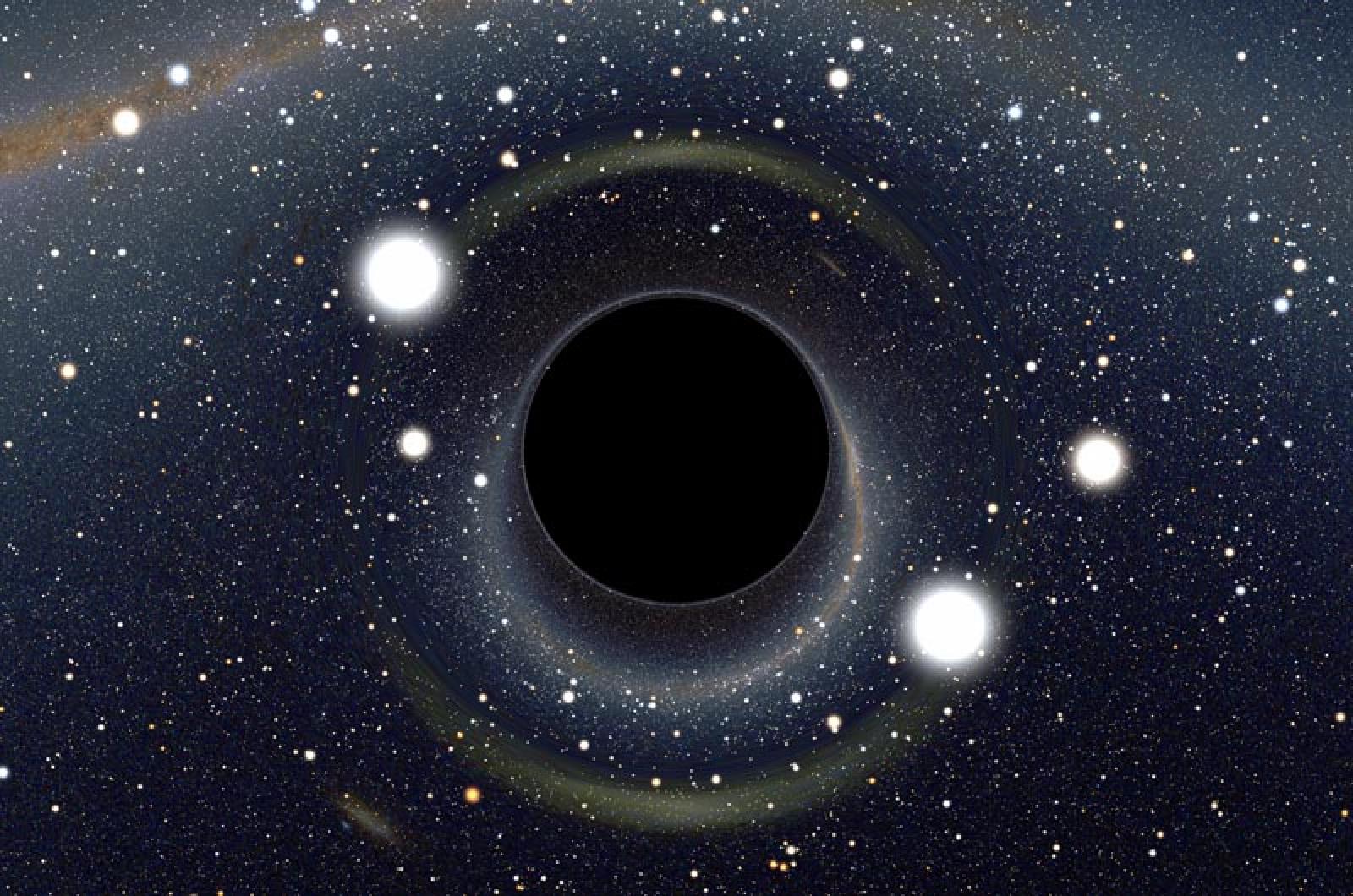
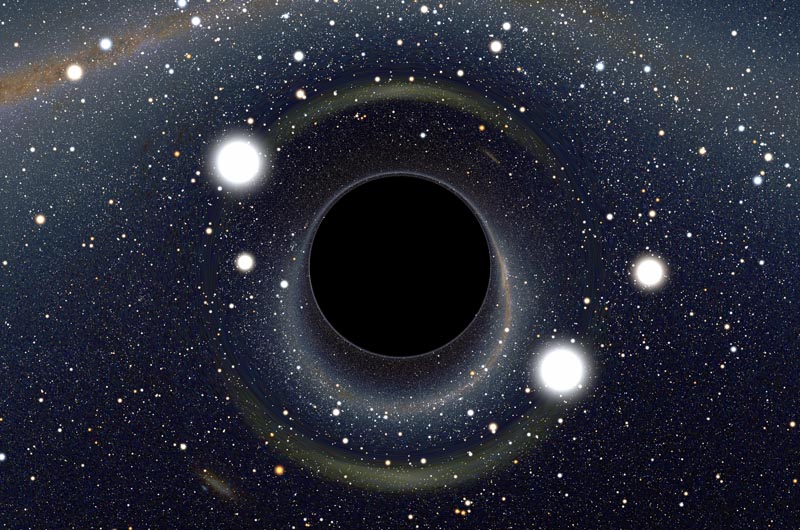
Black hole science might really just be a shot in the dark. Scientists agree that black holes are a bit of a mystery.
Black hole science might really just be a shot in the dark. Scientists agree that black holes are a bit of a mystery. American astronomer Andrea Ghez explains it this way: “We have this interesting problem with black holes . . . It is a region of space where you have mass that’s confined to zero volume, which means that the density is infinitely large, which means we have no way of describing, really, what a black hole is!”
She continues, expanding to the heart of the issue, “So our understanding of the center of black holes doesn’t make sense, which is a big clue to physicists that we don’t have our physics quite right.”
Or maybe it’s nature that doesn’t have its physics right! Physicist John Wheeler, who is credited with coining the term black hole, observed that these exotic phenomena “teach us that space can be crumpled like a piece of paper into an infinitesimal dot, that time can be extinguished like a blown-out flame and that the laws of physics that we regard as ‘sacred,’ as immutable are anything but.”
Albert Einstein added humor to the equation when he joked, “Black holes are where God divided by zero.” And we can’t forget Stephen Hawking, who sees some irony in the situation: “Consideration of particle emission from black holes would seem to suggest that God not only plays dice, but also sometimes throws them where they cannot be seen.”
So while I am not afraid of the dark, I am a bit confused and intrigued by those black holes that are found out in the galaxies.
The recent discovery of a massively large black hole had astronomers twittering last week. The black hole in question was both large and old. Researchers suggested that it is 12 billion times more massive than our sun and was formed around 900 million years ago, after the Big Bang. This particular black hole is also six times larger than most of its known contemporaries and is in good company, since it is believed that there are billions of black holes in the universe.
This finding is even more intriguing when you understand that you can’t actually see black holes, but can only detect materials falling in and being attracted by them. Even light cannot escape a black hole, but when gases and other materials get sucked in, they create so-called “fireworks” that can be observed.
But back to basics. A black hole is a star or dense region of space that has collapsed on itself. Its gravity relentlessly pulls everything nearby, including light, into it, but nothing can get out. One apt description of a black hole calls it a “mysterious bottomless pit.”
Not all stars will become black holes. Gravity and internal pressure are the forces that compete. When these two forces are balanced, the system is stable and a star or other celestial body remains. However, when gravity wins out, the star collapses and a black hole can result.
These celestial oddities create wonder and amazement among the public and scientists, but complete understanding remains somewhat elusive. The depths of the science of black holes and debates among experts may be as deep as those bottomless pits themselves. With so much fascination and fantasy surrounding them, it is hard not to get sucked in.
Suzan Bellincampi is director of the Felix Neck Wildlife Sanctuary in Edgartown, and author of Martha’s Vineyard: A Field Guide to Island Nature.
Comments
I think the generally
Bernie Goetz New YorkI think the generally accepted concept of a point singularity is nonsense. Schwarzchild showed that a point mass can mathematically contain light but that doesn’t mean a point mass or singularity exists in reality. A star smaller than about twice its Schwarzchild radius would also contain light and makes more sense than a star smaller than its Schwarzchild radius.
I'd like to retract the above
BernieGoetz New YorkI'd like to retract the above statement but still doubt that black holes collapse to a singularity. If the pressure P of ultra relativistic material is given as (rho)(c^2)/3, where rho is the energy density, the total supporting energy or virial energy of this star would be ∫PdV = (Mc^2)/3. The gravitational binding energy of a star is about 1.1G(M^2)/R. Using the virial equation, if (Mc^2)/3 is equal to 1/2 of 1.1 G(M^2)/R, the radius R of this object equals 1.65GM/(c^2), or 0.82 of the Schwarzschild radius.
I always learn so much from
Susan ChilmarkI always learn so much from Suzan's beautifully written columns. Her humor and her ability to find wonderful quotes such as those from Einstein and Hawkings make her columns a delight to read. I always turn to them before reading anything else in the Gazette.
Add new comment