

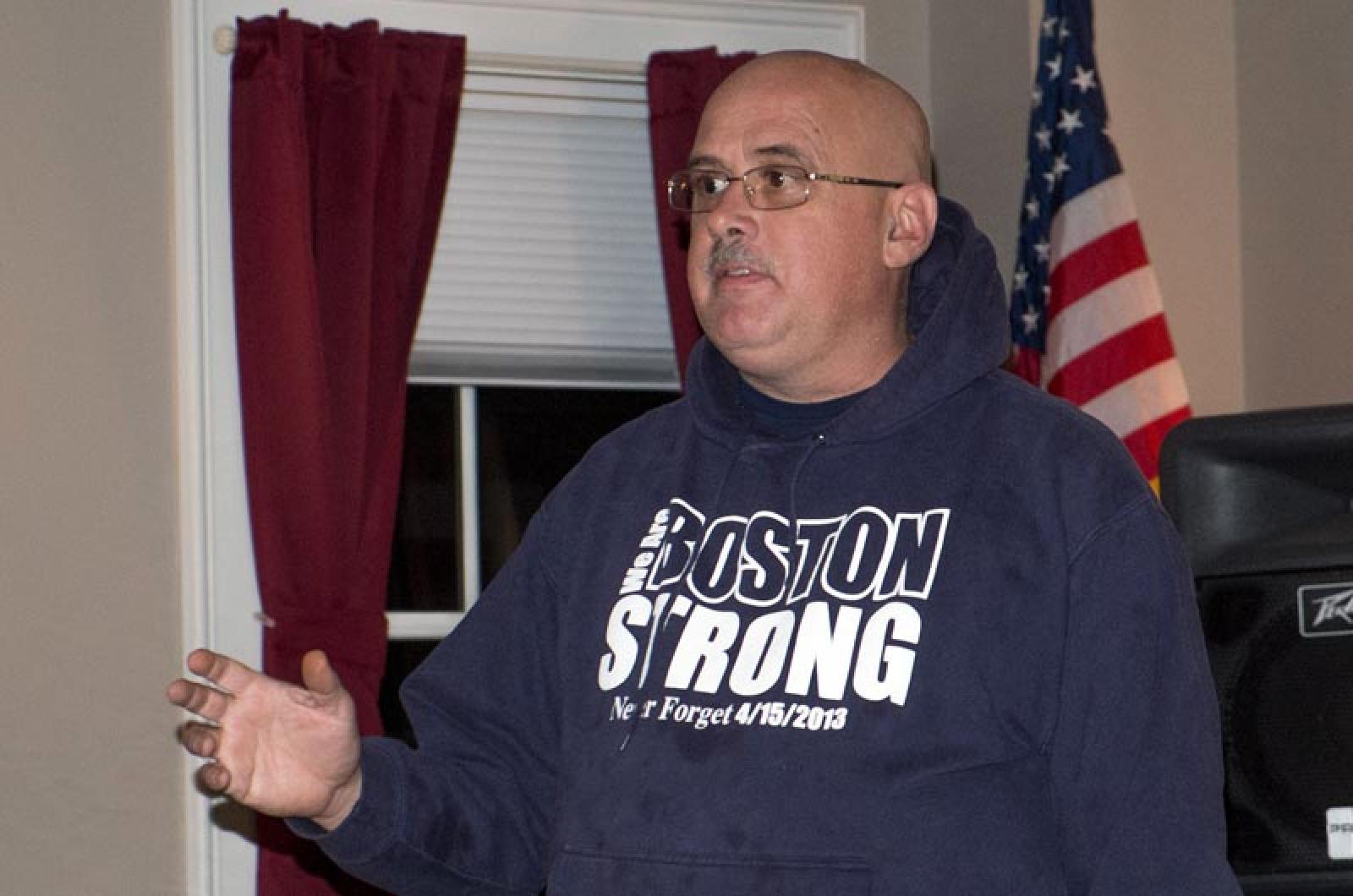
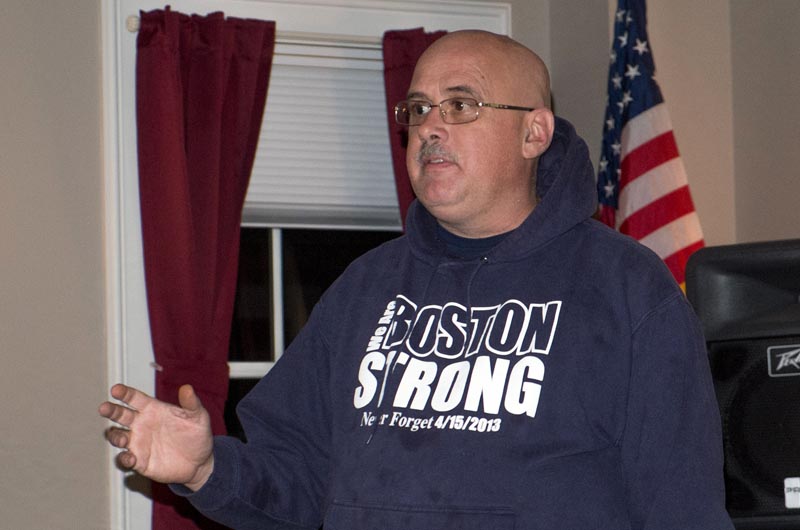
On Wednesday night, two members of the National Alliance on Mental Illness shared their stories at the Oak Bluffs Library as part of a program called In Our Own Voice. The program aims to break through some of the stigma that surrounds mental illness.
The National Alliance on Mental Illness has developed a program called In Our Own Voice that aims to break through some of the stigma that surrounds mental illness. The free presentations are offered by people who are living with mental illness. On Wednesday night, two NAMI members, Tom Raposa and Brian Ramsay, shared their stories at the Oak Bluffs Library.
A video accompanied the presentations, setting up the conversation and breaking it into components: dark days, acceptance, treatment, coping skills and successes, hopes and dreams. The stories shared in the video depicted people of all backgrounds living with schizophrenia, bipolar disorder, major depression, anxiety disorders, panic disorders and other mental illnesses.
One man in the video said that in the middle of his darkest days, he would get up and prepare for work and then drive to a parking lot where he would call in sick to his workplace. He waited until he knew his wife was gone to her job and then he’d go home and go back to bed. One of the women in the video said she spent most of the day in a closet because she did not want to experience what she called “all the stimuli” going on around her. There were stories about feeling worthless, like an alien in the world and stories of hearing voices and seeing things that no one else saw.
Tom Raposa is a 47-year-old Coast Guard veteran with a degree in sociology. He lives in the Bedford area where he’s active with the VA, volunteering his time helping other veterans who deal with mental illness and substance abuse issues. Mr. Raposa said his own problems began back in eighth or ninth grade with drinking and smoking marijuana with his friends. He said he had a paper route and made about $60 a week, which he promptly spent on partying.
“Me and my buddies would go out into the woods and party a lot. I barely made it through Catholic high school,” Mr. Raposa said. “I was put there from the public school and I didn’t know anyone and I just kept drinking.”
He said he had a good upbringing and his family has always been important to him, but the drinking and drugs took their toll. Mr. Raposa experienced a breakdown and ended up in Walter Reed Army Medical Center, eventually diagnosed bipolar with schizoaffective disorder. “Not a pleasant experience,” Mr. Raposa said.
Presentation included videos, books and support materials.
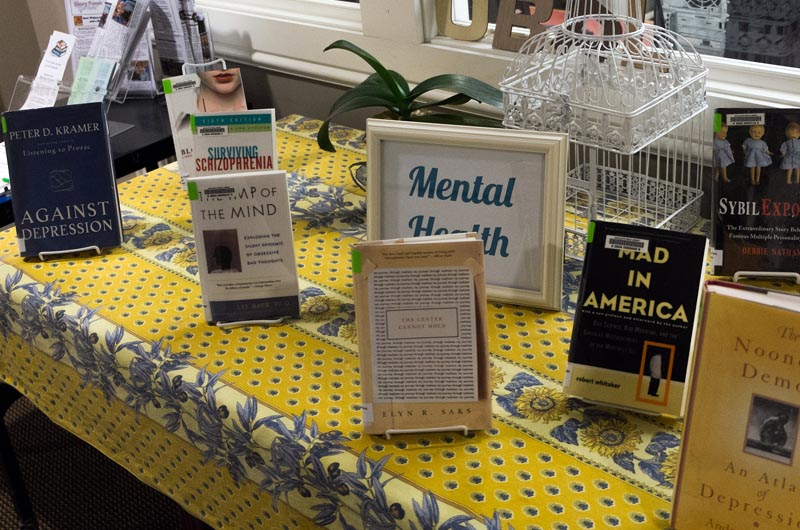
Presentation included videos, books and support materials.
He was hospitalized three times he said, before he found the help he needed. His journey brought him to Bedford where he landed a good therapist and psychiatrist directing his care. “I have a lot of friends who are supportive and some friends who are still doing the same thing, but I can’t even have a sip, so I concentrate on my sobriety,” Mr. Raposa said.
Brian Ramsay’s symptoms came on when he was in his second year at Northeastern University. “I stayed in bed for three days. I saw a psychiatrist, went to the hospital, heard voices. They put me on medication. I thought I could sleep it off. I couldn’t speak. I knew what was going on in my head but I couldn’t vocalize. They called this a mute stage,” he said.
Mr. Ramsay has been in and out of the hospital several times, but like Mr. Raposa, he has support through his family and through NAMI. Mr. Ramsay has worked at a supermarket in Orleans for 23 years, and has lived in his own apartment there for just as long. He plays tennis, goes to church, attends support group meetings and joined Weight Watchers, losing more than 60 pounds. Weight gain is a common side effect of many medications that help with mental illness. Both men said keys to their recovery are keeping busy, staying on their medications and family support.
“I’m just trying to be myself. Trying to be happy and it’s working right now,” Mr. Ramsay said. “Coping to me is living day to day, week to week, month to month taking care of my needs.”
After the presentation, Mr. Raposa said the most difficult part of coping with the aftermath of his mental illness is the feeling that he isn’t normal anymore. “Going from being a normal person to not being a normal person. Losing credibility, not being looked at like I was looked at before, like I changed and no one else did,” he said.
According to the National Alliance on Mental Illness, approximately 26 per cent of adults in the U.S. struggle with a diagnosed psychiatric condition in a given year. The most serious conditions affect about six per cent of those diagnosed. The illness doesn’t affect a particular socioeconomic, race, religion or other demographic. It can happen in any family.
NAMI has numerous resources on the Island. Support group meetings for families and friends of those coping with mental illness take place on the third Wednesday of the month in the chapel at the Martha’s Vineyard Hospital from 6:30 to 8 p.m., and on the first Sunday of the month at Daybreak Clubhouse from 6 to 7:30 p.m. A support group for those who have a mental illness meets the second and fourth Sunday of the month at Daybreak Clubhouse from 6 to 7:30 p.m. All meetings are confidential.
For information about family supports, call 508-627-5249 or 508-693-5872. For information about support coping with mental illness, call 508-693-5565.
Comments
Facing Claims of Stigma Head
Harold A. Maio Ft Myers FLFacing Claims of Stigma Head On---A Letter to the Editors
One of the most difficult things for me to understand is someone directing a stigma.” History has given us enough evidence of why not to. Still, there are people who cling to the idea that they can call prejudice (the accurate term),“stigma.” You have done so in your headline. You err.
We, at whom you direct this prejudice, are a broad and diverse demographic earning to the millions, holding every university degree and every professional, white and blue collar job. Directing prejudice at all of us is an impossible task. In my long career, no one has.
Mental illnesses exist on a spectrum. People with schizophrenia may live in a world where communication between us is impossible, and at the other end of the spectrum are people with doctoral degrees teaching at university. In between are numerous gradations of the illness. The same is true of other mental illnesses.
There are, on this spectrum, people who face prejudice on a daily basis. Your headline is one example for them.
Harold A. Maio, retired mental health editor
what concerns me is that many
Kathy McQueen Beaverton Oregonwhat concerns me is that many people struggling with mental illness are being shot and killed by the police. I have been in situations where I could not get my medication due to insurance issues, or some mistake my doctor made. I'm told I'm not supposed to start and we stop this medication but that is beyond my control. I always thought police were trained to shoot to wound a person not to kill. is this just a way of controlling the population or what?
Directing a "stigma" is an
Harold A. Maio [email protected]Directing a "stigma" is an act of deep prejudice, no matter its origin, victim or victimizer
I have known this veteran
Andrea J. Valin,RT/AS/CADC Bedford VA (VMHAP) Veteran's Mental Health Addiction ProgramI have known this veteran since 11/2003, when he already had 2years of recovery. He continued with his recovery program successfully, and worked very hard on developing a positive lifestyle while delaing with his mental illness. Eventually, I introduced this veteran to NAMI in 2009, and he took it to a new level of care. No only did he take advantage of it for himself, but he got involved for the purpose of helping other veterans.
To do this vet became a Peer Specialist, and further introduced NAMI to his fellow veterans, as a group leader for a period of time, and continues his support through 1:1 service. He serves on the Cental MA board, and works with NAMI doing presentations for IOOV.
(In Our Own Voice)). I'm very proud to know him, as he will help his fellow veteran anytime!
Add new comment