

Herbert Slater, who died last week, was one of a dwindling group of men who took part in the now largely forgotten harpoon fishery that made Menemsha a major source of swordfish landings on the East Coast in the fifties, sixties and seventies.
Herbert Slater, who died last week, was one of a dwindling group of men who took part in the now largely forgotten harpoon fishery that made Menemsha a major source of swordfish landings on the East Coast in the fifties, sixties and seventies. It was a vibrant and exciting chapter in the lives of those men and a since-unequalled time of activity for the harbor itself.
In those days, late in June Menemsha harbor filled with the small boat fleet, some local, some from ports on the mainland. Rigged with topmasts and pulpits, the boats tied up two, three and four deep the length of Dutcher Dock. When the weather was good, the fleet left early, the sound of engines starting and boats getting underway filled the air before sunrise. Some hours later, with two or three men in the mastheads, the boats crisscrossed the waters 10 to 20 miles south of Noman’s, scanning for the signature dorsal and tail fins cutting the ocean surface.
These men were hunter-gatherers, fiercely competitive and secretive about their plans. They rarely fished in sight of one another. Their radio “chats” were studies in non-communication: “Not much doing here; think we might try going to the west’ard some.”
“Not much” might mean two or three fish on deck and another struck and still in the water. “West’ard” could mean east or north or south.
When a fish was sighted, the striker climbed down the ratlines (if he was not already in the pulpit) and from a steering wheel at the masthead the boat was set on a course to intercept the fish. Struck, ideally in the back close to the dorsal fin, the fish usually dove, carrying with him 50 fathoms of stout hemp attached to an airtight nail keg painted with the boat’s colors and names. The doryman was dropped to pick up the keg and gradually, hand over hand, haul the fish alongside. It might take as few as fifteen minutes or as long as two hours to get the fish up the dory, where it was fatally lanced. A raised oar signaled it was time to be picked up, and the fish, now mostly lifeless, was hauled aboard by a fluke rope tied around its tail. On deck the tail and sword would be cut off to allow the fish to bleed, and then covered with a piece of canvas. While the doryman was out hauling, the boat would circle widely hoping to find another fish, and sometimes it did.
On a very good day, a boat might get two or three or four fish. On a bad day, none, and often only one. And because of the weather there were many days when boats couldn’t fish. So in a season, which generally ended soon after Labor Day, a boat might get 40 or 50 fish, sometimes over 100. The men were compensated with shares. In a boat with two men, the value of the fish sold, less the cost of fuel and food (sometimes they anchored out over night), was divided in three: one part for the boat, one part each for the two men.
The great excitement for those ashore was finding out how the boats had done. Late in the day the boats would round Gay Head and head for Menemsha with the setting sun behind them. If birds trailed a boat it was a good sign; the fish were being gutted. Most of the fish landed during that period were sold to Everett Poole who had a retail fish market on Dutcher Dock and a wholesale business that served fish markets on the Cape and in Boston. The fish were weighed on the dock and then hoisted into the cool room in the market. Gutted fish weighed between 150 and 500 pounds, which implied whole fish weights of 250 to 750 pounds.
There were bigger boats, the Larsens’ Christine and Dan and the Tiltons’ Three Bells, and others whose trips to Georges Bank lasted a week or more, and they would take their fish to the fish auctions in New Bedford or to Sam Cahoon’s in Woods Hole.
Many of the boats that tied up each night at Menemsha were commercial fishing boats, but not all. There was Nelson Blount’s Aphrodite, a sleek black yacht without a mast said to have been won in a card game; there was the Seer, a William Hand motor sailor with two very tall masts, which carried its wealthy superannuated owner out to the grounds in the usually vain hope that he would harpoon a swordfish. And there was of course Herbert Slater’s Aloysius, a former rum-runner with a saloon cabin amidships and a tall mast and pulpit added for the chase whose most important and enduring catch was his wife Jane. On the local commercial side there were Gay Headers Walter and Jimmy Manning and the boat Bozo, Chilmark’s Ben Mayhew and Eric Cottle in the Dorothy and Everett, Jimmy Morgan in the Mary B, and boats from Point Judith and New Bedford and Block Island and Newport. All together, a forest of masts and rigging stretched across the twilight sky.
The harpoon fishery got a lift in the late sixties from the introduction of spotter planes which made boats more productive by scanning wider areas, but the introduction of long lining doomed the fishery. Overnight sets of a 14-mile long line with baited hooks every 50 feet could catch 50 to 60 fish at one time. And whereas the harpoon fishery ended with the first big storm in September, the long liners, in bigger boats, pursued their catch down the gulf stream, off Hatteras and into the Gulf of Mexico. In a few years the swordfish were gone from local waters and the small boat fishery, the harpoon fishery, was finished.
Now at Menemsha harbor on a summer’s eve there is no such trail of boats coming in from Gay Head. The great excitement is the setting of the sun itself, and that to great applause. You can’t even find a place to park.
Comments
Those of us who aren't sword
MTM Washington, DCThose of us who aren't sword fishermen appreciate this recounting of the glory days of Menemsha harpooners. Thank you! I would think many young people were not aware that harpooners worked the waters not so long ago. Nor did many of us appreciate just how difficult and costly it was / is to operate a commercial fishing boat.
Thank you so much for this
Sarah Slater Bennett Attleboro, MAThank you so much for this wonderful snapshot of my father's life. I'm proud he'll be remembered as the striker on the Aloysius. I hope there are swordfish wherever he is now.
Peter, Thank you! It was good
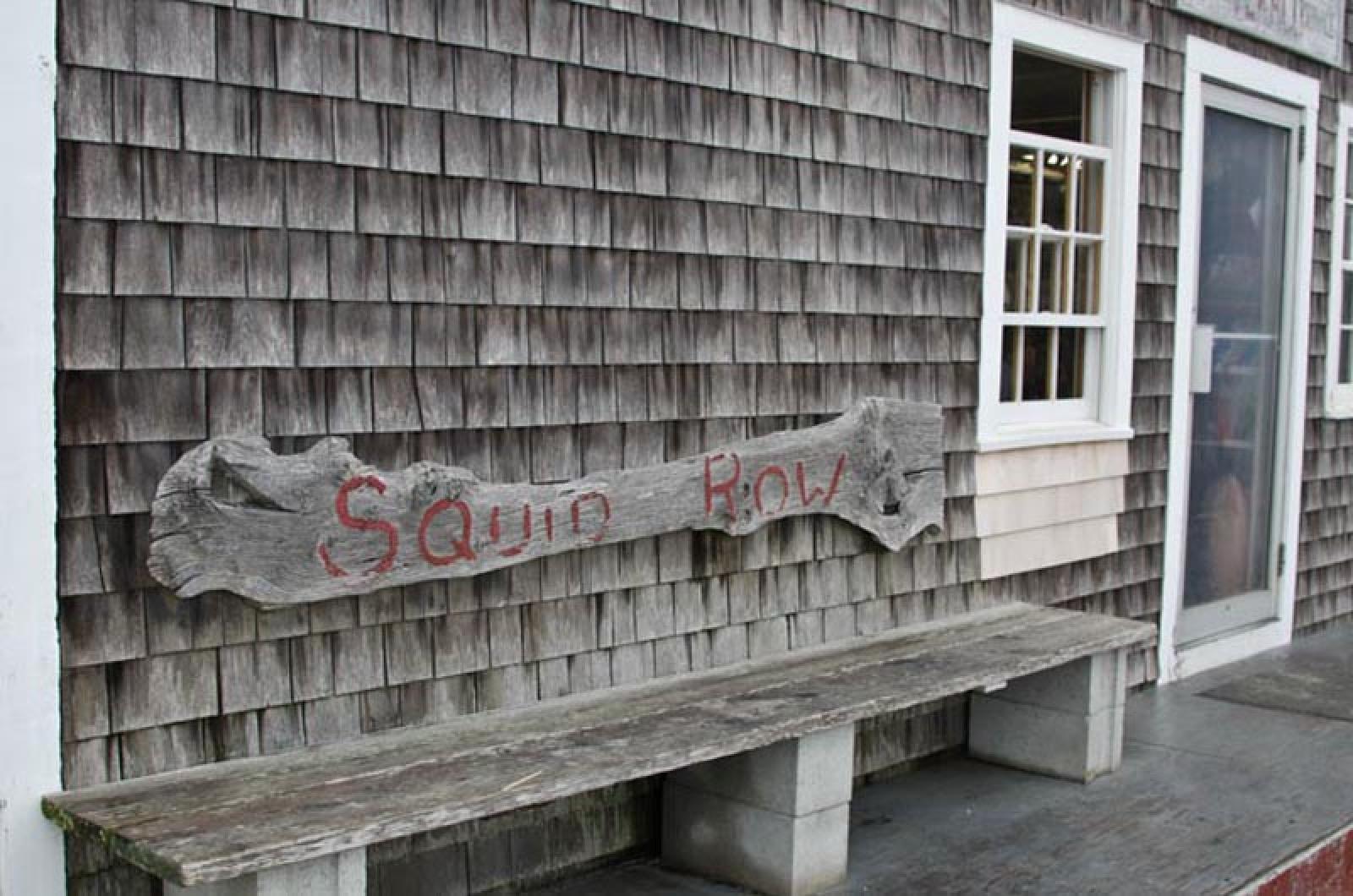
June Manning AquinnahPeter, Thank you! It was good to see you yesterday at Herb Slater's service. The photograph of Herb and Jane with a swordfish hanging from the dory is priceless. Oh, the memories. Not only did your recollections bring me back a few decades but also brought tears to my eyes reminiscing about the swordfishing era of days gone by. Menemsha Harbor was filled to capacity at Dutcher Dock in those days as the other two docks did not exist at that time. Many joyous evenings were spent with fishing families of several generations. In 2013, Katie Carroll insisted that I spend a few moments watching the sun set on Squid Row. That evening I sat down next to Louis Baptiste who had known our family well. His brother in law had purchased the Bozo in the early 70s. What a coincidence. We had fond memories of those summer nights when Menemsha was bustling with swordfishermen. This morning, my Grandson Noah and I headed to Menemsha Texaco and Menemsha Fish Market and the USCG Station Menemsha. Noah was astonished that there were no people around, no one on the beach or the jetty, no cars, no boats on the horizon. He had never seen it so empty ! One of my suggestions for the MV Museum is to have an exhibit about the Menemsha swordfishing fleet. I have a few postcards to share of those days and were they grand. I also know someone who is presently writing a book of those amazing days. Let's hear more from you Peter - your recollections are priceless as well. THANK YOU SO MUCH.
Such a great rendition of
Albert Fischer West TisburySuch a great rendition of Herb's way of life, sword fishing. Great job Peter, you captured Menemsha so accurately,the way I remembered it.
Wonderful tribute and
David Seward Vineyard HavenWonderful tribute and memories of the Menemsha fishing fleet Peter. Your mother would be proud! As a child I remember playing on Dutcher Dock ( usually sliding down the old ice chute in the long gone ice company building) and visiting Herb Slater, Frank Cyganowski, skipper of the Seer and Nelson Blount of the Aphrodite. All three men took time to humor my brother and me as we bombarded them with questions about their boats and sword fishing. Hurricane Carol of 1954 sunk the Aphrodite but the Seer and Aloysius survived the blow. But I remember the Rigadoon with its stern fetched on a piling anf it's bow underwater. Seeing all that destruction was the memory of a lifetime for us seven- year olds. Herb was indeed a walking compendium of nautical information. I was hoping to get some of his memories on tape. But just having known him was a privilage. Those of us who lived and grew up in Menemsha were fortunate to have known Herb Slater, Walter Manning, the Larsen boys, Eric Cottle, Ernest Mayhew, Ben Mayhew, Herb Flanders, Robert Flanders, Bob Flanders Lenny Jason, Carlton Mayhew, Donald Poole, Matthew Poole, Frank Cyganowski, Nelson Blount, Rasmus Klimm, Stuart Knight, Ingrid Olsen and some I am sure I have forgotten. Jimmy Morgan is one of the last of his era still living. What a legacy he and the others have left us.
thank you for bringing those
Heather Neill the studiothank you for bringing those boats and seafaring men back to life. I looked for those adventures behind the twinkle in Herbs old eyes...but you're right...it was mostly Jane he was smiling at.
thankyou Peter for your
Jane slater menemshathankyou Peter for your wonderful tribute to all that Menemsha was because of the swordfishes men.
Great article...those were
Hugh Weisman ChilmarkGreat article...those were wonderful days. And one of my most treasured memories was going sword fishing a couple of times on the Chauve Souris, a staysail schooner, owned by Hans and Mary Van Nes. Hans would spend the week in the New York, but we took it our several times with a crew captained by his eldest son, Hans, Gordon, Andrew, Nicky (who of course is still kicking around the Vineyard), my brother Jamie, and Jon Panken. Hans was the oldest and was a junior or senior in high school. It was pretty crazy for a bunch of kids from about 12-16 years old to take out a 68 foot schooner. But we did it, and we did it under sail. And one day when Jon Panken was chumming by puking over the gunnel laying on the deck on his belly, a sword fish surfaced directly below the source of the chum to his great surprise. Somehow, we managed to drop the sails and circle around and Hans put an iron in the fish which as I recall came in at about 150 pounds. We threw it in the back of my 1948 jeep and drove it up to show off to our parents who we found at Bil Baird's house...then back to sell it to Everett.
https://www.facebook.com
Sarah Bennett swordfishing pichttps://www.facebook.com/photo.php?fbid=10204236881814697&set=pb.100719…
My uncle, Earl Anderson,
Linda Spies Cape Coral FloridaMy uncle, Earl Anderson, accompanied Herb for years aboard the Aloysius, and captured those days in movies, slides, and photographs. I have that collection and have wanted to pass them along to someone who might enjoy them. He loved his days with the Slaters.
Linda,
Sarah Slater Bennett Attleboro, MALinda,
I am Herb's daughter Sarah and I knew Earl as "Uncle Earl" in my childhood. He was a wonderful man, and I'd be honored to take the collection.
Sarah
Ms. Spies and Ms. Bennett:
Tom Dunlop Vineyard GazetteMs. Spies and Ms. Bennett: Should you wish to transfer these important films to DVDs, the Gazette -- through its Historic Movies of Martha's Vineyard project -- can help. You can reach me at [email protected], and in the meantime here's a link to the movies we've saved and presented so far:
http://vineyardgazette.com/historicmoviesofmarthasvineyard
Linda, are you referring to
Jimmy kelly EdgartownLinda, are you referring to Earl O Anderson that lived at elderly housing in Tisbury?
No, he lived in East
Sarah Bennett AttleboroNo, he lived in East Providence, RI.
Great article. Thank you .
Gwen Nichols VhGreat article. Thank you . Jane so sorry . I didn't know. Xo
Add new comment