

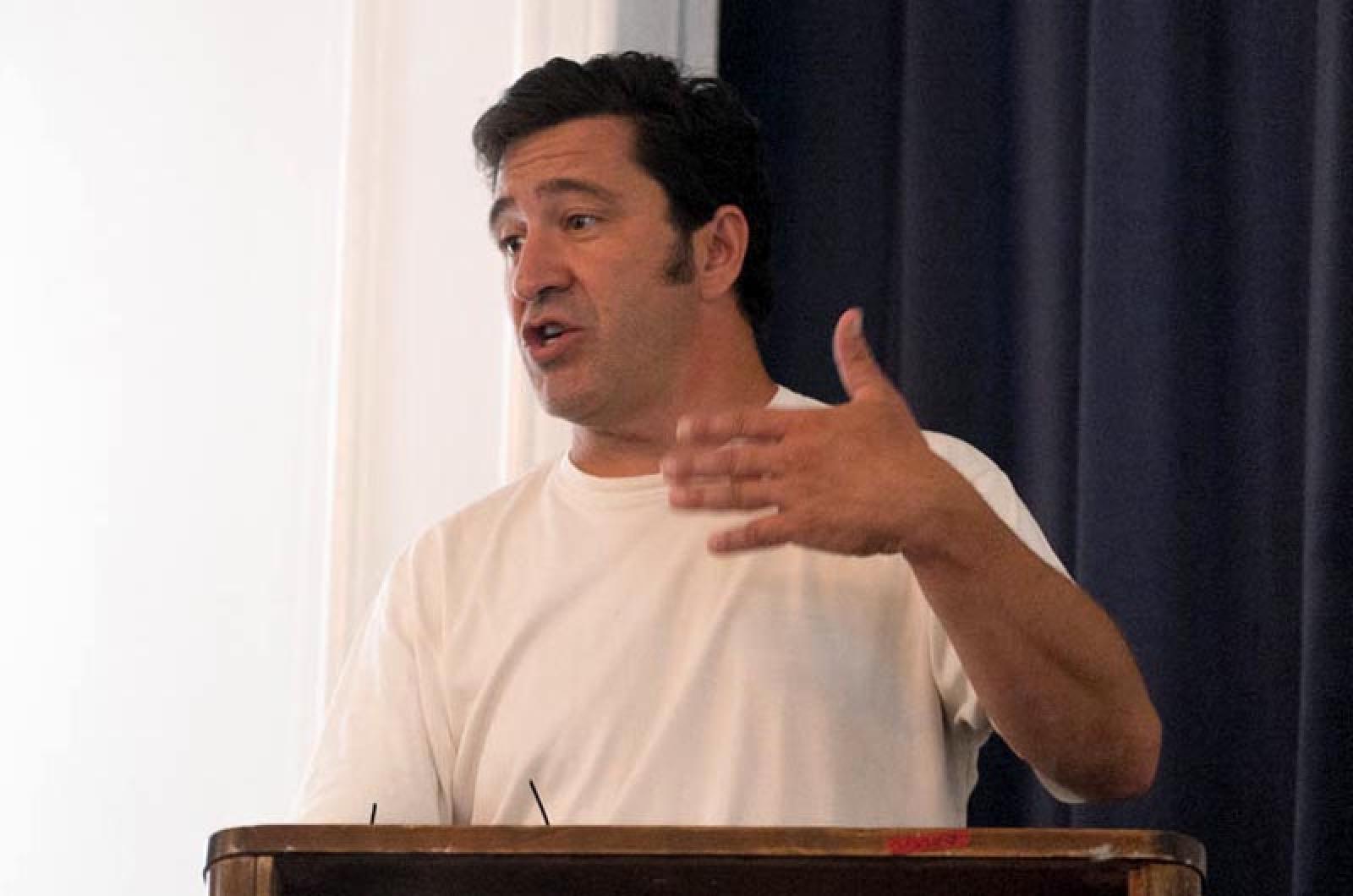
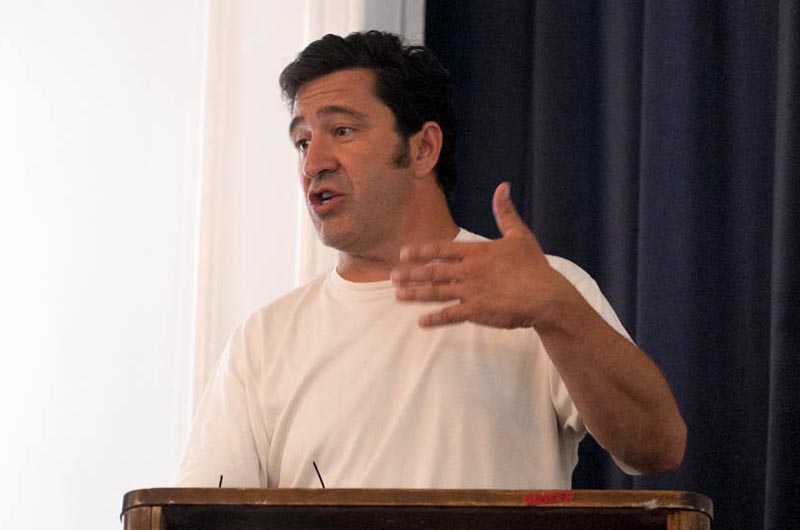
<p>The Island energy cooperative is entering the next phase of its plan to build a 40-megawatt wind farm south of the Vineyard, and has reached a clear turning point in its young history, president Richard Andre said at the fifth annual meeting Saturday.</p>
Vineyard Power, the Island-owned energy cooperative, is entering the next phase of its plan to build a 40-megawatt wind farm south of the Vineyard.
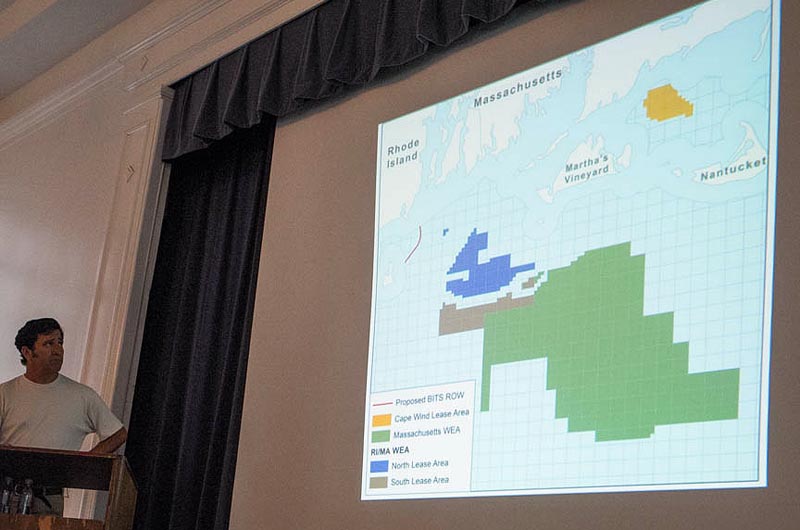
At its fifth annual meeting on Saturday, president Richard Andre said the cooperative will bid on a portion of the federally-owned Massachusetts wind area, which covers about 1,200 square miles south of the Vineyard and was recently opened to commercial wind energy leases.
That represents a major turning point, Mr. Andre said. So far, the cooperative has focused largely on four solar installation sites around the Island and on planning and assessment for the wind farm. “It’s a pretty exciting year,” Mr. Andre told a small group that attended the meeting at the Katharine Cornell Theatre in Vineyard Haven.
Vineyard Power has signed a community benefits agreement with a private developer to ensure that jobs and infrastructure associated with the wind energy project stay on the Island. The agreement also means that Vineyard Power will receive a five per cent federal credit to help it compete in the bidding process. (The credit will automatically raise its bid five per cent to match a competing bid.)
The cooperative is now advocating to raise the credit. Mr. Andre encouraged members and Island residents to submit comments to the Bureau of Ocean Energy Management (BOEM) requesting that the credit be raised to 20 per cent. A 60-day public comment period regarding the proposed sale notice ends on August 18. A final auction will likely be held later this year.
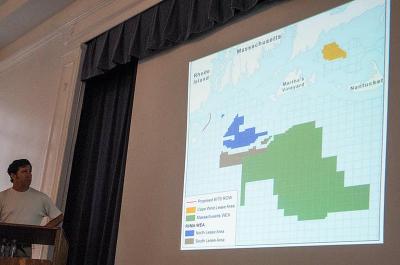
Island energy cooperative is entering the next phase in its bid to build a wind farm south of the Vineyard.
Island energy cooperative is entering the next phase in its bid to build a wind farm south of the Vineyard.
Over the last few years, BOEM visited the Island 39 times, Mr. Andre said. It reduced the wind energy area from 3,000 to 1,200 square miles and pushed the boundaries from three to 12 miles from shore.
Mr. Andre believed the agency had taken a lesson from the Cape Wind project in Nantucket Sound, which has been controversial in part because of its proximity to the surrounding shorelines. (Federal waters begin three miles from shore.)
The Massachusetts wind energy area was divided diagonally into four zones, but Mr. Andre believes most of the development will occur in the two western zones.
“Zones three and four, particularly zone four, is in such deep water it’s not even technically viable that offshore wind is going to be developed there for the foreseeable future,” he said. “It’s going to take floating turbines, which are in their very early stages.”
The zones are divided further into blocks of nine square miles each. Vineyard Power will bid on three blocks in zones one and two, in the area closest to the Island. “I think we were right in the early days to know that these were probably going to be the most cost-effective zones to develop — closest to shore, shallower water,” Mr. Andre said.
In June, BOEM submitted an environmental assessment showing that site assessment activities in the area would have no significant impact, but the report only covered preliminary work. “It does not include building a wind farm,” Mr. Andre said.
“Whoever ends up building a wind farm is going to have to do an environmental impact statement, which is a much higher level of detail, which will probably take two years to conduct,” he said. “But the developer is only going to do that once they realize the site is developable.”
Deepwater Wind, which holds the first competitively held lease in federal waters, won its bid last July and has already begun its environmental impact statement.
Deepwater’s joint development agreement with Rhode Island qualified it for a 20 per cent non-monetary credit, which allowed it to win the auction. The company paid $3.8 million for the 256-square-mile site off the Rhode Island coast.
As a nonprofit, Vineyard Power faces a range of complex challenges with complex solutions. To qualify for federal tax credits, for example, the project will be 99 per cent funded by a private investor, until the investment is repaid, at which point the cooperative would become the primary owner, with the option of buying the investor’s remaining portion. Mr. Andre called it a Minnesota Flip ownership model.
Another challenge is attracting enough members to make a 40-megawatt wind project realistic. Much of the discussion on Saturday focused on that issue.
Mr. Andre said the 1,500 current members were enough to make the group credible, but that more would eventually be needed.
The cooperative’s goal is to reach 8,000 members, about half of all Island homes and businesses. That would provide some certainty in terms of representation, and would also qualify the group for low-interest USDA loans. Part of the challenge is getting to 8,000 members, but part of it is having a binding agreement that would require members to purchase Vineyard Power’s electricity.
But the group has essentially stopped pursuing new members. Instead, it is working with Cape and Islands Sen. Dan Wolf to find ways to partner with Cape Light Compact, the primary energy provider for Barnstable and Dukes counties, to make Vineyard Power the default provider for a portion of Vineyard residents.
Cape Light Compact was formed in 1997 by an act of the state legislature that makes it the default supplier for the two counties. Consumers can opt out, but only about 30 per cent do, and those are mostly businesses and other large users.
“If we can use that legislative power that Cape Light Compact has, and ask them to default a proportion of Martha’s Vineyard over that we need to finance the wind farm, that helps us get, in effect, from our 1,400 members to 8,000 members,” Mr. Andre said.
Vineyard Power member Alex Boyle wondered why more people were not aware of the cooperative’s work. “I would say that probably nine out of ten people that I talk to about Vineyard Power cooperative never heard of it,” he said, “And I’m really puzzled at that, because this is a very environmentally-conscious Island.”
Member John Abrams suggested that the group’s work was not yet concrete enough to appeal to most people. “There is nothing there to grab onto,” he said. “The only thing there is the solar projects, which could be publicized more. But when there is a lease, I think that will have a huge impact.”
He suggested that people may also be suffering from “Cape Wind fatigue,” following the controversy surrounding that project over the last several years.
“The fact that these are 12 miles away, it doesn’t have that much impact,” Mr. Abrams said. “And it will never have that much impact, until there are wind farms there doing something positive, and then that’s where the impact is going to be.”
Mr. Andre said he believed that after 2015, there would still be another four or five years before the wind turbines would be spinning. He hoped that would allow enough time to raise awareness and gain community support.
But for now, his sights are more firmly set on the next few months. “What we need to achieve now is that we are players in this lease,” he said.
Comments
Please do NOT pursue this
Craig Hockmeyer AquinnahPlease do NOT pursue this Wind Farm Development. Ocean-based Wind Power is WAY too expensive to install and maintain, and the amount of un-reliable power generated is literally a drop-in-the-bucket compared to our grotesque use. Please Vineyard Power; pursue land-based Solar power generation and other lower-cost Green power sources. Developing our undisturbed Oceans is Not a step in the right direction for many valid reasons. Thank You
Gotta love the "Minnesota
Joe EdgartownGotta love the "Minnesota Flip ownership model". Sounds like something out of The Sting.
Assuming the average US house
James B Riley Edgartown and Arlington, MAAssuming the average US house uses about 1.3 kW on average, this proposal to build.a plant with a 40 kW output will power about 33 homes. Oh, and that 40 kW is probably peak, not average output. For what the plant will likely cost to build and operate, that's pretty pathetic.
With changes is micro wind
Valerie ChilmarkWith changes is micro wind turbines, i'm not sure why the ocean needs to be exploited at all and made further into a human junkyard. The use of sizes of wind turbines that can be affixed to indicidual homes, not stand alone, seem the least invasive future choice as they consistently improve in their output. Why would any MVer want to further spoil the planet when cleaner alternatives have come into the marketplace?
Don't get fooled by the green
Ivan Quinchia HebronDon't get fooled by the green label. This is a ponzie scheme that only makes money of the backs of the ratepayers and taxpayers for a few investors that know how to squeeze tax and ratepayer dollars thru these projects. Tax subsidies, tax credits, Minnesota flip, legislative interference and mandated purchase agreements. Nothing but smoke and mirrors.
Don't get swindled by these shady characters; even Warren Buffet said that these are loosing propositions without subsidies.
Be very careful when you hear
Fred Oak BluffsBe very careful when you hear the term non profit.
when the wind is blowing 20
Jim Oak Bluffswhen the wind is blowing 20 knots at night ,like last Saturday,the windows are open and there is no or low demand. Where does the electricity go? At what cost? When it is 80 degrees and the sea is calm. Where does the electricity to run the AC come from? And at what cost? Mother nature does recognize a demand curve or seasonal peaks.
This is a bad idea…. It is
Don Oak BluffsThis is a bad idea…. It is NOT GREEN and NOT CHEAP! Wake up to the better alternatives MV.
James, the reporter missed
Mike Jacobs Cambridge, MAJames, the reporter missed the units, 40 kilowatts should be 40 megawatts. Jim,the coordination of supply and demand with wind and customer use is done through the regional power pool. Each time windfarms are added to the grid, the remaining fossil-fuel plants are adjusted. The electricity flows to where it is needed, and continuous supply is maintained by pooling the many generators in a region.
Thanks to the reader, the
EditorThanks to the reader, the story has been corrected.
If this helps put a one more
paul adler west tisburyIf this helps put a one more nail in the coffin of Pilgrim Nuclear, its a good thing. If Pilgrim implodes, there is no Martha's Vineyard.
Add new comment