

More than three years after the town of Edgartown made a bet on green energy, the town's municipal solar sites are now feeding power back into the grid. But getting to this point has been anything but easy.
More than three years after the town of Edgartown made a bet on green energy, the town's municipal solar sites are now feeding power back into the grid. But getting to this point has been anything but easy.
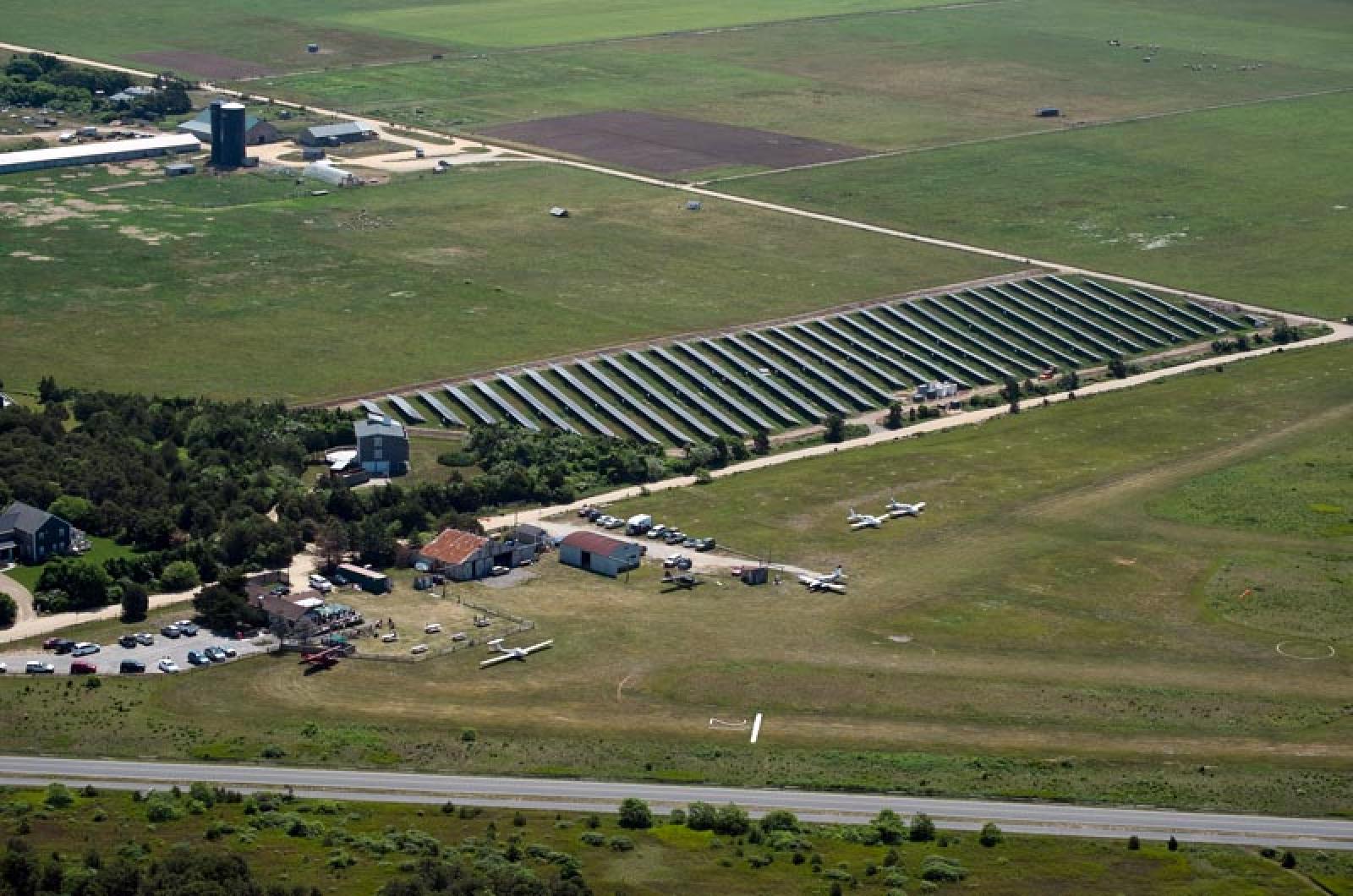
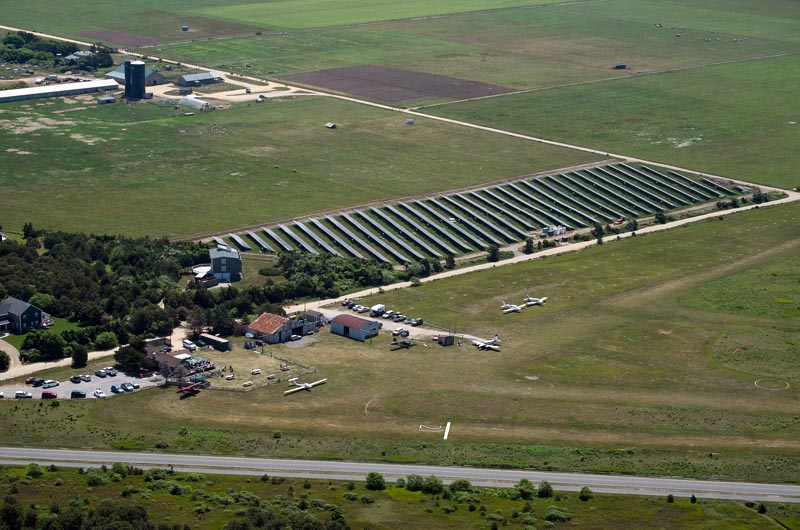
This is the largest operational municipal solar project on the Island, with two sites on town land, which together total 10.6 acres. Tisbury’s project at a capped landfill became operational last week.
The projects are managed by the Cape and Vineyard Electrical Cooperative, a group founded in 2007 to oversee renewable energy initiatives.
The largest of the two Edgartown projects is off Edgartown-Vineyard Haven Road in an area called Nunnepog, a Wampanoag name for Edgartown. That array, which occupies 5.8 acres and required the removal of trees and other vegetation, has been a source of concern for abutters. A fence was erected around the site, and trees were planted to obscure the panels, but neighbors have petitioned for taller trees and a darker-colored fence to block their view of the panels. The town has agreed to comply with the requests.
Largest of two Edgartown solar projects is off Edgartown-Vineyard Haven Road in an area called Nunnepog.
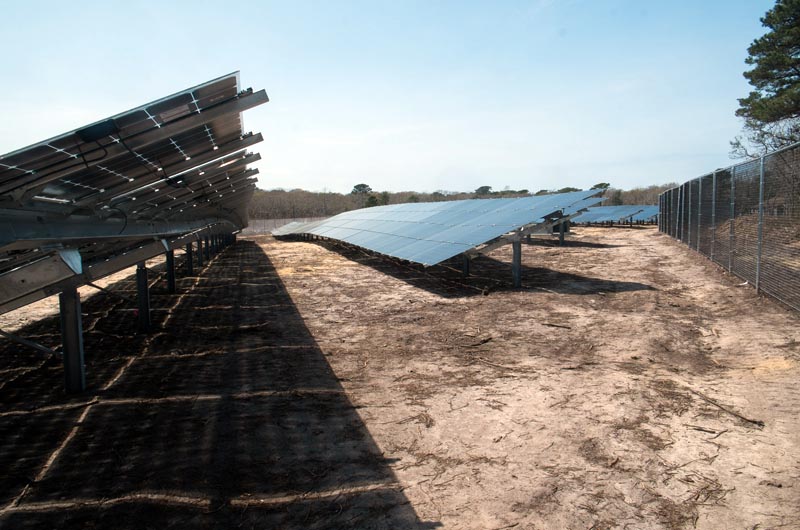
Largest of two Edgartown solar projects is off Edgartown-Vineyard Haven Road in an area called Nunnepog.
Out in Katama, the FARM Institute, a nonprofit teaching farm that leases the land from the town, lost six acres of grazing area to the solar arrays. In return, the town has designated an additional 14 acres for grazing purposes, which were originally going to be restricted to town use.
The town and CVEC have worked with neighbors to mitigate the impact of the projects, said Edgartown Board of Selectmen chairman Art Smadbeck.
“We try and do the best we can to fix it,” he said.
The seeds of the town’s solar efforts were planted in December 2010 when Edgartown residents voted unanimously at a special town meeting in favor of leasing land for renewable energy projects.
From the beginning, Mr. Smadbeck said he and his colleagues had an interest in generating green energy.
“We were very excited because what we were going to gain from it was not just participation in environmentally sound energy production but also more important, it was going to save money on the town’s electric bill,” he said.
But following the vote, the process of bringing the projects to fruition was fraught with obstacles.
“It was not a smooth road,” Mr. Smadbeck said. “It’s all new technology and there were a lot of players.”
When first exploring alternative energy options, the town considered solar and wind power options, but agreed that solar would be a more practical option.
“Wind is a great source around here,” said energy committee chairman Paul Pimentel. “The trouble is you have to get it up very high, away from the trees, and very big doesn’t go too well with people.”
In a study of possible locations for the solar arrays, 20 sites across town were considered, including the retired landfill on Meshacket Road. That site, though large enough, was not flat enough to support an extensive array.

Nunnepog solar array occupies 5.8 acres and required the removal of trees and other vegetation.
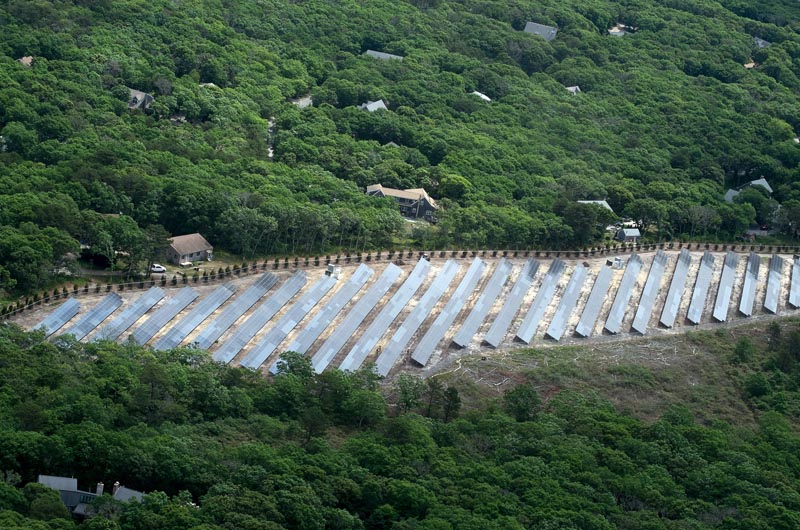
Nunnepog solar array occupies 5.8 acres and required the removal of trees and other vegetation.
The utility company NStar caused the worst of the delays, said Liz Argo, special projects coordinator at the Cape and Vineyard Electric Cooperative, in a telephone conversation this week.
“The biggest stumbling block has been the utility, and getting NStar to approve studies and plans and let these projects go to the second level,” she said.
In addition, she said all of the photovoltaic projects in the state have had to adapt to ongoing changes to the state incentive programs.
The contract with CVEC is for 20 years, but solar panels can last much longer, Ms. Argo said. In fact, panels installed at the Beverly High School in Beverly Massachusetts in the 1960s are still operational.
The power the panels produce is fed into the grid, offsetting the cost of the town’s electricity use. The panels will cover the town’s municipal load, with some energy left over to sell to other Cape and Vineyard Electric Cooperative members, like the County of Dukes County.
If all goes according to plan, in the first year the projects will generate an estimated $181,800 in earnings against the town’s electric bill.
Town selectmen say solar panels produce environmentally sound energy and could save money on town's electric bill.
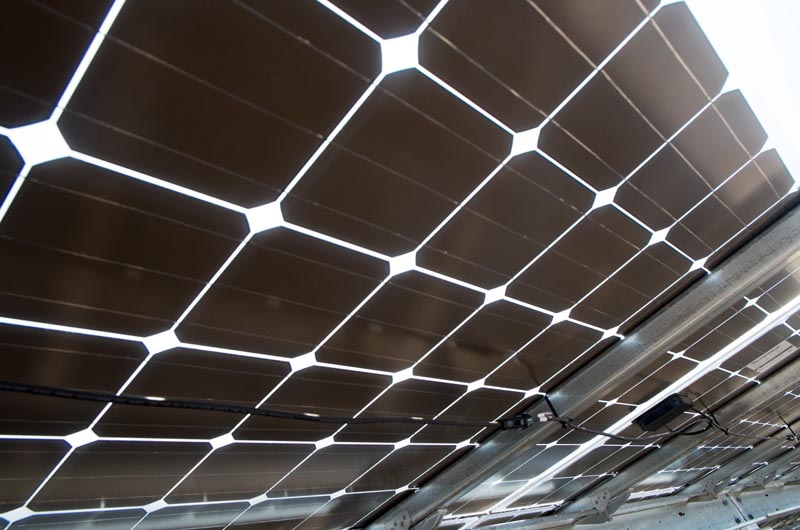
Town selectmen say solar panels produce environmentally sound energy and could save money on town's electric bill.
Mr. Pimentel has committed to evaluating the performance of the panels on behalf of the town.
“I will review the town’s numbers and make sure we are getting what we are expecting to get,” he said.
The location of Edgartown’s solar facilities near residential neighborhoods has also worried some residents.
Katama homeowner Judy Valentine, for one, is concerned that her property has lost value since the municipal solar project went in nearby. She built her house in 1986.
“This was a beautiful, pristine property that wasn’t going to be touched,” she said this week at her home. “The panels are the ugliest thing I can imagine.”
Though she attended one meeting of the town regarding the project, the decision to build the solar array “already seemed etched in granite,” she said.
Mr. Smadbeck said the use of a new technology always involves some risk, but it’s a risk worth taking.
“If everybody just said, I will wait and see what the next guy does, then no one would do it,” he said. “I was very proud that the town voted to do this.”
In the meantime, Ms. Valentine says she hopes the energy cost savings are passed along to the taxpayer.
“I hope they are going to make a lot of money and lower our taxes,” she said.
An a previous version of this article incorrectly stated that Edgartown was the first town with an operational municipal solar project. In fact, Aquinnah went live with their solar array at the capped landfill in January 2013, through an agreement with Vineyard Power. We regret the error.
Comments
I cannot wait to go solar
Bonnie Josephs 10beaxon avenueI cannot wait to go solar here on my home in OB!
I went solar on my home in woodstock, ny. I moved to ob end of January & am busy renovating interior. Soon as I as I am able I will be" going green" & go solar here on the vineyard!
Will this project completely
Douglas F Korves Edgewater NJWill this project completely eliminate the "rolling blackout" from town to town in high season.
That old custom of watching businesses close because the registers had no power and being able to see educated people and college students struggling to add and calculate taxes with a pencil. Dare we plug solar array in.
Katama has a long custom of radical projects starting with the original tribe burning the fields and to the Katama Dairy.
Who knows what birds and creatures may use the shelter of the panels for nesting and protection from hawks and osprey. Could it have saved Henry's beloved Heath Hen?
To the person worried about her land value, I bought a house on on the "paved part" of Meeting House Way in 1981 and did my walk around the "block" regularly enjoying the view across Hearing Creek farms to the dunes. Then they began the row of large "MacMansions" directly opposite the split rail fence.
I watched that farmer, with his tractor, grade a new pea stone private road with a 25 foot planting strip along side road for its complete length, 3/4 mile from the airfield to the farm entry at the pond to the west. He pulled baby pines, olives and cedars out of his field and planted them more and more for several seasons.
I asked him at the beginning of his labors what and why he was doing this? His reply was: "I do not want my ancestors having to look at those edifices! ". Note no comment about value, traffic, etc.
Go out there today and look at how nature and that farmer did shield the intrusion of "manifest growth". I now step inside his property and trespass on his his pea stone alley' when I walk. Thankee to him!
Aquinnah's Solar array went
Adam Wilson AquinnahAquinnah's Solar array went live well before Edgartown's...January of 2013.
What was the total cost of
Peter OB and MainlandWhat was the total cost of the project? and what is the estimated payback? Every article about solar or wind leaves these facts out. It would be helpful to rate payers to know what the cost/benefits are.
It amazes me to see land
Jason EdgartownIt amazes me to see land taken up by a project like this when we have plenty of roofs and parking lots (i.e. cronigs) that could be used instead. I guess it's all about money...one big swath of panels must make more sense financially. As to little creatures using the panels as protection from osprey, sure, whatever helps you sleep. I'm pro solar, just not like this. Hopefully this doesn't come back and bite us...
I agree, though I'm glad to
Carol formerly ChilmarkI agree, though I'm glad to see the big projects, too. We need a lot more rooftop solar. I have it on my house, courtesy of a so-called solar lease. Never a problem.
As long as we keep gulping
Mr. B ChilmarkAs long as we keep gulping power (and I know it isn't you, or me--it's "the guy behind the tree" in his McMansion), we are going to have to make concessions to getting it. You hate the look of panels. Well, you might like them far better than the giant windmills you see on some Vineyard "farms" nowadays. Or a new power plant dropped into Buzzards Bay. As a group, we have backed ourselves into these often unsavory choices.
By the way, what will the output of the array at the West Tisbury "dump" be?
Is the Farm Institute the
JOHN W OSBORN Edgartown, maIs the Farm Institute the only buffer preventing solar panels covering the entire farm acreage? Suppose no one wants to run a farm there any more. It is highly unlikely that the money generated by these solar panels will mean anything to tax payers. The better way is for individual property owners to invest in solar panels with the help of Town and State incentives. To really go green this is the key. Not taking valuable vineyard land.
Add new comment