

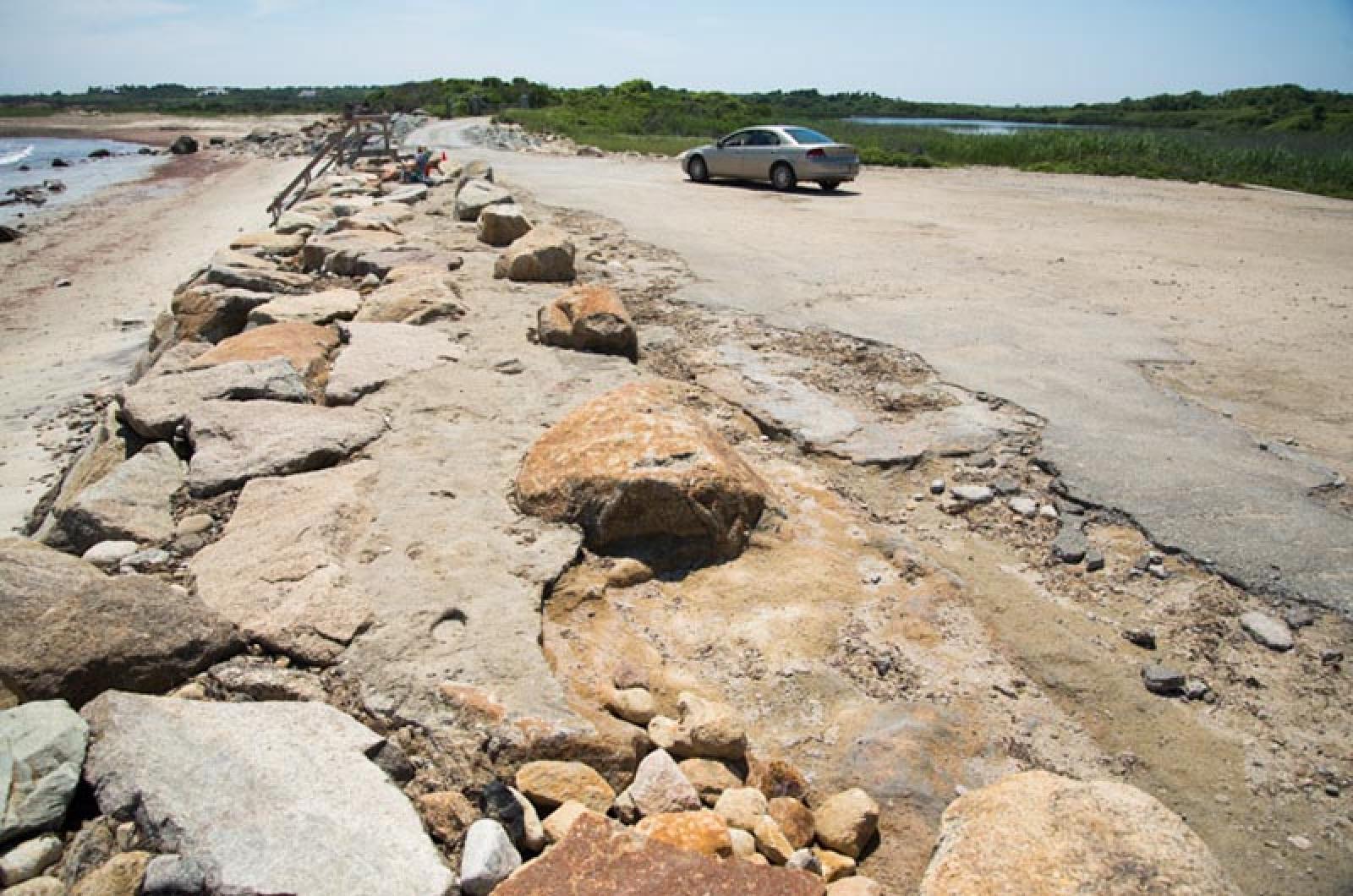
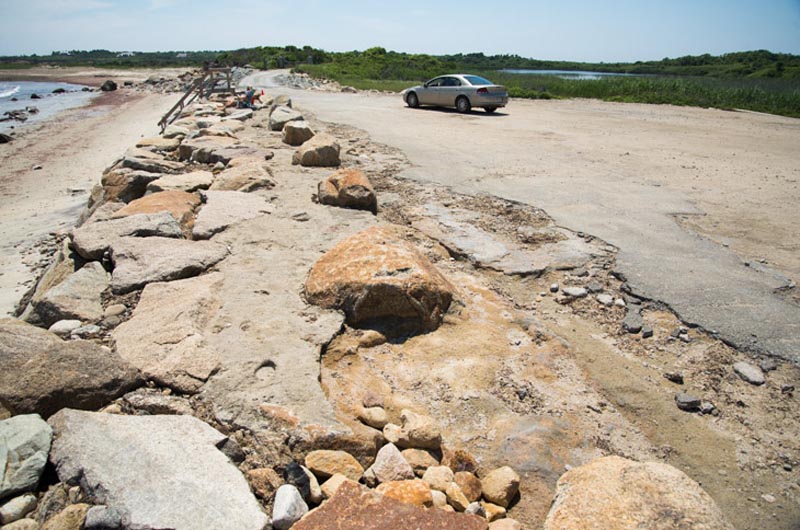
Facing an October deadline to complete its work, a Chilmark town committee charged with independently studying the best way to restore Squibnocket Beach is midway through its fact-gathering mission.
Facing an October deadline to complete its work, a Chilmark town committee charged with independently studying the best way to restore Squibnocket Beach is midway through its fact-gathering mission.
Since June, the committee has been meeting weekly to revisit the complicated issue of beach restoration at Squibnocket, which was ravaged by Hurricane Sandy in 2012. In late May the town learned it had received a $280,000 Hurricane Sandy Coastal Resiliency grant from Gov. Deval Patrick for beach restoration. The grant program is the first of its kind in the commonwealth, and Chilmark received the largest award.
But one month earlier town voters and taxpayers were sharply at odds over a plan developed by the selectmen to restore the beach and its lone access road. The road is also the only access to a development of private homes at Squibnocket Farm.

Squibnocket Beach restoration is complex problem.
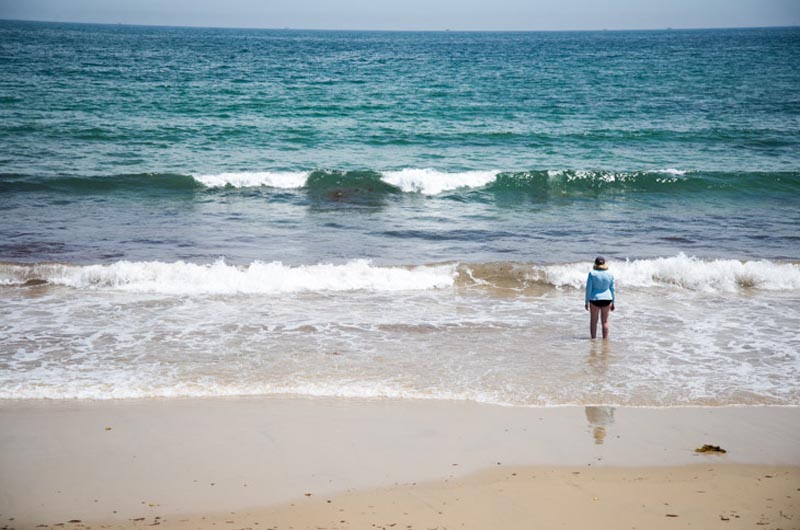
Squibnocket Beach restoration is complex problem.
At the annual town meeting in April, after debate that was at times bitter, voters narrowly rejected a proposal to allow selectmen to pursue a plan that included building a raised roadway, relocating and expanding an existing parking lot, removing a stone revetment and expanding the town beach an additional 1,000 feet.
The proposal was the result of a joint effort among the selectmen, the Squibnocket Farm Homeowners Association and the Vineyard Open Land Foundation that began in 2013.
At the town meeting voters agreed to approve the appointment of a new committee to look at alternatives to the town proposal. The committee has met six times since June 16. The public meetings are held on Tuesdays at 8 a.m. in the town hall.
Materials collected so far include an overview of existing documents and studies, consultants’ reports from the town project and letters from various stakeholders. Most of the documents are available on the town website.
On July 8, Charles Parker of the Friends of Squibnocket Pond, a group representing homeowners in adjacent Blacksmith Valley, presented a strategy for developing a new proposal. Mr. Parker provided an overview of the group’s design principles and its proposal for a detailed engineering analysis.
Committee chairman James Malkin has sent letters to neighbors and fishermen, as well as the town beach committee and the Squibnocket Beach Association, inviting them to make presentations.
On July 29, engineers who were involved in a Squibnocket Farm study in 2012 will present their original findings. Their recommendation at the time included building an elevated causeway spanning the existing parking lot, and building a new parking lot farther west. At the selectmen’s request, that recommendation was incorporated into their own study.
Lawrence Lasser, president of the association, said this week that the homeowners do not plan to immediately pursue their original plan to develop the raised causeway, although it would be within their right to do so, since the association owns the land.
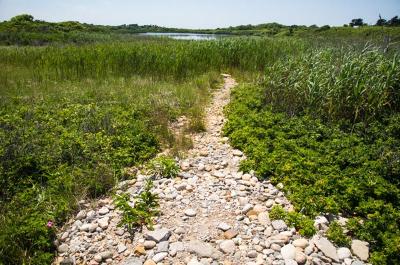
Topographical data will be used to develop a three-dimensional model of the area.
Topographical data will be used to develop a three-dimensional model of the area.
“We have withheld any action on our own in favor of working with the committee in the hope that they would come up with a plan which meets our criteria, and which also meets the objections of the adjacent, largely Blacksmith Valley, homeowners,” he said. He said he believed that opposition to the town proposal focused largely on the potential effects it would have on people’s views from their homes.
Mr. Parker acknowledged that views were one concern. “Views are a concern for everybody on the Vineyard,” he said. But he added, “There are other concerns that are as important in this whole equation.”
He said he believed the proposal that was rejected at the town meeting represented “the wrong strategy for our area.” The Friends of Squibnocket Pond have made progress since July 8, he said. Local engineering firms are continuing to collect data that will provide a “baseline for the analytic effort that we want to pursue,” he said. He expected a wetlands delineation map and the collection of topographical data to be completed this week. He said the Squibnocket Farm association conducted similar wetlands and topographical studies, which the Friends of Squibnocket later incorporated. “But we had to take it quite a bit further because our scope is broader than their scope,” he said.
The group plans to explore the possibility of creating a dune ridge that would help protect a new road or parking lot from erosion. Mr. Parker said the wetland studies would play a central role in determining the size and shape of the dune. The group favors a less intrusive roadway, and will look at the possibility of utility lines being separate from the road and buried farther inland for protection.
With erosion a constant threat, Mr. Parker added, “We don’t believe that it makes sense to have hard structures.” The group also favors the removal of stone revetments, which would allow the coastline to find its natural boundaries.
The topographical data will be used to develop a three-dimensional model of the area, which will help in visualizing solutions, Mr. Parker said.
In a letter to the committee dated July 18, Mr. Lasser stressed the importance of a timely solution. “It may be good in the abstract to explore every option, to include every voice and to research every finding,” he wrote. “But for the association, this is not a development plan to be pursued on a discretionary basis; it is a house on fire.”
The committee has no time limit on its work, but committee members hope to develop a recommendation in time for a special town meeting in October, and to have a final proposal by next April. The grant money must be spent by 2016.
Comments
And just where do you think
Lover of Squibby ChilmarkAnd just where do you think the sand will come from for this dune? The adjacent ocean? Disturbing the protective mussel beds hmmmmm? Is this the same Charlie Parker who wanted to put Rodeo in the pond? Now he professes to be a sensitive environmentalist? Am I confused, smelling hypocrisy or just money?
No house is on fire, thank
ann boyer middle road, chilmarkNo house is on fire, thank goodness. We need to take our time with this important situation, looking at it from all perspectives. It did not develop overnight, and could have been foreseen by Squibnocket Farms land buyers. Their anxieties and interests are not preeminent over those of everyone who wants to protect Chilmark and the island as a whole.
No public money for parking
billNo public money for parking lot and beach not open to the public! That grant money came from all taxpayers. Let the rich homeowners and people of Chilmark foot the bill.
The reality is that after
Steve McQuiggan ChilmarkThe reality is that after hurricane Bob in 1991 the revetment at the seaward facing side of the beach parking lot was improperly rebuilt and it actually contributes to the erosion along the water line. That section has repeatedly collapsed and has been repaired numerous times in the last two decades. Had they taken proper steps the last time the road to Squibnocket Farms was washed out, the beach would be more stable and in far better shape than it is today. A raised roadway or even a culvert under the road would have been the smart thing to do back in '92 when the whole road and lot had to be redone. The road and parking lot are all private property and while input from the town and its residents is a good idea, the last word should be given to the owners, not those who worry about their view being "spoiled".
I spent time there this past
mark c.I spent time there this past winter/spring. One evening in particular stands out. A good size storm high tide and wind were all happening when I approached the revetment...the wind and waves were hurtling rocks the size of softballs onto the parking lot and revetment . I had to time it between waves to make it through the gate. If this is the "new normal" it is obvious to me a new entry point away from the shoreline is necessary.
Add new comment