

<p>A hurricane outlook released by the National Oceanic and Atmospheric Association says the region will be seeing hurricane activity at normal or less than normal levels. The Atlantic hurricane season began June 1 and runs through Nov. 30.</p>
It could be a relatively quiet hurricane season on Martha’s Vineyard and the rest of the Atlantic Coast, if national weather forecasts are accurate.
A hurricane season outlook released May 22 by the National Oceanic and Atmospheric Association says the region will be seeing hurricane activity at normal or less than normal levels.
The hurricane season began June 1 and runs through Nov. 30. The Atlantic hurricane region stretches from the North Atlantic ocean to the Caribbean Sea and Gulf of Mexico.
NOAA’s Climate Prediction Center hurricane season outlook said there is a 50 per cent chance of a below-normal hurricane season and a 40 per cent chance of a near-normal season. The outlook calls for a 70 per cent chance of eight to 13 named storms, three to six hurricanes and one or two major hurricanes.
Seasonal averages call for 12 named storms, six hurricanes and three major hurricanes.
A named storm has winds 39 miles per hour or higher, while a hurricane is marked by winds 74 miles per hour or higher. A major hurricane has winds at or exceeding 111 miles per hour.
NOAA said there is a 10 per cent chance of an above-normal hurricane season.
“Current atmospheric conditions are not showing the typical precursor signals of an above-normal season, further reducing our expectation of an above normal hurricane season,” a NOAA press release said.
NOAA added that the hurricane outlook is based on large-scale climate factors that are known to influence seasonal hurricane activity as well as climate models that directly predict hurricane activity.
This year’s predictions take into account the likely emergence of El Nino, a weather phenomenon that causes unusually warm temperatures in the equatorial Pacific and thus impacts weather around the world. El Nino is likely to develop in the summer or early fall, NOAA said, and tends to suppress Atlantic hurricane activity. The NOAA press release said that predicting El Nino is a challenge for climate scientists. It is uncertain when El Nino will develop and how strong it will become.
Cool Atlantic sea-surface temperature and a strong El Nino could lead to hurricane activity on the lower end of the expected range, while warmer sea-surface temperature and a weaker El Nino would lead to the higher end of the predictions.
The 2013 hurricane season turned out to be below average, despite NOAA predictions for an above-average season.
NOAA notes that it only takes one major storm to cause a disaster, and the organization does not make predictions about whether hurricanes will make landfall. Whether a hurricane hits land can only be predicted within a few days of when the storm would hit.
NOAA said the hurricane season outlook will be updated in early August, which marks the beginning of peak hurricane season.
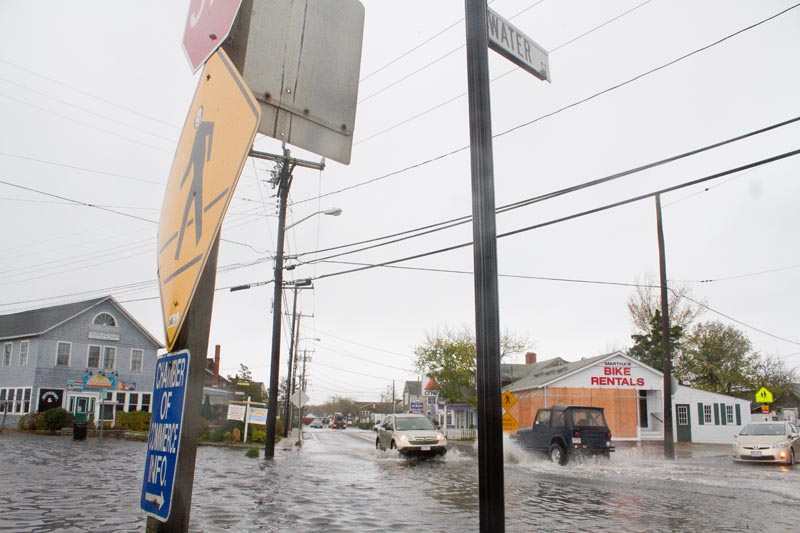
Hurricane Bob was the last named hurricane to make direct landfall on the Vineyard in August 1991. In late October 2012 the hurricane season closed with a bang as remnants of Hurricane Sandy roared across the Vineyard with hurricane-force winds and extreme flooding. Unoffically called Superstorm Sandy, the storm was the deadliest and most destructive of the 2012 hurricane season, wreaking devastation on the New Jersey coast and in New York city.
Comments
Whether or not we get a
tom hodgson wtWhether or not we get a hurricane this year, or some other year in the future, it's a sure bet that one will come. Don't let a forecast of a low-intensity year keep you from reviewing your preparedness during this pre-storms time of year. If a storm gets near, last-minute hunts for batteries, etc., can take time away from far more important tasks.
Anyone that has lived in
Ken Esq EdgartownAnyone that has lived in Florida knows that these long-term forecasts are wrong 90% of the time. It's really important to have a plan you can put into action in the event a storm starts tracking towards your home. It's even more important to be ready living on an Island.
Consider Flood insurance. It
Leslie OBConsider Flood insurance. It's not great but it's better than nothing.
Add new comment