

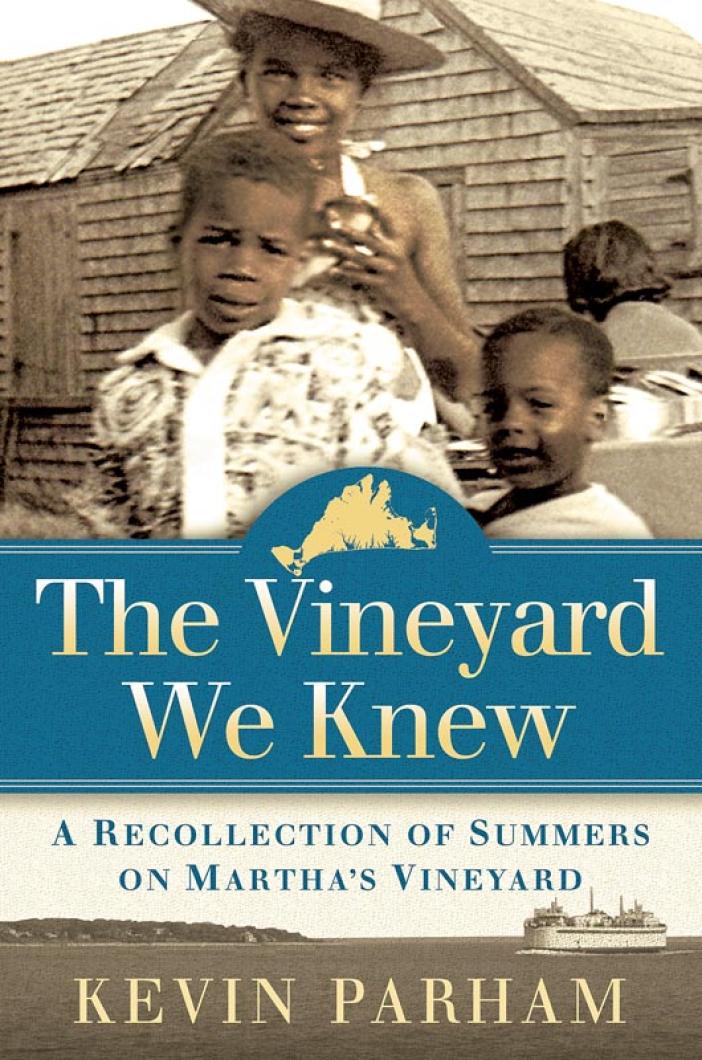
Kevin Parham’s new book, The Vineyard We Knew, certainly dispels the long-held stereotype that all of we African Americans who inhabit Martha’s Vineyard are rich, famous or both.
The Vineyard We Knew — A Recollection of Summers on Martha’s Vineyard, by Kevin Parham, Pria Publishing, 298 pages, soft cover.
Kevin Parham’s new book, The Vineyard We Knew, certainly dispels the long-held stereotype that all of we African Americans who inhabit Martha’s Vineyard are rich, famous or both. Or that we who share the now popular resort are as monolithic as widely believed. Full disclosure: I was part of that lucky gene pool of the few black people in the 1950s who didn’t grow up deprived and got to spend entire summers on this enchanted Island. Kevin was raised — in his words — in “a close knit African American community a few miles northwest of Boston,” one of three children with a single mom. To a small but disproportionately large number of us able to say we summered in Oak Bluffs, a single mom was one who spent the week waiting for the daddy boat to bring him over on Friday night and return him to America Sunday night. Kevin and his siblings and many much-loved cousins spent summers with Nana — and the mommy or daddy boats were few if at all.
Another disclosure: Kevin and I barely know each other. Kevin’s family have been Vineyarders since the 1930s. Kevin was 10 months old when he came for the first time in 1955 — the same year as my family, except I was six. By the time he was 13 years old, I was almost a grown man at 19 — accounting for why we twain never met and dispelling another notion that we black people on the Island all know each other. That may sound foolish but, as a columnist for the Vineyard Gazette, seriously, I get letters, emails and phone calls from journalists and other black people asking me where they can meet us — as recently as the day I write this.
Mr. Parham’s poignant book is filled with memories remarkably similar to mine — where we went, what we did, popular activities and places shared, wonderful memories of summers in a place close to paradise. We’ve picked the same blueberries, eaten the same apples and pears, found the same doughnuts, caught the same crabs (in the same places), dug the same clams, traveled to the ends of the Island, ridden the same bike paths and joined adulthood with unsupervised trips at an early age to Circuit avenue.
But the similarities end there. I didn’t have to live in Nana’s house with her stern rules and corporal punishment. Although she was obviously respected by young Kevin, it’s painfully clear she ruled by fear. Nana wasn’t the most popular character in the book to me — that’s the kindest way I can express that. She was a part of Kevin’s life though, an important one as you will see when you read his book.
His is the first I’ve read with an accurate portrayal of the life we led, privileged to spend summers on Martha’s Vineyard, some of us more than others. Many black summer friends of mine with nuclear families would have been characterized as less than middle class, something not widely acknowledged. While The Vineyard We Knew changes the perception, it also portrays the value of family to we fortunate ones, both the haves and the have-less. Kevin’s book will simultaneously raise eyebrows and lower expectations with a true and personal picture of growing up black on the Island.
— Skip Finley
Comments
Thank you for bringing this
Caroline Flanders West TisburyThank you for bringing this book to the fore. I am so glad Mr. Parham has written it. Simply sharing race or ethnicity with another does not, by itself, mean that you also share the same perspective or familiarity of experience. Of course the African American experience on the Vineyard is a diverse one, as is the Brazilian experience and the white experience, etc. Racial & ethnic stereotypes are uncomfortable and sometimes controversial to discuss. But they are real, and they are harmful to the Vineyard community. They breed fear, disparity, and sadness. That’s why it’s important for Mr. Parham, and you, to talk about your individual experiences. Because that’s what breaks down such stereotypes and, hopefully, leads to better understanding and reduced segregation among every racial, ethnic & economic group that lives on and loves the Vineyard.
Somewhere along the road of
obporch obSomewhere along the road of childhood and adult shared memories, bike runs, aimless days moving from Pay to State to Long Point to Jungle beach, ending the day wandering on Circuit ave/AC journalists suddenly declared that we were elite! We were kids doing kid things, now adults still doing kid things with those same kid/adults. We are not elite - we just refused to grow up! Your book says it all. The journalists however don't 'get it!'
Exactly, I am 44 and ride a
Kid At Heart On the BeachExactly, I am 44 and ride a skateboard to the Inkwell. The Vineyard allows you to still be a kid. Ignore all the rest and just play in the sand.
Even today, we have people
Dee HamdenEven today, we have people like Mr. Purham who visit the Vineysrd every summer. Why? Because they work hard and want to be around liked minded people, To also enjoy the intellectual / literary community, recent jazz, and the wonderful feeling of being spiritually free. Although, many people, some being African American can be very rude and pretentious. This book will shed light on the commonality of we can all do the same thing without all the titles! Enjoy the magic of the island as my daughter and I have done for over twenty years and hopefully, she will do the same with her family.
Why only recent jazz? Just
Jazzman OaklandWhy only recent jazz? Just curious.
In recent years on the
Dee HamdenIn recent years on the Vineyard several Jazz Festivals have taken place at various venues on the Island. Past two summers and Jazz on the Vineyard...other than private parties with jazz artist. Ck the chamber schedule. Other than the Newport Jazz Festival that had been around for years!
Add new comment