



There are 140 nonnative English speakers in the public schools across the Island, the highest count in recent memory. Most are second generation U.S. residents. Educators are responding by setting a standard for excellence in learning.
The small hand of fourth grader Victoria DeMatos shot into the air. “I have a question,” she said, commanding the attention of the teacher, Shannon Carbon. “Shuns, is it, t-i-o-n-s?”
Answering in the affirmative, Ms. Carbon began to read aloud the story, The Nights of the Pufflings, which describes the efforts of Icelandic Islanders to care for the puffin chicks that get lost in their village.
Words were discussed; hand gestures illustrated their meanings: burrows, speckled, surf, cliff.
“When I was learning about mythology, Hera threw her son off a cliff,” Emanuelly Nascimento informed her peers in clear English.
That same fourth grader did not speak three words in English last May when she entered the Tisbury School.
She’s one of 45 students at the school who speak more than one language, and one of some 140 nonnative English speakers in the public schools across the Island, the highest count in recent memory.
“We are at the highest level we have ever had,” confirmed Leah Palmer, director of the Islandwide English Language Learner (ELL) programming in the public schools.

Vocabulary words hang from the whiteboard.
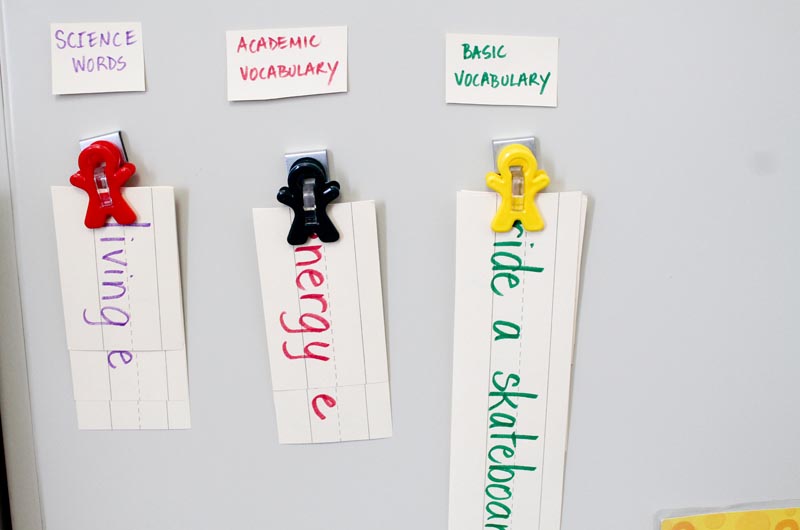
Vocabulary words hang from the whiteboard.
A total of 128 students enrolled in public schools are native Portuguese speakers.
And most are second generation U.S. residents.
Their families come from Brazil, Jamaica, France, Spain, Uruguay and Thailand.
And there are more to come. Currently, 39 ELL children are enrolled in childcare centers Islandwide, and it is believed that many more spend the day in home care situations.
One of 18 ELL kids at the regional high school, Chanaporn Eksiri gladly gave up her Thai uniform for a Vineyard Basketball T-shirt and jeans when she enrolled last year.
Her biggest hurdle here is English, a language with many unfamiliar sounds.
She spends six hours per week with ESL (English as a second language) teacher Dianne Norton, who helps her in all her academic subjects.
Outside of the ESL class, Chanaporn’s other teachers also help her to keep apace with the rest of the class.
“In math class, if I don’t understand, the teacher comes and tries to explain it to me,” she said.
Soon, however, the ELL coordinators won’t be the only ones required to prepare for class with kids in mind for whom English is a second language.
For many years, the Island schools have trained educators in teaching speakers of other languages. But the Island has historically been ahead of the curve, Ms. Palmer said.
In 2011, an investigation by the U.S. Justice Department found that on the whole, schools in the commonwealth were not serving the needs of the English language learner population. Specifically, the state was not doing enough to equip teachers to teach students with limited English proficiency, and reduce the achievement gap between those and mainstream students.
In response, the state Department of Elementary and Secondary Education passed new regulations called Rethinking Equity and Teaching for English Language Learners (known as RETELL) in 2012.

Teacher Shannon Carbon discusses words with student Nicholas Perini.
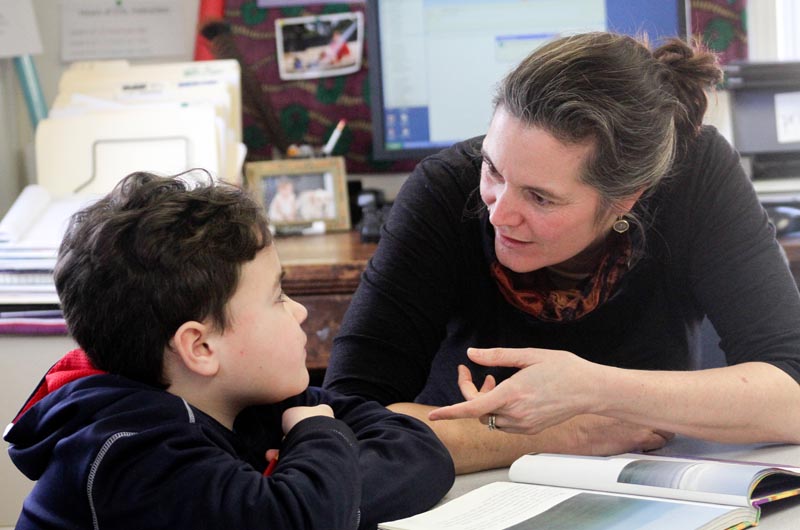
Teacher Shannon Carbon discusses words with student Nicholas Perini.
The regulations dictate that by July 2016, all core academic teachers who have at least one ELL student in their classes must undergo specialized training. The regulations also mandate training for the principals, and assistant principals.
This Sheltered English Immersion (SEI) training will be offered to Island teachers and administrators beginning in the fall.
While primarily focused on helping students acquire English language skills, the ELL staff also values the linguistic heritage of the Brazilian student community.
“I made a concerted effort to call myself the teacher of children who speak two or more languages,” Ms. Carbon said after her students had scampered off to their next class. “If you have both Portuguese and English, it gives you so many more choices in this life,”
Some parents enforce the use of both languages, and some parents do not, she said.
Many take ESL classes themselves, but tend to gravitate towards people they are similar to and share common experiences with, just like any other group, Mrs. Palmer said, which can limit their English-speaking fluency.
For Ms. Carbon, nurturing her Tisbury pufflings means equipping them with the language skills they need to safely set sail.
“My goal is for them to go to college, have the opportunity to choose whatever they want their future to be,” she said.
An earlier version of this story incorrectly reported the percentage of Ell students who are second generation U.S. citizens. The story has been changed.
Comments
If 84% were born in the US
Amy EdgartownIf 84% were born in the US and 21% immigrated from Brazil, plus the "remaining" are from other countries? This does not add up.
Thanks to the reader, the
EditorThanks to the reader, the story has been changed and we're checking our numbers.
English as a SECOND language!
American soldier Oak BluffsEnglish as a SECOND language! All our soldiers must be rolling in their graves, I know this living soldier is.
What language did your
MLP FalmouthWhat language did your decendents speck?
Many older generations who
Dan ObMany older generations who fought for our flag and our freedoms were happy to 'give up' their native tongues/flags to become a part of the greatest nation on the planet. The majority left the old countries because it was a place that couldn't provide for their families, and when they landed in America, land of opportunity, they found that they were able to provide a good life for their families, and strived to make the country greater than it had been before. Many denounced their old citizenships to become american. They were proud to be american. Now, to me it seems many immigrants today are still leaving their countries looking for a better way of life, and it is still being found on the shores of America. however, I feel the new wave of immigrant is not so eager to become an American in the traditional sense, but instead looks to fly their old country flags and speak their old country language. They don't have to denounce their citizenships, and much of the money they make here is sent back to support family in the native country. For the few families that are now lucky enough to become american citizens, and raise families in the states, it seems they still hang on tightly to the old traditional ways. And honestly, why shouldn't they? The problem with most Americans is that we are so far removed from our immigrant generations that we lose the old identity, and his will happen over time with the Brazilian population. Their children will fight in wars and defend our borders, speak English, create jobs and grow the economy. It's the way it's always been. New blood in America is as old as America itself. I think in future discussion, it's important we separate the immigrants who 'do it right' from the illegals throwing money out if the country. There is obviously a giant immigration reform needed in the country and discussion about the facts is a good starting place.
From what I know and have
Katama GirlFrom what I know and have read in history class here at MVRHS 99.9% of immigrants came to America back in the day Legally! Those who had issues were sent back. That is not the fact today and my guess is the 15 million plus that they admit to being here not only have come here Illegally, have been violating our laws, sending tax free dollars out of the country, repopulating, are filling our schools, hospitals and court systems to their braking points all om my tax dollars and my children's!
BTW even the indians came here as Martha's Vineyard use to be 2 1/2 miles under solid ice before they arrived just sayn!
kayla so proud of you and
Maria Vineyard Havenkayla so proud of you and congratulations to all the children who are growing up with 2 languages great future!!
These stats are not what I
Native Nam Vet Gay HeadThese stats are not what I served my country for! As a combat veteran and a native (yes, my family dating back to the Wampanoag Tribe of Gay Head) I am very upset what our country and our island has turned into.
We lost our native language many years ago and now this! I personally could not be more upset and the main problem is it can never be reversed on our island nor our country. Liberals have destroyed our nation and the conservatives have not had the gonads to save it! GOD BLESS our volunteer military!
I am rolling with you
US Soldier TexasI am rolling with you American Soldier. It is a disgrace for anyone to refer to English as a SECOND language in America. Have anyone ever heard of Mexico (spanish); Brazil (portuguese); China (mandarin); Pakistan (farsi); France (french); Germany (german) as second languages in those countries? Never! What's worse, they learn it at taxpayers dollars. Can our children travel to another country and demand to learn the language of that country at their taxpayers dollars and call it a SECOND language?
US soldier, you are so right.
Truthteller CAUS soldier, you are so right. I have lived in other countries and not one country provided me anything in English, it was my responsibility to learn their language, their country, and, by the way, this held for all contracts, as well, so one had to learn quickly.....thank you for your service..
I don't disagree with you but
Dan ObI don't disagree with you but hope to look at it a different way. We speak English, because we were colonized by England. Had it been Spain, we would all speak Spanish. Had it been France, we would speak French, like they did in New Orleans. If it so happens that 60% of America is of Spanish or Hispanic decent, it makes sense that we will all be speaking Spanish. The real question is, why are we allowing some many new immigrants, many of which have no education or job skills, into the country? Canada for instance requires a six-figure job, already established, and at minimum a bachelors degree. I think it's time we raise our immigration standards.
I guess it takes a brave
Voice of Reason MAI guess it takes a brave soldier to anonymously malign children.
While I appreciate the
ESL TeacherWhile I appreciate the passionate reactions, I want to assure everyone that referring to English as a "second" language does not indicate any loss of status on the part of the language. It simply means that, for these particular students, English is not their native (or first) language. If an English speaker went to China and learned Mandarin Chinese, they would absolutely be learning Chinese as a second language.
SEI means the child develops
Maria SansaloneSEI means the child develops literacy in both languages, or more! It serves to strengthen the individual and the quality of citizen the U.S. is offering the world.
I have read through all of
AnonymousI have read through all of the comments, and I have to say: I am surprised.
If you cannot use your critical thinking skills (your brain) to understand *why* English is referred to as a *second* language, then you should probably consider going to university to study for a bachelor's degree or a master's degree.
If you think paying for education is not worth it, then at least go to the library and read books on education, language teaching and learning, and philosophy.
You wouldn't want a mechanic giving you a health diagnosis, so people don't want to hear misinformed comments. Such comments just make you look really ignorant to the reality of the situation.
And for the record, Pakistanis do *not* speak Farsi. Get your facts, and more importantly knowledge, right.
Urdu, Farsi, Punjabi...does
Sandi OBUrdu, Farsi, Punjabi...does it really matter what they speak when America is becoming a country without language, culture and borders? You better educate yourself and do it quickly or you will forever remain Anonymous!!!
Add new comment