

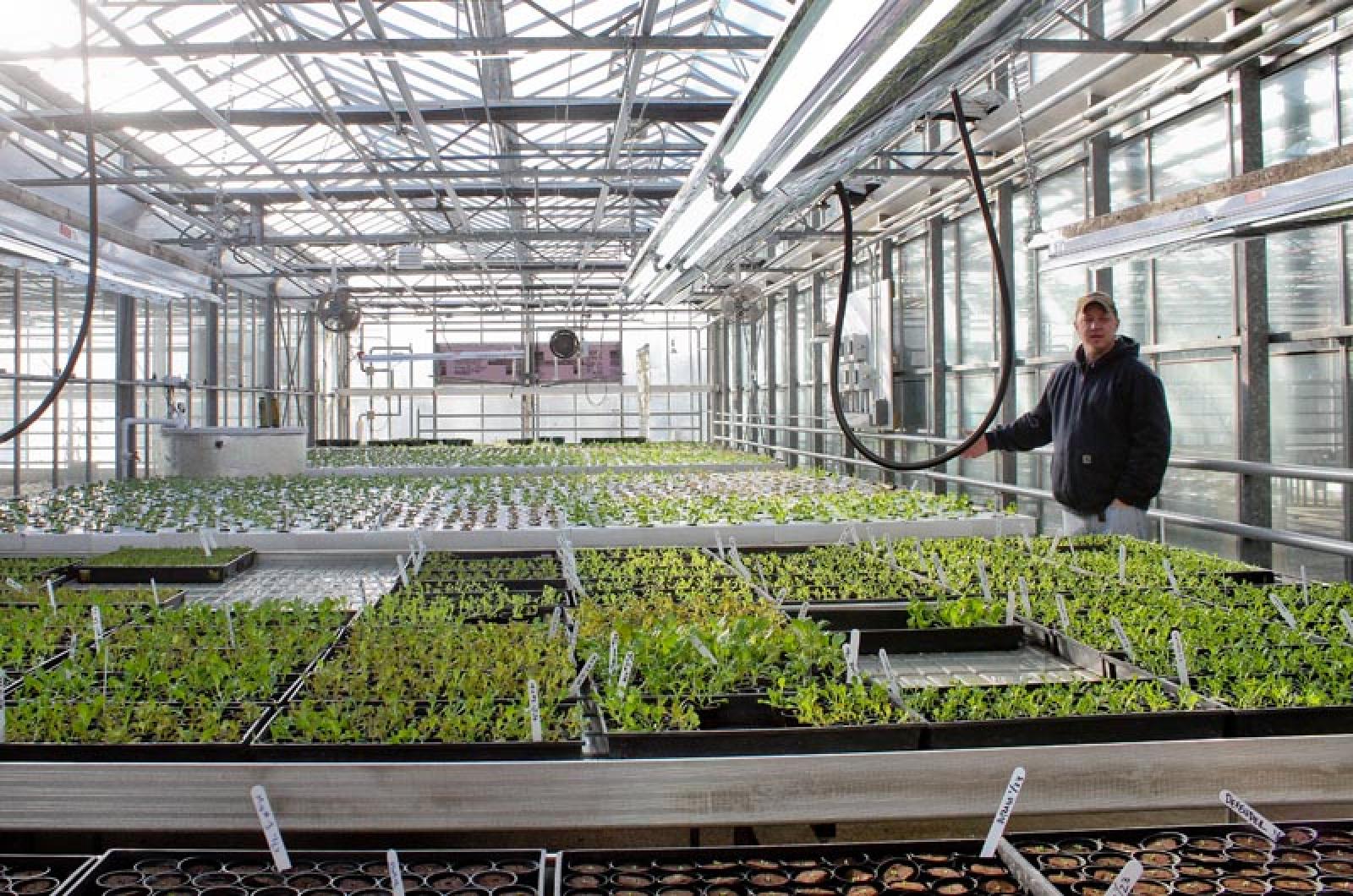
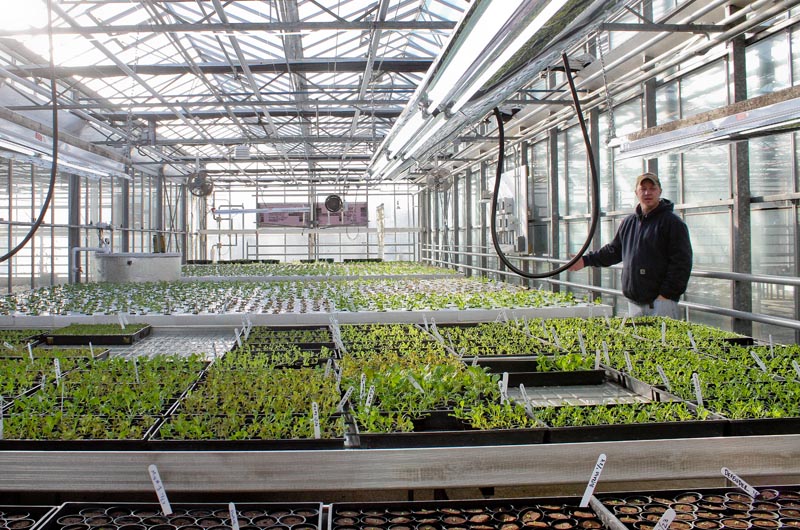
A 33,000-square-foot hydroponic greenhouse is the centerpiece of the new Island Grown Farms, a planned campus-style educational farm under the Island Grown Initiative.
In its first winter in production the Island Grown Farms greenhouse has been harvesting up to 100 pounds of salad greens a week for Island schools and restaurants. The 33,000-square-foot hydroponic greenhouse is the centerpiece of the new Island Grown Farms, a planned campus-style educational farm under the Island Grown Initiative. But with hydroponics, a farmer isn’t bound by terra ferma limitations.
“What you’re looking at is square footage,” manager Keith Wilda said. “I like to build things in 3-D.”
Future plans call for large fish tanks housing rainbow trout, which will in turn supply the water for the plants. The water will go through several filters, separating the nutrients from the waste water, and back into a filtration system that will be used as the primary water source for the vine crops. By May or June, the plants will be fed only by the fish, Mr. Wilda said.
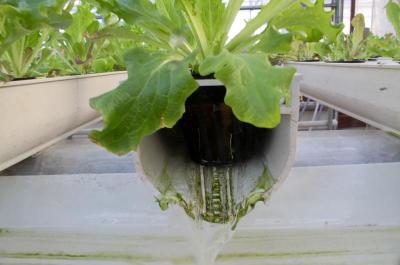
The plants grown inside the greenhouse never come in contact with fertilizer. Their nutritional needs are supplied through the irrigation water.
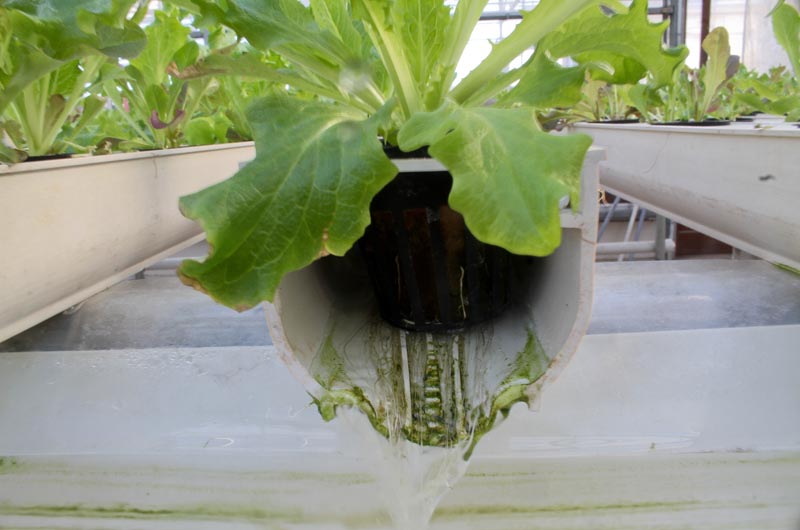
The plants grown inside the greenhouse never come in contact with fertilizer. Their nutritional needs are supplied through the irrigation water.
And everything will have layers. On the upper level of the fish tanks will be more plants. There will also be hanging plants in the seeding room. In the summer months there will be second tier of lettuce over the grow tables and mushrooms will be grown underneath.
Island Grown Farms will present an updated concept plan for the farm to the public on Feb. 8 from 10 a.m. to noon at the Oak Bluffs library. Future plans also call for building a slaughterhouse with in-vessel composting unit, a commercial kitchen, three farmer homes with apprentice dormitory-style worker house, a grist mill, office and distribution center. Acreage will also be leased for farmer tenants. The farm is accepting applications for a half-acre community garden which can be expanded into two acres. Educational programs are being developed and horticulture students at the Martha’s Vineyard Regional High School are already making weekly visits.
There will be no retail establishment at the farm. All product will be distributed on a wholesale basis.
The harvested food goes first to the West Tisbury School, the high school and the Martha’s Vineyard Public Charter School. It is then sold to the Tisbury Farm Market, the Harbor View Hotel, Lucky Hank’s, Tisberry Frozen Yogurt, and lastly Cronig’s Market.
Competition with farmers was an early concern among Island growers, but Mr. Wilda said that will not be the case.
“We’re going to fill in where the farmers haven’t,” he said. “We may go into markets they’re going into if the market isn’t completely filled with their products. We’re not going to compete with the farmers. Our price points are no lower than what a farmer would charge.”
Getting the greenhouse up and running has been a top priority for Mr. Wilda, who has a long background in building hydroponic greenhouse operations. The plants are seeded, placed in a germination chamber for three days and then placed on the ebb and flow tables. The tables are on a timer and water floods in and out. “Just like being on an Island,” he said.
“These plants never see topsoil irrigation and only get irrigated from the bottom. That means no fertilizer ever gets in contact with the plants.”
The greenhouse uses only organic fertilizer, he added.
The seedlings stay on the ebb and flow tables for two or three weeks, and then are transferred to the grow room. The grow room houses nutrient film technique tables, which have a constant flow of water 24 hours a day. The greens are planted in peat moss plugs to retain moisture.

The greenhouse grows around 100 pounds of lettuce a week.
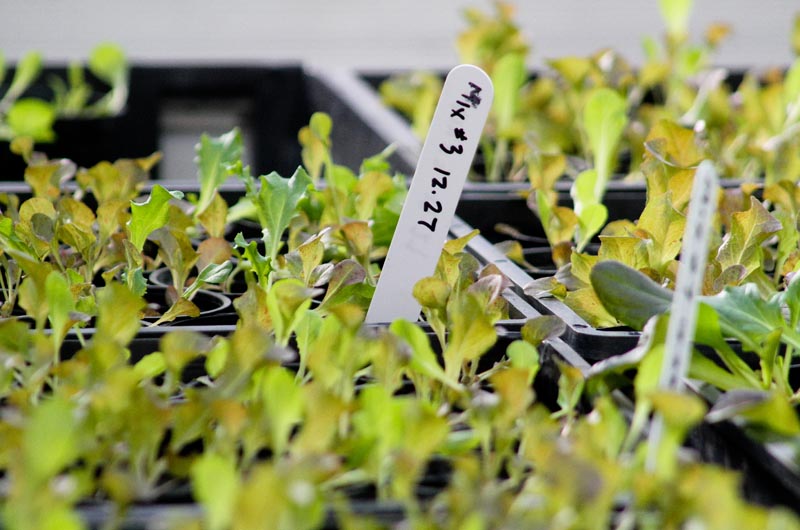
The greenhouse grows around 100 pounds of lettuce a week.
There are eight to 12 varieties of lettuce, chard and kale. Staff were harvesting anywhere from 80 to 100 pounds of greens a week in the fall and 60 to 80 pounds in the colder months. The greens are hand cut with scissors (pickers wear latex gloves) and directly bagged. The lettuce does not need to be washed.
Cucumbers, tomatoes and peppers grow in the vine room. There are 400 tomato plants and 250 peppers, and 50 cucumber plants will be donated from the high school. And strawberries are planned for April or May.
“What are things that we can grow in the greenhouse that aren’t being grown on Island?” Mr. Wilda said. “Nobody is growing strawberries in large quantities.”
The farm has a storied history of strawberry growth, from original farm owner Bud and Patricia Moscow, who grew berries along with hydroponic tomatoes, to the Whippoorwill Farm CSA strawberry patch. Mr. Wilda visited Nourse Farms in Whately to buy strawberry roots, the same farm where the Moscows used to buy their roots.
With no soil touching the leaves and no salt air, it begs the question: does it taste differently?
“Yes . . . I think it tastes better,” Mr. Wilda said, smiling. “We’ve done a shelf life test on our product . . . and there is lettuce that is three weeks old that tastes like it was picked today.”
Comments
Thank you for the article.
WinstonThank you for the article. An exciting concept. What are they going to feed the rainbow trout? Can they raise mayfly, caddis, stonefly and the like? A farmed trout fed something other than Purina fish chow would be an excellent addition to the output of this farm.
There’s a lot to like about
Helen ParkerThere’s a lot to like about what’s happening at the new Island Grown Farms. Unlike the IGI piece in last week’s MVTimes, however, this article makes no mention of plans for solar and wind energy systems at the Farm. Staying on top of IGI’s plans in the early stages is preferable to the big surprise, as many reported when the MGF wind turbine went up.
The FAA recently was asked to give a “flight obstruction evaluation” for two 170' tall wind turbines at this location. These spinning, strobing towers would be 20' taller than the MGF and Allen Farm [E3120] turbines, and would be sited less than 500' from the nearest home.
While these are not the 400’ (1.5MW) turbines such as we see in North Falmouth, the smaller turbines also have repercussions which extend beyond their property or even immediate neighborhood. The Woods Hole Research Center turbine to the left as you head north out of Falmouth, is a 150’ tall Northern Power Systems’ Northwind 100(kw).
See the January 31st article in the St. Albans (VT) Messenger which reports on health impacts of the Northern Power Systems “121’ tall” 100kw turbines: “STATE PRISON: Turbine Plan Fans Health Issue”:
http://www.samessenger.com/state-prison-turbine-plan-fans-health-issue/
See also in Nantucket’s ‘Inky Mirror,’ 2-9-2012, where a neighbor 750’ from the 100kw Nantucket HS turbine complains of accelerated heart rate, vertigo, dizziness and headaches: http://www.ack.net/healthimpacts020912.html
In 21 locations across Massachusetts, people living close to wind turbines are reporting health problems they didn’t have before the turbines went up.
http://www.capecodonline.com/apps/pbcs.dll/article?AID=/20130926/OPINIO…
And they’re finding that once the turbines go up, it’s very hard to get them to go away.
What actually causes me an
George NEPAWhat actually causes me an accelerated heart rate, vertigo, dizziness and headaches is when hypochondriacs complain about these symptoms claiming they are coming from a wind turbine 750 feet away! Most likely their symptoms are coming from either jealousy that they cannot afford alternative energy or they just do not want to look at it near their prissy property! The majority of the rest of these type claims are most likely disseminated by the filthy oil and coal barons that despise the idea of anyone clipping a percent or two from their multi-trillion dollar piggy banks! They won't be happy until every last waterway, fish and blade of grass are dead. Only then will they realize they can't eat their FIAT currency. If someone ever complained about a wind turbine on my property causing them medical issues from 750 feet away forcing me to remove it or other major hassles I would install a 2500 watt commercial microwave oven magnetron inside a tuned communications wave guide and focus that on their home from inside my attic and see what symptoms long term exposure to 2.5GHZ microwave radiation has on them! JK, At least then they might actually have some actual symptoms. lol
Add new comment