

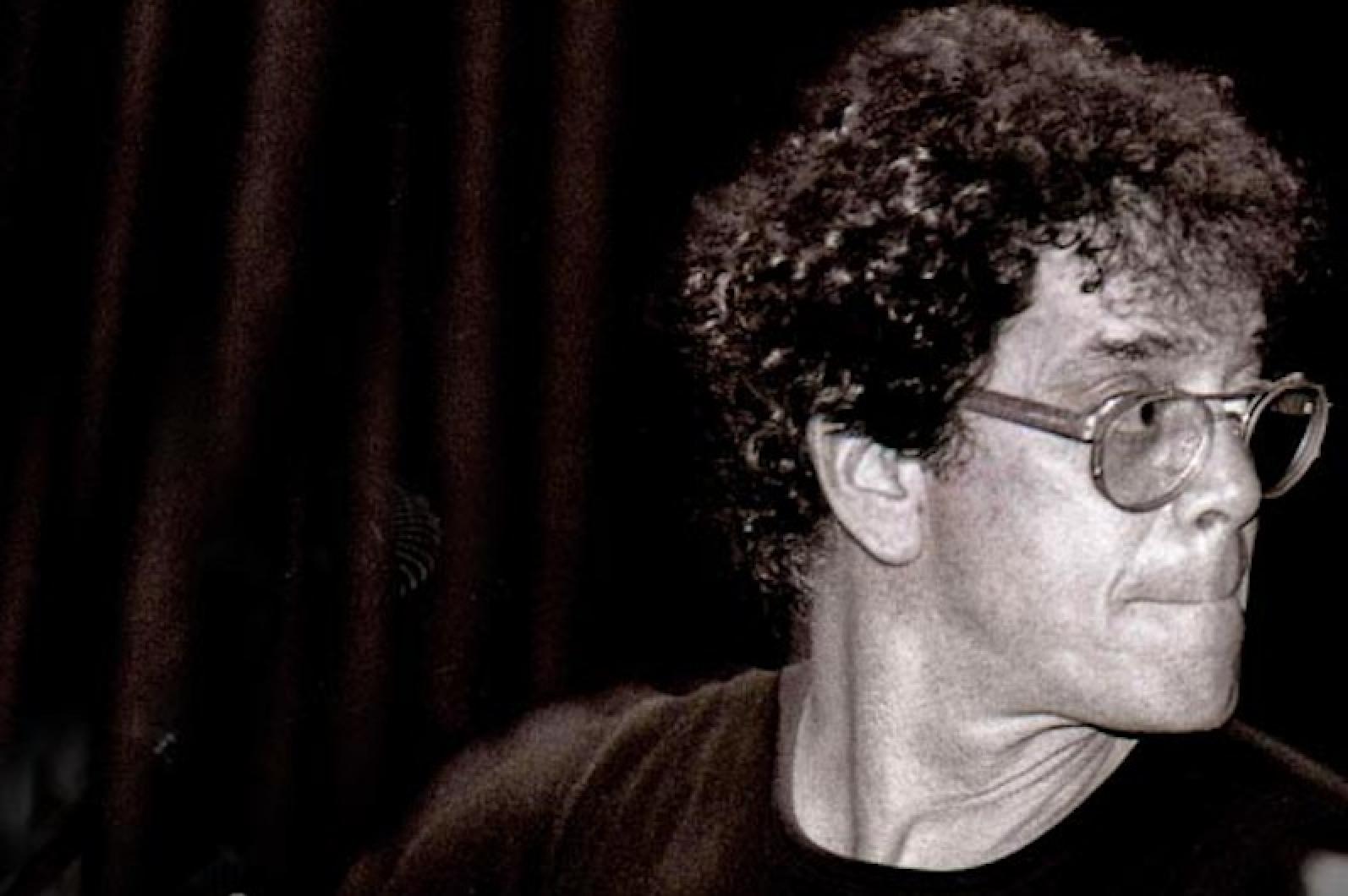
When Lou Reed arrived at WMVY in the early morning of Oct. 12, 1997 for an interview, there was a rooster in the tree next to the front door.
When Lou Reed arrived at WMVY in the early morning of Oct. 12, 1997 for an interview, there was a rooster in the tree next to the front door. I had seen the rooster around before and I thought, “There’s that rooster.” Lou saw it as we greeted each other outside and he said something like “I love that, a rooster in a tree!” It was a funny, and a very Vineyard kind of icebreaker.
When I heard the news last Sunday that Lou Reed had died, the memories of that morning came flooding back and I felt lucky that I had met him and had the chance to talk with him about his music. It was a relaxed, sweet and thoughtful conversation.
Lou was on the Vineyard to play at The Hot Tin Roof. The club had called earlier in the week to see if we wanted to have Lou stop by. “Are you kidding? Yes!” I said. But whoa, interviewing Lou Reed, one of the most influential figures in the history of rock and roll? It was time for some shaking in the boots.
I was pretty nervous that Sunday morning, but ready. Lou and I were standing in the production room where we would do the interview and I could tell he was sizing me up. After all of his time in rock and roll, he had been face to face with many interviewers, some good and some bad. Just as he was wondering which kind I was, I wondered which kind I was going to be that day, too.
“You’re in charge here,” he said finally, surmising that given his stature it was most likely the program director or another station veteran standing in front of him. It was more of a statement than a question. I nodded. We’ll see, I thought.
When I sat down with Lou Reed that day in 1997, he had been actively writing and playing music for over three decades. Early on he became interested in doo-wop, rock n’ roll and rhythm and blues. In 1964 he graduated with honors from Syracuse University where he had studied poetry under poet Delmore Schwartz.
After graduating from Syracuse he moved to New York city and soon formed The Velvet Underground. Andy Warhol produced their first album The Velvet Underground and Nico. The band went on to make three more records, the last of which was Loaded released in 1970, which included the songs Rock and Roll and Sweet Jane, the most commercially successful songs for the band up until that point and to this day two of the most enduring Lou Reed songs.
After The Velvet Underground broke up in 1970, Reed started a solo career that would take him through the next four decades. His second solo record Transformer, produced by admirer David Bowie and Mick Ronson and released in 1972, opened the doors to a wider audience for Reed and included Perfect Day, Vicious and his biggest hit Walk On The Wild Side. He released more than 30 records as a solo artist.
There was so much he had accomplished, so many great records, so much recognition, he was a true legend but all of that faded into the background the day he came to MVY. That day it was just the two of us sitting in a radio studio on Martha’s Vineyard talking about music, his guitar playing, songwriting and singing.
He spoke about the first music he listened to which was rockabilly and doo-wop, and fired off the names of some deejays and radio shows that he heard when he was a kid, The Sound of the Hound out of Buffalo, Magnificent Montague, Rosko.
Lou played what he heard on the radio and on records. He took a guitar lesson and the teacher taught him Twinkle, Twinkle, Little Star but he wanted to learn Blue Suede Shoes by Elvis Presley and Honey Don’t by Carl Perkins. He heard Fat Man by Fats Domino and became a fan of stride piano. That led him to boogie-woogie piano players Lux Lewis and Albert Ammons.
“I mean, I think that’s the secret to Chuck Berry in the end,” he said. “He’s doing a real piano boogie-woogie lick except he’s doing it on the guitar. If you hear it in your head, you suddenly say, ahhh, you’ve heard that intro a thousand times if you listen to some old blues stride pianists.”
He started singing a stride lick and pounding it out on the desk between us.
“Put it on the guitar, what an act of genius,” he said.
He told me that he had lots of electric guitars, mostly new ones. He raved about his acoustic guitar made by Jim Olson. “I have never been so stunned by a guitar, this guitar is a living thing.” It was one of the reasons that he was doing an acoustic-electric show at The Hot Tin Roof.
I asked him about his singing style and how it developed. He said that in the early bar bands that he played in, he stayed in the background singing “oo or something that couldn’t get anybody in trouble.”
But he eventually ended up in front. “I kind of talk-sang the songs, stayed in a certain range and worked through all the chords. Nobody seemed to mind much. I really couldn’t do the other stuff. I could sit around for the next 100 years and I’m not going to be Al Green no matter how much I want to. It’s not going to happen.”
In the 1990s Lou received a gift that had a great impact on his approach to singing. He brought the great jazz singer Little Jimmy Scott in to sing on his 1992 album Magic and Loss and then they went out on tour together. “In the process of that, without ever saying a word about it, Jimmy taught me how to sing.” Jimmy made him feel that “it was okay, that I could sing and I could do this and I could do that, it was all right there, that I ought to swim in the ocean, jump in the pool.”
Lou spoke about being interested in the lyric end of songwriting. “That’s another reason for this little show we’re doing [on the Vineyard], to try to speak to you as directly from the heart as possible, in an emotive articulate way, that’s the kind of thing that I look for..., that I’m trying to find...people who do that. It’s almost as unusual as finding someone who has a radio station on an Island and isn’t automated and taken over by Metro . . . Metro whatever.”
He thought the Vineyard was beautiful. He loved waking up that morning and seeing the sun and the ocean. I asked him if he had played on the Island before.
“You’ll laugh at my answer,” he said. “I don’t think so.”
“Lots of nights, lots of years,” I said.
“Yeah,” Lou agreed.
Barbara Dacey is the director of worldwide programming at WMVY radio. A recording of the interview can be found here.
Comments
Nice story
MtgmmcfNice story
Great story Barbara
Wayne St CroixGreat story Barbara
Love this piece.
Chris NYCLove this piece.
That was good to read Barbara
JJ West TisburyThat was good to read Barbara. Thanks, Jemima
You may recall, I assume you
kkurman LAYou may recall, I assume you were at that show, that the audience at the Roof that night were clueless about who they were there to see, that they were in the presence of a legend. I don't really remember much about the show, "Lots of Nights..." but I do remember him stopping the show and getting their attention. It was a rare opportunity, so sad now he's gone... Our hearts go out to Laurie...
I will never forget that
Scott Diodati Warren rhode islandI will never forget that moment drunk kids talking in front of the stage Lou sitting with guitar and saying" you better shut up and listen because you will never hear it like this again" I also was lucky enough to meet him and the band at the Aquinnah restaurant serving them 2 lobster rolls each earlier in the day. A moment I will cherish forever.
As the owner of the wondering
Jim Pringle Vineyard HavenAs the owner of the wondering rooster I'm glad to be able to contribute to Island lore. That rooster spent more time in that tree than he did at home. Most of liked the music.
Great story and memory
ann graham EdgartownGreat story and memory Barbara. What I love most about is getting to be there with you and Lou-- two people who love what their do for their lives so much. It really shines through.
I was at the show and the
CCI was at the show and the audience didn't give a hoot who was on stage. It was embarrassing for Lou. The article would have done well to mention that. The audience was there for the drinks and each others' company, not for the music. It was pretty clear and I was glad when Lou stopped and chewed the audience out.
i saw the velvet underground
paul hamilton austin texasi saw the velvet underground play on the vineyard. it was during the summer of 1969. the first night they played in the parking lot that's behind the movie theater in vineyard haven. the second night they played on the dock in edgartown near the chappy ferry. if i remember correctly only lou and mo tucker played. neither performance saw more than 10 people in attendance if that many. i remember thinking this must be the wrong group or something. i also remember it being a very good show.
I was at both these shows as
Dave Achelis NYCI was at both these shows as well. Whoever put the shows together hired me to pick up the band at the Ferry and take them to some house somewhere where they would stay the next few days. I seem to remember more than just Mo and Lou...perhaps Doug Yule was there as well. The Wharf was hilarious..The Underground and 10 preppies! The only other band that played at the wharf that summer was The Bodes.
They played three days. Last
Mark Coholan BostonThey played three days. Last day was Edgartown. Second day was in Oak Bluffs in a park off Circuit Ave. I went to all three
If a performer has to stop in
Steve M ChilmarkIf a performer has to stop in the middle of a set and browbeat or otherwise cajole an audience into paying attention to what's going on on the stage, then maybe the performer should do something that gets their attention, musically.
I saw Lou with The Velvet
Stuart Norton Bloomington, InI saw Lou with The Velvet Underground in the summer 1966, I think, on The Memorial Wharf. They were great! I think a couple of them got busted on the Cape the next night.
Thanks for telling this story
Rachel F. ChilmarkThanks for telling this story - especially for sharing the image of the rooster in the tree and Lou's reaction to it. I was lucky enough to have worked with Lou many times since 1998, having been a fan since I was 15 or so. I can hear his voice, with his thick accent, saying, "I love that! A rooster in a tree!". He had a good sense of humor and a great appreciation for beauty in nature. And, yes, he also knew how to tell off a disrespectful crowd.
I remember hearing a re
Sean Bethlehem, PAI remember hearing a re-broadcast of the interview on MVY. It displayed the reverence the staff had for Lou Reed as a bunch of people who normally would not be at work that day found a reason to be at work just to see or hear him talk. It made me recognize even further the scope of his influence on music.
BTW, congratulations on your return to FM.
Thank you for the remembering
Kathy T. HarwichThank you for the remembering Lou Reed, and, for the interview in 97. Did you ever consider writing a book about WMVY? There must be so many great stories that you and those you know were a part of...I just finished reading Carter Allen's Radio Free Boston about WBCN and it got me thinking about WMVY and how great a tale could be told. Just wondering?!? Cheers, Barbara!
Barbara, what a beautiful
Mary McGuire Mackinac IslandBarbara, what a beautiful article. Thank you for having me open for Lou, such a great moment for me as a musician. He was always a great inspiration to me.
The audience was actually cool for awhile, but they wanted electric Lou. It was just so different because he audience didn't expect Lou unplugged with the majority of the show being new material. I loved the way he played acoustic compared to electric and that he sat down to focus on his form and was super serious. I just thing the audience got lost, but when he stopped, he got the attention of the room and kept it for the rest of the show. Playing Take a Walk on the Wild Side helped too.
Those that didn't want to listen went out back anyhow. But, I do know it was a rich experience for those of us that paid attention.
Add new comment