

<p>Midweek at the Edgartown School an elementary student was squealing in delight. He had just communicated to his teacher, Serena Santinello, that he’d like her to draw him a tiger. But he hadn’t used his voice to make the request. Instead he scanned the library of zoo animals on a speech output app, Proloquo, with a pointer finger, and had pressed on a small picture that was labeled “tiger.”</p> <p>Ms. Santinello obliged, sketching a friendly tiger face next to a pretty young lady he’d requested minutes before.</p>
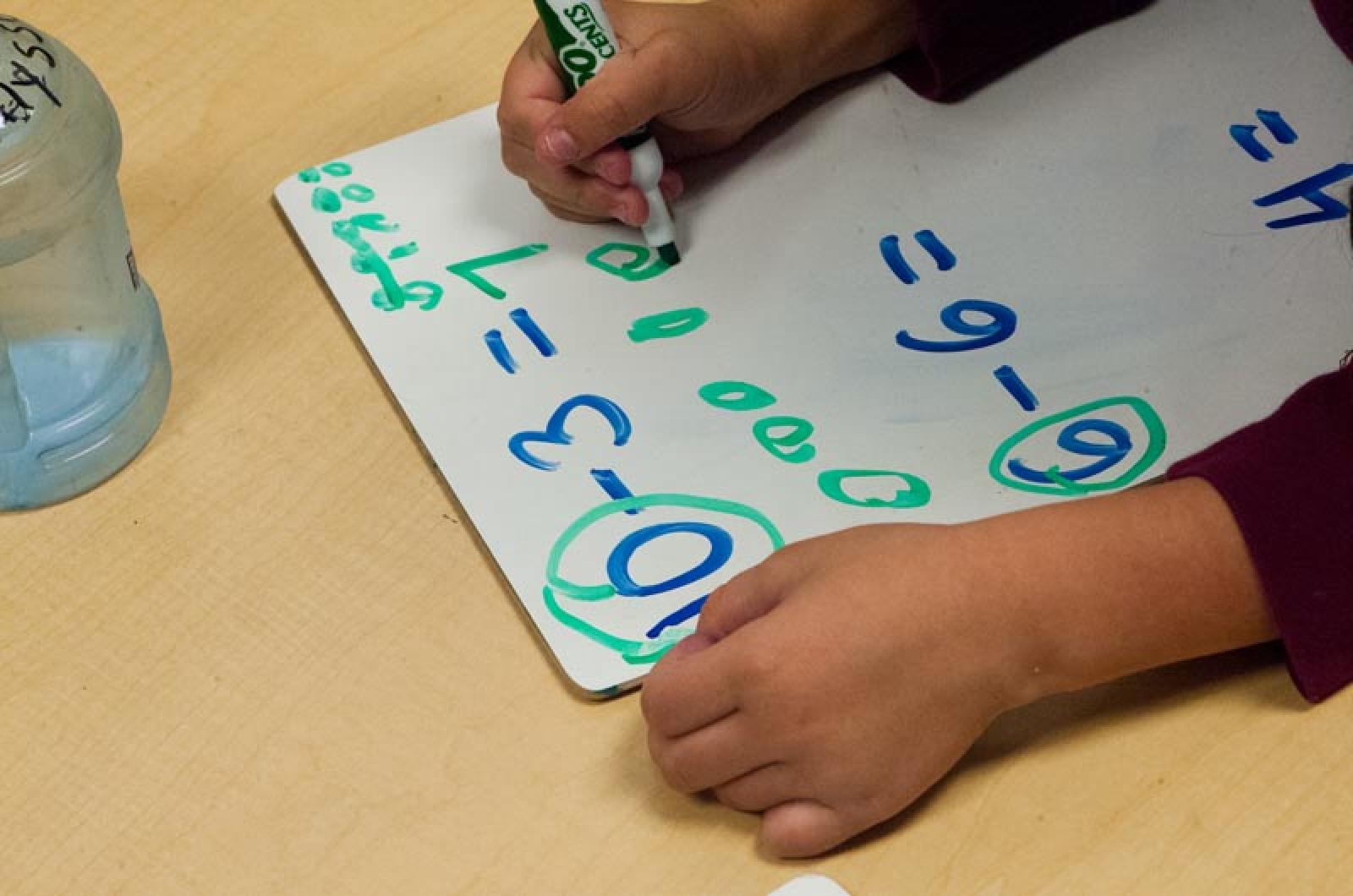
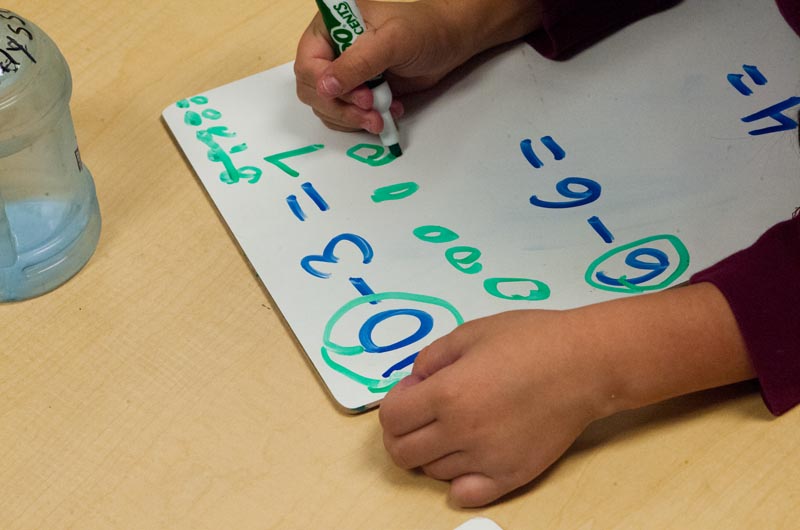
Midweek at the Edgartown School an elementary student was squealing in delight. He had just communicated to his teacher, Serena Santinello, that he’d like her to draw him a tiger. But he hadn’t used his voice to make the request. Instead he scanned the library of zoo animals on a speech output app, Proloquo, with a pointer finger, and had pressed on a small picture that was labeled “tiger.”
Ms. Santinello obliged, sketching a friendly tiger face next to a pretty young lady he’d requested minutes before.
The student is a member of the two-classroom Bridge program, which has served students with intensive needs for the past five years.
Serena Santinello.
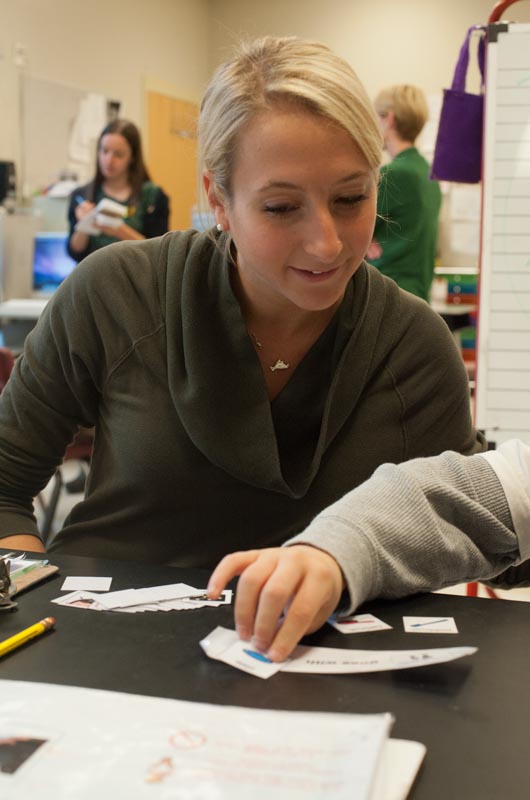
Serena Santinello.
The program was initially developed in the fall of 2008 for children identified on the autism spectrum. Consultants came to the Island from the Center for Children with Special Needs in Glastonbury, Conn., advised special education director Daniel Seklecki and intensive needs coordinator Hope MacLeod on how to develop an Islandwide program to serve autistic children.
But over the years, the program expanded to accommodate students with other intensive needs.
Next year the program mission will expand further, with a third classroom planned to accommodate students with the most extreme learning needs.
The new cohort of students do not have autism, but intensive global needs, which include mobility issues. These students, like the children with autism, require highly-specialized education programs and full adult attention, so they will learn alongside their autistic peers.
Bridge 1, also housed at the Edgartown School, is set up much like any other kindergarten. There’s a building area, an art area, and a dress-up wardrobe. Excited shrieking is answered by the reassuring tones of a teacher. But closer inspection reveals that each part of the room caters to the individual needs of the students. One corner has been set up to accommodate a child with critical visual impairment, who learns with the aid of a high-contrast blackboard. Wall space is covered with individual schedules, some written out in words, others with pictures, depending on ability. Upstairs, Bridge 2 enrolls kids in grades three through five. The classroom is set up similarly, with several groups of tables and two computer stations.
Kate DeVane’s son, now nine, was part of the first cohort enrolled in the Bridge program. His parents and teachers at Project Headway, a preschool program for children with special needs, agreed that he was not doing well in that environment, so they switched him to the fledgling program at the Edgartown School. “My son was having a meltdown every 12 minutes,” she recalled. “The teachers who were dealing with him were lovely people but the environment was wrong, the situation was wrong.” At Bridge, he got the assistance he needed to succeed in school. “They totally dealt with his situation and pulled it together, and he has been there and happy ever since,” Ms. DeVane said. She describes Bridge as lifesaving for her family.
“If they needed to, they put gloves on him so that he wouldn’t scratch them on their hands,” she said. “He was that tough to deal with, but they never balked at it.”
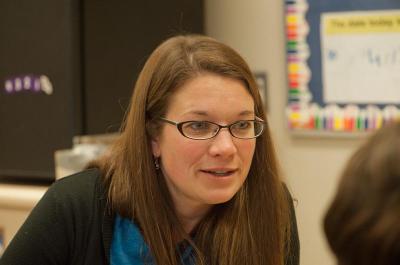
Kerry Branca, a lead teacher at the Bridge 1 program at the Edgartown school.
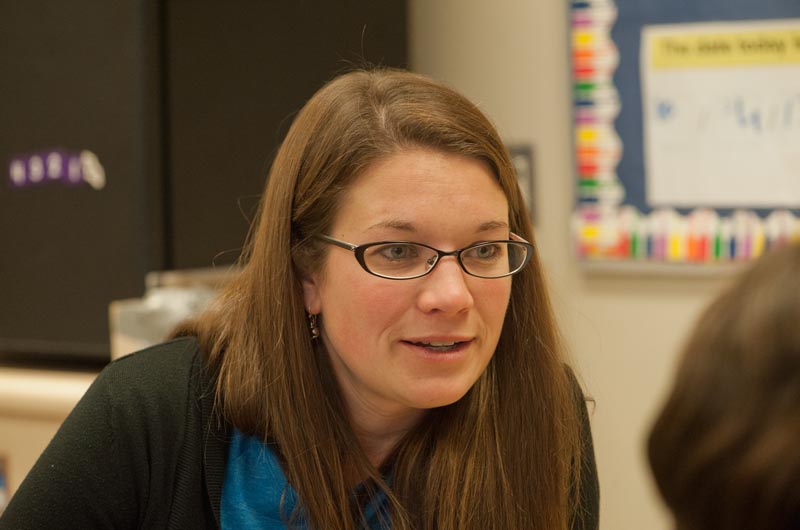
Kerry Branca, a lead teacher at the Bridge 1 program at the Edgartown school.
Years later her son’s behavior at school has improved significantly. He now spends more time with his peers in his grade-level classroom. “My son was not capable of going through the day without banging his head on the floor, and the people in the Bridge program fixed that problem as far as I am concerned,” she said. “They are running a really incredibly good program that is really serving the need that is there.”
Each of the two Bridge classes has a lead teacher and a group of educational support professionals, abbreviated ESP. Each student is assigned to an ESP throughout the school day, who follows them whether the student is learning in the Bridge classroom or in his or her grade-level class. ESPs help guide students through the day according to a personalized schedule posted on the wall of the classroom or on their individual clipboards.
Danielle Nalepa, the lead teacher in the Bridge 2 program upstairs, said she’s motivated to work with children with intensive needs by that moment of breakthrough. “When they learn that skill that you have been working on for months, and they just get it, it finally goes click to them, that is the best feeling in the world,” Ms. Nalepa said.
The ultimate goal is that students move out of the Bridge program and enroll fully into a general classroom environment.
The lead teachers, Ms. Nalepa and Kerry Branca in Bridge 1, consult weekly with the general education teachers to track curriculum developments. They are in charge of carrying out each child’s individualized education plan (IEP).
Some of the students have been able to participate in a grade-level curriculum since they first enrolled in Bridge, but have behavioral challenges that make it difficult for them to be productive in a regular classroom setting.

Bridge teacher Zachary Townes at Edgartown School.

Bridge teacher Zachary Townes at Edgartown School.
“We also want to utilize their time efficiency,” Ms. MacLeod said. Students are not allowed to be in the classroom if they are not benefitting from the instruction taking place. Each student has an individual set of goals against which success is measured.
One of the Bridge 1 students can now sit with the other kindergarteners at morning meeting and sing Twinkle, Twinkle with the rest of his class, using the iPad voice output application.
“The other students are like, look, he’s singing!” Ms. MacLeod said. “And he’s able to be a part of that class. And he might not be there all day, that is an important part of his educational experience, and he is an important part of theirs.” Three of the Bridge 2 students already spend most of their time in their grade-level classroom.
Before she had her son, Ms. DeVane had never met anyone with autism. But the faculty of the Bridge program helped her learn how to accommodate her son’s needs. Teachers even visited her home to get a better sense of her child.
Ms. DeVane also praised the school’s inclusiveness. “The police officer in the front lobby when I come in the morning is friends with my son, the lunch lady is friends with my son, the school nurse is concerned about my son,” she said. “The program couldn’t be housed in a nicer environment.” She said the same is true in West Tisbury, where students are taught to accept difference.
The third class next year will be housed in a different school; the site has not yet been determined.
The clipboard that follows the students throughout the day is labeled by first and last initial, in case it is accidentally left behind, protecting the confidentiality of the students in the program. But Ms. DeVane said despite all the careful measures in place to protect confidentiality, anonymity is impossible on a small Island. As a result, she said families often feel exposed when information is published about the increasing annual costs of educating their children, even though the names of specific students are not released. “A lot of parents of kids with disabilities feel like their privacy is invaded,” she said, referring to the published information in newspapers about dollar amounts attached to the programs their children attend.
Those dollar amounts are the subject of much public discussion these days surrounding the Vineyard schools superintendent’s budget which administers the Bridge program.
The third Bridge class proposed for the coming year will cost Island schools $80,000. Ten additional ESPs, spread throughout the Island’s special needs programs, will cost the school districts $281,000.
While the programs are costly, Ms. DeVane said that early intervention, like Project Headway and Bridge, save taxpayer dollars over the long term. These students, if not taught how to succeed in school, may become a drain on the system in adulthood, she said. The Bridge program is also at least as cost-effective as transporting students to the mainland for programming off-Island, or placing them in residential care, she said.
In general, she said the Island is supportive of families dealing with special needs. “It’s one of the reasons that these programs in these schools are so successful, because the community as a whole is really a giving community,” she said. “Everybody living on the Island is a little funky and different, that is just part of how our lives are.”
Meanwhile, a new director of student support services takes over this month. Philip Campbell told the all-Island school committee in October that he would look at existing special education programs with a critical eye to identify improvements and possible cost savings.
But he may not find there’s much work to be done, at least in the degree of support the school districts provide the most challenged learners.
“There isn’t a flaw in this place,” Ms. Nalepa said. “The system really gives the kids what they need.”
Comments
This is the ideal setting for
Jennifer Long BeachThis is the ideal setting for us to teach our children in. If only EVERYONE would take note. This would be a great place to do some research and peer reviewed journals (please!).
Looking at this program and
Christine DundeeLooking at this program and thinking about how to apply some of the best practices. Wondering what the qualifications of the ESPs are...
Patience, persistence, and
Vineyard Resident VHPatience, persistence, and more patience-- Not to mention a heart of gold. It takes a special person to be able to do what they do every day- regardless of what "qualifications" they hold.
A lot of ESP's are certified
Retired Teacher ChilmarkA lot of ESP's are certified teachers who can't find jobs here. Some hold Master's Degrees. They are very well-trained and possess all of the qualities from the previous response. Our schools would collapse without them.
It is gratifying to see that
Mary wood Athens. GeorgiaIt is gratifying to see that others are recognizing that there are students with intensive needs ... and programming to foster maximum developmental progress! Intensive interventions focused on each individual's developmental needs is truly cost effective over the long term!
This is the way programs
Elaine Bishop Cleveland OhioThis is the way programs should be run. The Positive Educational Program (PEP) in Cleveland started this type of program years ago and it is very very good. The Cleveland district I work in tries not to send our most needy students there because of the cost to the district, but they fail to look at the long term effects for all involved. I tried 6 years ago to get a extreamly autistic student there, and this year they finally put her into the program. Already she is doing so much better and less aggressive. I want to send this artical to the district special education director.
Everyday I wake up and I am
Bridge ESPEveryday I wake up and I am excited to go to work. I am excited to go to work because my day will never be like the day before, it is always a new adventure. I cannot tell you if my student will spent the day crying or amaze me by learning how to brush his own hair. I have observed children unable to speak, say words! I cannot describe the love I have for these children, watching them overcome life's struggles has changed my whole outlook on life. I no longer take my abilities for granted, I appreciate the smallest things in life, like being able to clap my hands. I am a Bridge Room ESP and by the way, Christine Dundee, I have two master's degrees!
Add new comment