


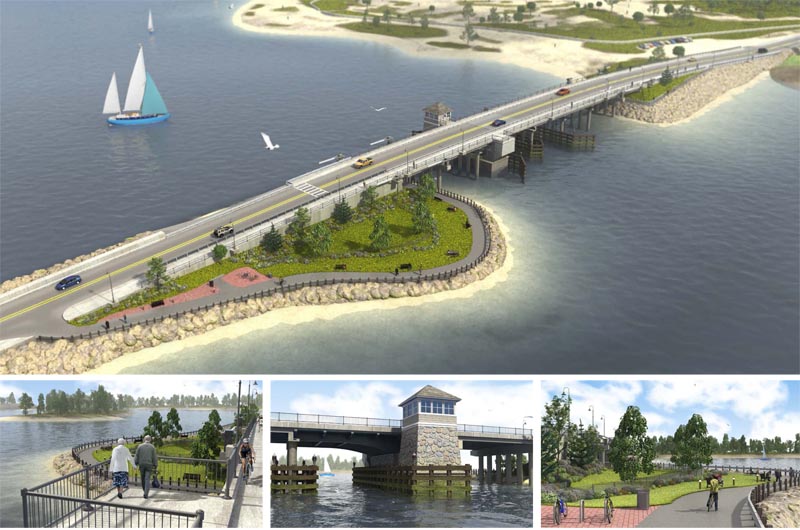
After nearly 10 years as a work in progress, the final phase of construction on the Lagoon Pond drawbridge in Tisbury is slated to begin this fall. “It’s been a long journey, I would say,” said Tisbury Department of Public Works director Fred LaPiana. “It’s nice to see it come to fruition.”
After nearly 10 years as a work in progress, the final phase of construction on the Lagoon Pond drawbridge in Tisbury is slated to begin this fall. Final permitting was issued in August, and preconstruction meetings by contractor Middlesex Corporation began on Sept. 12, said Melinda Loberg, chair of the Lagoon Pond Bridge committee.
“It’s been a long journey, I would say,” said Tisbury Department of Public Works director Fred LaPiana. “It’s nice to see it come to fruition.”
The project is financed by the state Department of Transportation. The Massachusetts Department of Public Works began surveying the bridge area in 1989 because the structure, then 54 years old, had outlived its lifespan. The bridge was first built in 1935. Most bridges have a lifespan of about 50 years. A plan for a temporary drawbridge was unveiled in 2003 and work began in the fall of 2007.
The final phase of the project involves constructing a permanent drawbridge across Lagoon Pond and taking down the temporary bridge that was completed in 2010. A park area, landscaped with native plants, will be built on the Tisbury side of the bridge by the Lagoon, and the bike path extended to the Tisbury town landing. A small fishing platform facing the Lagoon will be built onto the bridge itself. On both sides of the channel, there will be an area for pedestrians to walk beneath and around the bridge. Sidewalks on the bridge will be compliant with the American Disabilities Act.
The bridge will also be built at a height sufficient to account for sea level rise, Mrs. Loberg said.
The new bridge will be built “immediately adjacent” to the temporary structure, MassDOT public affairs representative Michael Verseckes wrote in an email. It will be on the envelope of the original 1935 structure, which is currently blocked via chainlink fencing from the Oak Bluffs side of the lagoon.
The temporary bridge uses a system of pulleys to raise and lower the sections, but the new structure is a bascule-style bridge, employing a pivoting weight to pull the bridge open and closed.
Mr. Verseckes said the temporary bridge will continue to be used until the new bridge is fully complete.
According to the contract, all work, including removal of the temporary structure, must be completed by summer of 2016.
As part of the final phase, the home adjacent to the bridge on the lagoon side of the channel, which has been owned by the Holloman family since 1962, was taken by the state via easement over the summer.
The first noticeable phase of the construction project will be the teardown and removal of the house, Mrs. Loberg said. Construction in the off-season is limited due to spawning of winter flounder in the lagoon, which occurs from March to April.
Construction costs for the final phase will be $44.94 million, Mr. Verseckes said. Initial estimates were about $20 million. By the time the temporary bridge was completed, they had risen to $34 million.
The temporary bridge that now spans the channel cost $9.2 million to build, after an initial estimate of $3.5 million for that phase of the project. The bridge was issued a temporary permit by the Coast Guard for seven years, and was a source of controversy initially, as some felt the temporary phase should be skipped and the new bridge constructed immediately.
Because the old bridge was in such poor condition, however, the state “couldn’t guarantee that it would last long enough to design, permit and build the new bridge,” Mrs. Loberg said. An independent engineer, commissioned and paid for by the towns of Oak Bluffs and Tisbury in 2005, “was equivocal enough” on the state of the old bridge that the temporary bridge plan moved forward.
Mr. LaPiana said that to his knowledge, the bridge project was “certainly the largest and the most complex” state undertaking on the Island.
Martha’s Vineyard Commission executive director Mark London said one success of the project was the creation of the Lagoon Pond Bridge committee itself. “Basically, it allowed the Island to speak with one voice when dealing with MassDOT,” he said. Typically, when the DOT worked, they would talk to municipal officials and hold public meetings, but meet “largely on their own,” he said. The steering committee, which met twice per month in its early days, “looked at the options and made a lot of suggestions that very much improved the design of the project,” he said. The creation of the park and the extension of the bike paths were some of those suggestions.
“We really wanted it to be more like a park and less like a roadway,” Mrs. Loberg said.
“I have to say, of the final product, the Island got a great deal from the state,” Mrs. Loberg said.
Tisbury selectman and bridge committee member Tristan Israel said he was “glad they were finally getting down to it,” but expressed concern about potential challenges due to having two large construction projects going on at the same time in town next year. A proposed expansion and renovation of the Stop & Shop building is currently under review at the commission.
The possibility of simultaneous projects is “pretty staggering,” he said.
Comments
It's upsetting and wrong that
Dan TisburyIt's upsetting and wrong that the state took the house and private property. I wonder who the elected official was that made the decision to get that done?
The old bridge regularly
Neil Off IslandThe old bridge malfunctioned with regularity, was considered no longer repairable, and not expected to function through the design and bidding process for a new bridge. A temporary bridge was required and thus the land south of the bridge. I do recall an unsuccessful search to find sponsors to move the house; not everything we want happens.
I read that when the Lagoon entrance was first spanned, many residents didn't want a bridge at all. A bridge there is now part of the Island. And this isn't a case of "moving forward" to keep pace with the rest of the world. The bridge was old, it needed to be replaced.
There was an excellent
Andrea Oak BluffsThere was an excellent article in the Gazette months ago that made it clear that MassDOT was responsible, annoyed that the responsible Holloman daughter had tried to use her substantial contacts to get some relief for her elderly mother who owned and loved the home. It seemed that it was just a bully being mean.
Cost of temporary bridge: 9.2
Thomas Hodgson wtCost of temporary bridge: 9.2 million. Cost of new bridge: 45 million. Total Cost: over 54 million dollars.
Cost of our new hospital: 42 million dollars.
How the heck does the state manage to make one little drawbridge project cost more than a great big hospital?
Hospitals don't have big
Neil Off IslandHospitals don't have big sections that move out of the way to let boats through.
I remember going to dance
susan mendell MaineI remember going to dance lessons in that house at the base of the bridge, that was about 55 years ago!
The price of the bridge does
John Somewhere-in-the-Middle, USAThe price of the bridge does seem high, but what bugs me more is how long it will end up taking from the start of work on the temporary bridge to the completion of the new bridge. I seem to recall that the Brooklyn Bridge and the Empire State Building were completed in one year. As to the cost of the hospital, that $42 million dollar cost would have been quite a bit higher if we had had to build a temporary hospital, tear down the old one, build the new one and then tear down the temporary hospital. The cost of the bridge was, no doubt, a result of dealing with the alphabet soup of Federal, State and island regulatory agencies that each held sway over some facet of the bridge design.
Add new comment