

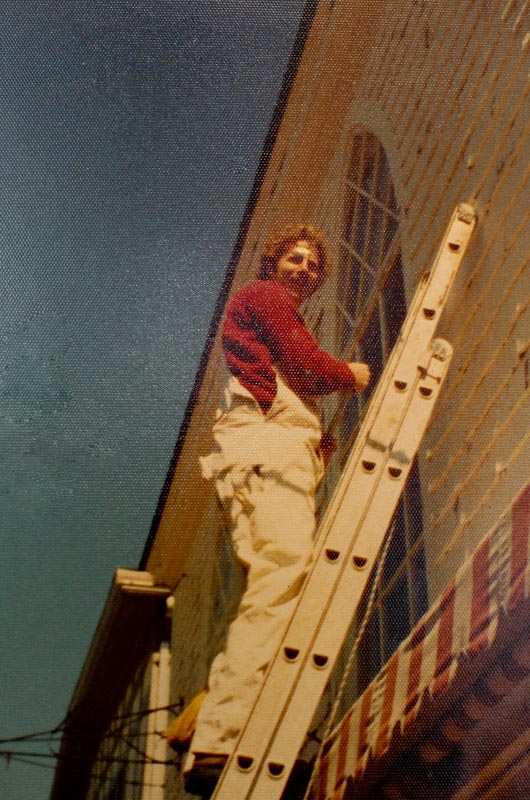
John Abrams came down from the mountains. It was 1975 and he had arrived on the Island from a commune in Vermont with his friend Mitchell Posin, his wife Chris, and his five-year-old son Pinto. They’d come to build a house in Chilmark.
John Abrams came down from the mountains.
It was 1975 and he had arrived on the Island from a commune in Vermont with his friend Mitchell Posin, his wife Chris, and his five-year-old son Pinto. They’d come to build a house in Chilmark.
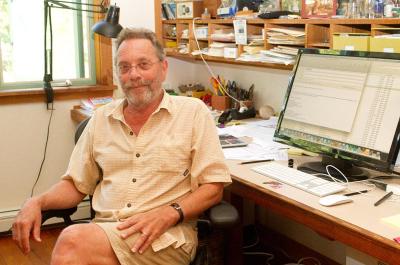
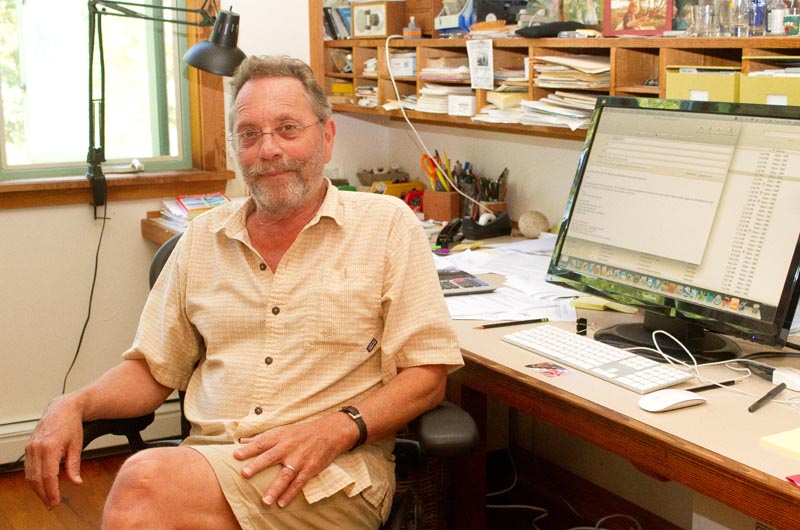
“We thought we’d be done with the house in about six months and have a pocketful of money, and head back to Vermont,” Mr. Abrams said on Tuesday, sitting in the South Mountain Company offices in West Tisbury, today an award-winning design-build firm on the Vineyard. He and Chris were “never coastal people,” they were used to a wandering lifestyle and they didn’t think the Vineyard was a place where they would stay.
The house took a year to finish. Money was running low. Somebody had asked about building another house. It was time for Pinto to start school. The Abrams family stayed a little bit longer.
“And it kept going like that,” Mr. Abrams said. “Until we suddenly looked around and said, Oh my God, we actually live here.”
Since 1970, the year-round population of Martha’s Vineyard has more than doubled, far outpacing the rate of growth in Massachusetts and that of the United States. According to census figures, the Vineyard population increased by 271 people between 1960 and 1970. Between 1970 and 1980, it increased by 2,845.

Growth has continued since then, but the influx of people was never as great as the wave that crested here in the 1970s. The baby boomer generation was on the move, and the nature of the Vineyard was changing. The back-to-the-land movement had landed, challenging the politics of the old guard, as was happening in many places, and sunbathing naked on Jungle Beach, as was not. But the 1970s wave was something deeper than that, tapping into the enormous reserve of potential stockpiled in the late 1960s.
Land preservation, explosion of the arts and music scene, stepping back from industrialization — it all happened on the Vineyard in the 1970s. The West Tisbury Farmers’ Market was re-established in 1974, the Martha’s Vineyard Commission was founded in 1975. The Yard had its first season in 1973. The Hot Tin Roof opened in 1979.
People came to the Vineyard, and stayed on the Vineyard because they could do what they loved. They could make it work.
“I just had this innate instinct that there was no better lifestyle,” said George Brush, who moved to the Island year-round in 1974 after spending his summers here as a child.
“By changing the place that you’re in, you change the world in some modest way,” Mr. Abrams said. “That was always the feeling of this place.”
Cheryl Barbara Stark was part of the first group, arriving on the Island in the summer of 1966 to teach jewelry making at the Island Craft Center in Vineyard Haven. She was 19. There were no jewelry stores on the Vineyard, no fixed places to purchase handmade goods like the peace sign necklaces Ms. Stark was crafting. The Island “really shut down on Labor Day,” she said. “There really wasn’t much going on.”
“It was still kind of the older people that had been here,” she said of the scene in the summer. “This was the beginning of an invasion of people that weren’t part of an [established] family that moved here, people on their own doing things to make a living.”
She stayed, she said, because it was in her bones to be near the water, having grown up in Brooklyn (on a street now wiped out, destroyed during Hurricane Sandy). Ms. Stark opened her first stand-alone shop in 1969 in a one-car garage, where the Black Dog Bakery is now. The Black Dog Tavern, with its pine beams and enormous fireplace, opened in 1971, intended to “give Islanders a warm place to come in from the cold,” as a 2002 New York Times article described. It was one of the first year-round Island restaurants, giving people like Ms. Stark a place to work in the dead of winter.
“I was a waitress when they opened, because I didn’t have an income in the winter,” she said. “I scalloped and painted houses, what everyone did.” Today Ms. Stark and her wife and business partner Margery Melzer own CB Stark jewelers, a respected, long-running business on Main street Vineyard Haven.
Ms. Stark’s jewelry shop in the garage was right next door to Carol Dodd Brush’s cheese shop, Martha’s Cheeses. Mrs. Brush opened up for business in 1971.
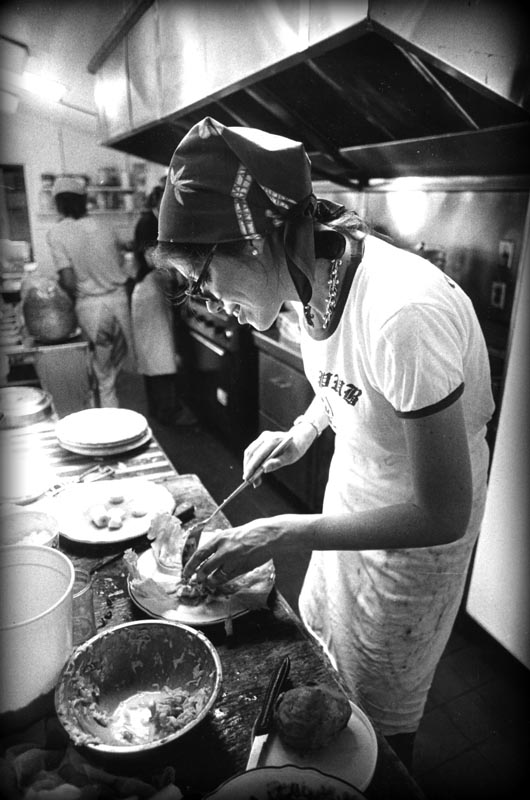
“Nobody’s ever seen this before — cheese on the Vineyard, wow!’” said Jaime Hamlin, who was Mrs. Brush’s chef after Martha’s Cheeses became Martha’s Restaurant in Edgartown 1974. Ms. Hamlin had just arrived with a freshly-minted degree in film, radio and television, to get a job working on Jaws.
“But I got here and of course all the jobs were taken,” she said. She saw an ad in the Gazette for a chef and applied. Mrs. Brush and Ms. Hamlin became business partners and bought the building Martha’s Restaurant was in. They wanted to serve food beyond the basic fare — crepes, fondue and such — and they learned the ropes from other Edgartown business owners.

“We felt like we could do anything — we were college-educated, we were smart, we could do it,” said Ms. Hamlin, who today owns her own prominent Island catering business. “I had no idea what I was getting myself into, but it was like, good, go for it.”
Mrs. Brush agreed. “You came here and you decided, how am I going to make a living on this crazy Island?” she said.
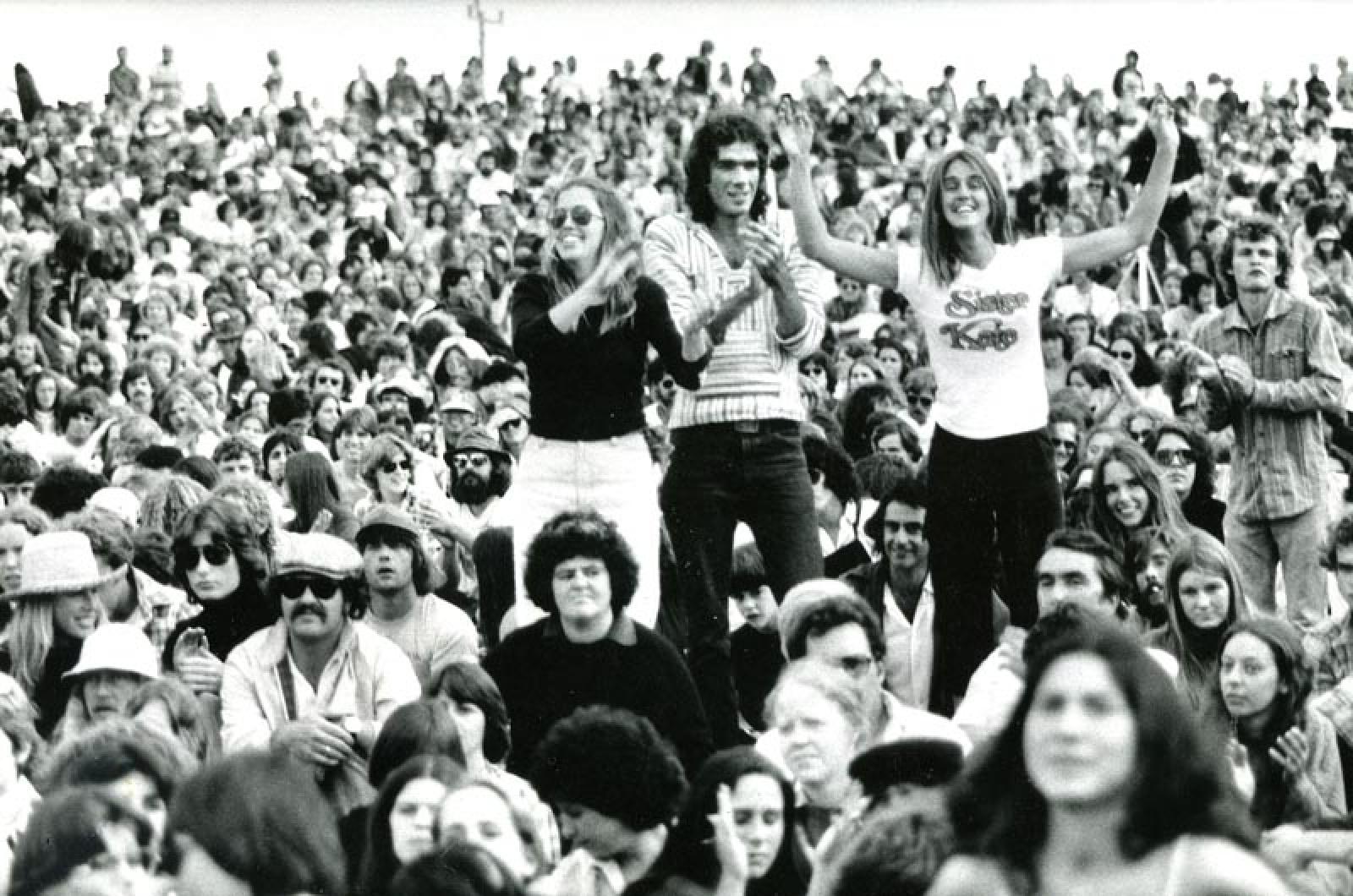
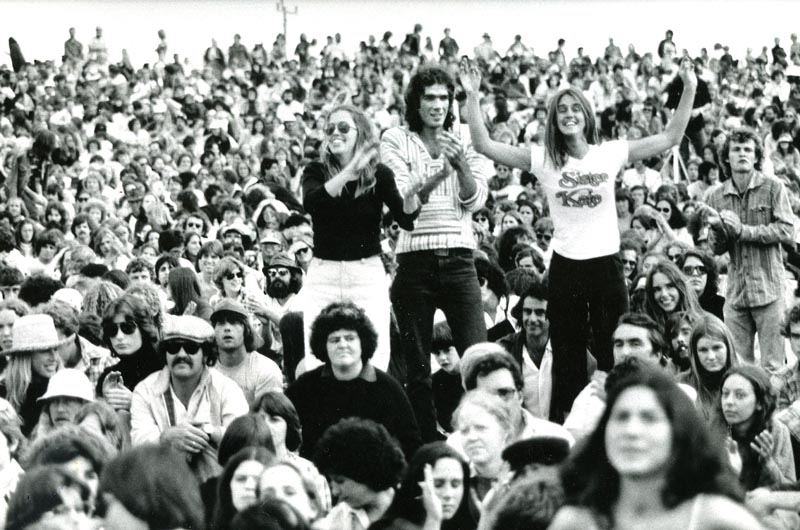
George Brush started the Hot Tin Roof because there was no place to dance. There were coffeehouses that played live music — the Mooncusser, the Unicorn — and there was the bar at the Seaview where bands played. But there wasn’t a dedicated music space, which was ironic considering that by the late 1970s, the Vineyard music scene was taking off. The No Nukes Festival in 1978 drew some 6,500 people to the Allen Farm, where Carly Simon, Kate and Alex Taylor and John Hall performed. “Surely never had Chilmark seen anything like it,” the Gazette wrote at the time.
Ms. Simon and James Taylor were living on the Vineyard at the time, and the next year, Ms. Simon came on board as a partner for the Hot Tin Roof with Mr. Brush and the late Herb Putnam, who ran the Quarterdeck in Edgartown. Mr. Taylor coined the name Hot Tin Roof, which Mr. Brush happily adopted as the name. His first attempt at a nightclub, in 1977, had been called the Boondoggle.
Music “was the galvanizing force that influenced our thinking,” said Peter Simon, who helped organize the No Nukes Concert. And The Hot Tin Roof was “a game changer,” he said. “It brought the youth hippie ethic together with the rich and famous, and everybody played together on the same level.”
It took 67 days to build the Hot Tin Roof, from the day the first tree was cut on the property to opening night.
“Everybody worked on it,” Mr. Brush said. “That was a big community effort to get it open.” Mr. Brush went back to law school at age 45. Today he is a practicing attorney.
The Art Workers’ Guild was born of a similar need. Anna Edey, then a weaver, moved to the Vineyard in 1972 from Cambridge, and started meeting fellow artisans while her house was being built — “friends of the carpenters,” she said. The common theme was that there was little opportunity for exposure
“I started saying, wouldn’t it be wonderful if we could have an artists’ co-op?” Ms. Edey said. “Within six months we had started the Art Workers Guild.” They rented the Nobnocket Garage from James Taylor, and set about getting insurance permits and constructing individual workspaces for the 16 artists in the guild. They raised money for the construction with cookouts, and continued to fund the Guild with Renaissance festivals, more cookouts, and eventually gallery exhibits.
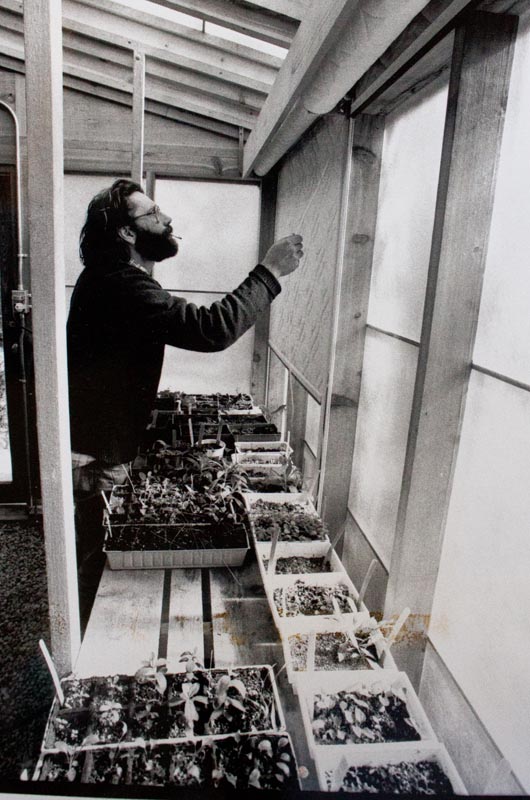
“The idea of having a year-round space to do your art work — that was really worth it,” said Ms. Edey. Her own home, once completed, contained a studio, but “many people were living in a chicken coop, literally,” she said. Ms. Edey left the guild eventually, focusing on her environmental work at her Solviva greenhouse.
The guild space gave them the chance to “really develop their best that they had in themselves,” Ms. Edey said.
“The Vineyard’s workforce is nontraditional and entrepreneurial,” observed the 2008 Island Plan written by the Martha’s Vineyard Commission.
Scott McDowell was on his way to art school in Maine in 1971, but he didn’t make it to that particular destination. He stopped on the Vineyard for a weekend, having visited the year before on a cross-country trip.
“There was no reason once I got here to leave,” Mr. McDowell said. He got a summer job repairing jewelry in Edgartown, and bought the shop he worked in two years later. In the winter, Mr. McDowell was a carpenter’s helper and eventually a contractor. But summers were for creativity.
“We made silver jewelry, but mostly we went fishing,” he said, laughing. Today, Mr. McDowell owns The Copperworks in Menemsha and is a charter fishing captain.
Pam and Nat Benjamin came from the sea. They had a two-year-old daughter, Jessica, and they were back visiting New England after sailing around the Caribbean and Europe. It was 1972, and they had come to sail a charter out of Edgartown, but that fell through.
“When we sailed in to Vineyard Haven Harbor . . . we went ashore, and the rosa rugosa were in bloom, and the beach plum, and Pam immediately said, this looks pretty good,” Mr. Benjamin recalled.
Mr. Benjamin started working at the Martha’s Vineyard Shipyard and Mrs. Benjamin at Fred Fisher’s Nip ’n’ Tuck Dairy. Daughter Signe was born in 1973, and in 1974 Pam and several other mothers organized the Vineyard Montessori School, bringing teachers up from St. Croix. There were 20 students when the school opened its doors. For a time, it was housed at Anna Edey’s.
“We just started having meetings, and inviting more and more parents of all these baby boomers who were coming to the Island with small children,” Mrs. Benjamin said.
“It just evolved, and we really liked the people — we loved the Island, of course, but we liked the people — not just the newcomers like us, but the old folks, the Islanders that had been here,” Mr. Benjamin said.
He worked as a carpenter for a year, and tried codfishing at one point, but came back to his first love — building and designing wooden boats. Mr. Benjamin worked out of his backyard until 1980, when he and his partner Ross Gannon founded their landmark boatyard on the Vineyard Haven harbor, Gannon and Benjamin.
“It probably would have happened somewhere else,” Mr. Benjamin said. “But it probably wouldn’t have happened as well.”
For more photos of the movement's changing faces, see the gallery Counterculture Island: Then and Now.
Comments
What a fun article! It never
Gina Hayes Cape Cod MaWhat a fun article! It never gets old reading where people came from, what brought them to the Vineyard, and why they stayed!
It's so fun to see how the
Jan Pogue EdgartownIt's so fun to see how the Vineyard has been shaped by these creative and individualistic people. And it's reassuring to know that it really is still going on -- young farmers and chefs and artists are creating the next "new" Vineyard.
Really cool article. I miss
DavisReally cool article. I miss Herb
Thanks for sharing this
Elaine Garvey Norwell, MAThanks for sharing this article. Fun reading about the famous and not so famous people who chose to make the Vineyard their home and the very special place I love to visit every summer!
Entertaining. Encore.
Dan ObEntertaining. Encore.
Yup, No Nukes was in
Nelson Smith EdgartownYup, No Nukes was in September '78. I thought Kate Taylor was far and away the best performer at the show. Alex pretty much yelled "No Nukes" the whole time and for some reason Carly was really hard to hear.
:-)
Marty Milner Flowery Branch:-)
Thank you for this wonderful
Polly Simpkins Vineyard HavenThank you for this wonderful article! As a young girl I loved Cheryl Stark's space by the Black Dog and I remember being in awe at the vibe she invoked just by being her, and making her beautiful jewelry there. I was so inspired by many of the people mentioned in this piece back then, and many still inspire me. This same Vineyard consciousness and spirit that remains today continually reminds me that there is no better place to live authentically and openly, inspired by an amazing island community of visionaries,thinkers and people just being themselves.
Did John Kerry speak and
SJ ChilmarkDid John Kerry speak and Cheryl Crow sing at that event? My memory is fading.
It was John Hartford, not
Wendy Gray West TisburyIt was John Hartford, not John Hall. Hartford was amazing and sang the No-Nukes song. I wish I had kept my T-shirt.
J
And isn't that Wayne Aruda?
Wendy Gray West TisburyAnd isn't that Wayne Aruda?
I'm guessing the reporter
Steve McQuiggan ChilmarkI'm guessing the reporter wasn't even born yet, by 1978? The real organizers of the No Nukes concert at Allen Farm were John Abrams, Mitch Posin, Steve Sinnett and Jay Walsh. It's funny how some people take credit when it's undeserved.
Just to set the record
John A.Just to set the record straight:
The MV No-Nukes Festival was on Sept. 23, 1978. Over 7,000 people attended. The proceeds were used to work against expansion of the Plymouth nuclear power plant. The speakers were Helen Caldicott (Australian physician who was one of the founders of Physicians for Social Responsibility), Sam Lovejoy ("Lovejoy's Nuclear War"), and Sara Nelson (chair of the National Organization for Women). Musicians were Carly, Kate T., Alex T., John HALL (formerly of Orleans and a US Congressman from 2007-2011, who sang his wonderful song Power), the Pousette Dart Band (remember them? great band), Joel Zoss ("Been too long at the fair"), and Mark Carroll, a local singer-songwriter in those days who was a particular favorite of mine. The night before, it poured rain in buckets until 5 AM, at which time the skies opened up, the clouds rolled away, and brilliant sunshine and good spirits became the order of the day.
wow. that day (and Helen
Carmel Gamble Lyons, COwow. that day (and Helen Cauldicott in particular) changed my life. I became completely immersed in Clamshell Alliance, taking me to the State House, Washington, Wall Street, the Black hills, jail in Seabrook for blocking the nuclear reactor on it's way in to town...!
But it's the Vineyard, and my life there in the 70's and everyone I knew then, that truly made me who I am (and I hope that's a good thing!?)
I will always be a Vineyarder, no matter where I am.
P.S. that long haired guy in the middle of Kanta and me, is not Tommy; that's my brother, Ross Gamble, sadly no longer with us, and missed dearly.
What a wonderful historical
Carroll Smith Garland Barrington, RIWhat a wonderful historical perspective. I am glad to be a small part of that illustrious group that came to visit someone (George Brush and Marian Webster)in the mid 70's after being overseas for 2 years and stayed to teach at West Tisbury School. I still feel my heartstrings pull every time I leave the island.
Add new comment