

Sam Low craves at least two things in life — the strong embrace of an ocean and the presence of a true ohana. He’s found both in two somewhat dissimilar places — Martha’s Vineyard and Hawaii. <p>Ohana is a Hawaiian word that means extended family. Mr. Low’s father grew up in Hawaii but moved to New England at the age of 17. On the East Coast, he sought a lifestyle similar to his Hawaiian upbringing and found it on Martha’s Vineyard, where “everybody let their hair down and everybody was fishing and clamming,” Mr. Low explained.</p>

Sam Low craves at least two things in life — the strong embrace of an ocean and the presence of a true ohana. He’s found both in two somewhat dissimilar places — Martha’s Vineyard and Hawaii.
Ohana is a Hawaiian word that means extended family. Mr. Low’s father grew up in Hawaii but moved to New England at the age of 17. On the East Coast, he sought a lifestyle similar to his Hawaiian upbringing and found it on Martha’s Vineyard, where “everybody let their hair down and everybody was fishing and clamming,” Mr. Low explained.
Growing up in Connecticut, Sam was exposed to Hawaiian cuisine, dance and hula — a form of prayer through dance. But Sam did not visit Hawaii until 1964 as a naval officer. His father died before he had a chance to reconnect with Hawaii, so Sam made it a lifelong mission to visit his father’s homeland. “I got a feeling I was going back for him,” he said.
Sam Low, now 70, served in the U.S. Navy in the Pacific from 1964 to 1966. In 1975 he earned a doctorate in anthropology at Harvard. As part of his studies, Mr. Low became fascinated by the subject of how the Polynesian people settled the many islands of the Pacific.
In his youth the popular book and documentary film chronicling Thor Heyerdahl’s famous balsa raft expedition from Peru to Fre
nch Polynesia received a lot of attention, and many accepted it as truth. Mr. Heyerdahl’s theory, proven to his satisfaction by the 101-day voyage aboard the Kon-Tiki, was that the Polynesians were descendants of ancient South Americans who built rafts and voyaged across the Pacific from east to west to populate the islands.
In the early 1980s, Mr. Low produced a movie entitled The Navigators — Pathfinders of the Pacific, which countered the Kon-Tiki theory, saying that the descendants had in fact traveled from west to east setting out from Micronesia. To do this the boats would have had to travel against the winds and currents, something a mere raft could not do.
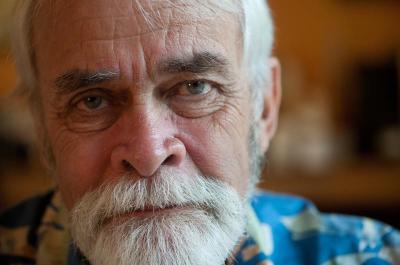
Author Sam Low divides his time between Martha’s Vineyard and Hawaii.
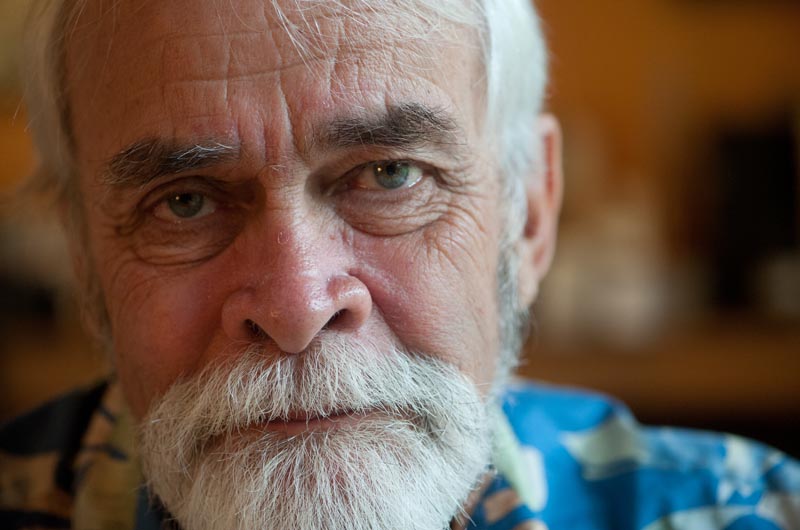
Author Sam Low divides his time between Martha’s Vineyard and Hawaii.
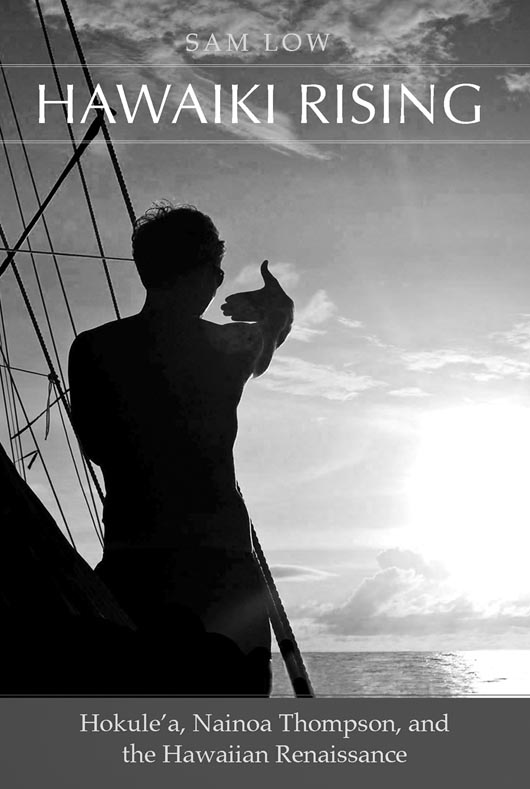
Mr. Low’s first book, Hawaiki Rising, which was published this past May, continues this conversation putting at the center of the story a double-hulled canoe named Hokule’a, a replica of the boats Mr. Low and others feel were key to the Polynesian diaspora. The H o k u le’a was a much more sophisticated sailing vessel than Mr. Heyerdahl’s raft and able to chart its own course to and among the islands of the Pacific. Mr. Low made many such trips as a crew member on the Hokule’a.
“The story is about the renaissance of Hawaiian culture, and the rediscovery of how our ancestors were able to navigate,” Mr. Low said. “They had to sail against the prevailing winds and currents, so they must have had very advanced equipment.”
On the voyages he attended in 1995, 1999, 2000 and 2007, he served as the official documentarian of the Hokule'a journey, composing 300-word posts each day.
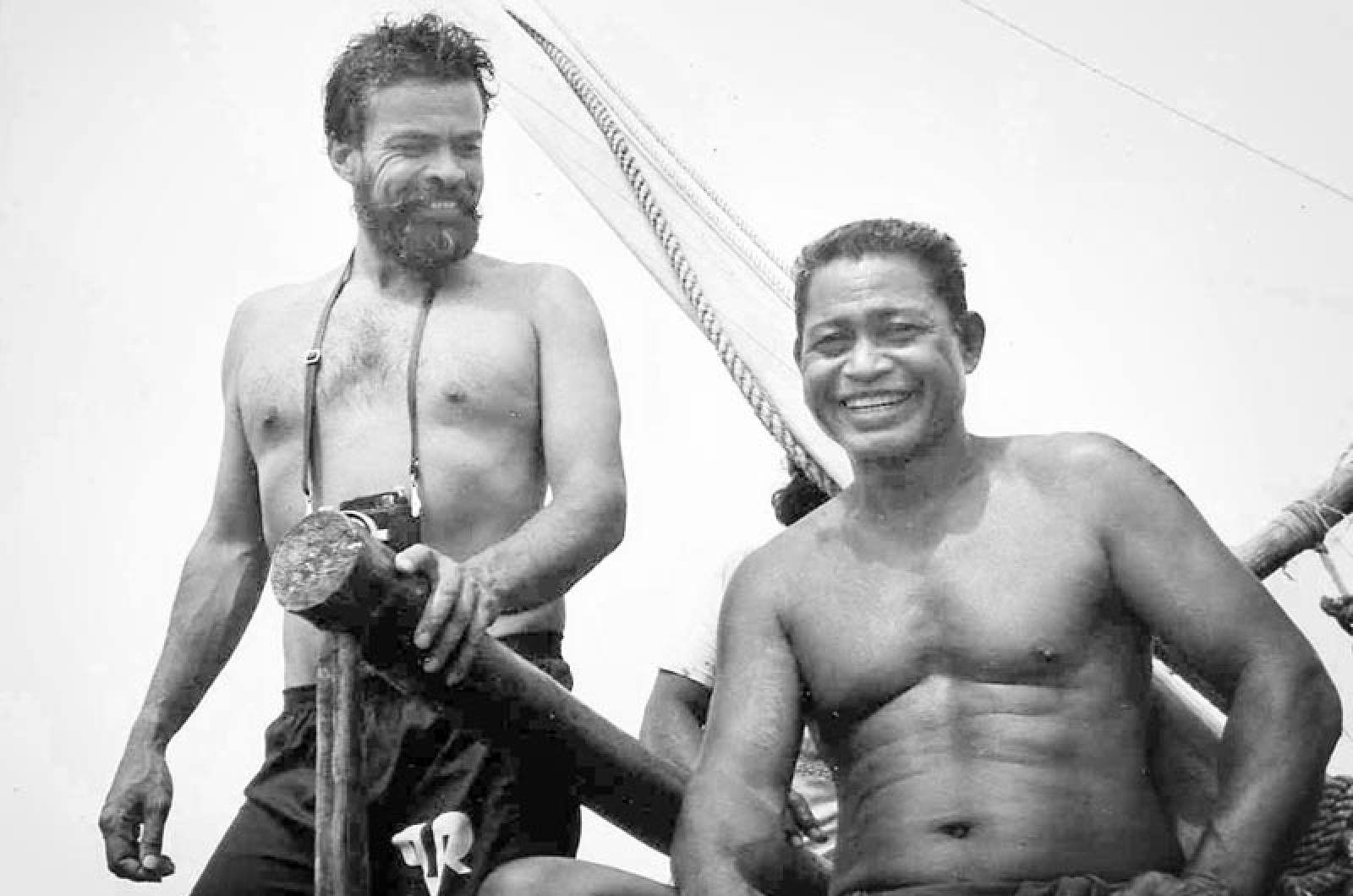
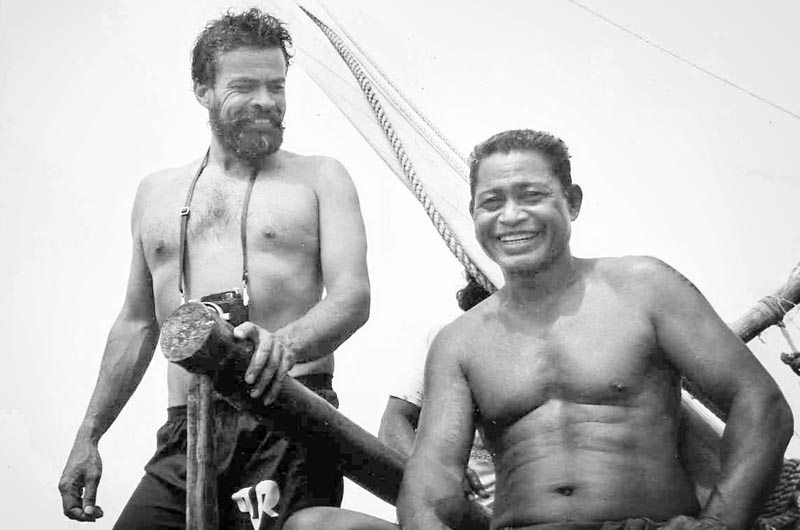
Mr. Low’s cousin, Nainoa Thompson, became the book’s focal point. Having grown up in Hawaii somewhat disconnected from his tribal roots, Mr. Thompson became interested in learning the ancient craft of navigation using stars. For years, Hawaiians were treated as second-class citizens in Hawaii, and the language, culture and history of the native people were not taught in schools. Mr. Thompson became a protege of Mau Piailug, a skilled navigator.
Mr. Thompson’s story is made central “because it’s his coming of age in Hawaii at a time when Hawaiian culture was almost disregarded and lost,” Mr. Low said. Nowadays, Mr. Thompson is known as a respected 60-year old navigator, but few are aware of the risks he took as a youth to take on the legacy of ancient Pacific navigation, revitalize it and prove its efficacy to the world, Mr. Low said. In 2017, Mr. Thompson plans to stop in Vineyard Haven while sailing the Hokule’a around the world.
Navigator Nainoa Thompson.
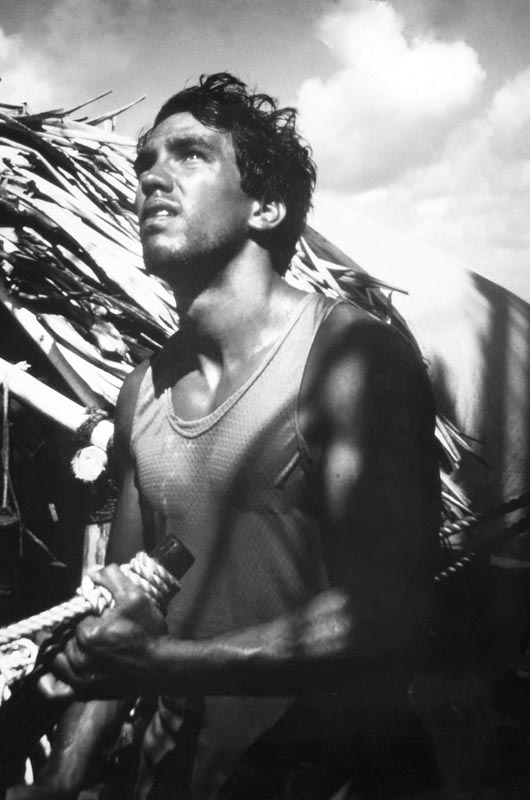
Navigator Nainoa Thompson.
Through the process of discovering their former preeminence in oceanic navigation, some Hawaiians became possessive of the canoe and wished to exclude others from the process of rediscovery. Previous books and films made about the subject of the Hokule’a emphasized the friction between the ethnic Hawaiians and the haole — white members of the crew. Mr. Low preferred to focus on the anthropological and archeological side of story, as well as the biographies of each of the crew members. Mr. Low sought to employ as much of the Hawaiian language in his book as possible without confusing the reader. He also provides a glossary at the back.
“When Hawaiians discovered this story about themselves, that in fact they once were the world’s greatest sailors and navigators, and they discovered the oppression of their culture . . . they got very angry,” he explained. “I appreciated that side of the story but I realized that something was missing.”
As Mr. Low sees it, the canoe’s mission did not end with discord, rather it culminated in a renewal of pride and dignity for all of the Hawaiians involved, no matter their ethnic makeup. That’s the takeaway message of his own narrative.
“Hawaii today is one of the most rainbow of societies that there is. There are so many different races, so many different cultures,” he said. “The ethic of this canoe is that you are Hawaiian if you have that spirit in you, whatever race you are . . . come voyage with us, become part of this.” In fact, the story appeals to anyone who has experienced a process of discovering a lost cultural identity, he said. When he tells people he sailed on a Polynesian replica boat, people assume that it’s the Kon-Tiki he’s referring to. But he’s quick to correct them. Though in his book he doesn’t focus on what he calls “the battle of the theoretical,” his book can serve as an antidote to that misinformation. He and others believe instead that it was the ingenuity of their navigation and their engineering that enabled the ancient Polynesians to populate the Pacific, not the unsophisticated audacity Mr. Heyerdahl sought to recreate.
In his book, Mr. Low reconstructs the early maiden voyages, beginning in the 1970s, of the canoe to Tahiti and other islands of the region, piecing together snippets from more than a thousand hours of interviews with more than 100 affiliates. Mr. Low did not join the crew until more than a decade later, so he absents his own persona from the writing.
“I want it to be a chorus of voices,” each speaking directly to the reader, he said.

Double-hulled Hokule’a canoe is at center of Hawaii’s past as Polynesian diaspora, as well as a present-day renaissance of Hawaiian culture.
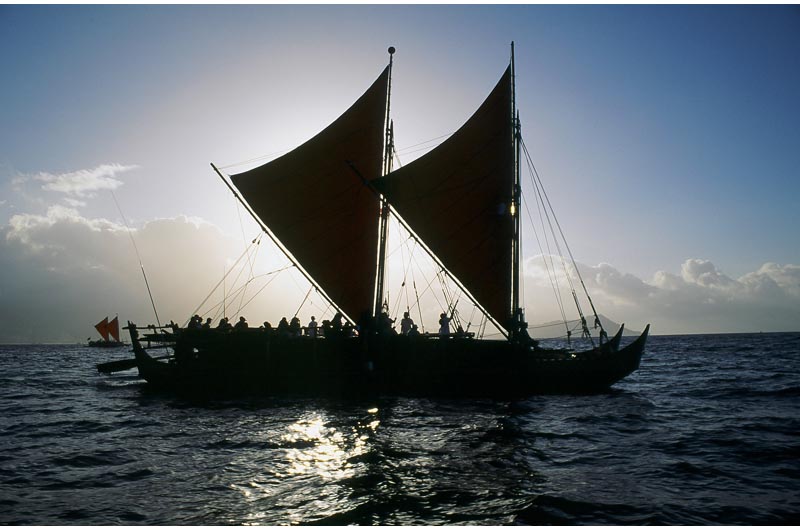
Double-hulled Hokule’a canoe is at center of Hawaii’s past as Polynesian diaspora, as well as a present-day renaissance of Hawaiian culture.
Beholding the canoe was for Hawaiians a powerful moment. “The canoe carried a song from a time before remembering, a time so far in the past that it had been forgotten, or worse, a time that had been erased from memory so as to not reawaken an ancient hurt . . . but H o k u le’a overwhelmed such resistance . . . ,” Mr. Low writes in his book. Though his research took place in the Pacific, Mr. Low wrote a good portion of it and designed it on the Vineyard with the help of Nan Bacon and Tara Kenny. He published it in May, using Island Heritage Publications, a Hawaii-based printer. All told, he dedicated 10 years of his life to the book.
For the past three years, Mr. Low has lived on the Vineyard year round. “This Island is an ohana,” he said. If you just stay around, stand up and present yourself as part of the community, you will be accepted here, he said. This culture of this Island, like Hawaii, is informal and community-oriented, he added, and both communities were integral to the publication of the book. The final copies of the first edition are available for purchase at Island bookstores. Another printing is under way.
“People come here to relax and to be themselves,” Mr. Low said. “When the Island calms down, most Islanders pretty much love to get together with each other.”
Comments
Sam Low has written an
Bob MacLean Vineyard HavenSam Low, a true bro, has written an evidently quite important work for us all.
Thank you Sam. Your written accomplishment is particularly poignant for me. And I haven't yet read it!
We both have Hawaii as a family touchstone, if not as physical anchor in earliest memories. We both later visited and chose to live on Martha's Vineyard, as did our talented brother Peter, and other P~A's (Pacific-Atlantic islanders) of astral-island connections.
I look forward to reading HAWAIKI RISING. Sam: you and I have in our hearts and minds, as do so many, the ocean's centrality to planetary life, and the place of ohana making our lives and those of others who live and visit the Vineyard, Hawaii, and alike communities throughout our world -- a celebration of serious compassionate connection.
Quite synchronistically, Len and Georgia Morris' upcoming film on world poverty is 'The Same Heart' (Media Voices for Children). They just hosted Awa Sangho of Mali and husband Daniel Moreno's 7-piece band, for a phenomenal 'through the roof' concert fundraiser on July 18 at Flatbread. Awa's 15-year old drummer son joined them onstage for the first time ever. Yeh for Malik!
Also: thank you, Philly D/CLA and all bands for your Hospice Benefit Event the same night, whom so many must surely enjoyed!
Thank you Sam for writing the Hokule’a story, being here now, and expanding the MV-Hawaii, aloha/community connection.
We're grateful to Len and Georgia Morris and to Phil Darosa too and all the helpers of Hospice, for the compassionate caring gifts of ohana they make happen here which spread and touch family members throughout the world.
Refrain: Congratulations, Mr. Low. Mahalo. Brother writer. Islander. Brother Ka'maiana!
Your book reminds us all on our precious ocean planet that we all have The Same Heart. Now, ever more crucially, our souls call for us to work in all ways to create and joyfully pass on and extend "our" eternal gifts, fruits of all lives given. Together. We can. (For real, soon summer visitor here, dear brother Barack! POTUS Punahou bro, from this Iolani School rival!)
We are from, we go to.... one Ocean Love.
Enjoyed this very much. I'm a
JL OakleyEnjoyed this very much. I'm a UH grad, went out in 1969 and was in Hilo when the Hokulea came into the bay after its historic trip to Tahiti. I live in the NW now but keep in touch with all things Hawaiian, including the strong connection between the NW and Hawaii in shipping and culture. (Many Hawaiians worked for Hudson's Bay Company 1820-1860s) Will look for this book. I'm also looking for Captain George Chase who was born on MV and later went out to San Francisco in 1849. He owned a ship that came to my town often. His brother William Chase continued to live on MV the rest of his life.
very cool
Robert Lowe Waipahu, Hawaiivery cool
I loved your book…. I want to
Joan LeLacheur AquinnahI loved your book…. I want to go back and read it again! It is a love story of a boat and her people
Add new comment