


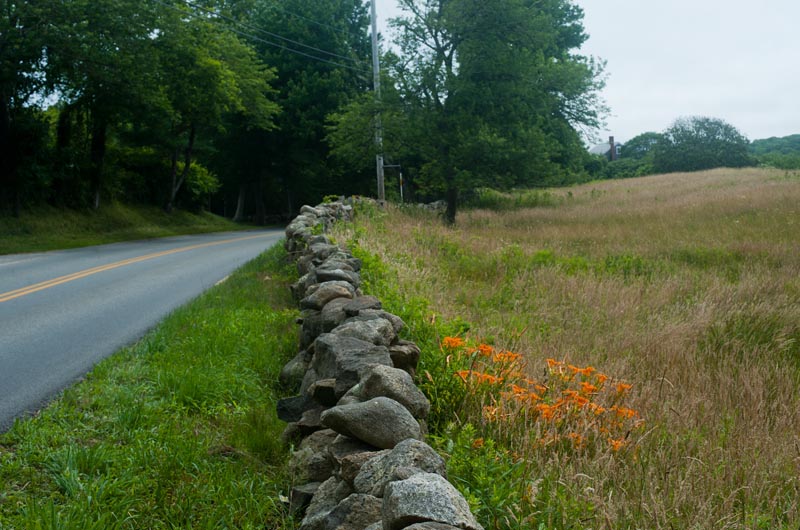
Middle Road wears an Island necklace in shades of gray. Allow the car behind you to pass and drive just slowly enough to glimpse it hiding behind a blur of trees and vines, or follow after it as it lends definition to the landscape on either side of the road from West Tisbury to Chilmark.
The Song Of The Stone Wall
Come walk with me, and I will tell
What I have read in this scroll of stone;
I will spell out this writing on hill and meadow.
This is New England’s entablature of rock,
Leagues upon leagues of sealed history awaiting an interpreter.
— Helen Keller
Middle Road wears an Island necklace in shades of gray. Allow the car behind you to pass and drive just slowly enough to glimpse it hiding behind a blur of trees and vines, or follow after it as it lends definition to the landscape on either side of the road from West Tisbury to Chilmark.

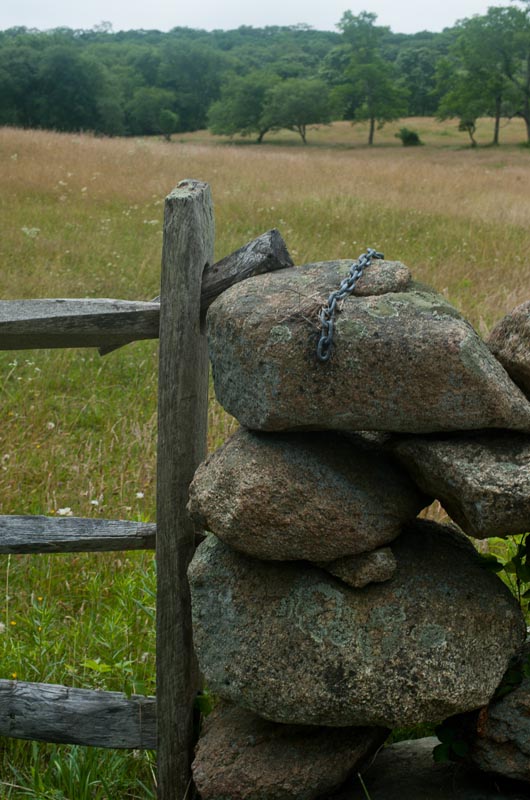
Today Middle Road hosts an ongoing game of tag between shadow and sunlight. It makes a sentimental painting: a honey stand, the hand-painted farm signs and grazing livestock, all given added significance by the permanent scribble on the landscape that chronicles the Island’s natural and agrarian history.
With a little imagination you might hear the ancient stonewalls — a visible percussion of massive base boulders, horizontal rows of strategically intersecting fieldstone, small chink stones that fill in the open spaces of a lace wall and the tablet-like caprocks that top the walls — a concert of timpanis, conga and snare drums and tom-toms.
“Stone is a beautiful thing,” says Valdemar Pires of P&P Masonary, sounding matter-of-fact. As he drives past Brookside Farm, Tabor House Road and Fulling Mill, he critiques the merits of this and that wall identifying style (rustic, farmers (smooth on only the facing out side), retaining, freestanding), structure and method (drywall or those using mortar).
With admiration, Mr. Pires points out the ancient, round stone posts that stand sentry at the openings of some of the walls. “For one thing, stone is forever,” he says.
Mr. Pires is a native of Portugal. There you can see old stonewalls, he says. There and at Seven Gates Farm.
Mr. Pires, whose brothers are also hardscape masons, remembers a childhood game. “We used to play with the stones moving them to let the cows get in and out.”
Although Middle Road craftily camouflages its stately farmhouses and sprawling seasonal homes, Mr. Pires knows how to find all its privileged nooks and spectacular crannies. He has built their retaining walls — double-faced, single-faced (only smooth on one side), and one as long as a thousand-feet, stacked four high and three-feet wide.
What the wall saw.
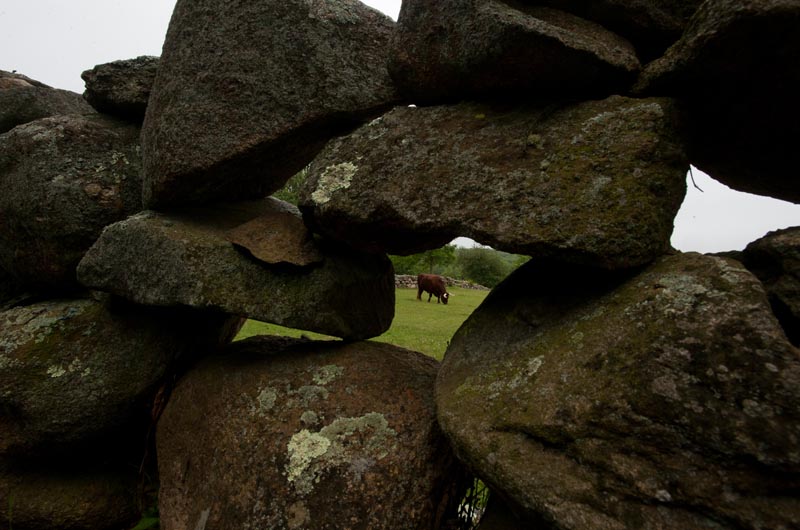
What the wall saw.
There’s obvious pride in his voice when he turns down one of the side roads whose rolling, expansive properties are wreathed in stonewalls that seem to go forever — appearing, disappearing, rising and dipping as they wrap around the circumference of ownership.
“You gotta create a good foundation for a wall,” he says. “You have to make sure it won’t move. Some of the free-standing walls are thousands of years old.”
As fields were cleared, stones were removed, collected and eventually stacked by the farmers. Most of the old stonewalls on Middle Road are dry built, and even though they were built on a proper gravel-based trench with matched stones they shift seasonally. Walls that go North and South don’t move, it’s said, but those that run East and West do because they lean toward the sun. It seems a whimsy to think of the huge boulders being somehow animated.
There is appropriate and legislated reverence for the Island’s stonewalls. At one time, if you needed some matched stones for this or that project, you could go to a stonewall and help yourself. No longer. Some of the older ones, which might go back to the 1700s (mortar wasn’t prevalent until after the Civil War), have only two rows of stone left in spots, made a shambles by deer, cars or the pull and push of trees and people. But don’t touch except to rebuild, because even down to a whisper you can still hear them — and stone is forever.
Comments
I love living in Florida but
Sue Cimmino Palm Harbor, FLI love living in Florida but do miss the beautiful stone walls on the Vineyard as well as the ones in CT where I use to live. THere is a hidden story behind each stone and holds their secrets forever and we can only imagine what a history they could tell. I treasure my trips up Island from OB and stopping to look and amaze at the length of time they have been there. These stone walls are an intergral part of the Island history and will still be there when all of us are gone, keeping guard on pastures and hills and the ocean nearby.
Add new comment