



Community action and regional cooperation will be critical as the Island tackles new solutions to an old problem: affordable housing. This was the consensus among community leaders who gathered at the Oak Bluffs Library Wednesday night to hear a presentation on the first draft of the Housing Needs Assessment Study.
Community action and regional cooperation will be critical as the Island tackles new solutions to an old problem: affordable housing.
This was the consensus among community leaders who gathered at the Oak Bluffs Library Wednesday night to hear a presentation on the first draft of the Housing Needs Assessment Study.
“I think there’s a need for regional collaboration and some general sense that there are particular strategies that make sense for communities and the Island,” said Karen Sunnarborg, the consultant who led the study. “I do believe there should be, within each town, a mutual concern about what’s happening across the Island.”
About 30 people attended the meeting; a second session will be held Tuesday at 6:30 p.m. at the Chilmark Community Center. During a presentation on the report, which will be done in three phases, Ms. Sunnarborg unpacked an array of economic data showing that the so-called affordability gaps make both home ownership and home rentals out of reach for many Islanders, and also that the demographic trends are shifting as the population ages and poverty levels rise.
During the discussion that followed, many town leaders agreed on the need for some kind of regional approach to the issue.
“There is a huge demand for people to come here in the summertime; it’s an absolutely fabulous place to live,” said Richard Toole of Oak Bluffs. “But there needs to be a more concentrated effort to come back to a smart growth effort in areas with the least environmental damage but which also make most sense . . . it’s going to require support from all the towns to do this.”
There was some discussion about the annual practice among Island towns of using Community Preservation Act monies to support rental subsidies and other forms of affordable housing. Mr. Kristal said Tisbury is considering adding a $50,000 line item to its town budget instead of seeking annual appropriations from the town Community Preservation Act fund for affordable housing subsidies.
“This is just a drop in the bucket,” he said. “If the Community Preservation Act goes away, we have no funding mechanism. Let’s fund this over the next couple years through the town budget and not go through the [community preservation committee].”
Oak Bluffs selectman Walter Vail agreed.

Middle Line Road affordable housing project in Chilmark combines rental and home ownership.
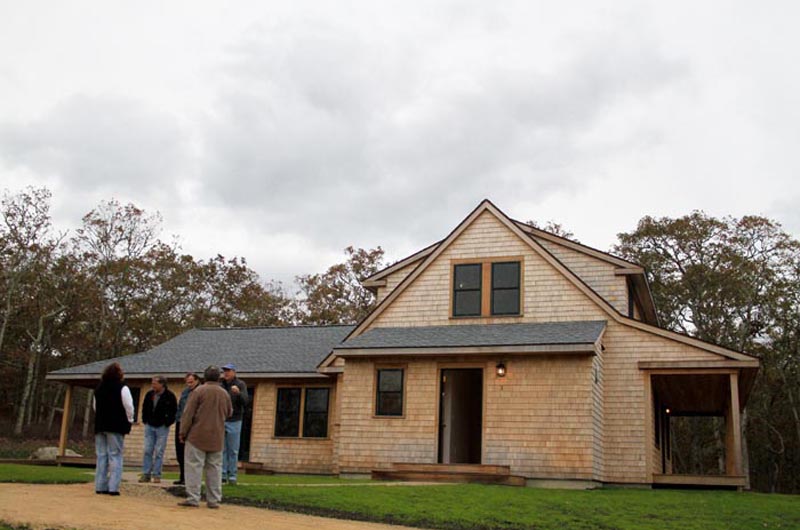
Middle Line Road affordable housing project in Chilmark combines rental and home ownership.
“I hope it’s still around [the CPA] and our voters will support it but I have no guarantee of that,” he said.
Oak Bluffs housing committee chairman Ewell Hopkins called the report sobering, especially when it comes to the aging population on the Island.
“From the numbers, I see that the need is focusing on our elderly population,” Mr. Hopkins said. “The poverty level these folks are having to live at, to me is a quiet or an often unseen reality of so many people’s lives on this Island.”
David Vigneault, executive director of the Dukes County Regional Housing Authority, which among other things administers rental assistance vouchers for Islanders, said the first phase of the report confirms what he is seeing: scarce availability of decent, affordable rental housing. “Timing and luck and availability play way too much a part in it,” he said. “It’s tough, especially when you get to large-size houses, of which there are fewer to find.”
And he pinpointed another trend. He said the county housing authority has seen high turnover rates in recent years because “folks are finding leases in good faith and then four or five months later they don’t have those jobs. Income and housing are incredibly tied in a pretty bad dance right now.”
Mr. Vigneault said there are around 150 Island families who do not have physical addresses. Their children are enrolled in schools, but increasing numbers of families are doubling up and moving around, he said.
“That number has tripled in the last couple of winters,” he said.
The report also found that homelessness is on the rise on the Vineyard. The Rev. Richard Rego, pastor of the Trinity United Methodist Church in Oak Bluffs, said Island clergy are keenly aware of the problem. Churches have a discretionary fund to assist people in need, he said.
“The number one increase we’ve seen over the last year has been giving money to people in order to keep their rentals,” Reverend Rego said. “We’re losing the ability to be able to help people who rent, even at this level.”
“Eventually when [the fund] is exhausted, there’s really nowhere [for people to go], there’s no plan,” he added.
On the issue of zoning Doug Ruskin, president of the Vineyard branch of Habitat for Humanity, suggested that the study explore multi-family units to help address “an enormous problem.”
“This is an Island where almost everybody you talk to likes single-family dwellings, and scattered-site housing is what we’ve been building, and it’s barely a drop in the bucket,” he said. “I’m not talking about six-story apartment buildings necessarily, but there has to be a way to approach this.”
But Christina Brown, a member of the Edgartown conservation commission and the Martha’s Vineyard Commission, said she thinks more public education is needed about the flexible zoning tools already in place in many towns to make more affordable housing possible.
“As a community this Island needs a lot more affordable community housing or we will change as a community,” she said. “The diversity of people who live here, who make our lives more fun, more interesting, more meaningful, will diminish. We need the public education and outreach to make people say, Hey, I’m going to take advantage of this.”
Mr. Ruskin noted that the report, which was funded by the six Island towns, the Martha’s Vineyard Commission and a state grant, is rich with information and data.
“This is probably the most comprehensive study with enormous amounts of information,” he said. “If it doesn’t get disseminated, we have not made the best use of the money.”
Comments
The current housing model is
Housing for Everyone!The current housing model is broken. That's unsurprising, because the current housing model isn't about HOUSING--it's about income changes and social rise.
Put simply: the current model is designed to allow people who live in the homes to profit. When you give money to the homeowners so that they can walk away with a profit, then you're losing money which could be put into housing for others. Moreover, almost all of the affordable housing builds in the last decade have a "heirs" provision and lack a payout provision.
Let's take an example of Harry and Mary Homeowner.
Harry doesn't make much and Mary works part time because of young kids. They buy a house at age 30; they qualify at the 80% level and pay $175,000 for it. Harry's mom fronts the down payment.
By the time they are 40 years old, Harry is making a heck of a lot more money and Mary is back to work. Due to the nice low guaranteed rent, they have plenty of money and the family easily exceeds the 140% level. Harry drives a Volvo; Harry and Mary take vacations with their family. Harry's mom eventually dies, leaving him another $200k.
40 years down the road, at age 70, Harry and Mary move to an old age home. At that point they own their house free and clear, have benefited from subsidized-low housing for 40 years, and haven't been "in affordable need" for the past 30 years.
Not only that, but they can actually walk away with a good-sized profit, and can also
Do people not know this? Do folks not realize that much of the town-funded affordable development in the last decade results in people living in affordable houses who aren't qualified for affordability?
If we want to have enough housing we need to stick with well-run places like DCRHA. Or we need to start identifying the trust fun babies who drive volvos, and move them out to make room for the needy.
Read this article recently
Island Housing TrustRead this article recently published by HUD in Evidence Matters entitled "Shared Equity Models Offer Sustainable Homeownership" at http://www.huduser.org/portal/periodicals/em/fall12/highlight3.html#tit…. This shared equity model has been successfully used by the Island Housing Trust over the past seven years to create and sustain over 50 homes on ground leases land. As the report concludes, share equity programs provides stable, affordable homeownership opportunities to low-income families who would otherwise be priced out of the housing market. At the same time, these programs ensure that public resources invested in affordable housing are maximized. Homeowners realize many of the same benefits offered by traditional homeownership, only with much lower risk. Inherent safeguards — such as mandatory homebuyer education and fixed-rate mortgage requirements — continuous monitoring, and other stewardship activities that are a part of shared equity models support a sustainable homeownership experience.
Here is a theory.... You cant
Gus O'malley OBHere is a theory.... You cant afford something you just dont buy it....
Add new comment