



<p>Herbert Foster began teaching industrial arts for the New York city public school system fresh out of New York University, thanks to the G.I. Bill. It was Nov. 3, 1950 and his salary was set at $13.25 per day. He was 23 years old. On his first day teaching mechanical drawing and blueprint-making at Haaren High School in Hell’s Kitchen, Mr. Foster lost control of the classroom.
Herbert Foster began teaching industrial arts for the New York city public school system fresh out of New York University, thanks to the G.I. Bill. It was Nov. 3, 1950 and his salary was set at $13.25 per day. He was 23 years old.
On his first day teaching mechanical drawing and blueprint-making at Haaren High School in Hell’s Kitchen, Mr. Foster lost control of the classroom. He had made it through a stint in the Army but the classroom full of emotionally disturbed and socially-challenged teenagers brought him to his knees. Halfway through his first day, he wound up hiding under his desk.

Mr. Foster was the subject of a Life magazine photo in the 1950s.
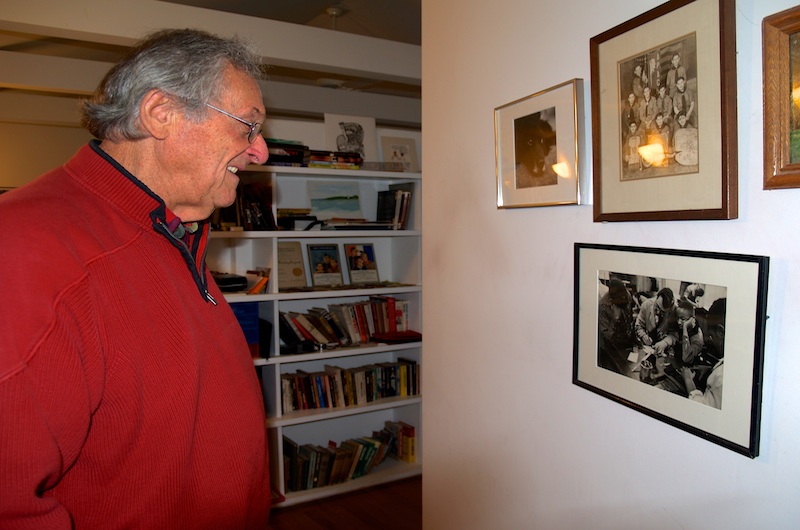
Mr. Foster was the subject of a Life magazine photo in the 1950s.
After his difficult baptism in the classroom, Mr. Foster had an important realization. He had to change his behavior before he could expect to change his students’ behavior. He said he had trouble relating to dysfunctional families because his own experience had been so positive. When he was growing up in Brooklyn, Mr. Foster explained, all the other mothers used to open the window and yell at their children outside to come in for dinner.
“My mother would come outside and say to us, ‘When you’re finished come on up and eat your dinner,’” he remembered. “I was a picky eater and my mother used to strain my vegetable soup until I joined the Army.”
Mr. Foster went on to spend 17 years working in New York city schools and then nearly 30 years at the State University of New York at Buffalo in the education department. He is professor emeritus of the Department of Learning and Instruction at the Graduate School of Education there.
On Thursday, Jan. 31, he celebrates his 85th birthday. As per tradition he will throw a party for himself on the Island by inviting more than 100 people. In lieu of birthday gifts, guests are asked to bring food items for the Island Food Pantry.
The middle of three boys, Mr. Foster said he grew up with both sets of grandparents in a household that survived without a lot of money. In the summers Mr. Foster and his brothers, along with their mother, would go upstate and work on farms for extra money.
“The other kids would come to the farm to see what the Jews looked like,” Mr. Foster laughed.
He became a Boy Scout when he was nine years old and he claims to be the oldest continuously registered Boy Scout in the U.S. In 1998 he retired to Edgartown with his late wife Anita. They had been visiting the Island since the 1970s.
Mr. Foster served on the board at the Martha’s Vineyard Hebrew Center and is actively involved in many community organizations. These days he said he is hoping to highlight the issues he addressed during his decades of teaching, notably communication and language of ethnic groups, which still proves to be a barrier in classrooms today.
“There are very few courses about classroom management and school discipline, chaotic classrooms and aggressive students taught to teachers,” he said.

His book explores cultural differences in the classroom.

His book explores cultural differences in the classroom.
A firm believer in experience being everything, Mr. Foster often took his students on experiential learning adventures while teaching in Buffalo. In 1995 he published the results of a major study involving 3,130 subjects, mostly white and more than half of them educators, regarding perceptions of black males. He asserts that educators, whether consciously or unconsciously, allow their stereotypical beliefs about black males to influence their reactions.
In 1974 Mr. Foster published his first book, Ribbin,’ Jivin’ and Playin’ the Dozens: The Persistent Problem in Our Schools. The book focuses on problems and solutions for understanding cultural differences both in and out of the classroom. For example, chapter five reveals how middle class white teachers may have no problem communicating with middle class white students. However, those same teachers may bring little to no life experience with diverse populations into their classrooms. When they have students from underprivileged, minority and working class backgrounds, the teachers often cannot relate to them or communicate with them effectively.
Mr. Foster still goes on the road discussing this topic and his book. On Nov. 3 he spoke at the annual convention of the New York State Council for Exceptional Children in Saratoga Springs, N.Y. His topic was entitled Black Males and Referral to Special Education.
Mr. Foster illustrates the issues underlying the difficulties of classroom communication by going through language used on inner city street corners versus typical white middle class standard English used in the classroom. In his book, Mr. Foster reminds the reader that there are common words used today with roots in the U.S. immigrant population.
“From the Dutch we have borrowed sugar, butt, and waffle; from the Spanish, mosquito, calaboose, and corral; from the French, chowder and levee; from the Germans, kindergarten, burger, and delicatessen; from the Italians, spaghetti; from the Jews, bagel and blintz; from the Turks, chisel; from the Chinese, chow mein; from the Swedish, smorgasbord, to name a few.”

Ribbin,' Jivin' and Playin' the Dozens was published in 1974.
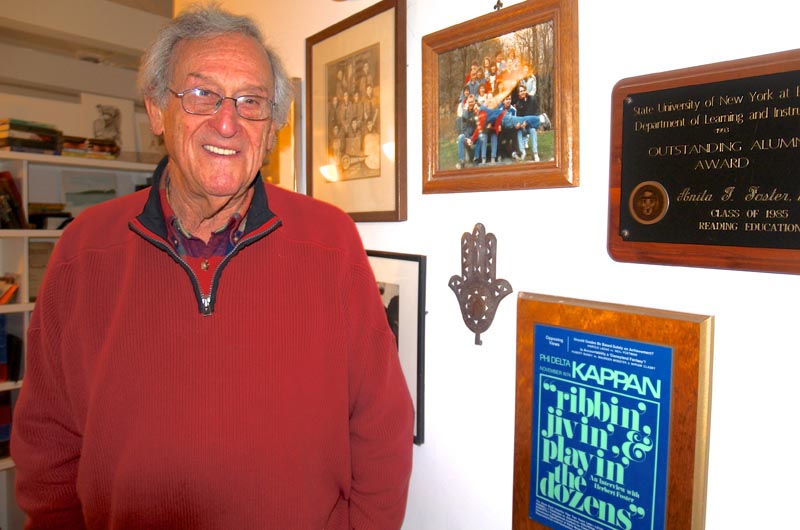
Ribbin,' Jivin' and Playin' the Dozens was published in 1974.
Since these words originate from other cultures, it is easier for Mr. Foster to get to his point — that black culture and other ethnic cultures have a language unique to their population. Mr. Foster notes that teachers’ inability to communicate and their tendency to misinterpret body language, street slang and behavior results in a disproportionate number of students being referred to special education classes or disciplinary action.
The fundamental problem, Mr. Foster said, is that “We don’t know one another, and there aren’t yet enough professors of education who have taught successfully in inner city schools.”
Mr. Foster is currently working on another book, this one concerning Yiddish and Jive.
“Yiddish and Jive are everywhere,” Mr. Foster said. “A lot of people use the words and a lot of people don’t know what they mean or where they came from.”
As an example, Mr. Foster said, “Do you know what shrek means? Years ago a Jewish guy wrote a children’s book and shrek in Yiddish means fear.
Mr. Foster has spent most of his lifetime speaking to groups about racism, education and language and he said he’d love to continue doing just that here on the Island. He’s developing a PowerPoint presentation so that he can speak to larger groups.
“Oh yes, I’m available to speak — even on a topic I don’t know,” he said with a chuckle.
To find out more about Mr. Foster’s books and speaking availability, contact him at [email protected]. Ribbin,’ Jivin’ and Playin’ the Dozens is available at Bunch of Grapes in Vineyard Haven and at Edgartown Books in Edgartown.
Comments
Kudos to Connie Berry for an
Ed Housman EdgartownKudos to Connie Berry for an insightful piece on a great man, and a friend.
Dr. Foster has spent a
George H Siegel FloridaDr. Foster has spent a lifetime working with, and relating to people. His years of teaching and doctoral studies helped prepare him for what has become his trademark, the fostering (no pun intended) of person-to-person and group-to-group relationships. Shaped by Brooklyn, the US Army, New York University, Columbia University, Rockland County, Buffalo, and the Vineyard, his has been a journey of learning and contribution. Herb has always enjoyed relating to a wide variety of personalities and outlook. I'm proud to be his brother-in-law.
My colleague and "Ace" Herb
George Singfield Bethpage, L.I. N. Y.My colleague and "Ace" Herb Foster, like me, is still at it; imparting information and ideas to the young, old, experienced and novices. Herb personifies the adage: "with age comes wisdom" or should I say more wisdom?
My brother-in-law, Herb, has
Zita Foster Fort Lee, NJMy brother-in-law, Herb, has been a source great pride to our family. His dedication to education and people in general has been his mantra for the 50 years I know him. It will be my pleasure to attend his birthday bash. Jack would have loved this article.
Good to read about my good
Al Pautler Sun City, SCGood to read about my good friend and his good work . We worked together at the Uniersity at Buufalo. Skied together. Boated together. Tennis together. What a role model. Keep it going.
having spent 37yt in
jack kane rockaway, njhaving spent 37yt in education, i take my hat off and salute herb for his life-long dedication to those who needed help. at his age, he is like that timex watch--just keeps on ticking. god bless him.
I had the pleasure of meeting
Julie Leitch Watertown, NYI had the pleasure of meeting Herb Foster at the NYSCEC mentioned above. His love for and belief in the education of our youth is inspirational.
It's a pleasure to read about
Lynne Sommerstein Buffalo, NYIt's a pleasure to read about my mentor and friend Herb Foster. I learned so much from him and carry on his message. Go, Herb!
Well said. Herb is indeed
Gerry Rising Buffalo, New YorkWell said. Herb is indeed among the good guys. He has provided a unique voice in education and I am honored by his long time collegiality and friendship.
Great article. Herb continues
Mary McVee Buffalo, NYGreat article--so representative of Herb. Herb continues to be an inspiration in so many ways to me in his desire to keep learning, keep meeting people, and keep following his passions. What a legacy! Those of us at University of Buffalo have a lot to live up to to continue this good work.
So THRILLED to read about Dr.
Julie Grayson (Betsy Aaron's daughter) Franklin Lakes, NJSo THRILLED to read about Dr. Foster's continued accomplishments and contributions. Mom has known him since their NYU days, and Anita was mom's best friend since junior high. Happy 85th!!!!
This insightful article has
Howard Kight Buffalo, NYThis insightful article has convinced me that Herb's next book should be his auto-biography. Even though Herb was one of my closest colleagues at the University of Buffalo, I always felt as if he had a wealth of experiences that would make for facinating reading. As one of my closest colleagues at the University of Buffalo, we spent a lot of time working together on research papers as well as hiking, sailing, and devouring turkey subs. His enthusiasm was and still is beyond belief. What an inspiration!!
Add new comment