

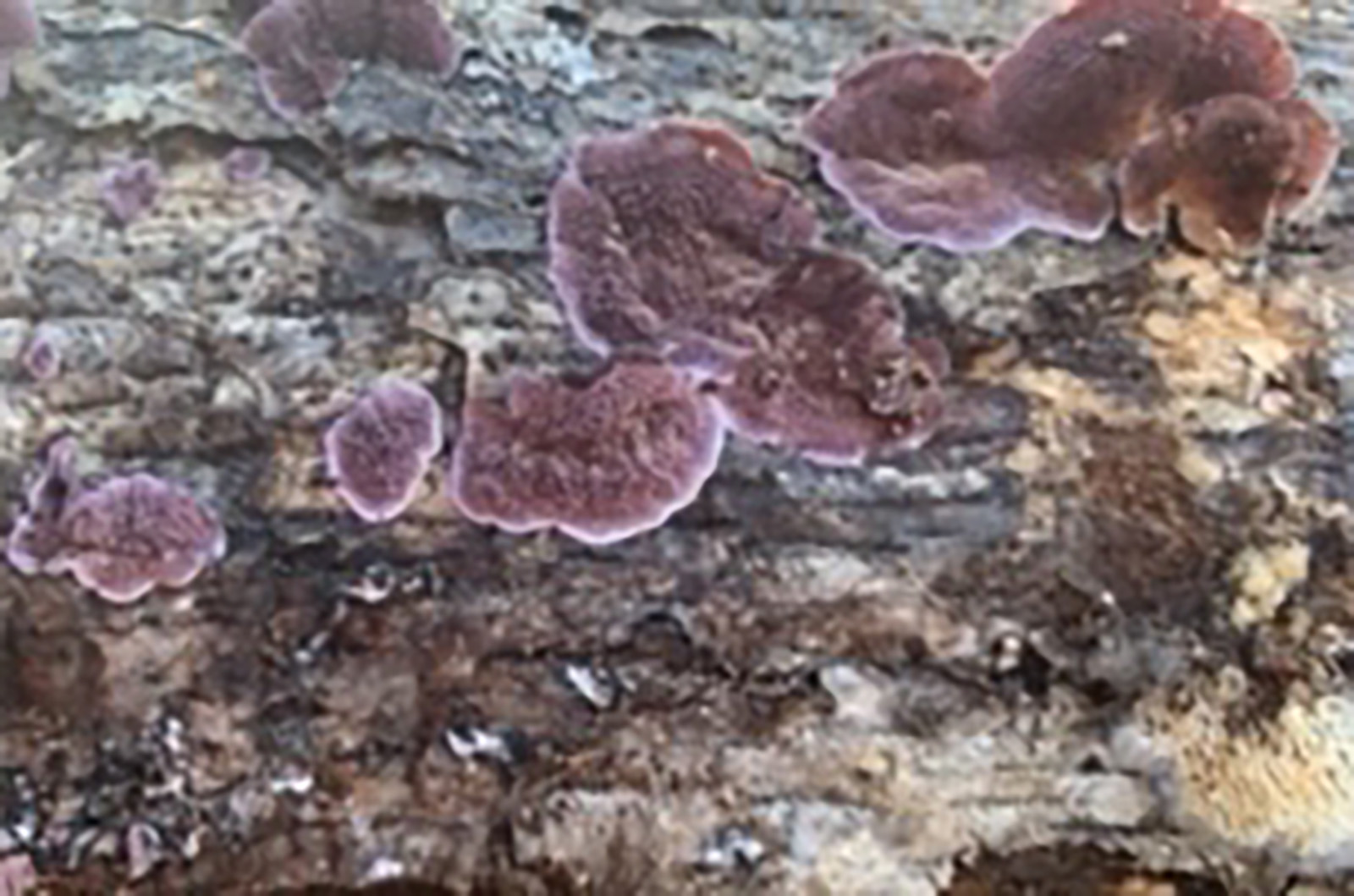
Your point of view matters when you see a violet-toothed polypore.
Your point of view matters when you see a violet-toothed polypore. Looking from above, these bracket mushrooms appear as indistinct brown clusters growing out of a tree or log. One could easily be fooled about this fungus’ identity, thinking it the more well-known (and medicinal) turkey tail mushroom.
Also called purple tooth, violet tooth, purplepore bracket, and violet-pored bracket, these mushrooms show their true colors when seen from below. The bottom or underside of these fungi are brilliant purple, easily distinguished now from its top-side resemblance to turkey tails.
Timing also is everything to experience its brilliant purple hues. As these mushrooms age, the vibrant violet will fade to white, grey, ochre and brown. The margin of the mushroom can keep a purple edge, and the fruiting body can also take on a green hue due to a harmless, if not opportunistic, alga.
This time of year, I spend a lot of time with wood. Cut, split, stack, carry and repeat over and over again, as we fill and refill the woodstove to heat our house. Wood work becomes a meditation, and as my mind wanders, my eyes focus and find life among the logs.
The purple polypores were impossible to miss and there were lots of them to see on the log pile. Found in all 50 states and Canada, this mushroom variety is common and widespread. It is one of four species in the genus Trichaptum. All of Trichaptum species are found on wood and never growing out of the ground. They can be observed on more than 65 tree species, both deciduous and evergreen.
Trichaptum, translates into “with clinging hairs,” describing the bristly nature of the mushroom’s fruiting body. Its species, biforme, refers to the pores on the underside that hold its white spores. The pores can appear tube-like or toothed depending on the individual specimen.
Within the wood is the fungus’ mycelium or vegetative part, which will send out the mushrooms that are its reproductive structure. Purple toothed mushrooms are small at under three inches width, stemless and colonial.
Two notable fungus fans were both credited with early observations and documentations of the genus in the 19th century. One, Elias Magnus Fries, was a Swedish mycologist known as the “Linnaeus of micrology,” and called the “founding father of modern taxonomy of mushrooms.” His claim to fungal fame was developing the first system for their scientific classification.
The other was an English cryptogamist named Miles Joseph Berkeley. Cryptogams are plants or plant-like organisms that lack seeds or true flowers and include botanical oddities such as liverworts, fungi, mosses, algae and others. Berkeley was more a plant pathologist, considered “mainly a namer” and is credited with recording over 6,000 species.
Both men were fanatical about their focus on fungi — naming, describing, and documenting all that they could during their lifetimes and both describing this polypore. They were contemporaries, jockeying to further scientific knowledge and their own understanding of the many magic mushrooms and their unique attributes.
There need not be winners of losers in the quest for understanding the wonders of the natural world. It is easy to be admirers of purple polypores and their relatives: count me too among these enthusiasts. Fries must have understood this, as he was described at the end of his life as an “octogenarian with a young man’s enthusiastic twinkle in the eyes…working happily right up to his death.”
Suzan Bellincampi is director of the Felix Neck Wildlife Sanctuary in Edgartown, and author of Martha’s Vineyard: A Field Guide to Island Nature and The Nature of Martha’s Vineyard.
Add new comment