
Lest you think that science is all fun and games, consider the story of British Zoologist William Elford Leach.
Lest you think that science is all fun and games, consider the story of British Zoologist William Elford Leach.
Leach was an early 19th-century overachiever who reexamined and improved aspects of Linnaeus’ system of biological classifications and made important contributions to modern zoology.
Dr. Francis Boot, a colleague of Leach and secretary of the Linnaean Society of London, enthused, “Few men have ever devoted themselves to zoology with great zeal than Dr. Leach, or attained at an early period of life a higher reputation at home and abroad as a profound naturalist. He was one of the most laborious and successful, as well as one of the most universal cultivators of zoology which this country has every produced.”
Leach left a legacy of legs. One of his major accomplishments was the study and reclassification of millipedes and centipedes. Linnaeus had catalogued them as insects, but with his studies, Leach realized that they were different and reclassified them into his newly designated subphylum Myriapoda, which is where they remain today.
While Leach had an exceptional career, it was short, sidelined in his early 30s by overwork, exhaustion and mental illness. He left his prestigious position to convalesce in Europe with his sister before his early death at 45 years old from cholera. Perhaps it was the counting of the legs of the pedes (millipedes and centipedes) that brought him to his described “nervous breakdown.”
Whatever the cause, we can thank him for his efforts to untangle the limbs of those wormy wanderers.
Millipedes and centipedes differ in a few basic ways. Millipedes are herbivores with two pairs of legs per segment and move slowly. Centipedes are fast crawling carnivores with only one pair of legs per body segment.
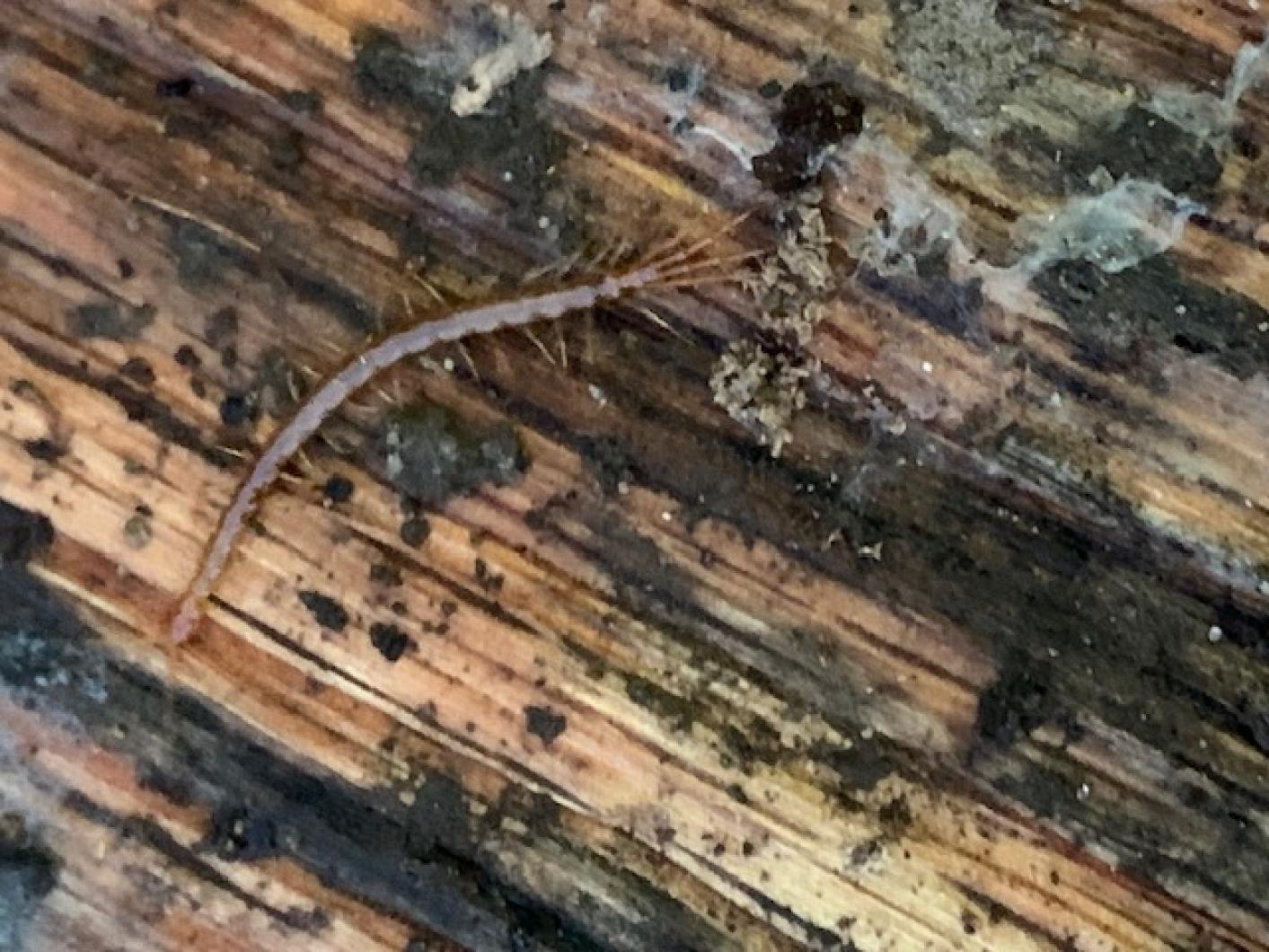
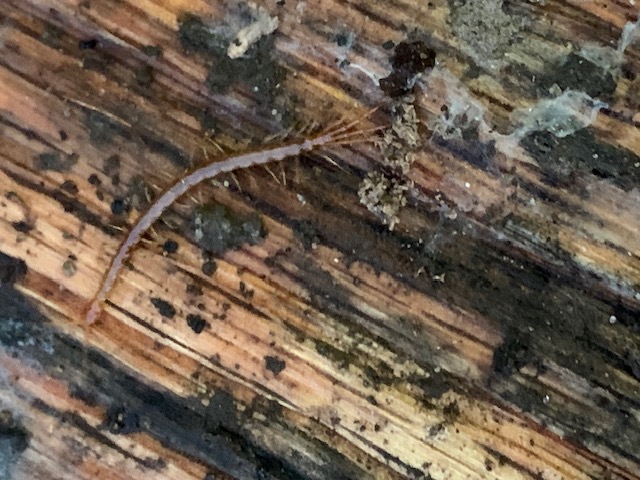
It was a brown centipede, Lithobius forficatus, that introduced me to Dr. Leach. This centipede, also called stone centipede, was first documented by Linnaeus, but reclassified and renamed by Leach. It zipped across a log that I was stacking in the woodpile though I caught a quick look.
The brown centipede doesn’t have a leg to stand on: it has up to 15 pairs of legs to stand on. When this animal emerges from its egg, its leg count is seven pairs of legs (one for each body segment). For every molt, the centipede adds body sections, each with its own pair of legs, until it gets to its maximum limit of 15 pairs.
Those legs are multifunctional, providing for transportation, food acquisition and reproduction. Centipedes have poor eyesight and use their antennae and legs to feel their way around the dark crooks and cervices they call home. They can walk backwards as quickly as they can go forward.
Specially adapted front legs called forcipules resemble fangs and contain the venom that will poison prey (spiders, worms flies and slugs are faves) before they eat them. Males use those legs to perform a courtship dance, after which he will make a silk package called a spermatophore and leave it for his mate to absorb and fertilize her eggs (no copulation necessary). All of these factors give centipedes a leg up on their survival game.
Leach was not only a leg man. His accomplishments went beyond these limbed loiterers, having described, named, and reclassified crustaceans, mollusks, mammals, reptiles, amphibians, and other groups of organisms. More than 135 species were named for him by others who clearly believed that his good works had legs, and, despite his illness, left a solid leg-acy.
Suzan Bellincampi is director of the Felix Neck Wildlife Sanctuary in Edgartown, and author of Martha’s Vineyard: A Field Guide to Island Nature and The Nature of Martha’s Vineyard.
Add new comment