


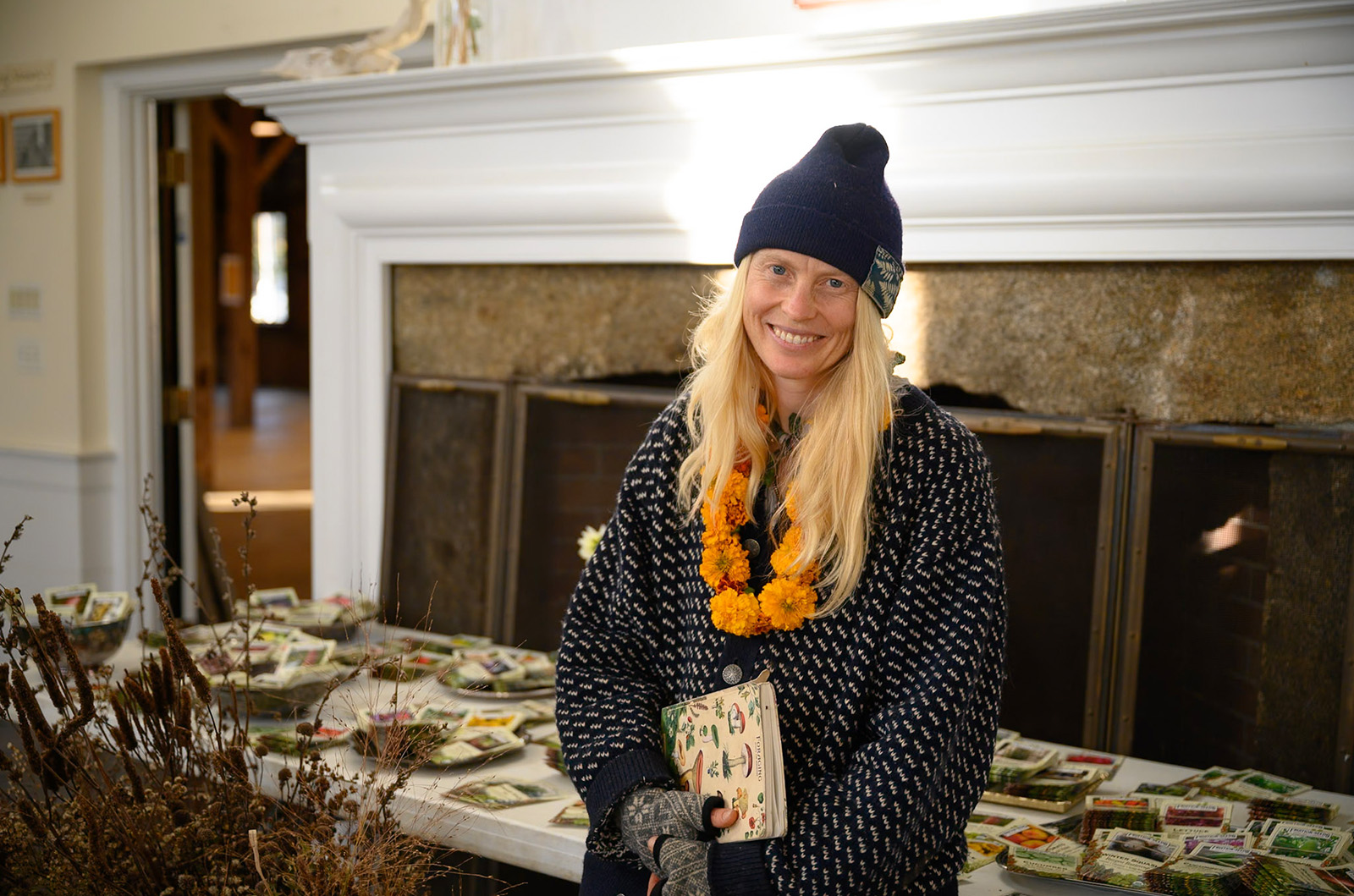
When Petra Page-Mann stood to face a circle of Island farmers and gardeners at the Agricultural Hall on Saturday, she was wearing floral overalls printed with tiny gnomes and a chain of marigolds around her neck.
When Petra Page-Mann stood to face a circle of Island farmers and gardeners at the Agricultural Hall on Saturday, she was wearing floral overalls printed with tiny gnomes and a chain of marigolds around her neck. Packets of seeds from her company, Fruition Seeds, were arranged on banquet-style tables lining the room.
The room vibrated with quiet curiosity as the celebrated farmer from the Finger Lakes region of New York welcomed guests to the “seed feast.” The feast was a focal point of an entire week sponsored by the Agricultural Society and Slough Farm. Ms. Page-Mann worked with schools, farms and community organizations across the Island, as well as the Wampanoag Tribe of Gay Head (Aquinnah), to explore gift culture, donating hundreds of packets of seeds in the process.
“I was asked to bring [Ms. Page-Mann] by farmers, Island Grown school educators and gardeners on the Island,” said Lucy Grinnan, program and outreach manager for the Agricultural Society. “She was able to bring a lot of our communities together around seeds.”
At the seed feast, Ms. Page-Mann ensured everyone that they would leave the hall with as many seeds as they needed. But first, she asked the group to make a series of considerations: Which seeds spoke to them? Which seeds served specific purposes in their gardens and lives? And which seeds could go a long way if given to a friend or neighbor?

Her company Fruition Seeds exists on a reciprocity model.
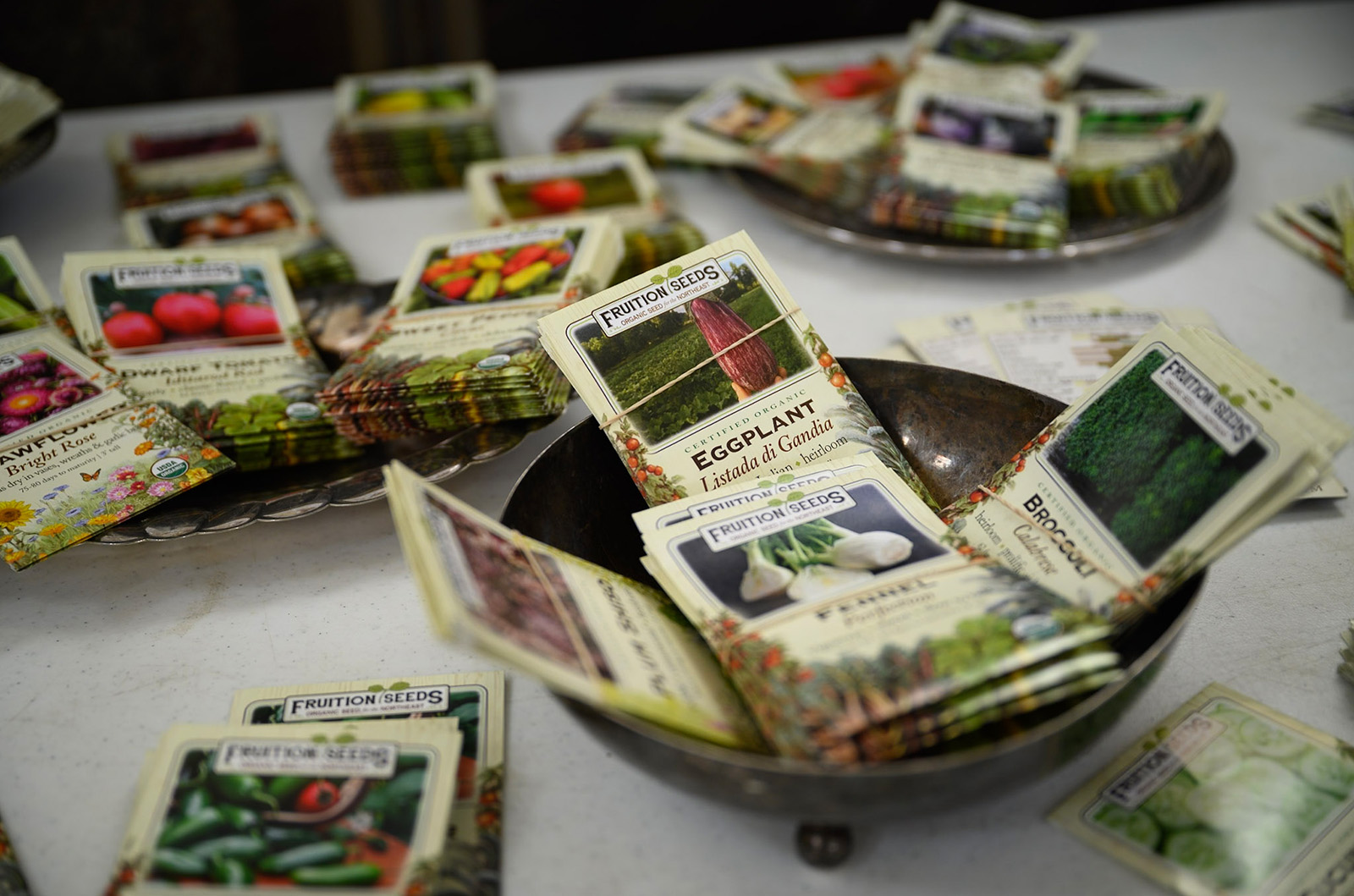
Her company Fruition Seeds exists on a reciprocity model.
Absent from Ms. Page-Mann’s considerations when distributing her seeds are profit margins. That’s because there are no profits to be made; all of Fruition Seeds’s products have cost zero dollars since 2024. Instead, Fruition Seeds operates on a “reciprocity model” — the idea that communities thrive when gifts are given freely, and without the expectation of immediate repayment.
“These seeds are their own selves. They are not mine to buy and sell, and they’re not mine to give, really,” Ms. Page-Mann told the group Saturday. “But it is my responsibility to share what I love with people that I care about.”
Her display at the Agricultural Hall Saturday resembled a miniature, horticultural Antiques Roadshow. The seed feast’s purpose, Ms. Page-Mann said, was to cultivate a spirit of enthusiastic giving, receiving and thoughtful consumption.
Ms. Page-Mann even led the group in “seed shanties” — classic sea shanties re-worked to carry an agrarian message of egalitarianism and anti-fascism.
For Ms. Page-Mann, the reciprocity model is a form of resistance against the market economy, which, in her view, reduces people to what they are able to produce while fostering shame about receiving things “for free.” For her, Fruition Seeds is an experiment — a window into what could be if people could detach themselves from material possessions and re-attach to one another.
Fruition Seeds is based in the Finger Lakes area of New York.
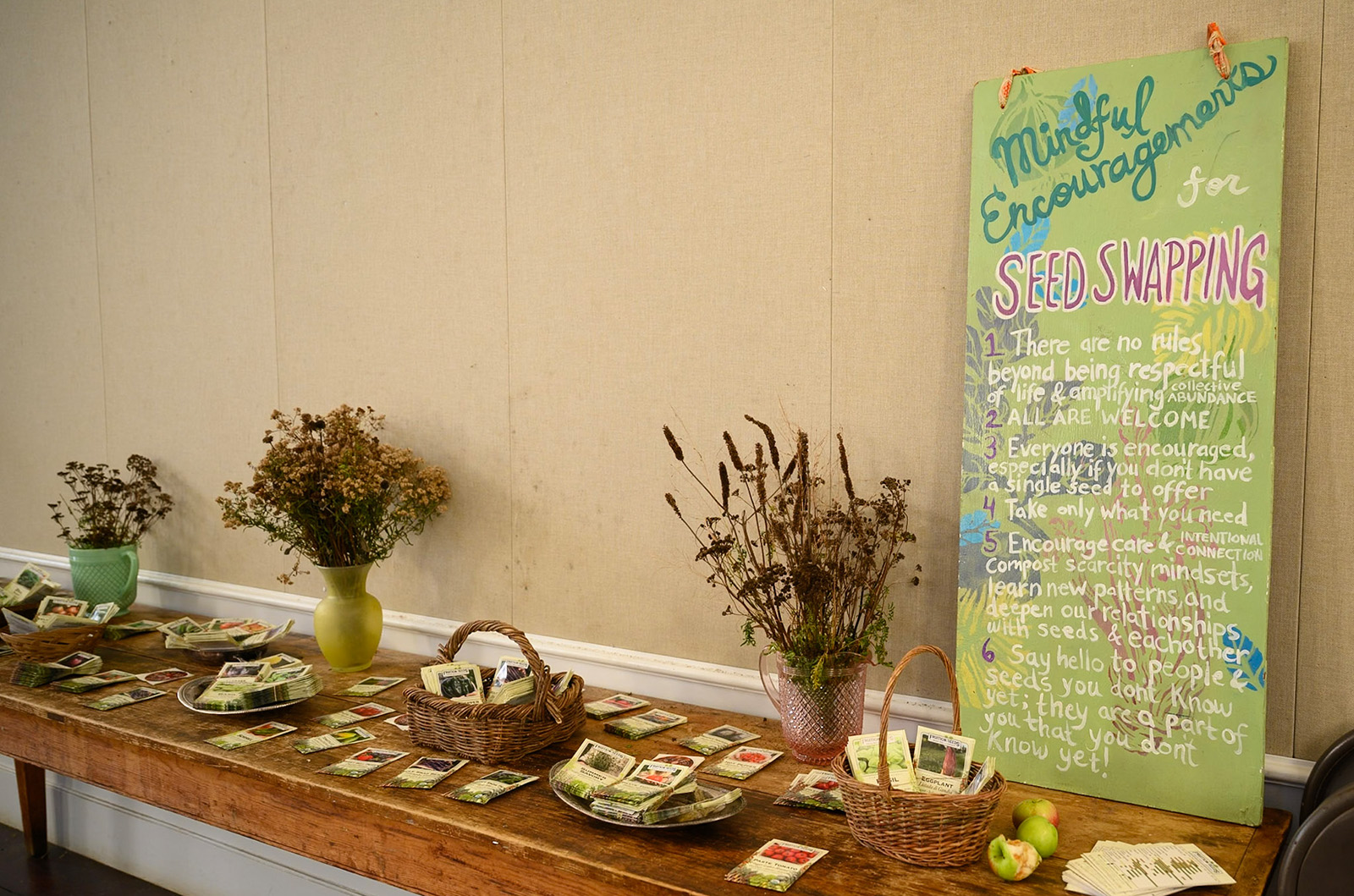
Fruition Seeds is based in the Finger Lakes area of New York.
The reciprocity model is also what enables Ms. Page-Mann to sustain herself. Fruition Seeds’s needs are detailed across three spreadsheets: one for relational needs, material needs and financial needs.
While donations of money and household items are necessary to keep Fruition Seeds going, Ms. Page-Mann said that cultivating relationships is the “bread and butter” of the organization.
During her Island visit, Ms. Page-Mann endeavored to bring this spirit of gift-giving to as many places as she could. She called her meetings with local farms, Island Grown Initiative, the schools and the tribe “ludicrously powerful.” On Sunday, she gave a talk at Stillpoint in West Tisbury on Fruition Seeds and its gift-based model.
Grinnan feels the breadth of Ms. Page-Mann’s visit sparked a lot of important community conversations about how to rely on one another.
“I noticed at some of the events she was running, [there were] a lot of people that I don’t feel like we reached as the Ag Society before,” Grinnan said.
Ms. Page-Mann looks forward to returning to the Island and hopes that those curious about her work will visit her in the Finger Lakes.
“I’m blown away that this Island is infused with that level of care and love and presence and capacity,” she said. “It’s so lovely to hear their joys as well as their longings.”
For more information, visit fruitionseeds.com.
Add new comment