

Some say that the meek will inherit the earth; others suspect that the cockroaches and insects will outlast us all. But David Mabberley posits that it could be a group of plants.
Some say that the meek will inherit the earth; others suspect that the cockroaches and insects will outlast us all. But David Mabberley posits that it could be a group of plants.
Dr. Mabberley is a modern British botanist, educator and writer who is quoted in The History and Folklore of North American Wildflowers as saying that the scientific plant family known as Compositae “are of little value to [humans] except as ornamentals, the edible ones having low levels of toxins, or as in lettuce, having had them selected out; some are insecticides and fish poisons, but many are noxious weeds....With increasing clearance of vegetation throughout the world, these aggressive toxic plants will inherit it.”
Compositae are a large and inclusive group of plants that were first described by Dutch botanist Adriaan van Royan in 1740. Now called Asteraceae, this taxonomic family encompasses more than 1,300 genera and 21,000 unique species worldwide.
A variety of plants resides in the scientific family, including edible ones such as lettuce, globe artichokes, and sunflowers. Herbs are represented with chamomile, calendula, echinacea and wormwood. Native and ornamental flowers that we all know — asters, marigolds and chrysanthemums — are part of the family, too.
It was an aster that welcomed me home last week. There are many autumn asters flowering across the Island and across the continent. With over 150 species in the aster genus (a level or so down within the family Asteraceae) in North America (and 75 of those in the east), there are many to choose from to add to your garden or to try to identify in the wild.
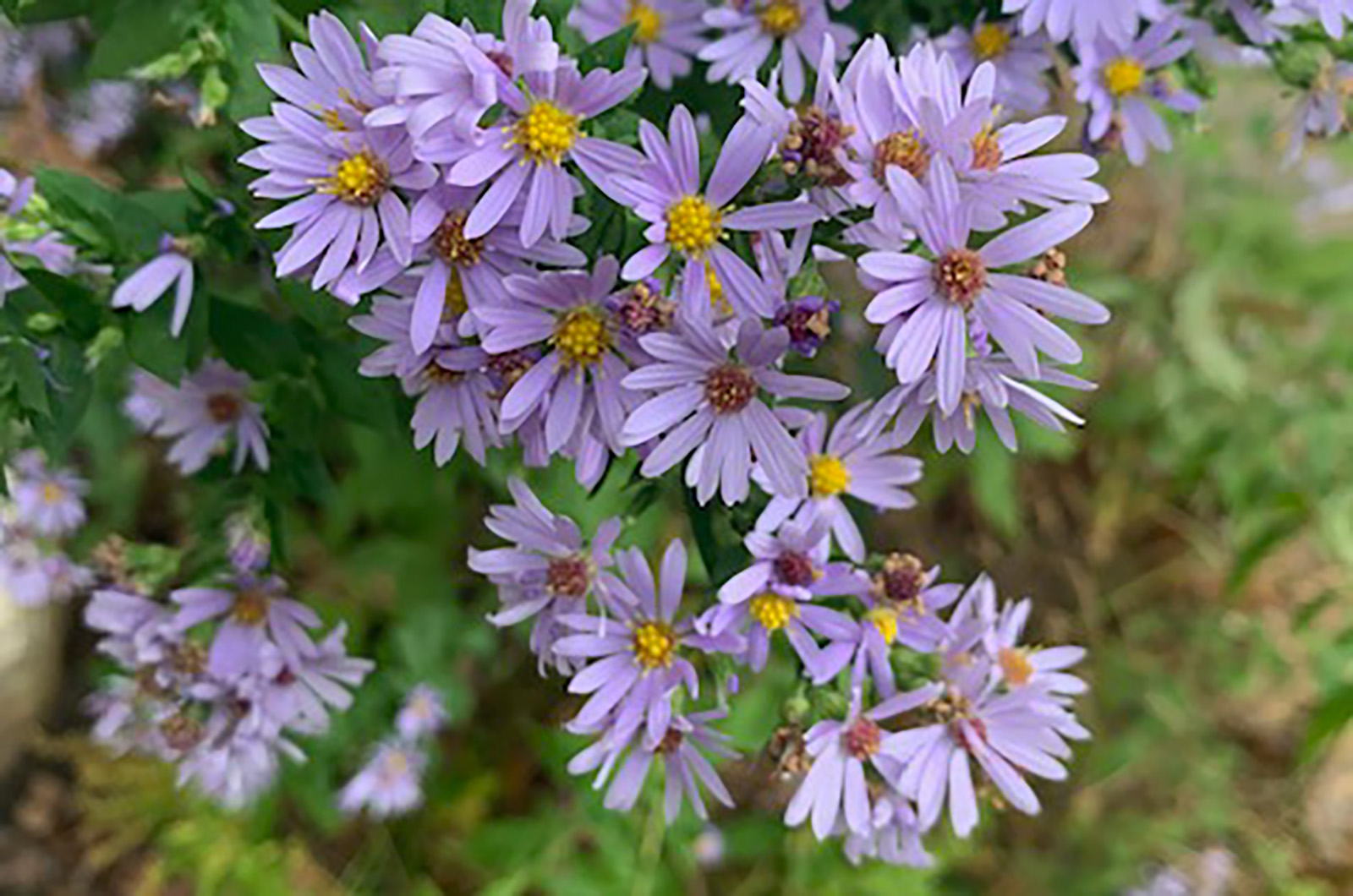
While I hadn’t planted it, wavy leaf aster found its way into my yard. Originally called Aster undulatus, and now known as Symphyotrichum undulatum, this well-named species translates loosely to “wavy plant that grows hair together.” Hair is suggested by the flower’s anthers. Anthers are the part of the stamen that produce and contain pollen.
There is no reason not to welcome this late-blooming beauty. Stunning purple flowers appear along with interesting leaves that clasp the stems on the top of the plant, and ones that don’t at the bottom of the plant. These leaves gave rise to the “wavy” nomenclature.
The word aster comes from a Greek root meaning star, and that could refer to its star-like flowers or from lore suggesting that these blossoms emerged from star dust. Both are beautiful origin stories.
Wavy leaf asters are a pollinator’s paradise. At a time when many other sources have gone by, these asters can provide food for caterpillars, including those of the pearl crescent, aster flowerhead moth and aster-head phaneta moth. The flowers also serve the nectar and pollen needs of sweat bees, flower flies/hover flies, and adult butterflies and moths. And these blooms bring bright purple to the reds, yellows, and browns of the fading summer season.
Since Dr. Mabberley spent his life studying these plants, I expect that he loved them and respected them more than most. I am sure he would concur that we could do worse than his forecast of a future of Asteraceae inheriting the earth.
Suzan Bellincampi is director of the Felix Neck Wildlife Sanctuary in Edgartown, and author of Martha’s Vineyard: A Field Guide to Island Nature and The Nature of Martha’s Vineyard.
Add new comment