

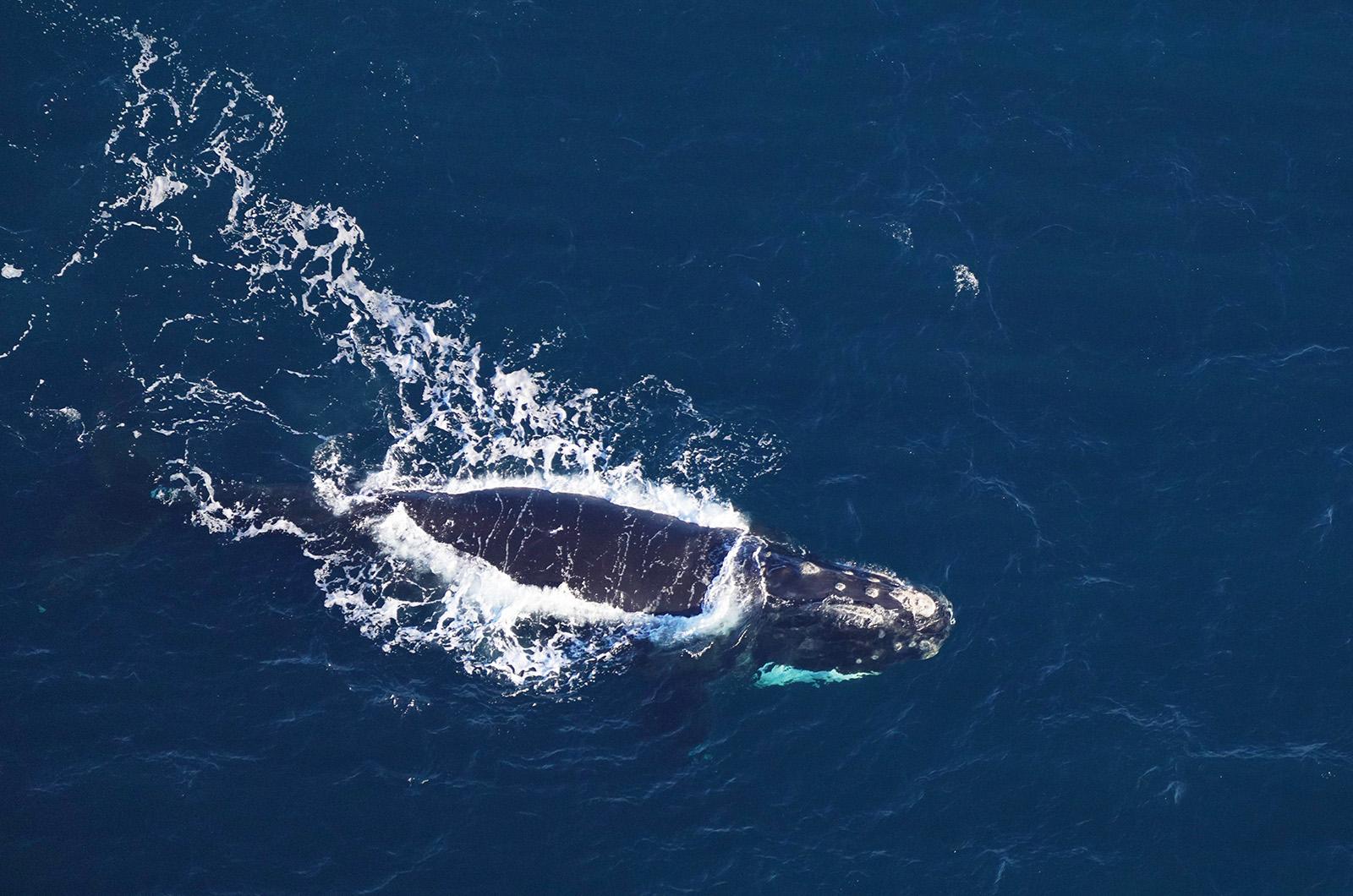
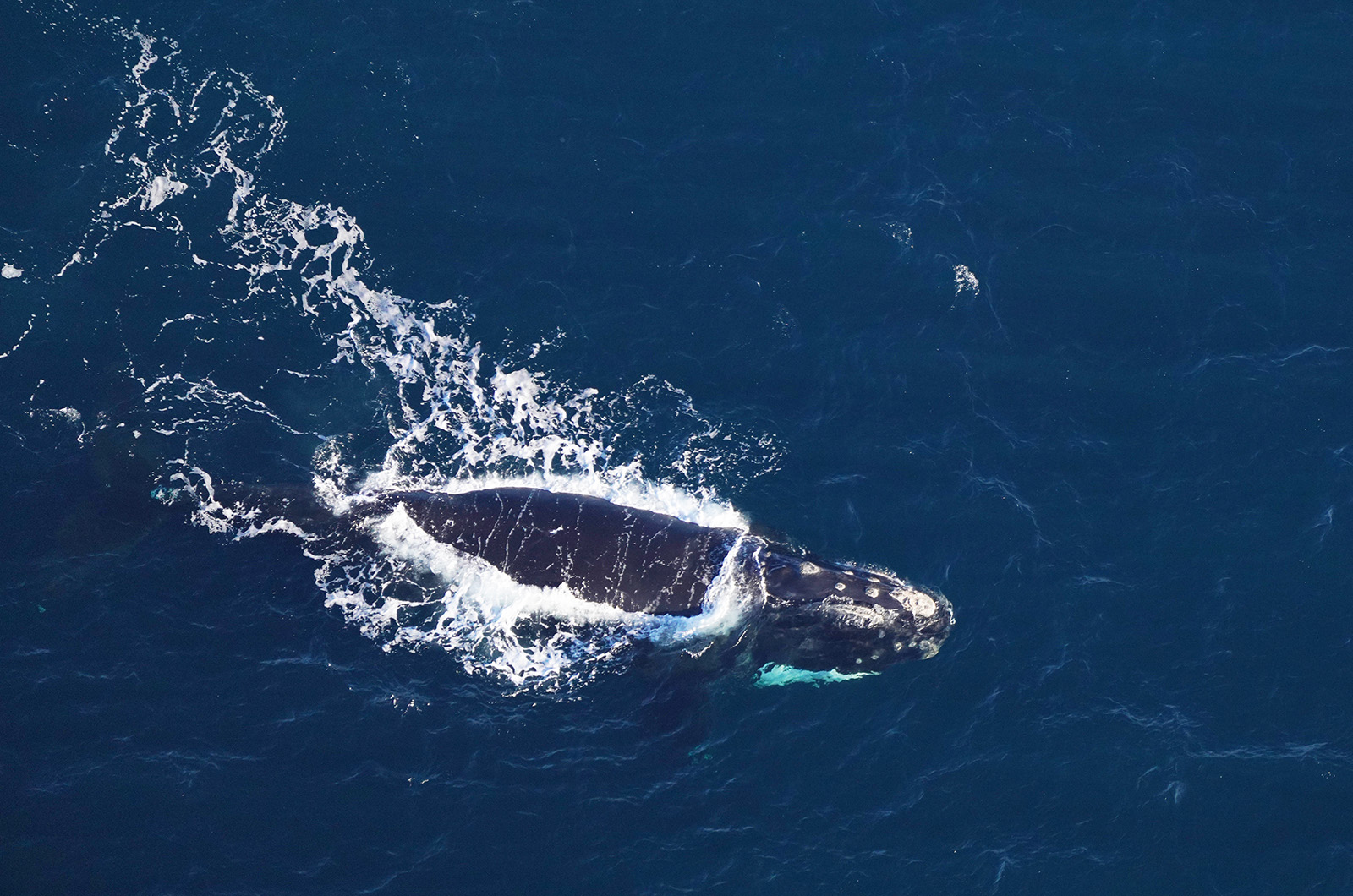
A new report by researchers at the New England Aquarium in Boston, Bigelow Laboratory and the University of Maine is four years in the making and focuses on zooplankton copepods, tiny floating crustaceans that right whales consume in mass quantities.
In April, one of the largest aggregations of right whales was sighted swimming in shipping lanes off the Island’s southern coast. The arrival of over 60 right whales so close to Vineyard shores came as a surprise to scientists who spotted the critically endangered species, which by some counts is down to about 370 individuals.
For a species that takes up so much space in the water, much about their lives, and especially their migrations, remains a mystery.
Recently, however, researchers have been working on a new tactic to track right whales. A report published last month documents how a shift in the way scientists follow right whale prey could lead to new and potentially lifesaving data.
Historically, scientists have tried to track potential food sources to estimate right whale migration patterns through data observed from satellites focused on phytoplankton, microscopic marine algae. Phytoplankton is not a direct food source for these whales so the data only provided limited insight to the whales location.
The new report by researchers at the New England Aquarium in Boston, Bigelow Laboratory and the University of Maine is four years in the making and focuses on zooplankton copepods, tiny floating crustaceans that right whales consume in mass quantities.
“It’s this really interesting sort of size mismatch in the environment where these whales are the size of a school bus sometimes, and their prey is the size of a grain of rice,” said Dr. Camille Ross, an associate research scientist at the Aquarium’s Anderson Cabot Center.
Ms. Ross specializes in the intersection of computer science and marine mammalogy, and is the lead author of the new study called “Incorporating prey fields in North Atlantic right whale density surface models.”
“The study showed that incorporating whale prey does improve our ability to predict where they might show up,” she said.
Since 2021, Ms. Ross’s team has analyzed zooplankton data collected from bongo nets, two circular nets that drop 200 meters below the ocean’s surface and collect samples of zooplankton on their way back up. The team then used mathematical models to approximate zooplankton density several times a year and in various areas of the ocean.
The highest concentrations of zooplankton appeared during the summertime and dropped off during the winter in the depths of the Gulf of Maine and the Great South Channel, southeast of Nantucket.
Dr. Damian Brady, an oceanography professor at the University of Maine who worked with Ms. Ross on the study, said the study provides important new clues about right whale movements, which had become murkier in recent years.
For example, in 2010, due to a climatic shift and rising ocean temperatures, the whales started to travel along un
familiar routes chasing prey. When the whales move through unfamiliar territory, they are more vulnerable to vessel strikes and net entanglements if there are no designated slow zones and commercial fishing vessels are unaware of their presence.
“When whales pop-up in different places like near the Great South Channel or now Jeffreys Ledge or the Scotian Shelf... it sort of sends everyone into a tizzy,” Mr. Brady said.
Here on the Vineyard a device called a Station Keeper was installed in September at the Gay Head Lighthouse to promote the safety of right whales, lighthouse keeper Chris Manning said. It sends National Oceanic and Atmospheric Administration alerts to vessels warning if a whale is detected nearby and directing them to slow down.
Protecting right whales goes beyond one single species as the whales are a vital part of the ocean’s overall ecosystem, Ms. Ross added. When whales die naturally, they sink to the ocean floor and create rare ecosystems for unique communities of organisms to thrive, which are not found anywhere else. Their bodies also store carbon for hundreds to thousands of years, thus keeping it out of the atmosphere.
“There have actually been estimates that if large whales were at their pre-whaling numbers, that they would have an impact on climate change [and] current carbon levels in the atmosphere,” Ms. Ross said.
Though it can be daunting to see how few right whales are left, Ms. Ross said each advancement in research is a reason to remain positive.
“Whales are really worth saving and we shouldn’t give up hope...” Ms. Ross said. “Every single whale is important to the population and they just need advocates throughout the community.”
Add new comment