


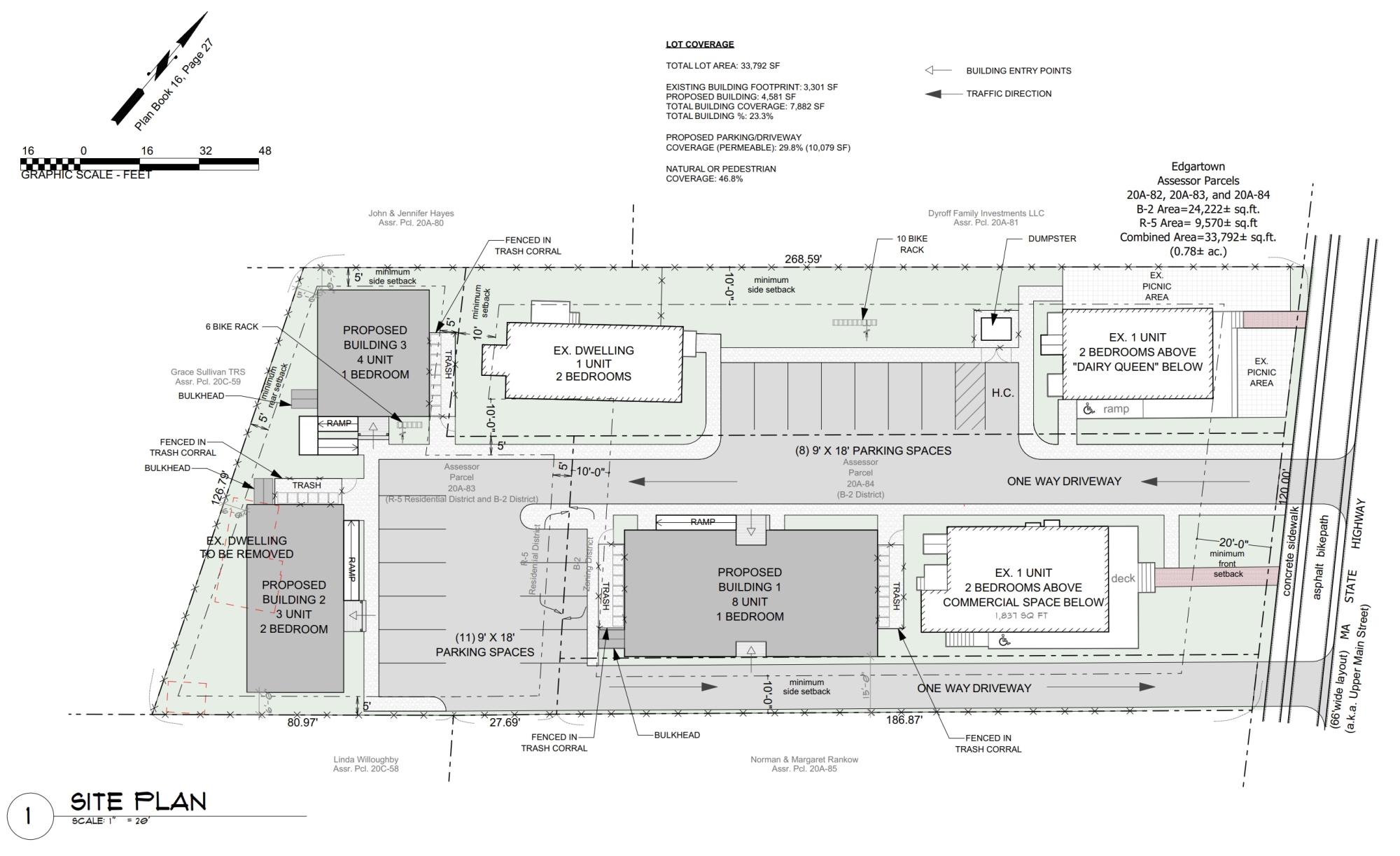
The Edgartown planning board unanimously voted to send the latest iteration of Katama Meadows, a subdivision plan off Meeting House Way, and a 15-unit project near Dairy Queen on Upper Main street to the Martha's Vineyard Commission for review.
Two new proposed housing developments are headed to the Martha’s Vineyard Commission after being referred to the regional planning agency.
The Edgartown planning board unanimously voted Tuesday to send the latest iteration of Katama Meadows, a subdivision plan off Meeting House Way, and a 15-unit project near Dairy Queen on Upper Main street to the commission for review.
Katama Meadows’ new plan, as presented by surveyor Doug Hoehn and attorney Robert Moriarty, includes donating 14 lots to the town for housing and carving out 12 year-round homesite lots for people making up to 250 per cent of the area median income. The project would also create 26 market-rate lots.

Rendering shows the new proposal for Katama Meadows.
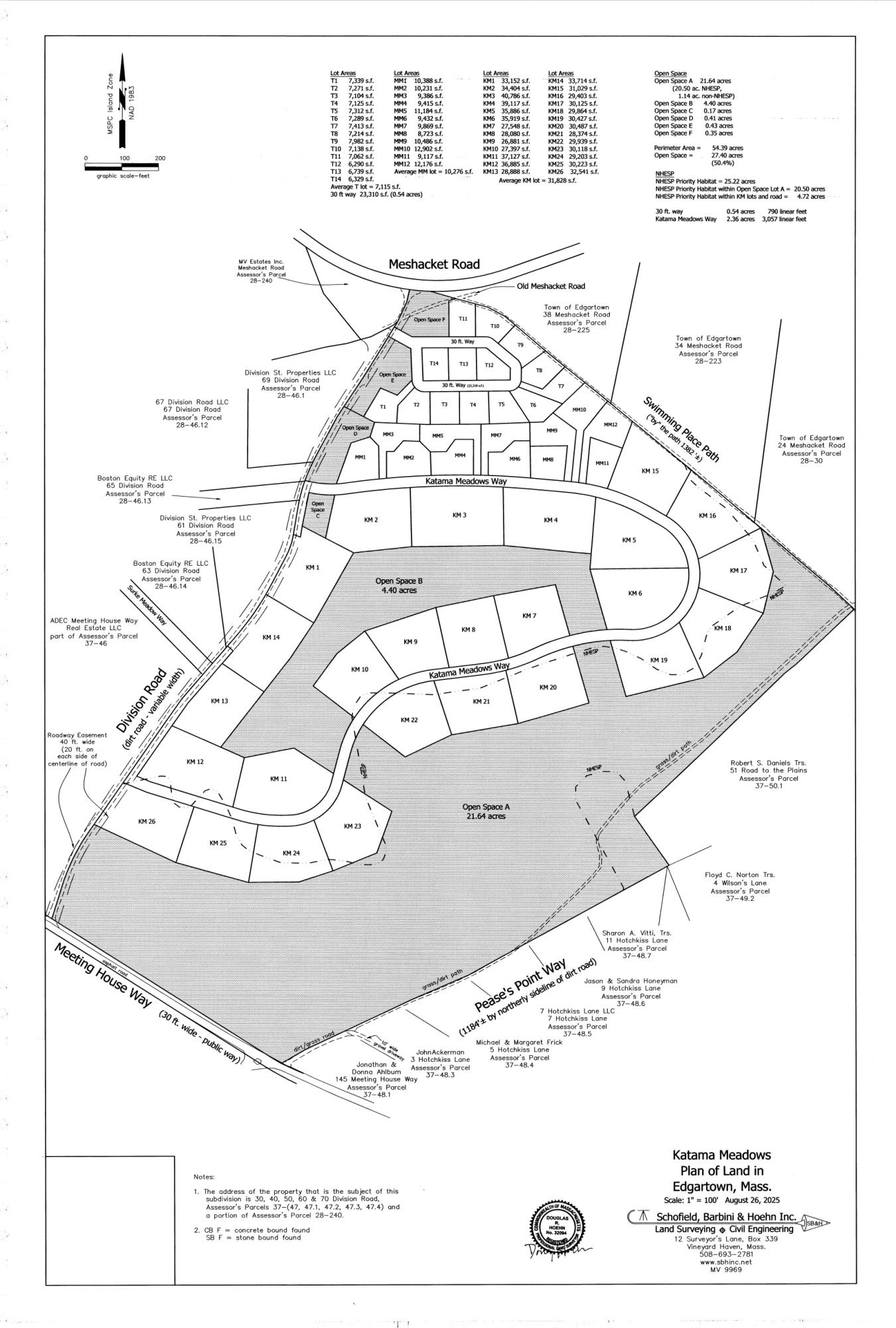
Rendering shows the new proposal for Katama Meadows.
The project has been contentious and has undergone several redesigns. The previous iteration included an affordable housing complex, which was dropped in favor of the new configuration.
Built on about 54 acres of land, about half of the site would be preserved for open space. The town lots measure between 6.300 square feet and 7,400 square feet. The 12 non-market rate lots are expected to be between 9,000 and 12,900 square feet and the market rate lots average to just under 32,000 square feet.
The proposal was drafted with input from the town select board and the affordable housing committee and now targets the “missing middle” income earners who are often not able to qualify for affordable housing.
“This is the best iteration of this project yet,” Mr. Moriarty said.
The brief presentation Tuesday drew praise from planning board chair Mike McCourt.
“I think this plan is much better than the last,” he said.
The proposal will now be reviewed by the Martha’s Vineyard Commission, and, if approved, would need to come back for planning board signoffs. The commission turned down a previous version of the subdivision, which resulted in a lawsuit.
If the new project does make it back to the planning board, Mr. Moriarty has asked that one of the planning board members recuse themselves. In a letter to the board on Tuesday, Mr. Moriarty requested that Julia Livingston, who has been critical of the past proposals, not participate due to prior statements she’s made. In the request, Mr. Moriarty included a homeowner’s association letter that featured a note from Ms. Livingston.
“My personal belief, based on what I know, is that this land is not an appropriate location for dense residential development of any kind,” Ms. Livingston wrote in the April note to the Katama Association.
Mr. Moriarty claimed this statement on the previous design was impossible to reconcile with the board’s oath to take up “faithfully and impartially discharge” the duties of a board member, and he cited several other alleged conflicts of interest.
In an interview with the Gazette on Friday, Ms. Livingston said she had not made up her mind on if she would recuse herself, though she did not see any conflict of interest. She said she has no potential for financial gain from the project, nor does she live in the area or have any other personal ties to the development.
“I think I’m entitled to take a position on the merits,” she said. “All I’m doing is raising issues from what is apparent in the public record.”
The second housing project that the planning referred to the commission Tuesday was on Upper Main street. It was put forth by an LLC connected with the Rosenberg family, which owns the Dairy Queen property. Under that proposal, the developer wishes to build three new buildings, with a total of 15 apartment units. Dairy Queen would remain in its current location.
One of the buildings would have eight single-bedroom apartments, another would have three two-bedroom apartments and the third would have four one-bedroom apartments.
All of the units would be deed restricted to year-round occupancy aimed at workers, said attorney Geoghan Coogan. There are no proposed income limits for the project.
As proposed, the new buildings would be behind the Dairy Queen, and the current driveway would become a one-way entrance. More parking would be added and people would drive back out onto Upper Main street via a driveway on another easement.
Some members of the public raised concerns about access for fire crews and if the project would be within the town’s zoning setbacks.
Mr. Coogan assured neighbors that they would work with them to smooth out any potential kinks as the project goes to the Martha’s Vineyard Commission.
“We love working with the abutters to recognize those concerns,” he said. “We will reach out and work on those types of issues because we are cognizant of the neighborhood and where this location is.”
Editor's note: a previous version of this article incorrectly stated Doug Hoehn's position. He is a surveyor.
Comments
This will be the first step
Charlie Callahan So Boston EdgartownThis will be the first step for the NIMBY to get it shut down,Can just imagine the reasons the dysfunctionals will use to get these good projects held up.
The lots close to Meshacket
EdThe lots close to Meshacket Road are gonna stink to high heaven with the sewer vents and rotting shellfish so close. I hope they factor in the extra air filtering needed and lack of usable outdoor space
With the Dairy Queen
EdWith the Dairy Queen development, with parking already so tight, has Stop and Shop approved us using their lot to get our blizzards? and do setbacks still matter? Isn’t there a case against the town now about setbacks? Does the town want to eliminate setbacks?
Add new comment