


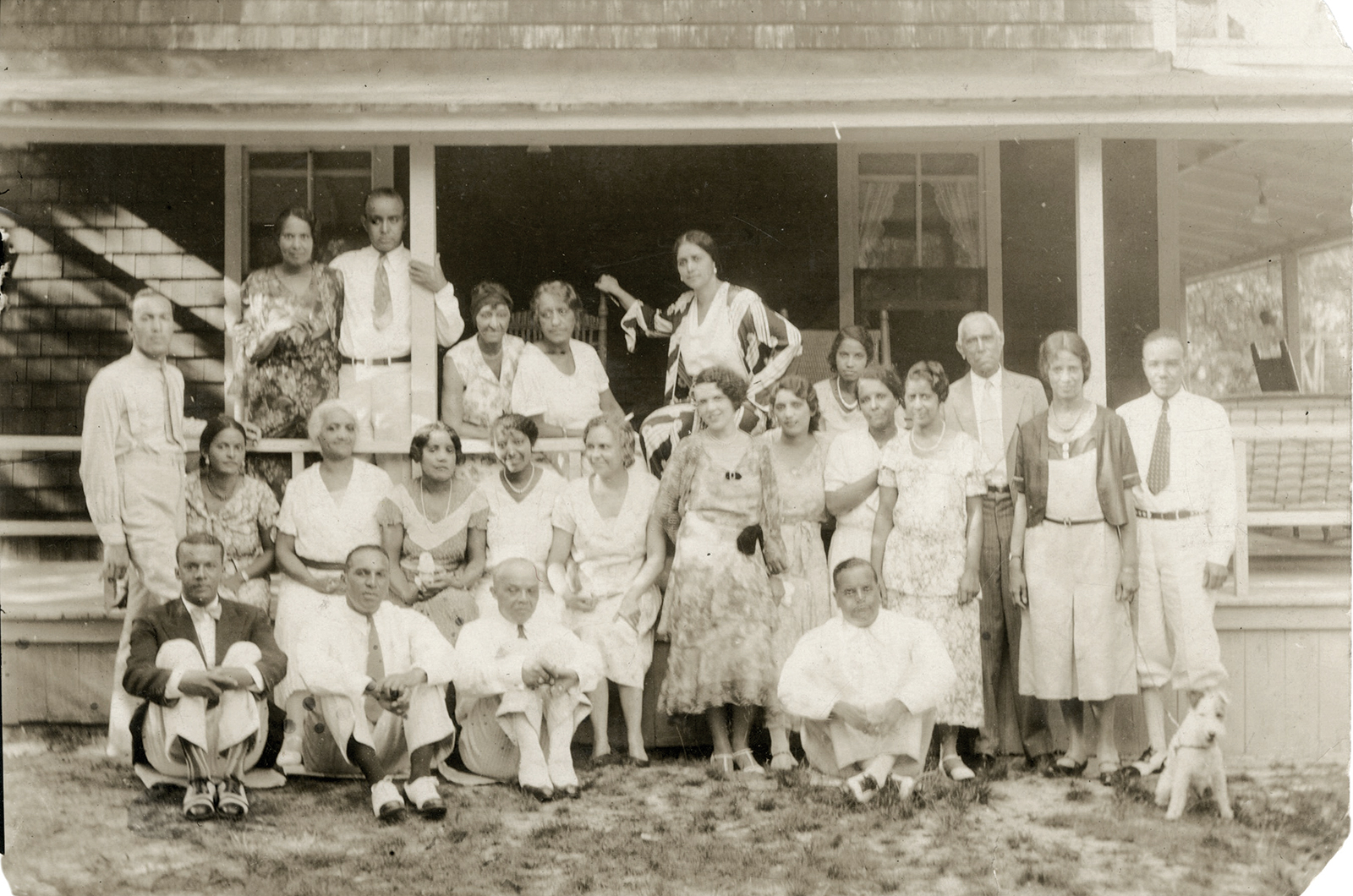
From the September 15, 1972 edition of the Vineyard Gazette by Dorothy West: Mrs. Mildred Johnson Edwards and her teenage daughter, Melanie, live in a large, pleasant house on Tuckernuck avenue in Oak Bluffs, where the cottages share a fine stretch of park.
From the September 15, 1972 edition of the Vineyard Gazette by Dorothy West:
Mrs. Mildred Johnson Edwards and her teenage daughter, Melanie, live in a large, pleasant house on Tuckernuck avenue in Oak Bluffs, where the cottages share a fine stretch of park.
Mrs. Edwards has been a cottage owner for 14 years, but she has been an Island visitor — now and again at first, and then with increasing faithfulness — since the summer she learned to walk at Shearer Cottage. Shearer’s, in the Highlands, took guests to board, and among its distinguished boarders that summer were Harry T. Burleigh, the composer, whose lasting contribution to American culture was his giving permanence to the soul-deep spirituals in a lifetime of researching them and setting them to music and Mrs. Edward’s father, J. Rosamund Johnson, and her uncle, James Welden Johnson.
The brothers were also composers, and over the years of their successful partnership gained Broadway fame for some 200 songs written for light opera. J. Rosamund’s Under the Bamboo Tree is still a familiar title and tune. His Didn’t He Ramble was adopted by Yale as its rally song, and generations later is still rousing Yale men to bring home the victory.
James Weldon’s Lift Every Voice and Sing became the official song of the N.A.A.C.P., and was soon generally referred to as the national Negro anthem. In these years of black awareness it is heard more often, and sung with swelling pride.
When Mrs. Edwards was a child her uncle was already on his way to becoming a major figure in other fields. His achievements were especially notable because he refused to be turned back from his upward climb in an era that was laced with hostility toward men who came in colors unlike the American image.
Mr. Johnson had no children of his own and Mildred was very close to him. Because his widow, Grace Nail Johnson, in her prime a beauty, with great style and charm, is no longer able to travel with ease, Mildred Edwards and Melanie were invited to attend the sesquicentennial of Jacksonville, Fla., as guests of the city for the James Weldon Johnson Day held on June 16.
He was born in 1871 on Lee street in Jacksonville. He died in 1938. The commemorative plaque unveiled at the site of his birthplace in June records him as poet, author, lyricist, educator, lawyer, diplomat, publisher, and militant civil rights leader. A special plaque given Mrs. Edwards to present to his widow says in part of the honor accorded him...so that the youth of today can be introduced to the men of history.
It does not say black youth, as it should not. It does not say black men, as it should not. All youth should know what links men to one another without regard to creed or color.
He was one of the first blacks to pass the Florida bar and practice in Jacksonville. He was principal of Stanton High School for a few productive years. He recognized the void in Negro self-knowledge and published Florida’s first Negro newspaper. Knowledge of him reached government circles, and he served as consul to Venezuela and Nicaragua.
In his New York years he became the first black executive secretary of the N.A.A.C.P., and served brilliantly from 1917 to 1930, succeeding in giving national organization and strength to the association.
He continued to increase in stature as poet and novelist, the vocations that were the real marrow of his bones. In 1931 he received an appointment to the Adam K. Spence Chair of Creative Literature at Fisk University, and was there until his death.
On James Weldon Johnson Day, Mrs. Edwards was presented with keys to the city. At a luncheon following the unveiling of the plaque, Dr. Ellen Moers of Barnard College spoke eloquently of Mr, Johnson’s life and achievement. Everywhere the day was filled with the tunes of James Weldon and J. Rosamund, evoking nostalgia in many listeners.
When he left Jacksonville as a second class citizen of that city, respected in some degree, accepted in none where manhood was tested, he could not dream that he would some day be proclaimed as one of its most illustrious sons.
That young Melanie, riding through Jacksonville with her mother in a chauffeured car with beaming whites beside her, feeling the excitement without the bemusement, was light years away from the rawness of remembering is a statement at the heart of continuing controversy.
A father and uncle whose lives were testaments to goals achieved with grace have given Mildred Edwards and, through her, Melanie a radiant self-assurance without which life is a painful progress.
Mrs. Edwards and Melanie went to Lisbon in August, then on to Madrid, Malaya, Marekesh, and finally Casa Blanca. This was the fourth year they have divided the summer between the Island and abroad. For Mrs. Edwards this may be her last year of plunging here and there before she decides that the flesh is less inclined than the spirit. But to see far places in company with Melanie has been a treasured experience.
Compiled by Hilary Wallcox
Add new comment