

The Martha’s Vineyard Regional High School reconstruction plan cleared a significant hurdle last week, when the Massachusetts School Building Authority board of directors approved the conceptual design for a combined renovation and addition.
The Martha’s Vineyard Regional High School reconstruction plan cleared a significant hurdle last week, when the Massachusetts School Building Authority (MSBA) board of directors approved the conceptual design for a combined renovation and addition.
Island schools superintendent Richard Smith said the state authority’s support was unanimous and clears the way for the next phase of the project: developing a schematic design. Over the next few months, the school’s architect will continue to develop and refine the conceptual plan into a buildable design, complete with project budget.
“Then, costs will no longer be estimates,” Mr. Smith said. “They will be firm costs, and we will, as a school building committee and as an administration, go out to the communities and seek input [and] answer questions.”
Schematic design work began Tuesday evening with a two-hour meeting of the high school building committee and Tappé Architects to go over the school’s square footage needs.
The committee also voted in a new size limit of no more than 199,900 square feet for the project, a reduction of 11,100 square feet from the conceptual design. The current school is 165,000 square feet.
Principal architect Chris Sharkey said Tappé has trimmed square footage wherever possible without falling afoul of MSBA requirements for educational space.
Proposed cuts to the previous 211,000-square-foot conceptual design include some of the gymnasium, which at 14,000 square feet exceeds the 12,000 square feet allowed for reimbursement from the MSBA.
To maximize state reimbursements, the latest plan reorients the basketball court area by 90 degrees, shortening the space behind the hoops to create a 12,000-square-foot main gym and using the other 2,000 square feet for a weight room, a yoga studio and a second, smaller court for practices.
The main gym then would meet the MSBA template, Mr. Sharkey said, while the other areas also would be eligible for reimbursement.
Mr. Smith said the reconfiguration would allow more teams to practice without having to leave campus after school and return later.
Former principal Sara Dingledy, who continues to advise the building committee, said the facility no longer can accommodate all the sports the high school offers.
“Right now, wrestling does not have a location to practice because the gym is occupied in the wintertime with our basketball teams. So the girls and boys basketball teams kind of jostle for space, and wrestling has been sometimes in our cafeteria, sometimes at the Y,” she said.
There’s also demand for volleyball, Ms. Dingledy said, which would increase the space crunch.
Sam Hart, the high school’s coordinator for the building project, said he expects the firmed-up costs for the schematic design to be available in December.
The next state milestone comes in February, Mr. Smith said, when the high school committee brings the fully-realized, community-vetted design and costs back to the Massachusetts School Building Authority board.
“In simple terms, they’ll essentially say if they approve... and if so, what portion of the [state] funding of the project will happen,” Mr. Smith said.
“At that point, we’ll have firm numbers to go forward to our town meetings and present the project [and] the budget,” he said.
The state authority is expected to reimburse more than 38 per cent of most construction costs, although the actual reimbursement rate will likely be closer to 20 per cent when all of the project’s costs are included.
But that can only happen if Island voters agree next spring to borrow the remaining amount, which was estimated in June to cost between $220 million and $270 million for 211,000 square feet with the state reimbursements and at $334 million without them.
Under state law, the high school committee may bring its borrowing request to voters in one of two distinctly different election scenarios.
Following the traditional town meeting legislative system, the funding needs to pass at all six annual town meetings and, presuming the towns seek debt exclusions as well, at all six corresponding town elections in order to receive final approval for the MSBA reimbursements.
The high school committee also has the option to bypass the town meeting process by calling an Islandwide election, held on the same day in every town.
The single-item election would be decided by a simple majority of voters across municipal borders. The election would be administered by the town clerks, but the cost would be covered by the district.
“The first way will require 12 votes. The second way will require one vote,” said all-Island school committee chair Amy Houghton, who also sits on the high school committee, the building committee and the Tisbury School committee.
The district-election strategy has been used in some mainland communities, but never on the Vineyard, school officials have said.
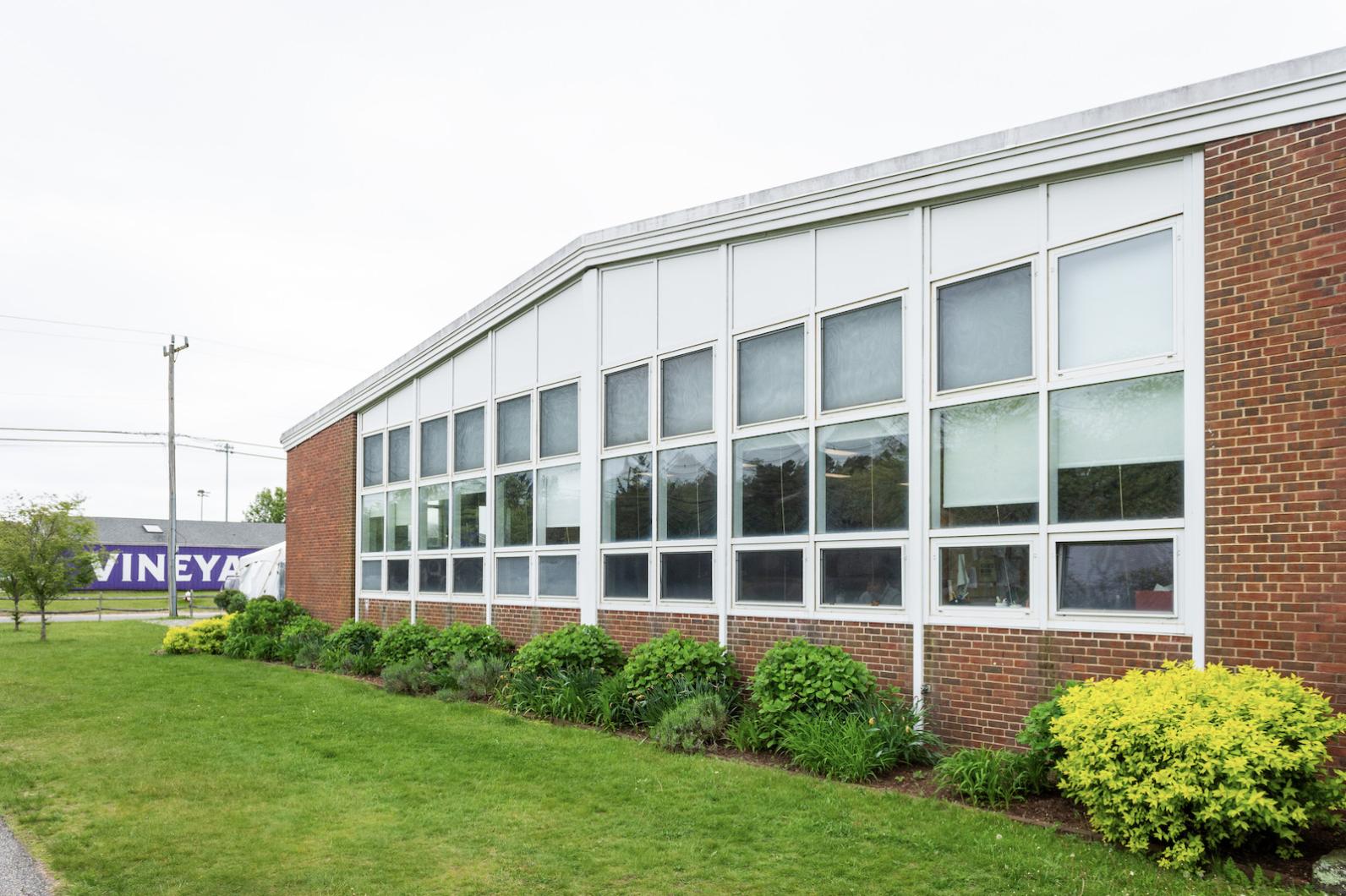
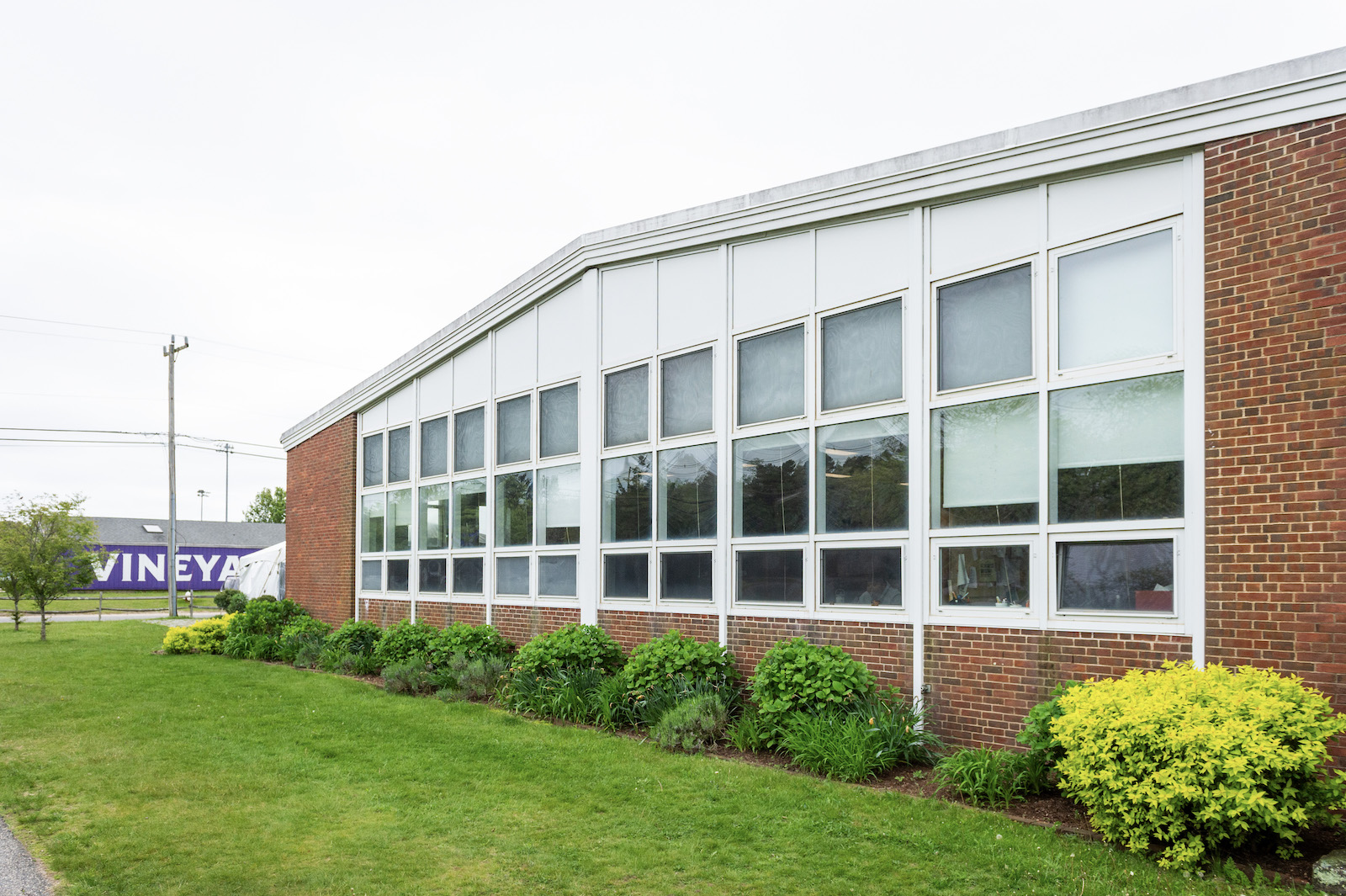
The Tappé design calls for renovating the existing high school, originally built in 1959 and updated in the 1980s, and adding a two-story classroom building.
The plan retains the Martha’s Vineyard Performing Arts Center, a centerpiece of the last renovation that Mr. Smith said will become a prominent feature of the redesigned campus.
“We heard from the community that that was something that folks wanted to keep in the plan [and] that is now the heart of the school,” Mr. Smith said of the auditorium, which is used frequently for public concerts and films as well as school events.
“[It] will be incorporated in the school and not be an exterior building any longer, when this project goes through,” he said.
About 70,000 square feet of interior space will be renovated, Mr. Smith said. All of the construction and renovation work would take place on the north side of Sanderson Road, where the main school is located.
The only outdoor athletic facility slated for improvement is the running track on the south side of Sanderson.
Comments
$334,000,000 for a school for
Charlie Callahan So Boston/Edgartown$334,000,000 for a school for an island of only 15,000 people is insanity. What are they looking for heated toilet seats and robots to serve them meals.The current trade shops don't even have classes that teach heating,AC and plumbing
Then they voted last night to
Henry Cowen West TisburyThen they voted last night to make the present gym smaller in order to get the size down. So they are lying when they say they plan to keep the gym. Why spend money renovating existing space and making it smaller rather than cut the space from someplace else? Most of this committee is happy to spend away with no concept of the consequences.
This plan is an enormous
Jose Oak BluffsThis plan is an enormous financial lift for our community. It sure would be nice to hear from our government officials and School Committee how this proposed building could be used to more comprehensively serve our community, not just the 700 or so students that attend for a fraction of the year. For example, the building is largely unused for much of the summer other than for a handful of summer classes. How can we more creatively use this facility to establish a better value proposition for our taxpayers? And this comment equally applies to all of the other school facilities in Island.
First off, we're not 15,000
here we go again Vineyard HavenFirst off, we're not 15,000 year round any longer. Secondly let's kick this can down the road even longer like Tisbury did. That way this Regional High School will cost us more and we'll lose the state funding source which is substantially better than going at it alone. Why we're at it, Massachusetts General Laws Chapter 71, Section 16(d) allows regional school districts to adopt, in their agreement, a provision that capital projects may be approved by a single district-wide referendum. In that system, all registered voters across all towns vote on the same ballot question, and the project is approved if a simple majority of all ballots cast across the region are “yes.” This avoids a situation where one or two towns can hold hostage a regional school veto even if the project is supported by a large majority. Like the school field fiasco. Does anyone know if the regional agreement allows for this vote?
Add new comment