


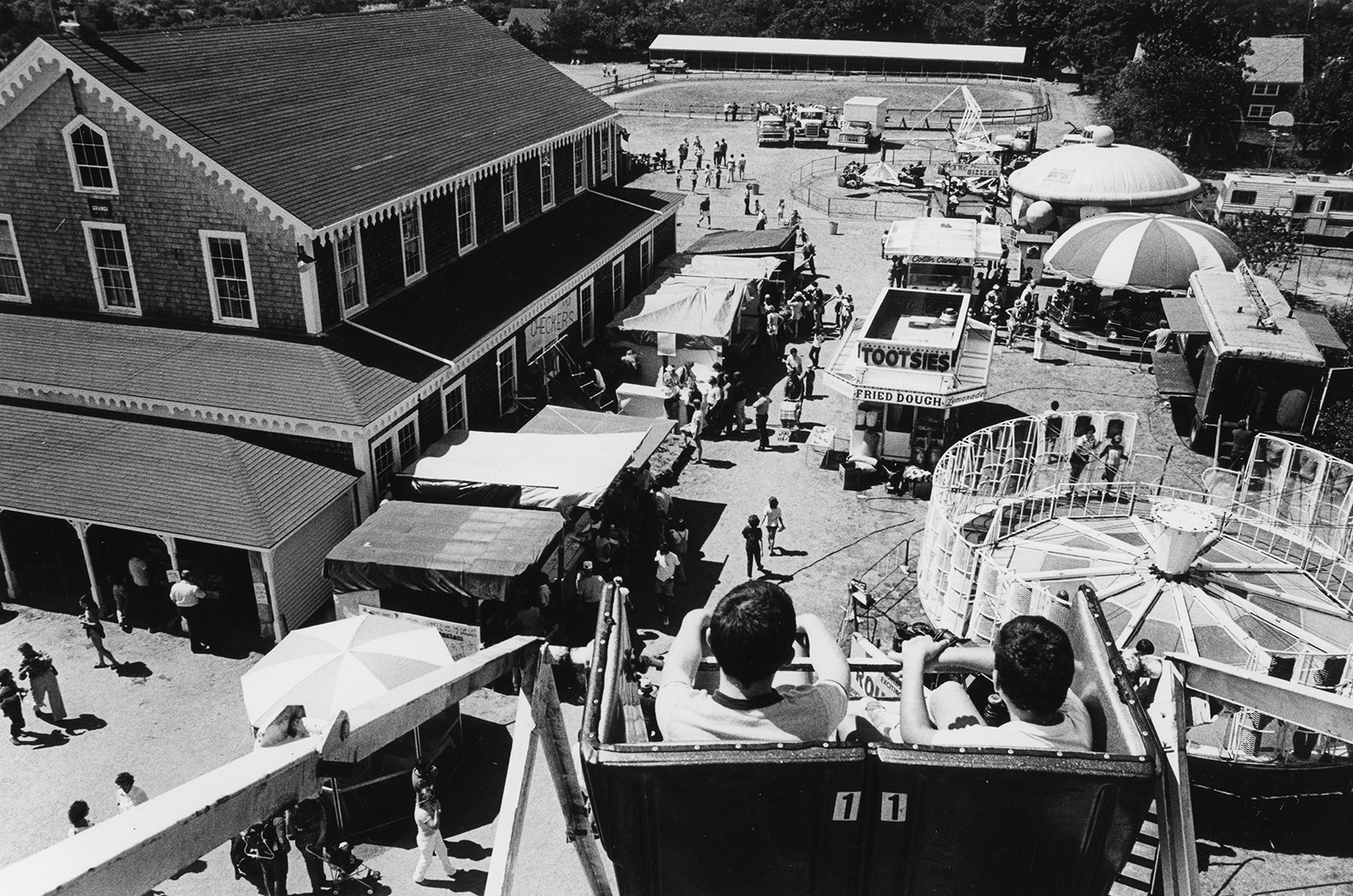
From the August 22, 1950 edition of the Vineyard Gazette: The fair, say the old-timers, isn’t quite what it used to be. But then, they add with reminiscent chuckles, it never was quite what it used to be.
From the August 22, 1950 edition of the Vineyard Gazette:
The fair, say the old-timers, isn’t quite what it used to be. But then, they add with reminiscent chuckles, it never was quite what it used to be. Long about half way through the second fair ever held, someone said wistfully, “You know, last year things were thus and so, and we had such and such, and I guess there never will be a fair like that again. And so the thing began.“
In the old days, of course, the fair was even more of a social event than it is now. With the horse and buggy as the chief means of transportation, casual visits from one end of the Island to the other were hardly the fashion. When on branch of a family lived in Chilmark and another in Vineyard Haven, they saw each other rarely; and old friends, separated by the distance from Gay Head to Edgartown, seldom dropped in briefly of an evening. The fair was about the only time in the year when “everybody saw everybody.”
One old-timer explained:
“With all due respect, it was something like church. Not that people didn’t go to church, then as now, to worship — and maybe more so. But it was kind of a social time too, when people who lived a little ways out got a chance, once a week, to visit their friends in town. In the intermission between church and Sunday school, folks got together and settled everything from courtship to pig-trading, not being sure they’d see each other again during the week. The fair was like that; except it was once a year, and people came together from all over the Island.”
Others fondly remember the sports: the baseball games, the tug-of-wars, the horseshoe pitching.
“Sports brought the young people, and the young people brought the old people. Anyone would go to see how his kids were doing, even if he didn’t know the ball from the bat.”
One West Tisburyite speaks with deep nostalgia of the arguments that took place in by-gone days.
“What arguments we used to have!” he says. “Everyone joined in — the three Tilton boys, the Looks, and all the rest of them. Once a year at the fair, we all got together and — well, the same people aren’t here anymore. Still, I do like a good argument. Not that anyone ever gets me mad.”
“No, nor changes your mind, either,” adds his wife gently.
In past years, there were more participants, fewer spectators in the crowd. As the old saying had it, “The fair is where everybody goes to look at his own pumpkins.” The fair took place late in the fall, and the summer vegetables, no longer fit to eat but plump, yellow, and beautiful to look at, were displayed with pride. So well did the vegetables keep that one old farmer was accused — admiringly — of exhibiting the exact same bowl of prize-winning wax beans year after year.
Everyone has his favorite fair stories, both of the recent and the long ago past. There was the horse racing — and the betting, though nothing official as to the latter. “Lord they’d have had us down to Edgartown for that!”
There were the days when West Tisburyites, waking before dawn on fair morning, heard the lowing of the cattle being driven from long distances into town — “it sounded right festive, somehow.” There was the time when a yoke of ancient, scrawny oxen, brought down by their owner for utilitarian purposes only and not even entered in the fair, casually walked away with a stone boat, which several sleek prize yokes had failed to budge.
An old-timer, who held a life membership in the Martha’s Vineyard Agricultural Society, and therefore rated free admission to the fair, was one of the Island’s most faithful fair goers. Year after year, he approached the admission window, asked for his ticket and his wife’s and walked on through. It is said that on one of his rare visits off-Island, he similarly approached the astonished young man at the steamship dock, and said in an absent-minded, off-hand manner, “The tickets for me and Mindy Jane, please.“
Sheep dog contests were popular in by-gone times, as they undoubtedly would be today. There was a bit of confusion about one such contest held at the fair. It seems that the flock reaching the pen in the shortest time proceeded there in orderly fashion, following close on the heels of their shepherd, who rattled a can of corn at regular intervals. The dog, like the well-trained animal he was, lay under a nearby bush, watching alertly to see that none of his charges strayed.
In the past, there were half-acre and quarter-acre farm contests, and judges traveled the countryside to see the non-transportable displays. There was more handiwork — but no art exhibits, fewer exhibits for youth only.
“We say it’s not the same,” comments one elderly fair-goer, “but if we could go back to a fair of forty years ago — well, I wonder.”
And so it goes. No one would miss the fair, or any part of it, in spite of an occasional grumble that nothing is quite the same anymore.
Compiled by Hilary Wallcox
Add new comment