


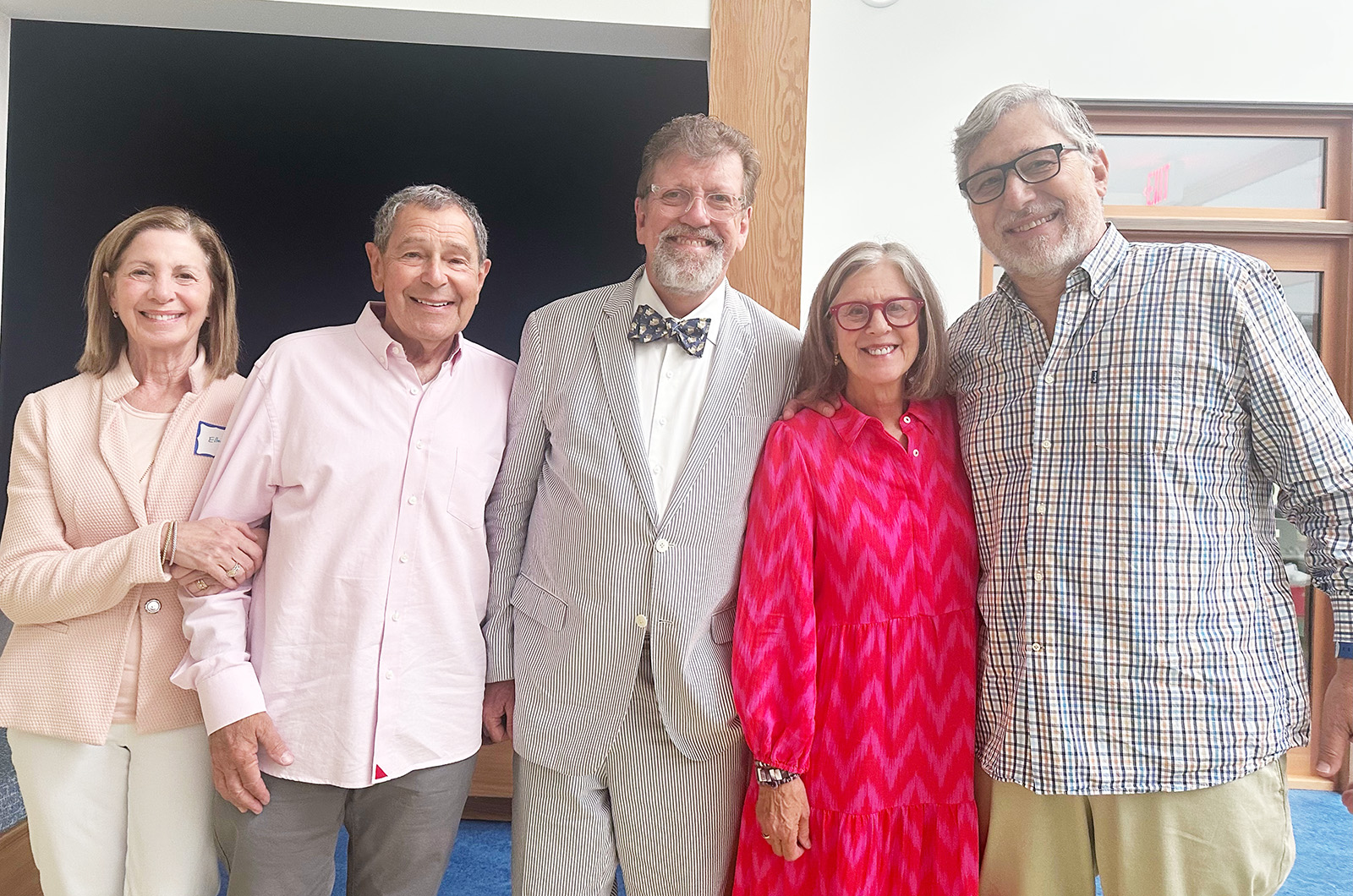
Oskar Eustis, the artistic director at the Public Theater in New York City, gave the final presentation of this season's Summer Speaker series at the Martha's Vineyard Hebrew Center.
Theatre is a mirror. Theatre is participatory, theatre is ancient, theatre is uniting.
But, according to Oskar Eustis, the artistic director at the Public Theater in New York City, theater is also in trouble.
“We’re doing pretty badly right now,” said Mr. Eustis, whose talk on Thursday at the Hebrew Center wrapped up the Summer Institute’s speaker series.
In addition to his current position, Mr. Eustis has worked on countless shows including the premiers of Hamilton and Angels in America. He discussed both in his talk, along with the national decline in support for theatre and why the medium is necessary, now more than ever, in America.
“The directness of how the theatre can affect our culture should not be underestimated,” he said.
Mr. Eustis noted that theatre was born at the same time as democracy in ancient Greece’s Athens, and that it was Uncle Tom’s Cabin — the stage version — that fueled anti-slavery sentiment as much or more than Harriet Beecher Stowe’s famous novel.
With tens of thousands of separate productions across the country, “the stage production is what seared itself into American consciousness in the North,” Mr. Eustis said.
He then discussed Tony Kushner’s Angels in America, a the groundbreaking seven-hour play that follows multiple gay characters during the AIDs crisis in the 1980s. Mr. Eustis commissioned and directed the world premier of Angels in America in 1986 at the Eureka Theatre Company in San Francisco.
“What I will propose is that Angels was the high cultural flag of a moment in history that changed what it meant to be gay in America,” Mr. Eustis said. “It’s because it had characters that were proudly and openly gay who claimed to speak for every American.”
Mr. Eustis recalled his second production of Angels in America in Rhode Island, a heavily Catholic state where many audience members had openly admitted to being homophobic.
“I would stand at the back of the theatre at the end of Angels in America and watch the entire audience leap to their feet,” Mr. Eustis said.
Theatre isn’t an intellectual, rational process, he continued. It is an art form that forces an audience to identify with all characters, humanizing them in the process. More than an exercise in empathy, theatre is an exercise in “empathic fluidity,” he said.
But for years, the art form has been facing financial headwinds.
“We’ve lost more theatres in the last five years than ever,” Mr. Eustis said.
Corporations have stopped supporting nonprofit theatre since the Reagan era. Funding for the arts has plummeted further under President Trump.
Mr. Eustis noted that in addition to financial cutbacks, the subject matter in recent years has also been part of the problem.
“There’s nothing that we have made in theatre in the last 10 years that holds a mirror up to America,” he said.
The last production to do that was Hamilton, said Mr. Eustis, who produced its premier in New York in 2015. Hamilton tells the story of Alexander Hamilton’s rise and fall from political power in the late 18th century. It typically casts actors of color, a production decision that is “laced into its very DNA,” he said.
This meant that Hamilton’s message was fundamentally about who exactly could claim America for their own: “the people who were brought here as slaves and oppressed workers,” said Mr. Eustis.
Hamilton’s huge success exposed “a suppressed hunger of progressive people to feel patriotic,” he added. “And when we had a chance to see something about America that we could love, we just watched it.”
In March, Hamilton announced it would cancel its shows at the John F. Kennedy Center in 2026, citing the firing of the center’s president and President Trump replacing its chairman.
The Trump administration has also canceled tens of millions of dollars in funding to the National Endowment for the Arts and the National Endowment for the Humanities, cutting off grants that support nonprofit theatres across the country.
“They’re shameless,” Mr. Eustis told the Gazette. “They do not want the truth to be told; they do not want any history except their white supremacist version of history to be told.”
One audience member asked if real-life drama is currently overshadowing staged drama.
“There’s a political theatre going on, but it’s a theatre that’s designed to numb us into acquiescence,” Mr. Eustis responded. “That’s a theatre that we should be walking out of and not participating in.”
What we should be participating in, Mr. Eustis said, is not just professional theatre. It’s school plays, community theatre and semi-professional theatre, acting as an “unbroken web” to expand democratic possibility.
“And if the theatre works and does its job, it reveals that the play, on some level, is just a machine for turning all those individual spectators into a community,” he said.
Add new comment