


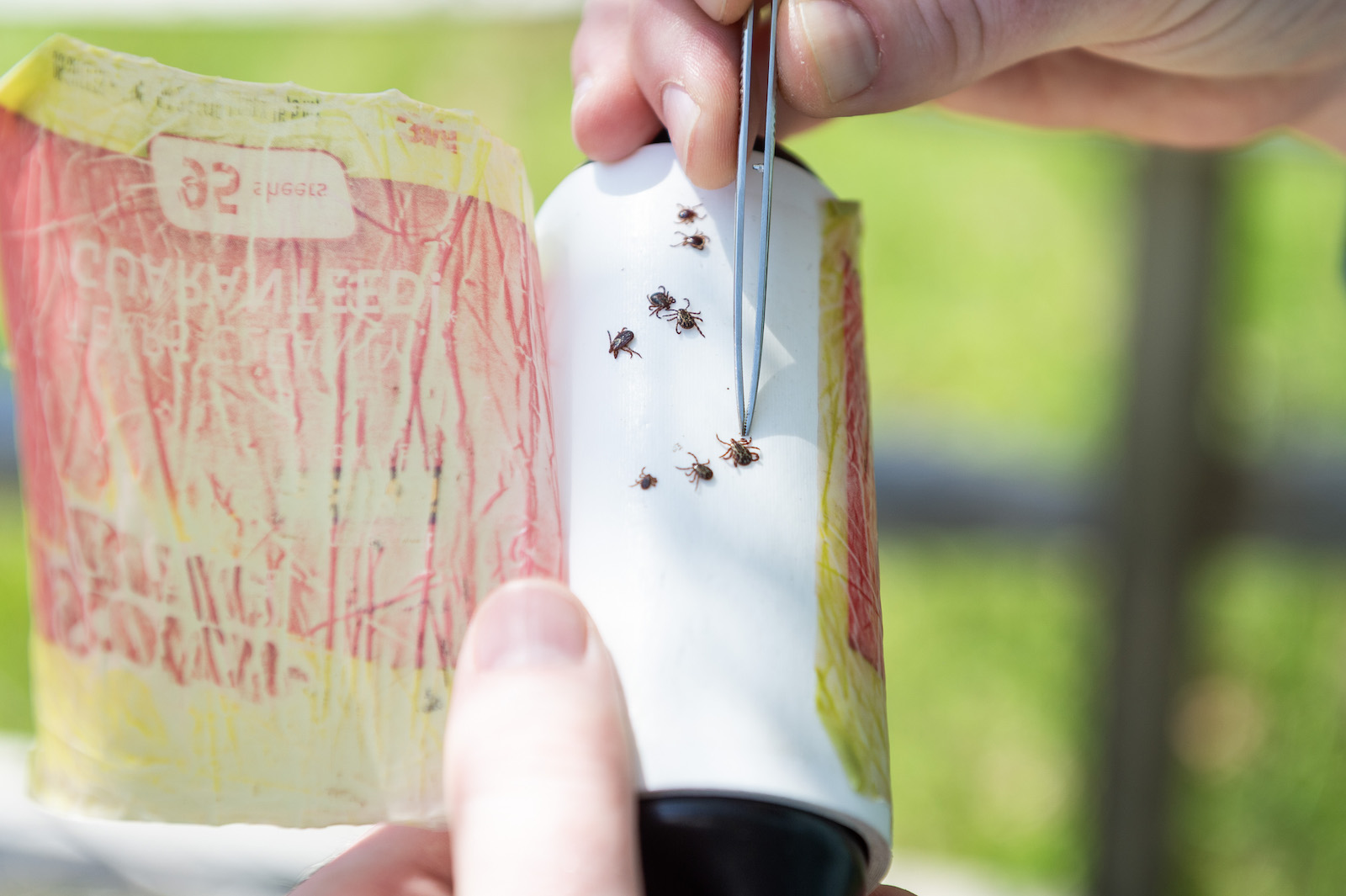
Vineyard public health officials are investigating a preliminary case of Powassan virus – a potentially lethal infection that has only been found on the Island once before in the last 20 years.
Vineyard public health officials are investigating a preliminary case of Powassan virus – a potentially lethal infection that has only been found on the Island once before in the last 20 years.
The Island boards of health announced the preliminary case in a Martha’s Vineyard resident on Monday. The virus is rare, and can be transmitted by deer ticks. Unlike other tick-borne illnesses, where ticks may need to be attached to a person for hours to be contracted, Powassan can be spread within only 15 minutes of a tick bite.
There is no specific treatment or cure of Powassan, which can cause brain swelling, confusion, seizures and long-term neurological complications.
Officials did not identify the person who had contracted the virus or say what town they were from. There have been three other cases of Powassan in Massachusetts confirmed by the U.S. Centers for Disease Control and Prevention in the state this year.
In the statement from the boards of health, Tufts professor and longtime Vineyard tick researcher Sam Telford said the virus is present every year in a small percentage of deer ticks, but fortunately severe disease remains very rare.
With the help of Vineyard tick biologist Patrick Roden-Reynolds, Mr. Telford’s lab has tested more than 3,500 nymph deer ticks between 2021 and 2024.
“Between 1 and 2 per cent of nymph deer ticks on Martha’s Vineyard are infected,” Mr. Telford said. “This is a similar rate to that seen elsewhere in New England. This suggests that many people who are exposed may successfully fight off the virus without ever knowing they were infected.”
Deer ticks have long been established on Martha’s Vineyard and the nymph ticks are active on the Vineyard from May through July.
“Their activity coincides with when we spend most of our time outdoors and, unfortunately, when our Island population grows for tourism season,” Mr. Roden-Reynolds said in the statement. “This makes nymph deer ticks the main driver of infectious diseases such as Lyme disease, babesiosis, anaplasmosis, borrelia miyamotoi and Powassan virus.”
Because Powassan can be spread so quickly and there is no cure, Dukes County epidemiologist Lea Hamner stressed protective measures to prevent tick bites from occurring.
“With deer ticks, lone star ticks and American dog ticks all present on Martha’s Vineyard, it is possible to encounter ticks during any month of the year,” she said. “Tick bite prevention needs to be a year-round habit.”
Officials recommended permethrin treatments for clothing, regular tick checks, wearing light clothes and wearing other tick repellents.
Powssan was first reported in the 1950s in a child who died of encephalitis in the town of Powassan, Ontario. In 2023, there were 44 cases in the U.S., with Massachusetts leading the way for any single state with 10 cases.
Comments
These articles always have
Christine SengeThese articles always have health department officials saying what individuals can do to prevent tick bites. What is the island doing with the deer population? Extending the haunting season and providing some form of birth control for the deer are two ways the Martha’s Vineyard commission can take some action. People are going to stop coming here if this situation isn’t contained, and it can’t all fall on the individual.
I continue to be surprised
Inde West TisburyI continue to be surprised that as an island we can’t tackle this. We are not the mainland. Ticks don’t swim. Ticks do not seem to be an important part of our island ecosystem. Can’t we dump lots of the drug we give our pets in pellets all over the island and effectively give a tick killing medicine to the mammals that sustain the tick population? Or if not, aren’t there some other options? Scientists, help us out here. We are an island! We should be able to do something. We are humans getting sick. It feels like we are frogs in a pot of hot water, oblivious to the increasing temperature. Let’s act! There should be a will and a way.
Add new comment