


Some couples are just not meant to be.
Some couples are just not meant to be.
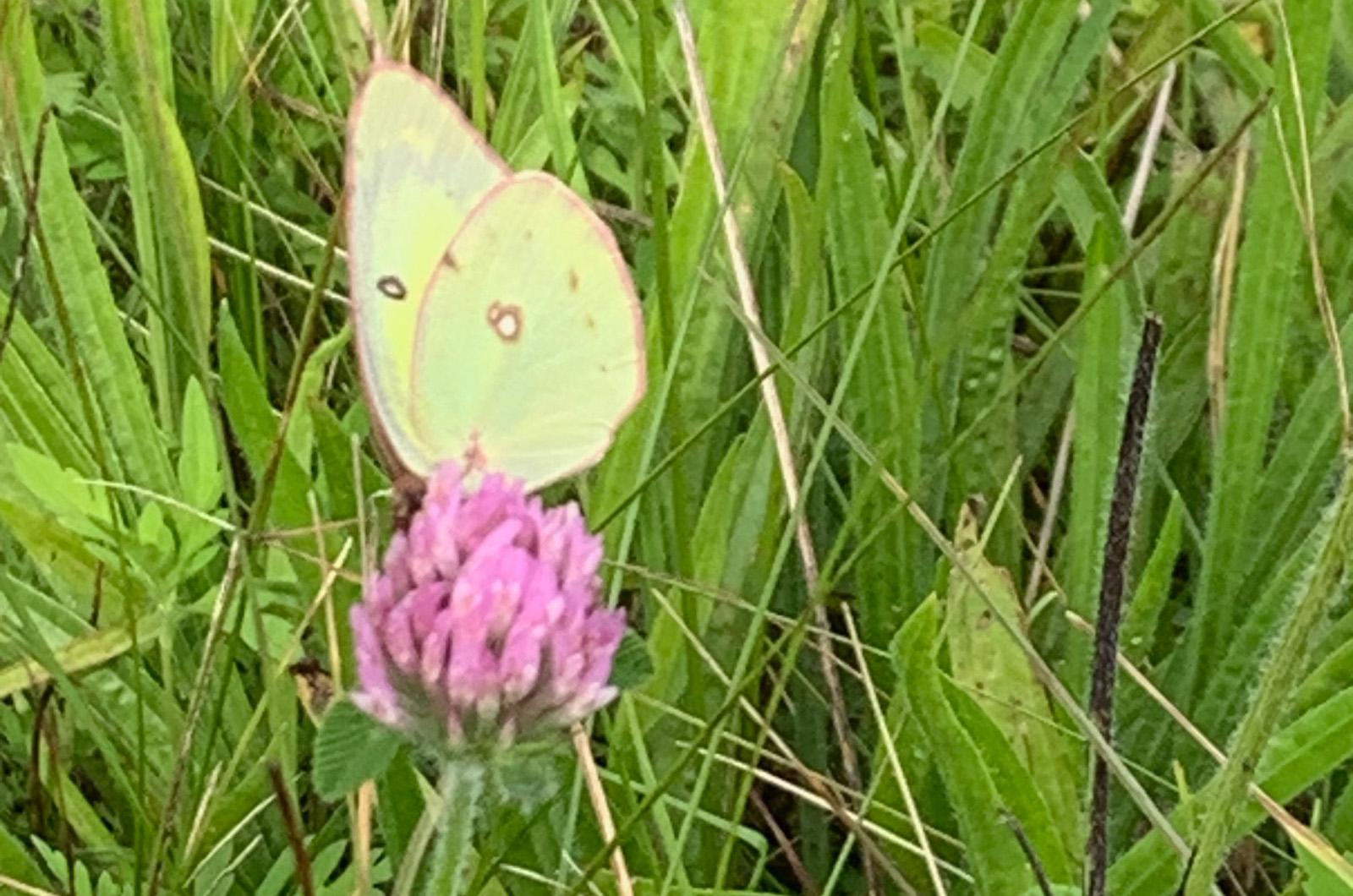
When adult female clouded sulphur butterflies emerge from their chrysalis, they begin to receive attention from the opposite sex. Adult male sulphur butterflies are looking for love and cruising around the field seeking a receptive partner. They approach females at will.
With his wings, the male butterfly repeatedly strikes the body of the female and releases his pheromones. These chemical scents serve as attractants to the female, who, if receptive, will lower her abdomen to receive his attentions.
Researchers have found that females less than an hour old sometimes make mating mistakes. Blame it on youth and inexperience. Their error, which can have serious genetic consequences, occurs when they are not able to properly discern the pheromones of male clouded sulphur butterflies and instead mate with a different species of sulphur, the male orange sulphur that had come knocking on her door.
This interspecies dating doesn’t always go well, since the offspring from cross-sulphur sex can be sterile, effectively ending the gene line right there. Those spawn can be an evolutionary dead end or, more simply put, a bad date with destiny.
Normally, female sulphurs can differentiate the orange and clouded males because they can detect the different ultraviolet patterns unique to each variety. Clouded sulphur wing surfaces absorb UV light and orange sulphur wings reflect it. Consider this the opposite of a blind date: the female enters the relationship with eyes wide open.
Successfully mated female clouded sulphurs lay eggs singly on the leaves on one of the many host plants that can serve the emerging caterpillars. The eggs laid are pale yellow, but will turn red after a few days, then gray before hatching after a five-day incubation period.
Caterpillars are green with a white stripe and will go through multiple instars before morphing into a green chrysalis. The final instar can also overwinter as a caterpillar. Adults that emerge live short, and hopefully sweet lives of only seven days on average, though up to a few weeks of life is possible for the very fortunate few.
Both orange and clouded sulphurs are ubiquitous on the Island, though it was the latter that caught my eye last week in a field at Short Cove Preserve in West Tisbury. Sulphurs flutter among their favored nectar and larval plants, which include alfalfa, clover, and vetch, among others.
This is a case in which common nomenclature makes common sense, because Clouded sulphurs are more yellow, like a cloudy evening, while orange sulphurs are — not surprisingly — more orange. Difficulty is encountered in distinguishing the two, for us (if not them), when both species are in their alba, or white, color morph.
Historically, the clouded sulphurs were, according to 19th-century Boston entomologist Samuel Scudder, “everywhere the commonest species to be found” in Massachusetts. That remains true, as these fliers are easy to find in fields, grasslands meadows, and roadsides, and can be seen congregating at mud puddles, where they assemble to drink in the water and minerals in the muck. Katama grasslands, Tisbury Meadow Preserve, and other iconic Island open spaces are easily accessible venues that may be crowded with the cloudeds.
Orange sulfurs were not as common in Massachusetts until recently. Starting in the 1930s, these butterflies began to be observed and now are as plentiful as the cloudeds.
With the relatively recent influx of orange sulphurs, it is perhaps understandable that young female clouded sulphurs get confused in their early moments of life. Don’t blame those young’uns. Most of us have made poor decisions in our dating lives. American journalist Sydney J. Harris summed it up nicely when he said: “Regret for the things we did can be tempered by time; it is regret for the things we did not do that is inconsolable.”
Suzan Bellincampi is director of the Felix Neck Wildlife Sanctuary in Edgartown, and author of Martha’s Vineyard: A Field Guide to Island Nature and The Nature of Martha’s Vineyard.
Add new comment