
The Keepers
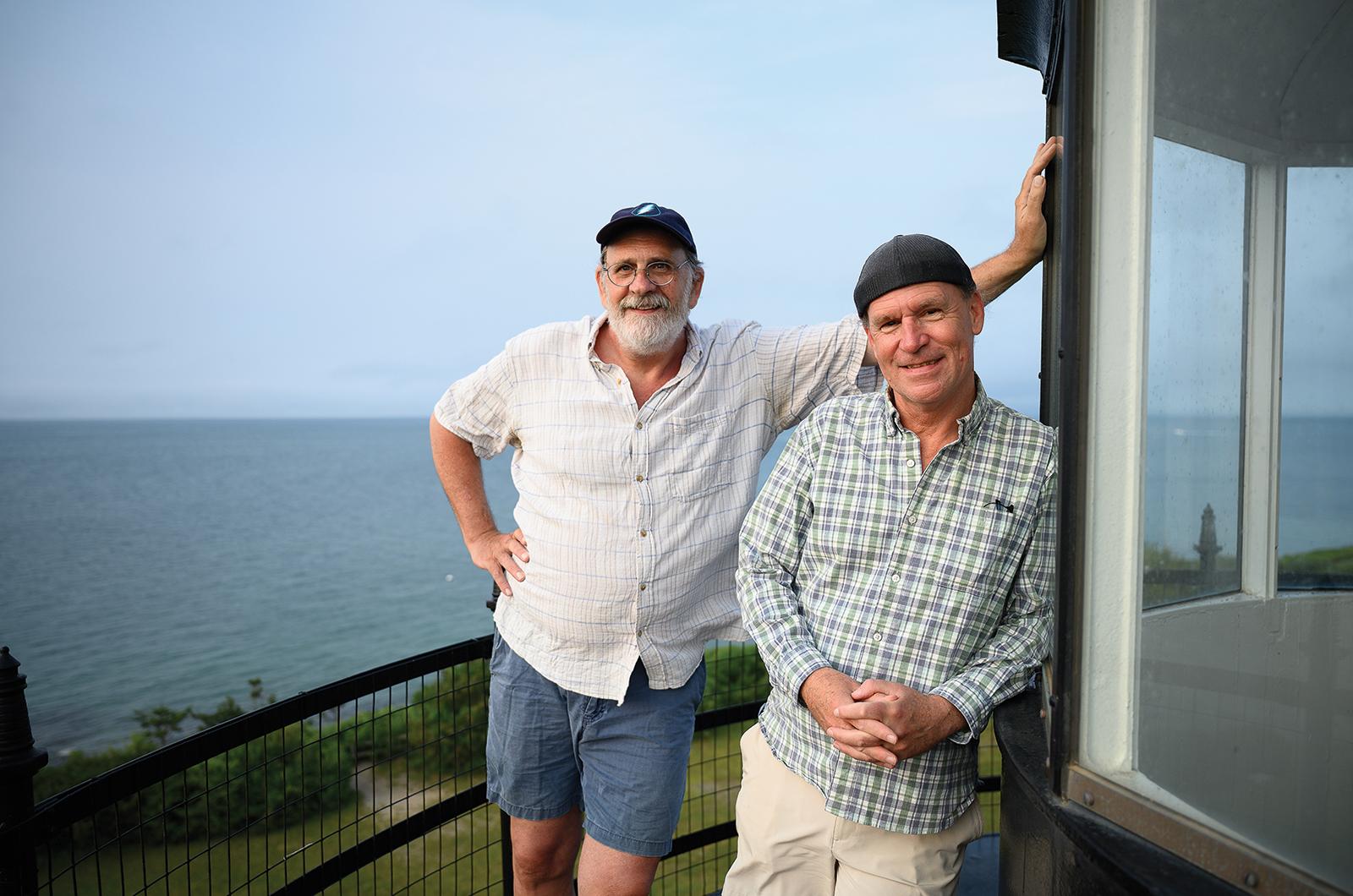
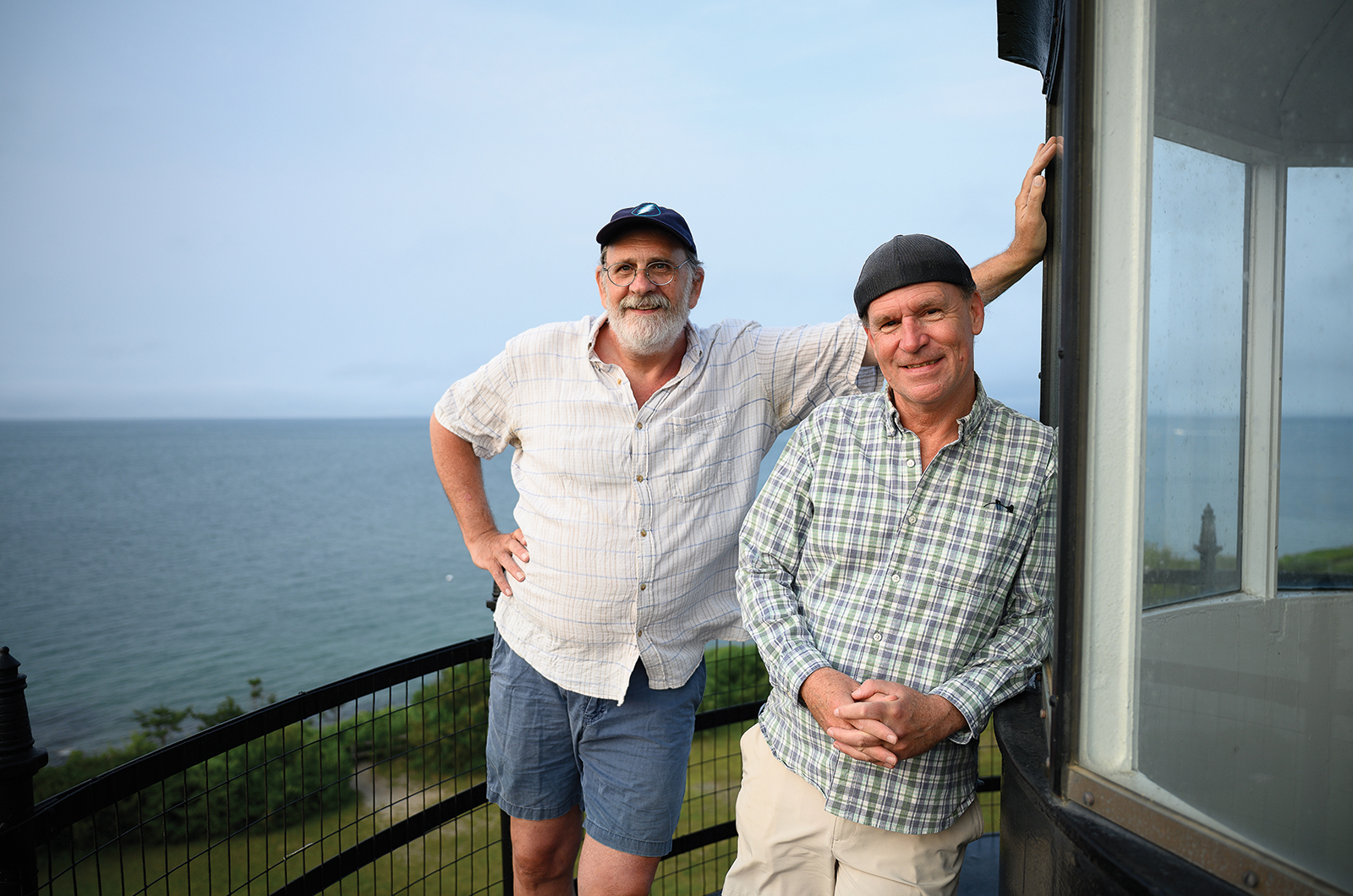
Longtime friends and Oak Bluffs neighbors Rob Hammett and Steve Durkee have been keeping the doors of the East Chop Light open for twenty years.
Gone are the days when a lighthouse was illuminated by lights lit with whale oil or kerosene. Gone, too, are the days when a lone lighthouse keeper lived on the grounds, near enough to periodically hand-crank a clockwork mechanism that allowed the light to rotate. No longer, thanks to modern technology, is a flashing beam of light needed to guide mariners through shoal waters and narrow passages.
But just because lighthouses are now automated — and Vineyard waters are far less crowded than they were in the 19th century — doesn’t mean that a light, a Vineyard light, shouldn’t have someone to care for it. Or, even better, two someones.
“A historic building has to function, it needs to be open, to welcome people, to breathe to stay alive,” says Rob Hammett, the official lighthouse keeper of the East Chop Light on Telegraph Hill in Oak Bluffs since 2005.
One of the first things Rob did when he accepted the position was to ask his good friend and Oak Bluffs neighbor Steve Durkee to assist him. Now, 20 years later, it’s still Rob and Steve who will greet you at the cast iron structure if you visit the lighthouse when it’s open to the public at sunset on Sunday evenings. (The lighthouse is managed by the Martha’s Vineyard Museum and owned by the United States Coast Guard, see history below.)
"A historic building has to function, it needs to be open, to welcome people, to breathe to stay alive,” Rob says.
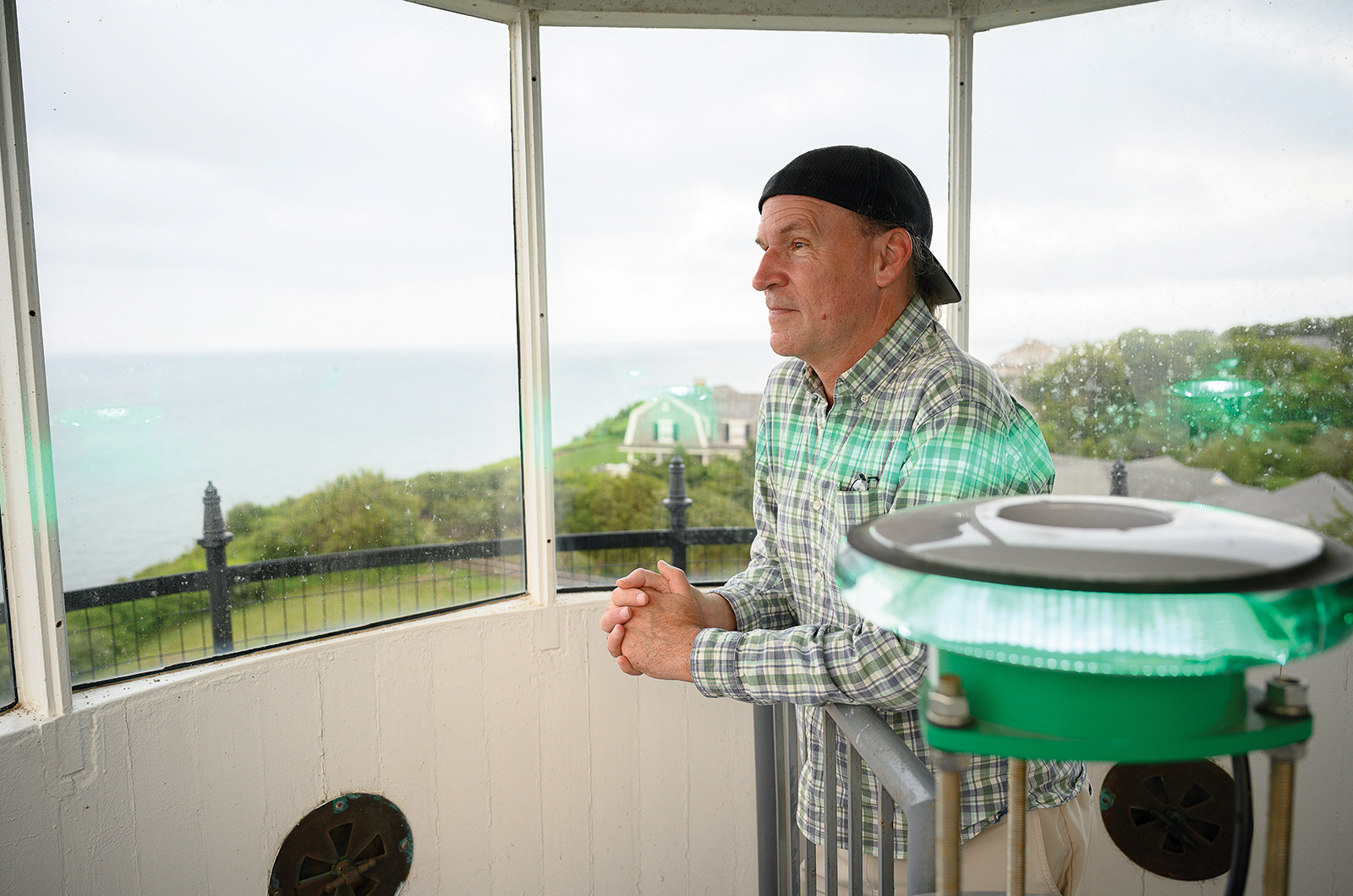
"A historic building has to function, it needs to be open, to welcome people, to breathe to stay alive,” Rob says.
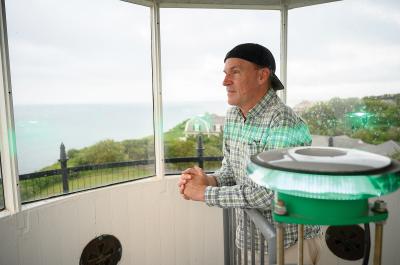
After adding you to a visitor log, one of them will guide you up the 32 winding steps to the workroom, and from there up a steep seven-step ladder to the lantern room, where you can then stoop and scooch through a waist-high door out on to the gallery (a balcony with a guardrail) for a bird’s eye view of Vineyard Haven Harbor to the west, the vast expanse of sea where Vineyard and Nantucket Sounds converge to the north and east, and the leafy canopy over East Chop summer houses below.
Here you are 70 feet above sea level, one of the highest points you can be down-Island. The view is breathtaking on a clear summer night, even if you aren’t lucky enough to be right at the top as the sun dips below the horizon. It’s a Vineyard bucket-list activity for sure, and Rob and Steve are there to help you enjoy it and to answer your questions.
For these two guys, getting a chance to hang together – while also passing on a bit of Vineyard history to visitors – makes lighthouse keeping far more gratifying and far less grueling than it was a century ago.
Besides, how very cool is it to be a lighthouse keeper? Not many people can add that to their curriculum vitae.
In typical Vineyard fashion, Rob has several jobs, which include managing his family’s student tour business, being the recovery support advocate for the men’s house at the Vineyard House sober living campus in Vineyard Haven, working a few days a week as a Martha’s Vineyard Land Bank attendant at Moshup Beach, and staying in close touch with his two adult daughters, Emily and Rilla.
Rob, who’s been a year-round resident of the Island for 39 years, first came to the Vineyard as a baby (his father was well-known Episcopal minister, the Rev. Robert Lee Hammett) and spent a lot of time on the water. He always felt drawn to the East Chop Light.
“I loved the romance of it — it always seemed a bit mysterious. I wondered what was in there! And it was an icon, a steady presence in our lives,” Rob says. So when a serendipitous encounter with (then) East Chop Light keeper Joan Desautelle occurred one day in 2005 while Rob was walking with one of his young daughters to Telegraph Hill, Rob didn’t hesitate to profess his love.
The windows of the lantern room still need cleaning, thought the job is much easier than many years ago when soot from kerosene fuel was a constant problem.
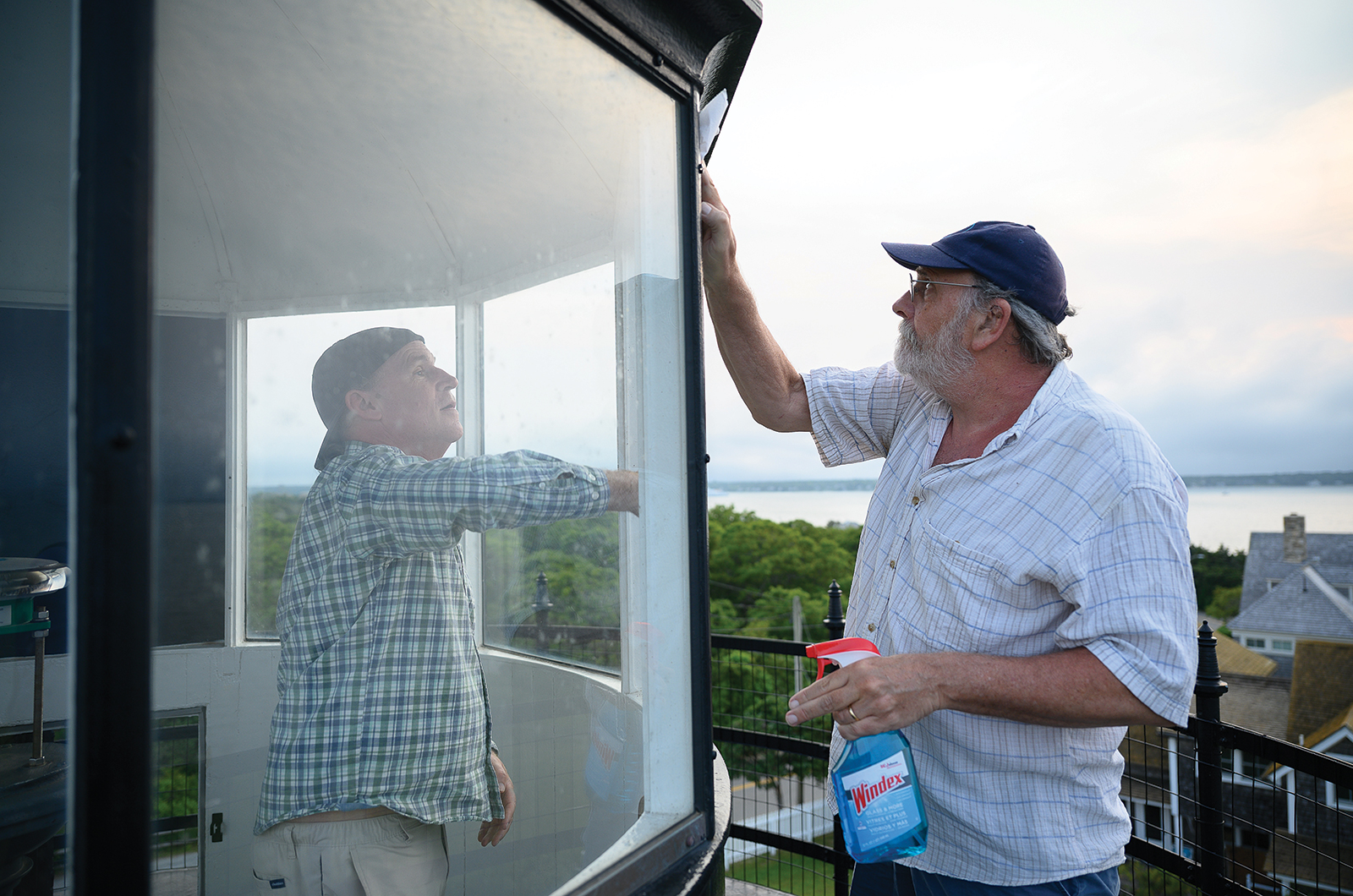
The windows of the lantern room still need cleaning, thought the job is much easier than many years ago when soot from kerosene fuel was a constant problem.
Joan mentioned she was retiring, and Rob immediately threw his hat in the ring.
“I’d love to take your place,” he told Joan. Not too long after, Rob ran into Matthew Stackpole, who was the executive director of the Martha’s Vineyard Historical Society (which became the Martha’s Vineyard Museum) at that time. He told Rob it was his understanding that Rob would be the next East Chop Light keeper. Just like that, Rob was good to go.
For Steve, who lives in a jewel-box Oak Bluffs cottage with his wife Liz Durkee and is recently retired from being the longtime art director of the Vineyard Gazette, the chance to pass on a bit of Vineyard history to others was irresistible. Also a former Vineyard summer kid and a year-round Island resident since 1990, Steve is a big guy with a soft heart — and the self-appointed child wrangler at the lighthouse.
“My job in the lantern room is to bang on the glass and tell people to be careful,” he says. He also confides that kids love to throw stuff off the balcony, run down and pick it up, and run back up to the top of the tower to do it all over again. After a round of that, Steve gently encourages a redirection of energy. After all, there can be anywhere from 30 to 100 visitors to the lighthouse on any given Sunday evening.
Another crucial duty is keeping visitors out of the lighthouse for a few minutes if a marriage proposal is about to happen. This happens a few times a year – as do weddings at the lighthouse, which can be reserved for special events.
“The best thing is seeing visitors return year after year. There is a family that used to come every year with their little girls, always dressed in matching outfits,” Steve recalls. “Every year they were always surprised that we remembered them. Now the girls are coming back with their own children.”
And then there are the passionate lighthouse aficionados.
“There are legions of them,” Steve says, “who regale us with their stories of other lighthouses when they visit.” Some of them arrive with lighthouse passports, stamped from visits to lighthouses all over the country.
On the Vineyard, if the season and the stars align, these enthusiasts will have an opportunity to visit three of the Island’s five lighthouses: East Chop Light and Edgartown Light, both managed by the Martha’s Vineyard Museum, and Gay Head Light in Aquinnah. West Chop Light is not open to the public, and over-sand tours to Cape Pogue Light, managed by The Trustees of Reservations, are on hiatus.
“People have a genuine interest in lighthouses,” Steve says. “I like being part of passing on the history, the knowledge, to other people.” Especially the history of the East Chop Light, because it’s part of the identity of the town Steve loves. “Just like the Gay Head Light is for Aquinnah, the East Chop Light is an icon for Oak Bluffs,” he says.
Sure, the lighthouse isn’t absolutely necessary in today’s high-tech world, Rob concedes. “But I know fishermen, sailors, boat captains who still use it, just like they still use their intuition. There’s very much an old-world reliance of looking up and seeing that light as a physical touchpoint. GPS can fail, but the lighthouse is always there.”
For Rob, satisfaction comes from knowing that he and Steve, with the museum’s stewardship, are helping to keep the doors open to a place that was closed to the public for most of a fifty-year span. (Not to mention that they’re keeping the windows clean!)
“I love being part of something that has such a vital history, and I love being a part of getting people in there to experience it,” Rob says. “Though I’m not saving lives anymore, this is an entity that was.”
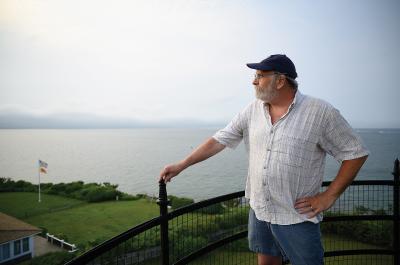
For Steve, the chance to pass on a bit of Vineyard history was irresistible.
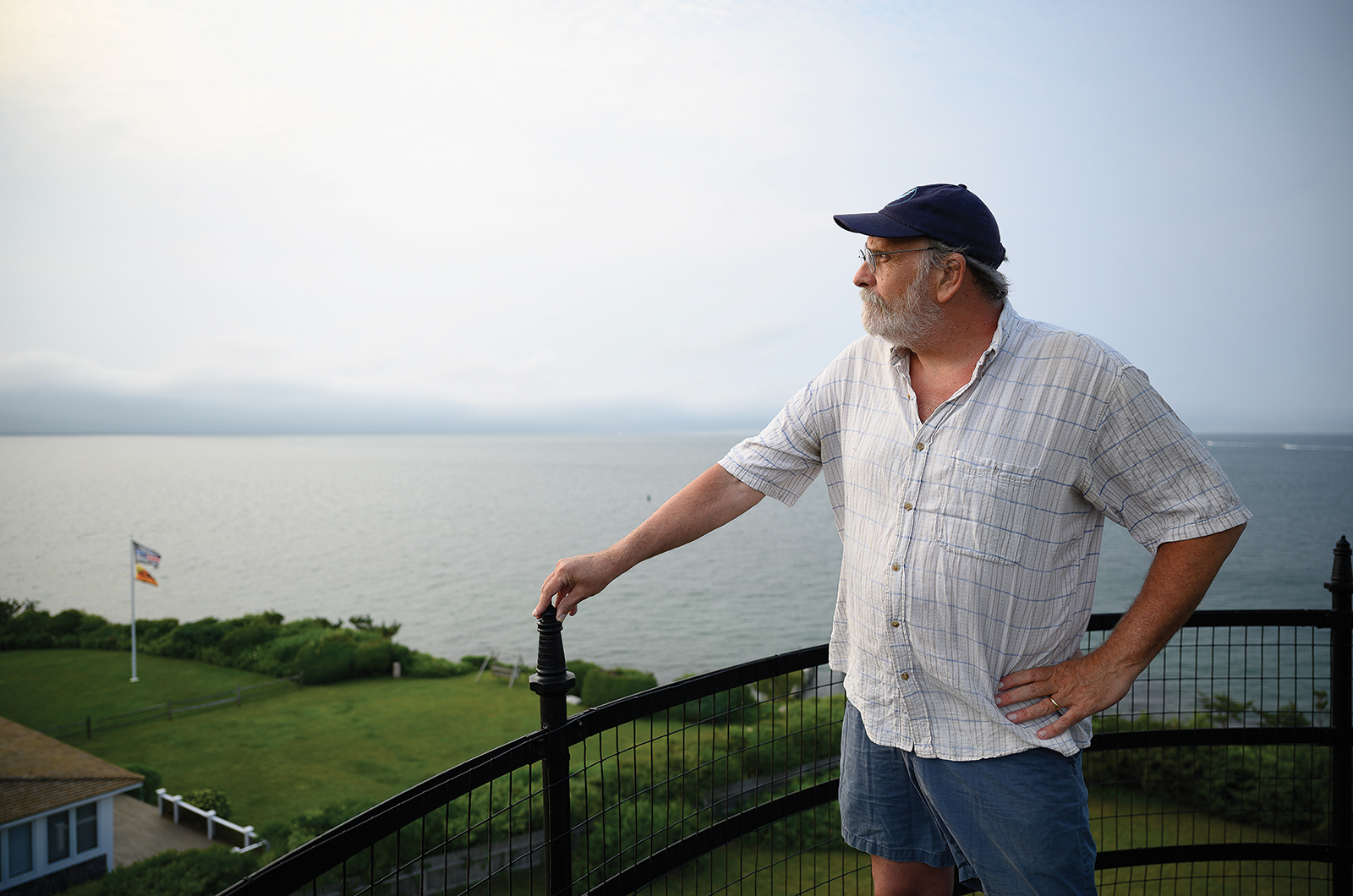
For Steve, the chance to pass on a bit of Vineyard history was irresistible.
Susie Middleton is editor of The Vine.
The Fifth Light
Of the five Vineyard lighthouses, East Chop Light was built last, after Gay Head Light (1799), Cape Pogue Light (1801), West Chop Light (1817) and Edgartown Light (1828).
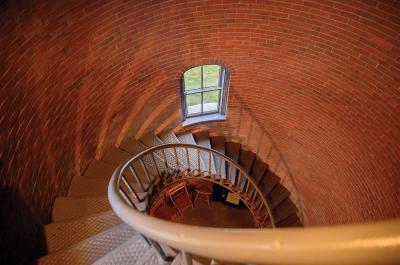
It looks like more, but it's actually only 32 steps to the work room. From there a steep seven-step ladder takes you to the lantern room.
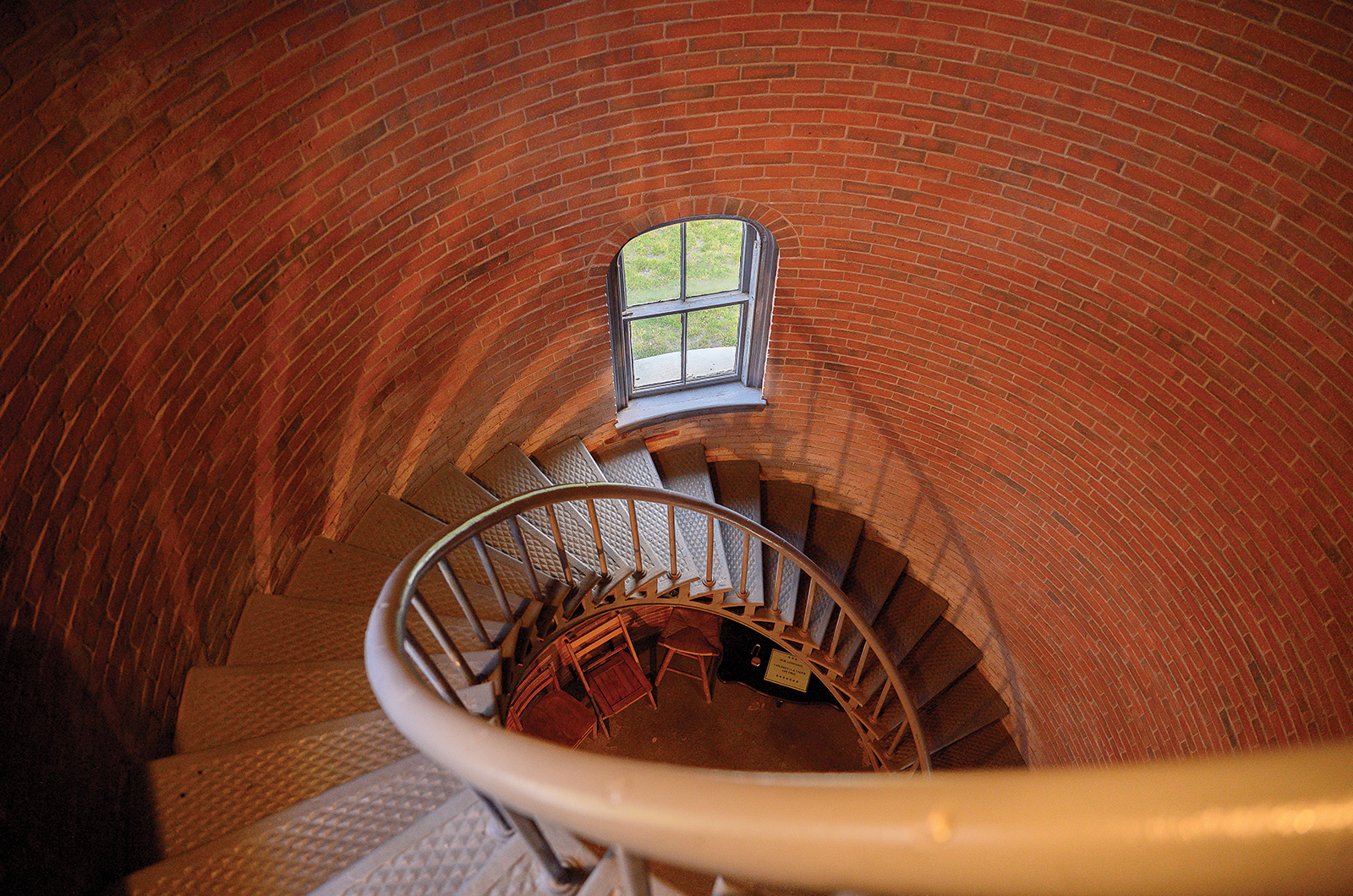
It looks like more, but it's actually only 32 steps to the work room. From there a steep seven-step ladder takes you to the lantern room.
The two spits of land (or “chops”) that flank the entrance to Vineyard Haven Harbor are, of course, called East Chop and West Chop. Though they were both natural spots for navigation aids — back when Vineyard Haven was called Holmes Hole and hundreds of schooners anchored regularly in the harbor — West Chop was awarded a light long before East Chop. The first West Chop Light was built in 1817 with $5,000 appropriated by Congress, while over on East Chop a telegraph semaphore station — but no light —was erected in 1828. Many mariners thought there should be a light on East Chop, too, to provide for the safest entrance into the harbor.
The government resisted for so long that in 1869 a private citizen, merchant marine captain Silas Daggett, took it upon himself to erect the first East Chop Light. Daggett’s structure burned in a fire in 1872, but he promptly rebuilt it. Though he had some financial help from other mariners, maintaining a lighthouse privately proved to be a difficult proposition.
Fortunately, the United States Lighthouse Board at long last “saw the light” on the necessity of a light on East Chop. In 1875, Congress authorized $5,000 for the light station, bought Daggett’s rather rustic structure from him in 1876 and promptly built a cast-iron lighthouse in its place in 1877.
The light had a fourth-order Fresnel lens made up of about 350 prisms, able to beam light a distance of 10 to 15 miles. In comparison, the Gay Head Light’s Fresnel lens that now resides in the Martha’s Vineyard Museum was a first-order light with 1,008 prisms that could project a beam 21 miles. (In the 19th century, Vineyard Sound was the 1-95 of waterways, with thousands of ships a day passing through it.)
In 1984, East Chop Light’s Fresnel lens was replaced by a modern beacon with a three-second green flash (three seconds on, three seconds off). It still beams light to mariners today.
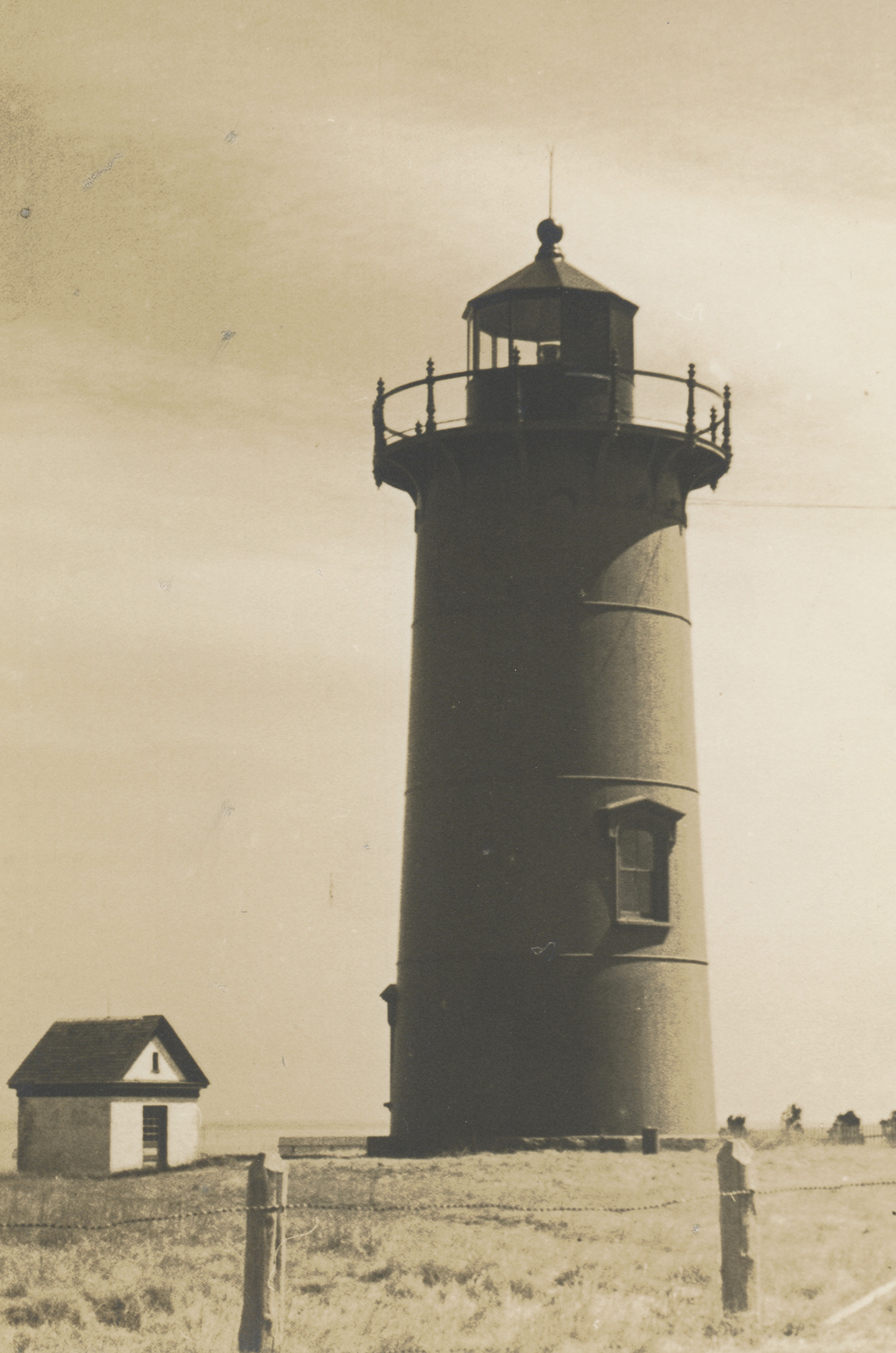
The 40-foot-tall lighthouse was initially painted white, but sometime during the 1880s it was painted a chocolate brown, earning it the nickname of the chocolate lighthouse (1950s photo, lower right). In 1988, it was repainted white to prevent the inside of the lighthouse from overheating.
From 1912 to 1934, George Walter Purdy cared for the lighthouse, lived on the property with his family and kept a cow across the street. Purdy had only one arm, having lost the other to an engine accident on a lightship. Yet he could build or fix anything, from a secure boat landing for the lighthouse tender to a sturdy flight of steps up from the beach (a 30-foot rise). He regularly painted the tower himself and cleaned the kerosene soot from the windows. He would be the last keeper to live on the grounds.
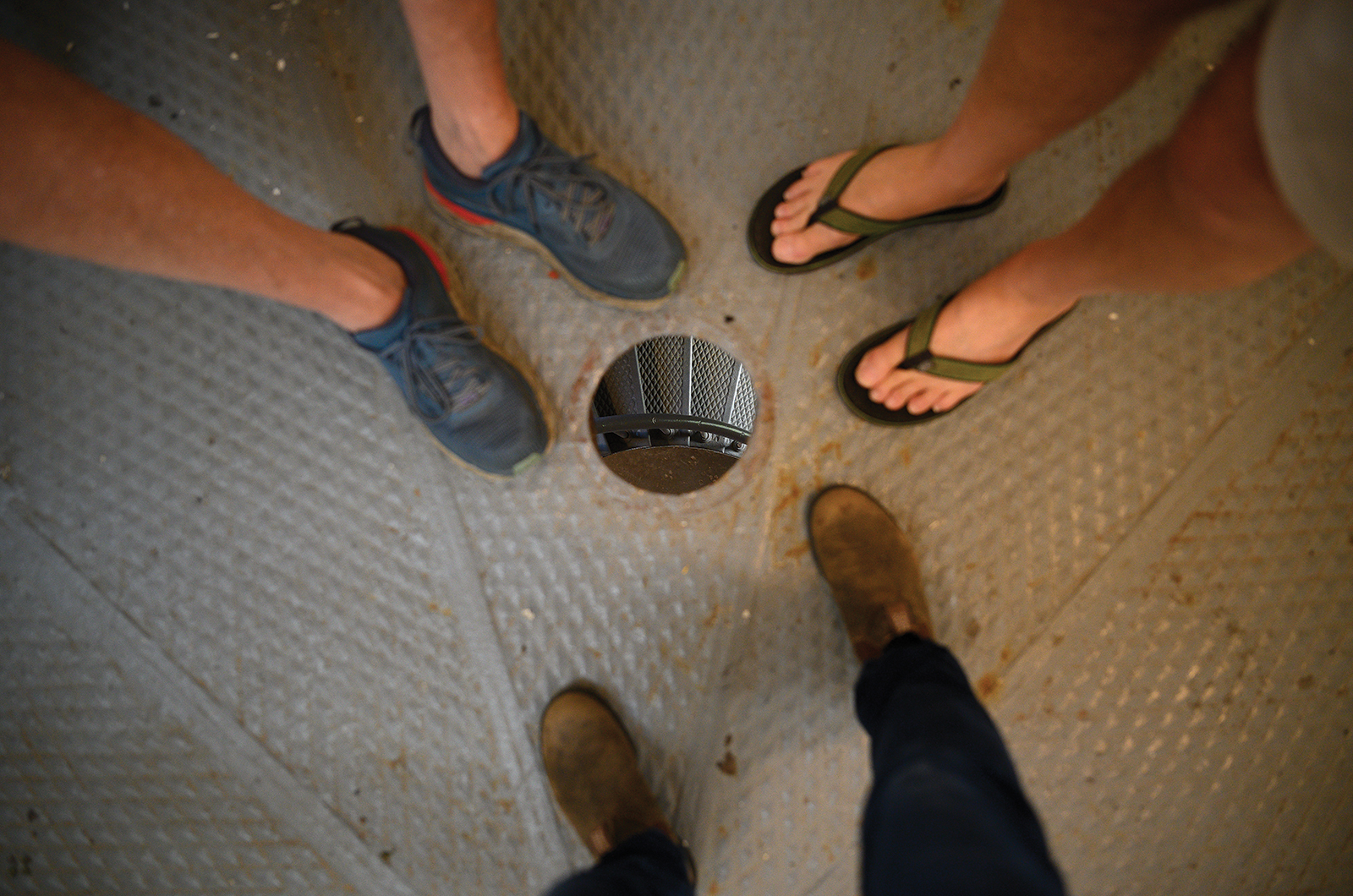
The light was automated (connected to electricity) in 1934. Not only did that eliminate the need to fuel the light with kerosene or oil; it also meant that a lightkeeper did not have to periodically wind a clockwork mechanism – a cable with heavy weights – to keep the light in rotation. When you visit the lighthouse today, you can see a hole in the floor of the workroom where the cable passed through on its way to the first floor.
After the Purdys, with the exception of a period during World War II when Islanders used the light to look for German U-boats, the tower was visited less and less. Funding for lighthouses shrank. The light fell into disrepair.
In 1985, with demolition threatening, an organization called the Vineyard Environmental Research Institute (VERI), led by William Waterway, set about lobbying Congress to acquire the license to run the lighthouse. With help from Congressman Gerry Studds and Senator Ted Kennedy, they were successful and became one of the first private entities to manage a lighthouse. They immediately embarked on raising funds for a much-needed restoration.
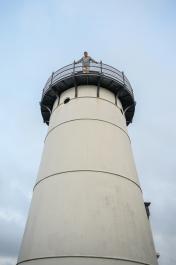
The lighthouse was painted a chocolate brown for many years, but returned to its original white color in 1988.
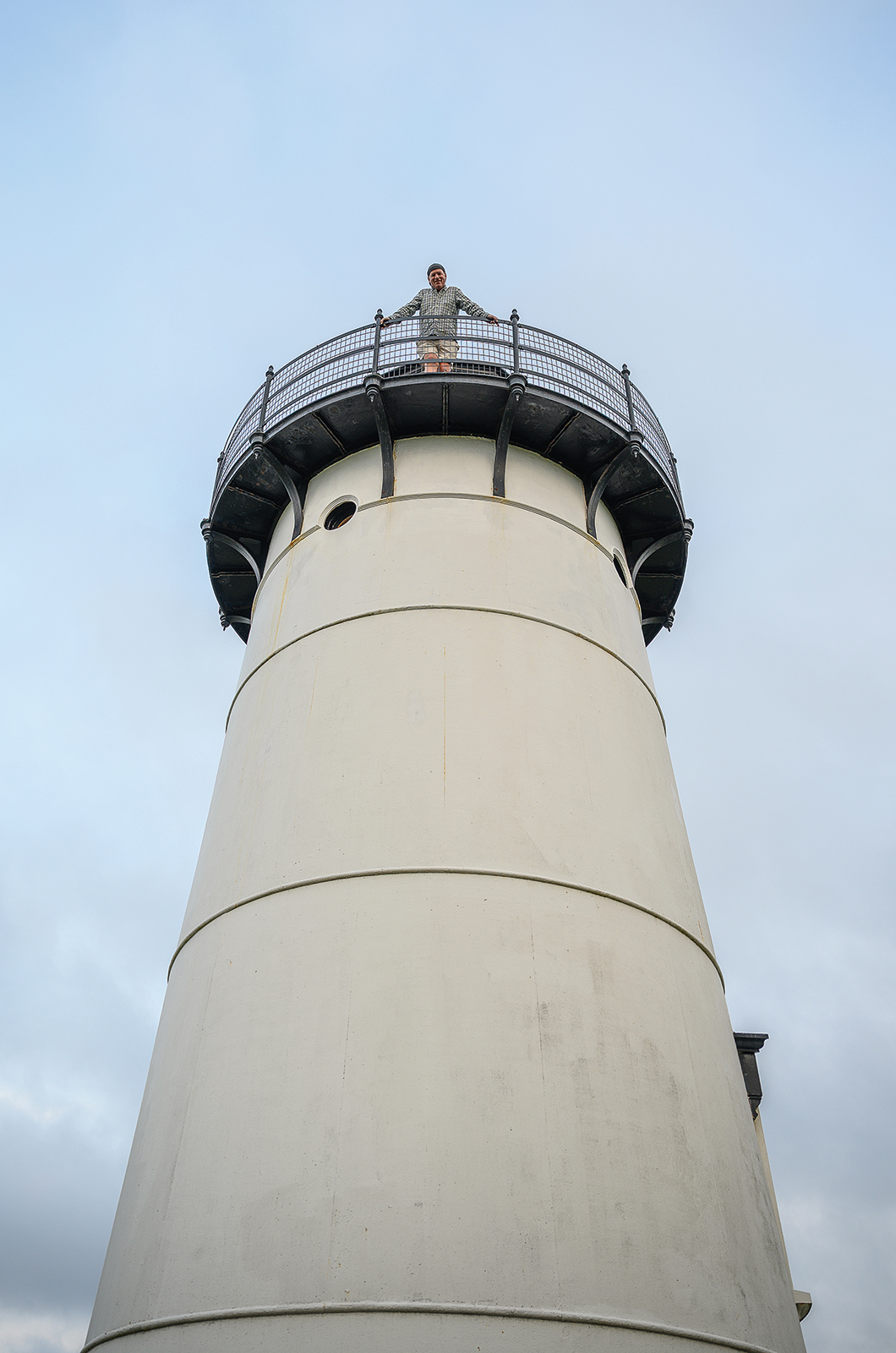
The lighthouse was painted a chocolate brown for many years, but returned to its original white color in 1988.
In 1994, the Martha’s Vineyard Historical Society (now the Martha’s Vineyard Museum) accepted the transfer of responsibility for East Chop Light from VERI, and today, while the United States Coast Guard owns the building (and the Coast Guard ANTS — Aids to Navigation Team — service the actual light), the museum maintains the tower and employs a part-time lighthouse keeper (Rob Hammett, see page 20). The land surrounding the lighthouse is an Oak Bluffs town park.
The light is open to the public at sunset on Sunday nights during the summer. (7 to 9 p.m. in June and July; 6 to 8 p.m. in August.) For more information, visit mvmuseum.org.
View fromt the top: Nantucket Sound and East Chop.
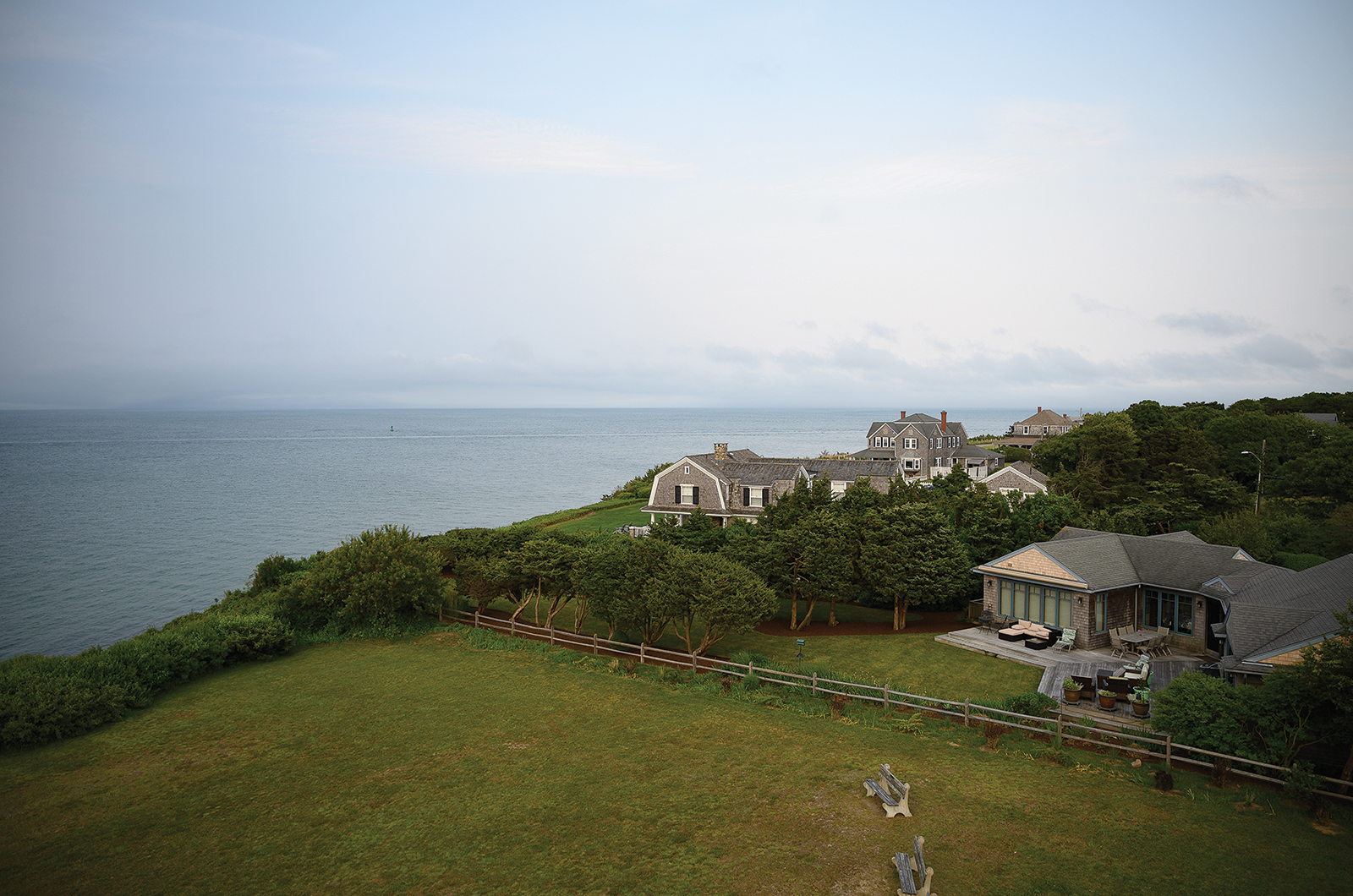
View fromt the top: Nantucket Sound and East Chop.
Add new comment