


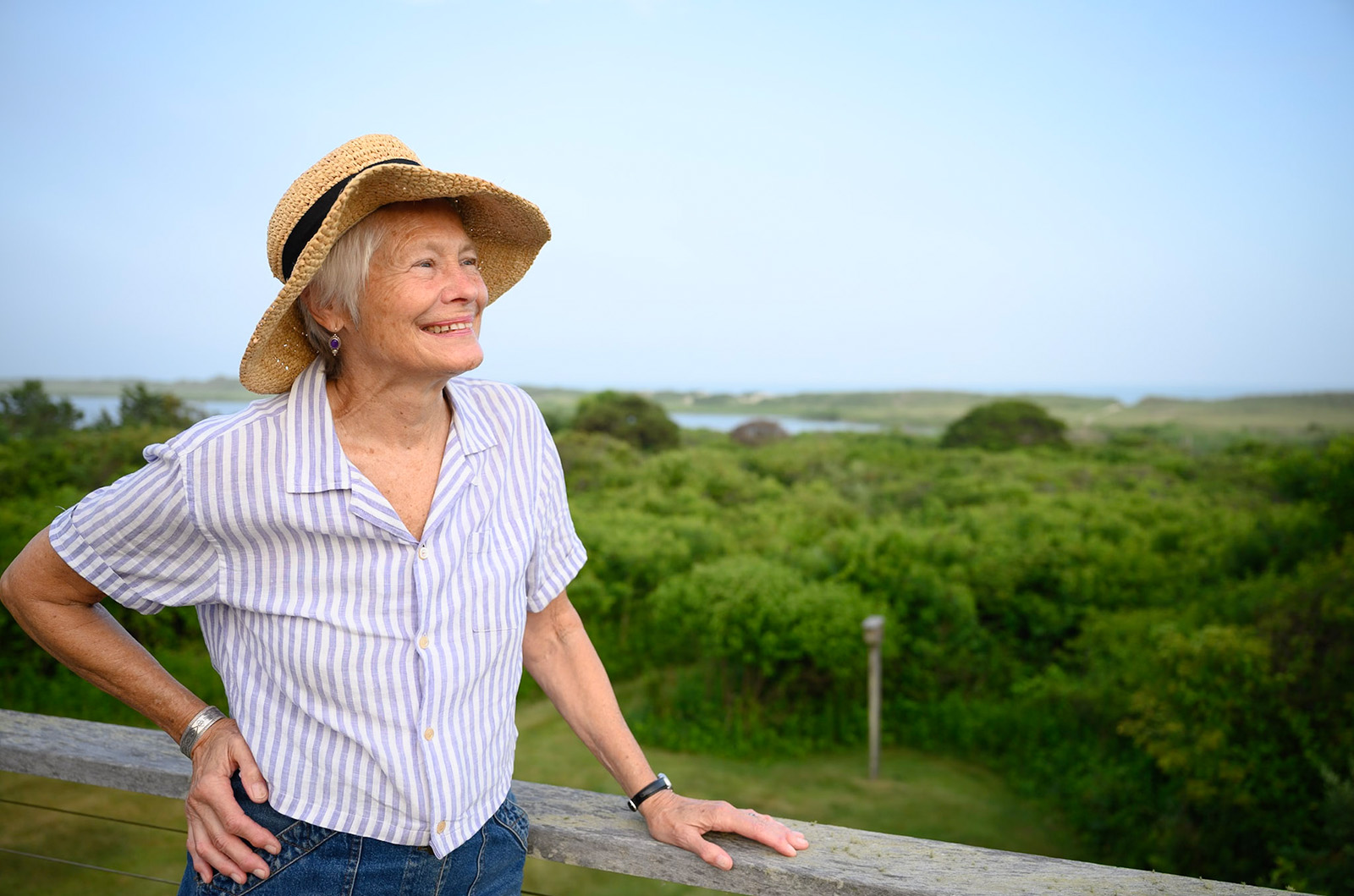
When Gail Straub was growing up in Wilmington, Del. in the 1960s, she didn’t have many vivid examples of travel — or worldliness — before her.
When Gail Straub was growing up in Wilmington, Del. in the 1960s, she didn’t have many vivid examples of travel — or worldliness — before her. Her father was a high school teacher, her mother a devout Irish Catholic homemaker.
Still, she describes standing in her teenage bedroom, posters of Bob Dylan and Joan Baez on the walls, holding her passport in her hand and knowing it was a sort of “sacred talisman.”
“This talisman opens a portal that I must pass through, even though I don’t understand why,” Ms. Straub writes in her latest book, Home Inside the Globe.
A human rights activist and teacher, a co-founder of the Empowerment Institute and women’s empowerment initiative IMAGINE, Ms. Straub lives in Woodstock, N.Y. and calls Chilmark her summer home.
On Monday, July 14, she will take part in a discussion about her book with Ellen Wingard. The event is part of Tales of Edgartown, a summer lecture series hosted by the Martha’s
Vineyard Museum at its Edgartown campus, located at The Cooke House, 51 School Street, Edgartown. The talk begins at 4 p.m.
Ms. Straub said she spent eight years writing her memoir, which documents not only her travels around the world but a journey through her interior terrain, navigating girlhood, womanhood and cronehood.
“Like most writers it started out as something completely different,” she remarked this week. “I thought I’d write a series of travel essays.”
But after sending a proposal to an editor, who nudged her in the right direction, she describes the writing of the book as “an invaluable process” of sifting through boxed-away journals and clippings, some 60 years old.
“I didn’t set out to do that, but it was very meaningful to get to have this intensive, long review of my life,” she said.
Ms. Straub said she was conscious early about feeling like an outsider in “Wilmington’s wealthy WASP society.”
A trip to Paraguay on an America Field Service trip in high school was a seminal experience.
“Paraguay was a devout Catholic society. And as an American, I was considered affluent,” she said. “So, all of those insider/outsider feelings I’d had at home as a teenager quickly reversed themselves.... Even then, I understood this idea of being different is a very slippery slope.”
That experience, she said, planted in her a “longing to dismantle those differences.”
After her initial summer trip to Paraguay, Ms. Straub studied Marxism at the Sorbonne in Paris during a year abroad at Skidmore College. Following college graduation, she joined the Peace Corps as a volunteer for two years, serving in West Africa. While many of her friends were heading off to careers, graduate school or getting married, she described the move as “an inevitable step.”
One day, she writes, she became violently ill. She learned shortly after that her mother had passed away suddenly back in Wilmington. Ms. Straub was just 23 years old. Upon returning to her post after the funeral, she crossed the Sahara and met numerious indigenous women who helped her manage her grief.
“It was a society where women were absolutely equal to the men, in any way, shape and form,” she said.
Ms. Straub and her husband, David Gershon, co-founded the Empowerment Institute in 1981. The aim was to explore the concept of empowering people to grow and realize their full potential, all around the world. The Institute’s work has included the First Earth Run, a global relay event held in 1986 to promote peace and cooperation, with a torch of peace carried around the world.
“We were audacious. I guess we’re all audacious when we’re young,” Ms. Straub said. “But this was the early ‘80s. Maybe all us pioneers of that human potential movement, us Baby Boomers, maybe we were particularly audacious.”
Yet, despite that early drive and early success, Ms. Straub said she found herself, in the 1990s, asking herself “why am I, a seemingly highly successful woman, feeling dead?”
“Most of us have a moment or a period in life like that,” she noted. “Especially I think here in our culture in America, it has both shadow and light. We’re encouraged to excel. And I’m very grateful for that. Yet, we can take it too far. The drive for success at its central nature is a very vital life-giving thing. But sometimes we don’t know when we’ve turned it up too high. When we’re on overdrive. When we need rest. There’s this balance of the interior life and the life of service.”
From then on, she said, her work became “more about teaching about the balance of interior life, whatever that is for each of us, and the outer life, doing good in the world.”
These days, she said, her summer moments center around writing in Chilmark’s solitude, punctuated by kayaking adventures and long walks on the beach with her husband.
“Right now, I have the privilege, the honor, of looking back and seeing what was effective and what wasn’t effective,” she said. “The opposite of audacity perhaps is wisdom.”
For tickets and more information about the event on July 14, visit mvmuseum.org.
Add new comment