
“I like big bugs and I cannot lie.” This entomological paraphrasing is an improvement to American rapper Sir Mix-A-Lot’s crass song Baby Got Back.
“I like big bugs and I cannot lie.”
This entomological paraphrasing is an improvement to American rapper Sir Mix-A-Lot’s crass song Baby Got Back. He was not singing about insects, though might have appreciated the big, bold and full-figured polyphemus moth, especially the female who is larger than the male and has a swelled abdomen to hold her eggs.
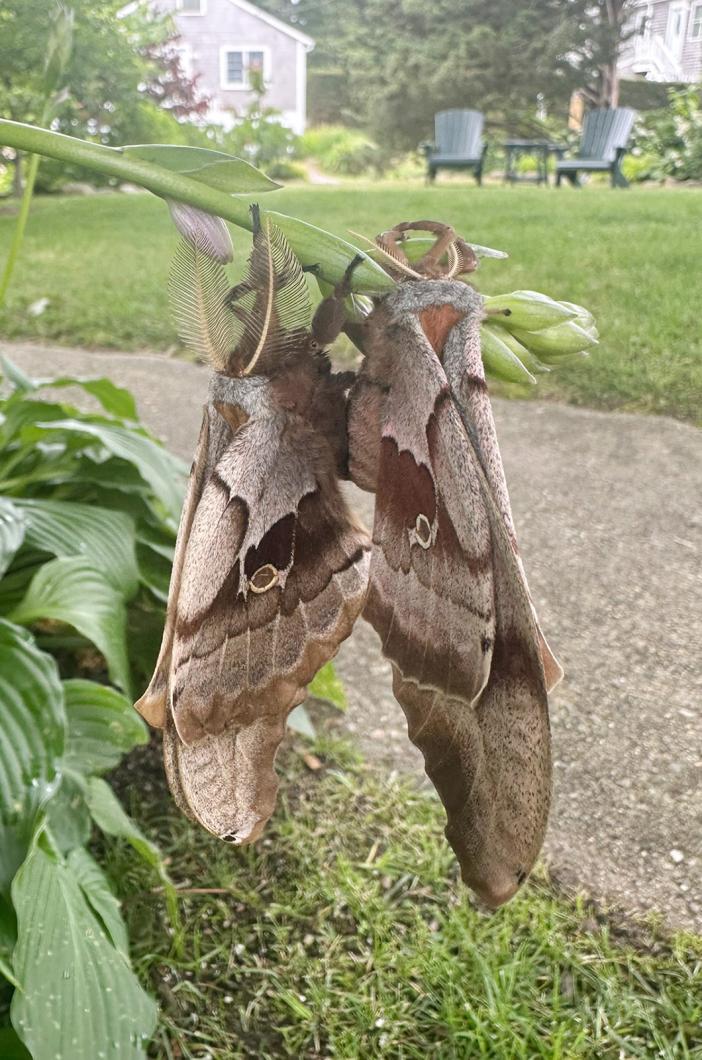
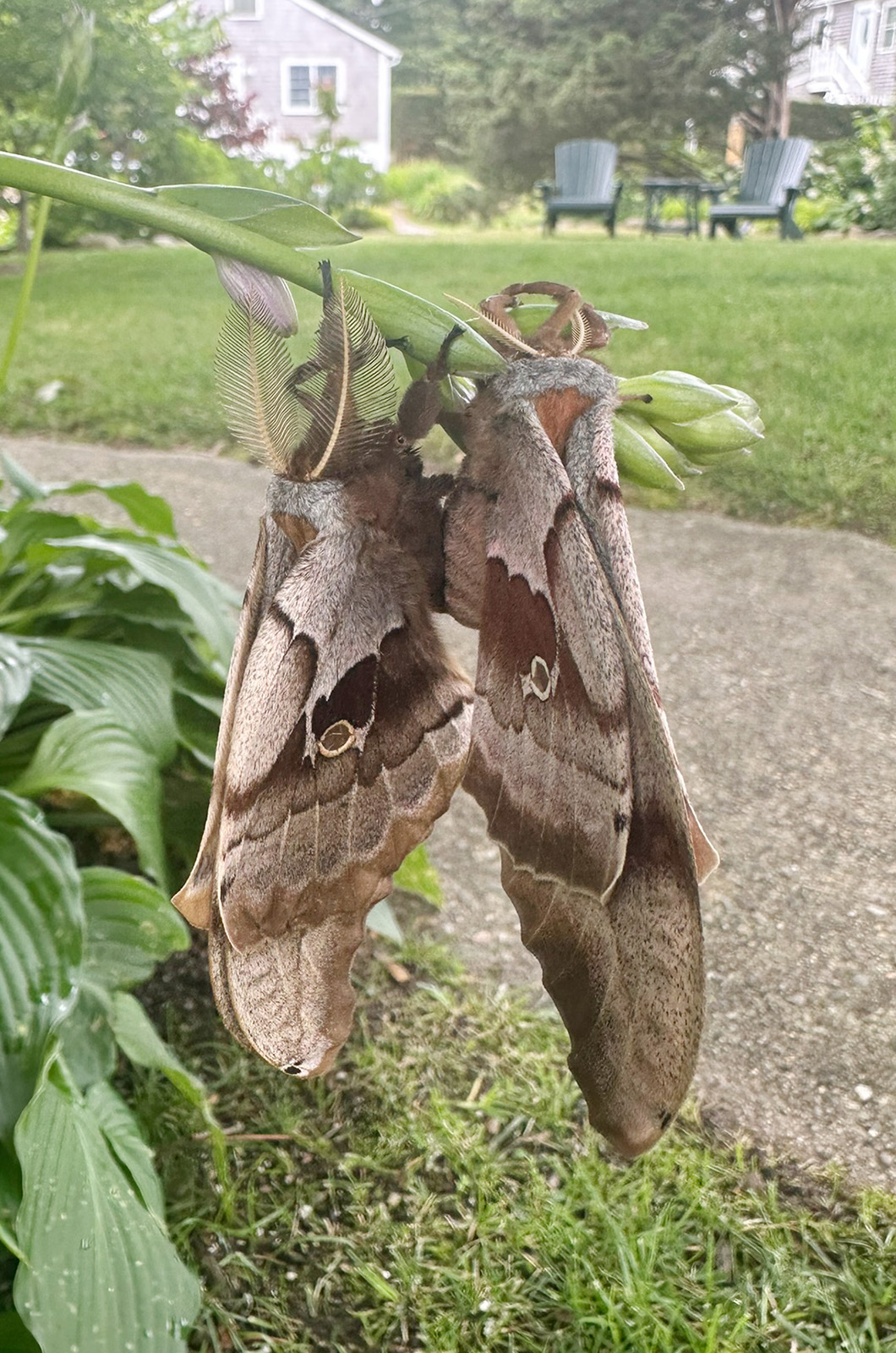
This moth is living large with a wingspan of up to six inches, and has been showing its fabulous physique island wide. Last week, two sightings were reported from Chilmark and Tisbury with pictures of this incredible insect.
A sizable silk moth, the polyphemus is so called because of the giant cyclops in Homer’s Odyssey. That one-eyed wonder inspired the naming of this moth which has its own large purplish eyespot on its wings.
These eyespots serve as a distraction display, confusing predators since the placement of the spots seems to resemble the eyes of a great horned owl. Some predators aren’t fooled and these big bites can be consumed by raccoons and squirrels.
The moths that were observed had likely just emerged from their cocoon. Eclose is how entomologists describe the adults’ entry to the world from its protective cover. These recent arrivals are small and crumpled and must pump up their wings with a fluid called chemolymph to grow to their full size. Chemolymph is comparable to human blood and circulates through the insect’s body.
Adult polyphemus moths only live for four days. In that time, they do not eat, having an underdeveloped mouth. Instead, they focus their energy on mating and setting up the next generation. Females have slender antenna and will send out chemical signals called pheromones to attract a male. Males, with their bushy antenna, will sense the pheromones from up to a mile away and come to court and copulate with the female.
Tan to brown eggs will be laid on vegetation whether these nocturnal lovers find each other or not. Interestingly, females will release fertilized or unfertilized eggs.
Polyphemus caterpillars are not picky when it comes to their food, so adult moths lay their eggs on many types of plants including, oak, elm, willow, sassafras, prunus, pear, walnut, hickory, beech or other species. Tiny caterpillars emerge from the eggs after 10 days and will consume their own eggshells for nourishment.
Caterpillars are immediately voracious, feeding for five weeks, and consuming more than 86,000 times their weight at emergence in foodstuff. After five instars, even consuming their own skin each time, the caterpillar turns into a pupa and ensconces itself in a brown cocoon covered with leaves.
Predators of these caterpillars come in all shapes and sizes. One of these is a petite parasitic wasp that lays its eggs inside of the polyphemus caterpillar and will hatch and consume it from the inside out. If the caterpillars survive all of the internal and external dangers, the pupa will emerge as an adult in two weeks. It can also overwinter inside that protective sheath.
And to borrow the style of Sir Mix-A-Lot’s rhymes, this polyphemus-inspired one might be the next big hit: Mega moths come to hang and flutter / They won’t eat a thing, not even butter / Protection lives in spotted wing, / Though never ever will they sing / Big bugs make me quite silly, / Their flights and lifecycle thrilly.
Suzan Bellincampi is director of the Felix Neck Wildlife Sanctuary in Edgartown, and author of Martha’s Vineyard: A Field Guide to Island Nature and The Nature of Martha’s Vineyard.
Add new comment