

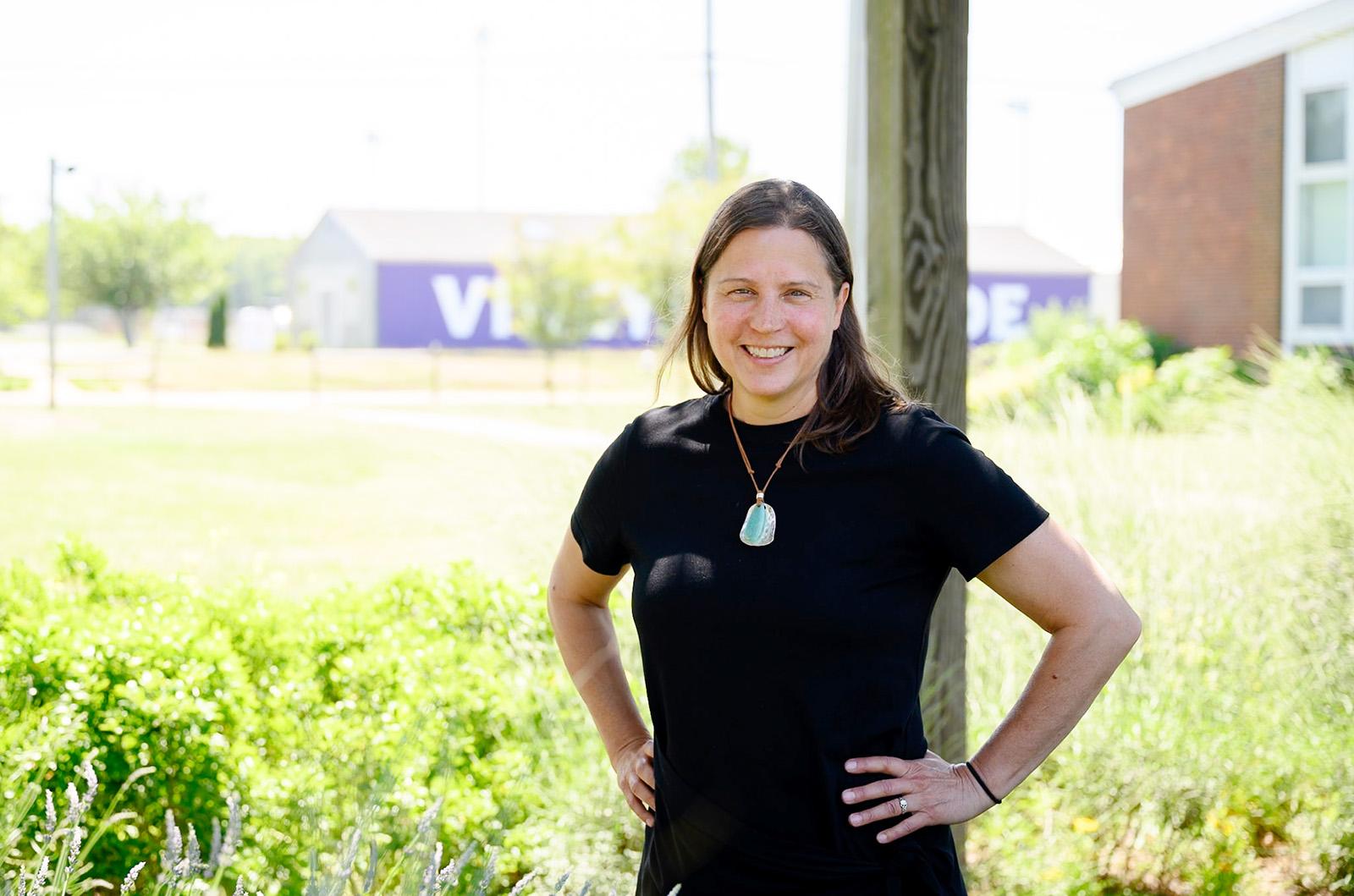
As she's set to take on a new role with the Vineyard public schools, Sara Dingledy reflected on how the high school has changed since she first arrived as principal in 2016.
When Sara Dingledy took over as principal at Martha’s Vineyard Regional High School in 2016, four different people had held the job in the previous two years.
After Stephen Nixon abruptly resigned in the spring of 2014, he was replaced on an interim basis by assistant superintendent Matthew D’Andrea. The next principal, Gilbert Traverso, lasted barely a year before resigning in 2015, at which point retired MVRHS principal Margaret (Peg) Regan stepped back into the role as an interim hire.
Nine years later, Ms. Dingledy has become the school’s longest-serving leader since Ms. Regan retired in 2008. Now, it’s time for someone else to take the job: Ms. Dingledy is starting a newly-created central position this summer, working with assistant superintendent Megan Farrell on a shared curriculum for town schools across the Island that will prepare all students to enter the regional high school.
“I think she’ll bring a wealth of gifts to the central office,” said schools superintendent Richard Smith, who also praised Ms. Dingledy for bringing stability to the high school after a turbulent time.

Sara Dingledy's tenure as principal has been the longest since Peg Regan.
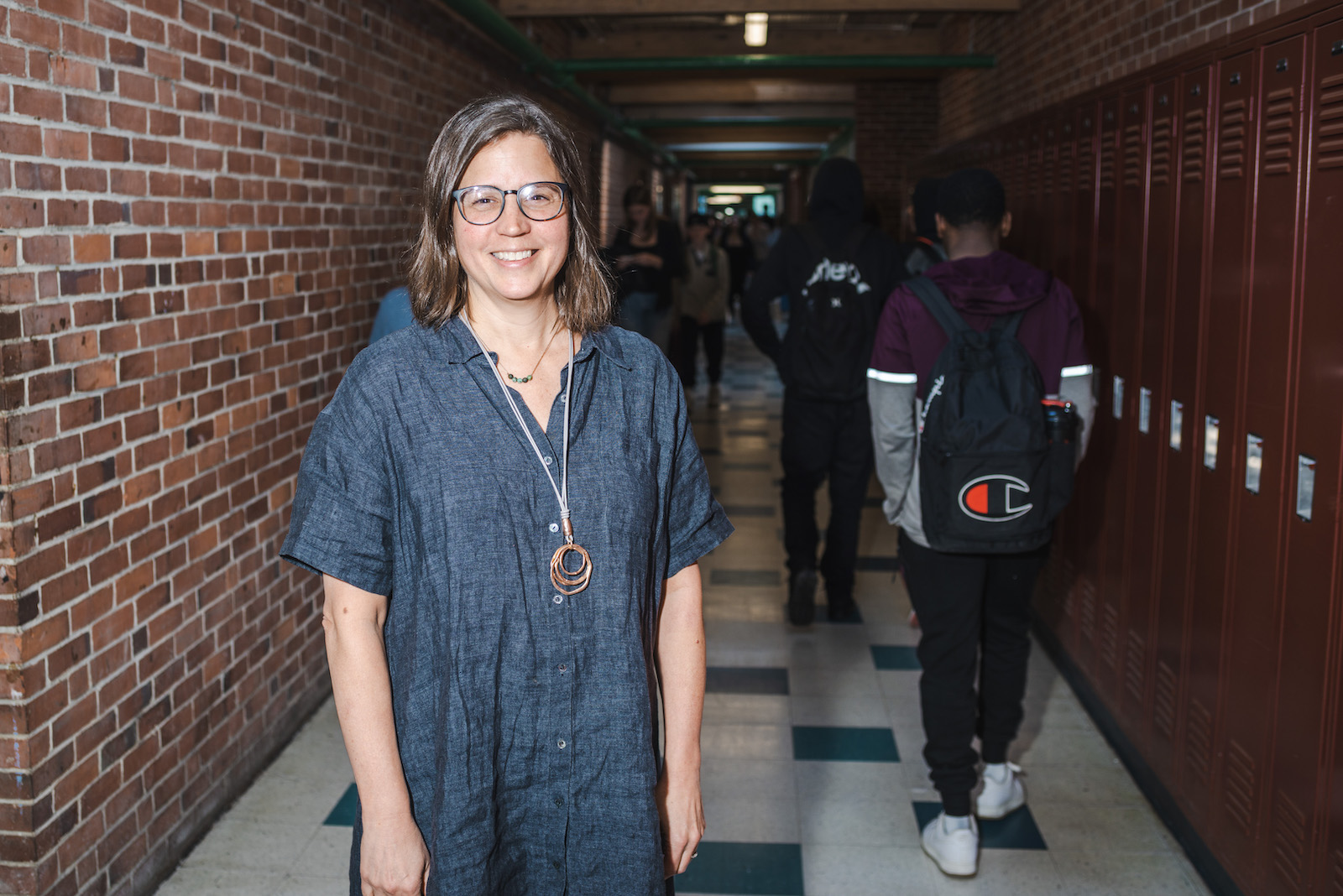
Sara Dingledy's tenure as principal has been the longest since Peg Regan.
In a conversation with the Gazette at her high school office this week, Ms. Dingledy reflected on how the high school has changed since she arrived in the summer of 2016.
Ms. Dingledy came to the Vineyard from the New York City Public Schools system, the largest in the country, with more than 1 million students in 2016 and a centrally-controlled curriculum with little leeway for individual schools.
“It has a huge infrastructure,” Ms. Dingledy said. “Principals are... focused on teachers [and] student culture, and that’s pretty much it.”
She found a very different environment in the Martha’s Vineyard Public Schools system, where principals are expected to make most decisions on their own.
“There’s a ton of autonomy in each school around even interpreting the [employee] contract, doing evaluations, working with parents and community, setting school goals and setting metrics that you’re looking to achieve. That was usually handed to me in New York,” she said.
Ms. Dingledy spent her first year on the job getting to know the school, staff and student body, before beginning to change some of the ways things had been done for years — including the cumbersome, opaque record-keeping system.
“Everything was manually entered and grades appeared at the end of quarter four,” she said. “I couldn’t see the inner workings of the school. So we moved to change that and to have much more transparency around data.”
Transferring the written records to a digital information system has made it possible for school staff to get up-to-date student data at a moment’s notice, she told the Gazette.
“Administrators [and] counselors... can see snapshots of student attendance data, of student performance data, of how teachers are assessing and giving feedback to students on a regular basis,” Ms. Dingledy said.
Students and their parents also can check their latest data online, which helps to avoid unpleasant surprises at grade time, she said.
“By no means do I want to say that I think grade stalking is good, but at least every two weeks for parents to have an update on how their students are doing academically and attendance-wise, I felt was super important,” Ms. Dingledy said.
Another early priority was to correct the state’s data profile for Martha’s Vineyard Regional High School, which she said counted private-school students as dropouts and contained other demographic errors.
“I felt like it was important for us to have an accurate [data] snapshot,” Ms. Dingledy said.

Sara Dingledy talks to students at a past honors night.
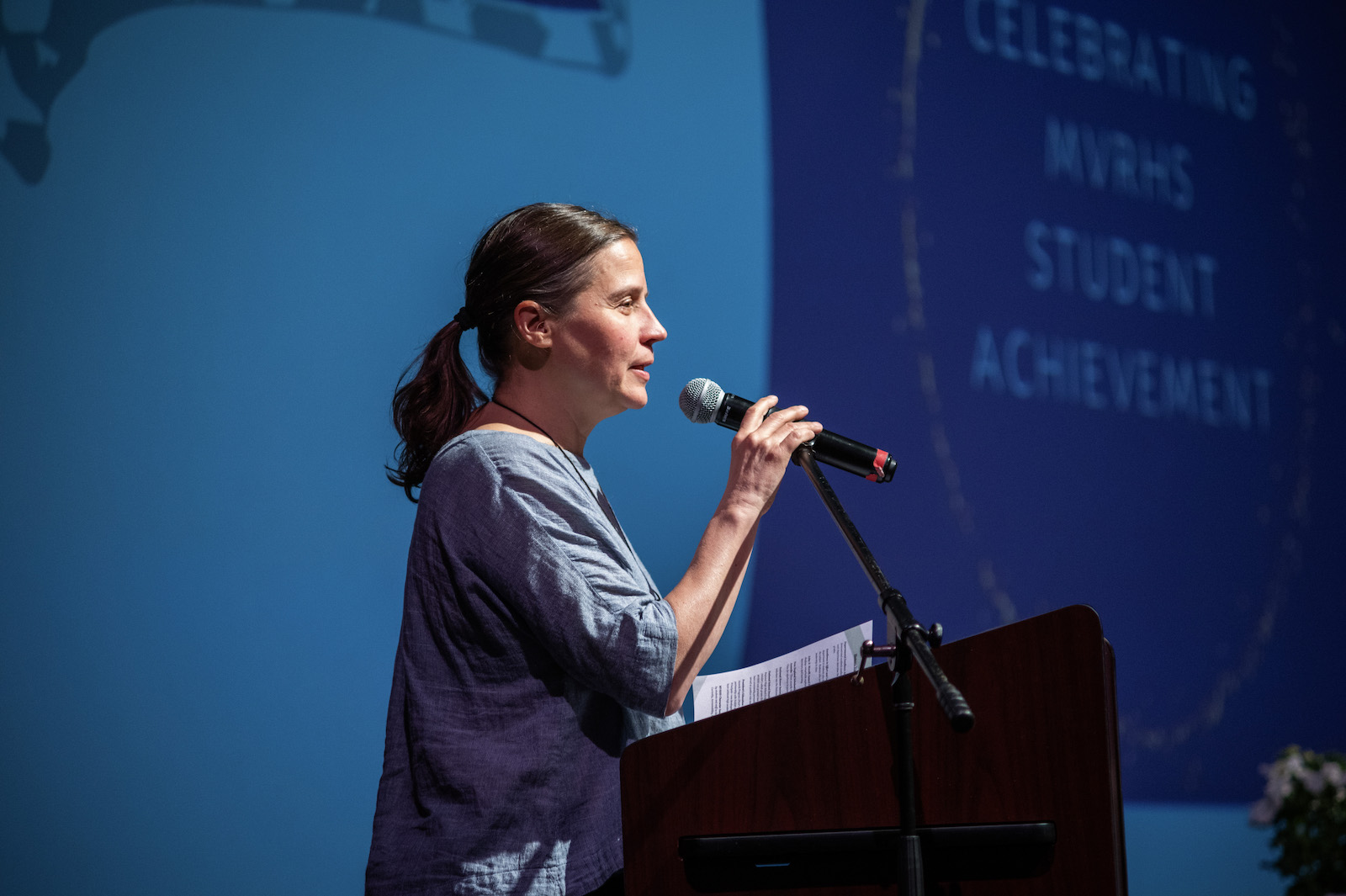
Sara Dingledy talks to students at a past honors night.
She also worked to upgrade the school’s notoriously feeble Wi-Fi service, formerly the cause of frequent complaints, she said.
All of these technological advances came in handy when schools had to switch to remote learning during the Covid-19 pandemic. But the Covid years also brought a new challenge that couldn’t be solved with computers: a larger-than-usual influx of Brazilian teenagers seeking to learn English and enter the Island job market, Ms. Dingledy said.
“Educating a newcomer at 16 and 17 who doesn’t know the language is very different than [educating] newcomers at seven or eight who are learning the language,” she said. “So we worked hard to keep students engaged, to provide meaningful English learning classes, and for many of them to graduate and continue to pursue academics.”
To encourage Brazilian students to stay in school, Ms. Dingledy and her staff changed up their teaching methods and hired more Portuguese-speaking educators, including teachers from Brazil.
“A priority, absolutely, was [that] kids need to see themselves in staff members,” she said.
Today, the front-office greeter is a bilingual MVRHS graduate of Brazilian heritage and the school also has Portuguese-speaking guidance counselors and classroom support staffers, Ms. Dingledy said.
“We are miles ahead of where we were five years ago, in terms of our teaching staff knowing that there are going to be language learners in their class and they have the skills and support to address it,” she said.
“Really, it’s a new way of teaching, and I give credit to our teachers who embrace it,” Ms. Dingledy said.
Along with improvements in teaching English language learners, the high school has expanded both its Advanced Placement (AP) courses for college-bound students and its career-training programs known as CTE, for career and technical education, she said.
With Covid upheavals now in the rear-view mirror, Ms. Dingledy has begun asking teachers and students alike to do less with technology, rather than more. Last year, she convinced the high school committee to approve a policy called Away for the Day, in which students are prohibited from using cell phones and other personal devices during the entire school day, including lunch.
“It’s not just about putting the phone away, it’s promoting pro-social behaviors throughout the day and having kids build connections with one another and feel like school is a place where they talk, where they connect, and where they learn how to healthily interact with one another,” Ms. Dingledy said.
At the same time, the school enacted a policy requiring all students to use school-provided Chromebooks instead of personal laptop computers, which educators said were a persistent source of distractions and cheating.
The identical Chromebooks also erase distinctions between students who can afford higher-end devices, of their own, and those who can’t.
“Equity is a big piece of what the school committee wants,” Ms. Dingledy told the Gazette, noting that MVRHS sports programs are free to all participants for the same reason.
While students are required to put their cell phones into locked, signal-blocking pouches while at school, Ms. Dingledy said teachers, too, are expected to keep their phones out of sight. She’d also like to see the school-issued laptops stay closed, except as needed for specific schoolwork.
“The Chromebooks are there as a tool, but the core of our instruction should be discussion-based and should be student production,” Ms. Dingledy said. “It is so hard to manage [artificial intelligence], it is so hard to manage the corner-cutting, that if we can just keep focusing on school being engaging between people, discussion-based and student production-based, we’re going to be on the right path.”
As Ms. Dingledy moves to the central district office in Vineyard Haven, Mr. Smith and a committee of more than three dozen volunteers — MVRHS teachers, parents, at least one student and representatives from numerous Island community groups — have looked over 14 applications for the principal’s job, all from off-Island educators.
Speaking with the Gazette Thursday, Mr. Smith said that the committee is leaning toward appointing an interim principal to start work this summer, while taking more time to search for a long-term successor.
“The feeling [is], let’s not rush into something if there’s an opportunity to have a deeper pool of candidates this fall,” he said.
Current high school employees — who have witnessed Ms. Dingledy attending countless night meetings in all six Island towns during the months-long budget season — have not applied for the job, Mr. Smith said.
“People on staff have seen what Sara has gone through,” he said.
However, Mr. Smith said, some staffers are willing to try on an interim basis.
“I think there are some great people in-house [and] there are several people that would step into the role because they care about the school,” he said.
Comments
I have know Sara since she
Maureen Kenney New York City & formerly W TisburyI have know Sara since she was an emerging teacher at a large NYC high school. From the beginning her perceptive analysis, strategic thinking and laser focus were evident. She was also fearless and able to initiate and embrace change. I was thrilled to learn that she got the job as principal and am equally gratified to see her move into the managerial role. Good for Martha’s Vineyard to acknowledge her talents and skills. More good changes will come…congratulations to Sara and the schools!
Thank you Sarah for your
Kara EdgartownThank you Sarah for your dedication and hard work. In what is often a thankless job, you have made real, tangible change and progress. You are a big part of why our school is something we can all be proud of. Congrats on your new position, I am glad that the island will continue to benefit from your leadership.
Add new comment