


Federal regulators have shut down Vineyard Wind while they investigate what caused a 107-meter turbine blade to break and spill fiberglass into the ocean.
Two weeks ago, Vineyard Wind was touting how it had grown to be the largest offshore wind farm in the country when it brought its 10th turbine online. It’s all come crashing down since.
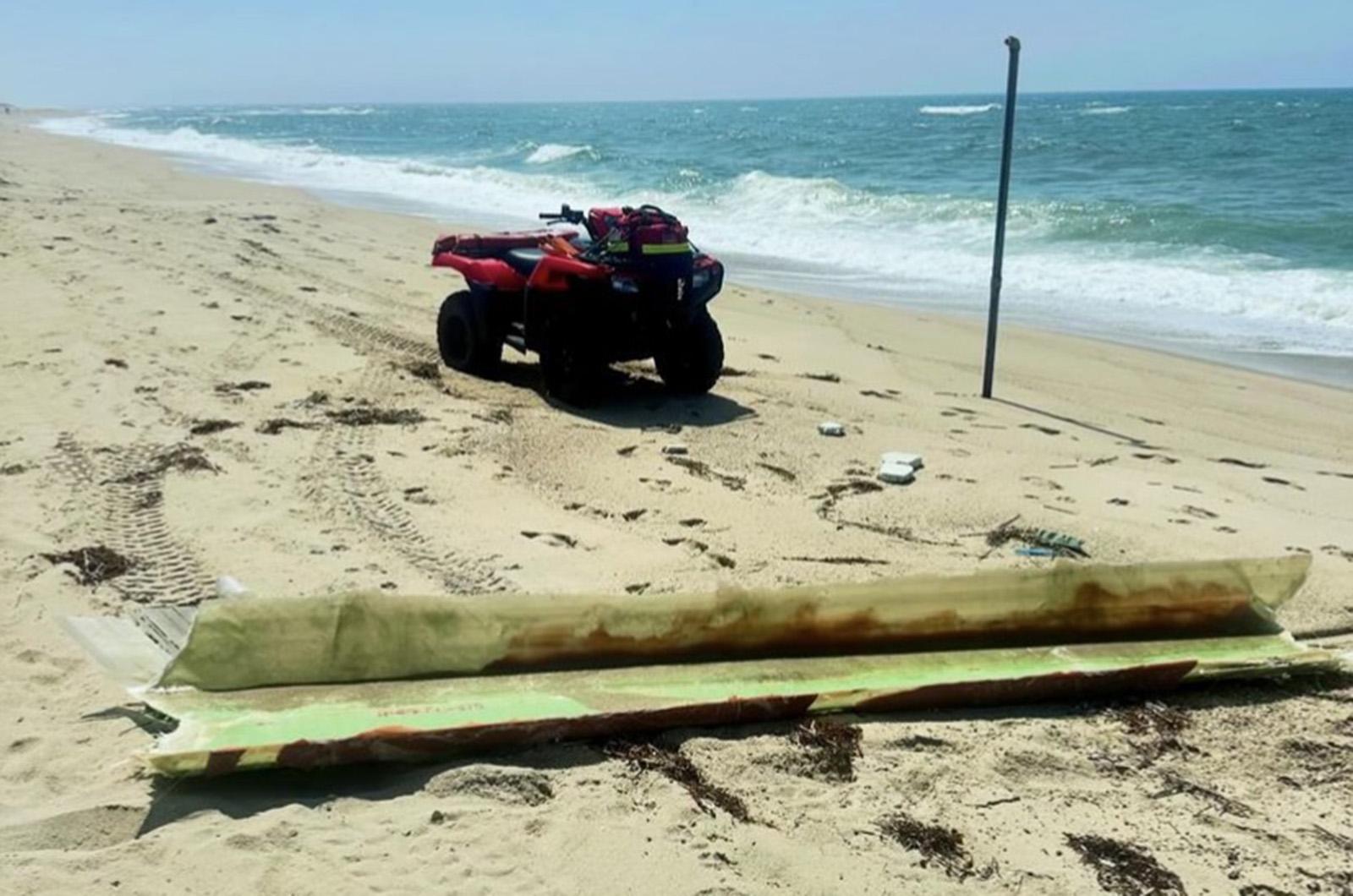
Over the weekend, one of the blades on the offshore wind energy company’s turbines broke — spilling white and green fiberglass debris into the ocean. On Thursday, a large chunk of the blade separated from the turbine and tumbled into the water.
Officials with Vineyard Wind and the turbine’s manufacturer GE Vernova are investigating how the 107-meter blade folded over, but the project’s been shut down indefinitely until federal regulators can figure out what went wrong.
It’s a major setback for Vineyard Wind, which boasted its planned 62-turbine project about 14 miles south of the Island as being the “forever first” commercial scale offshore wind energy project in the U.S.

Cause is being investigated, meanwhile the wind farm has been shut down temporarily.
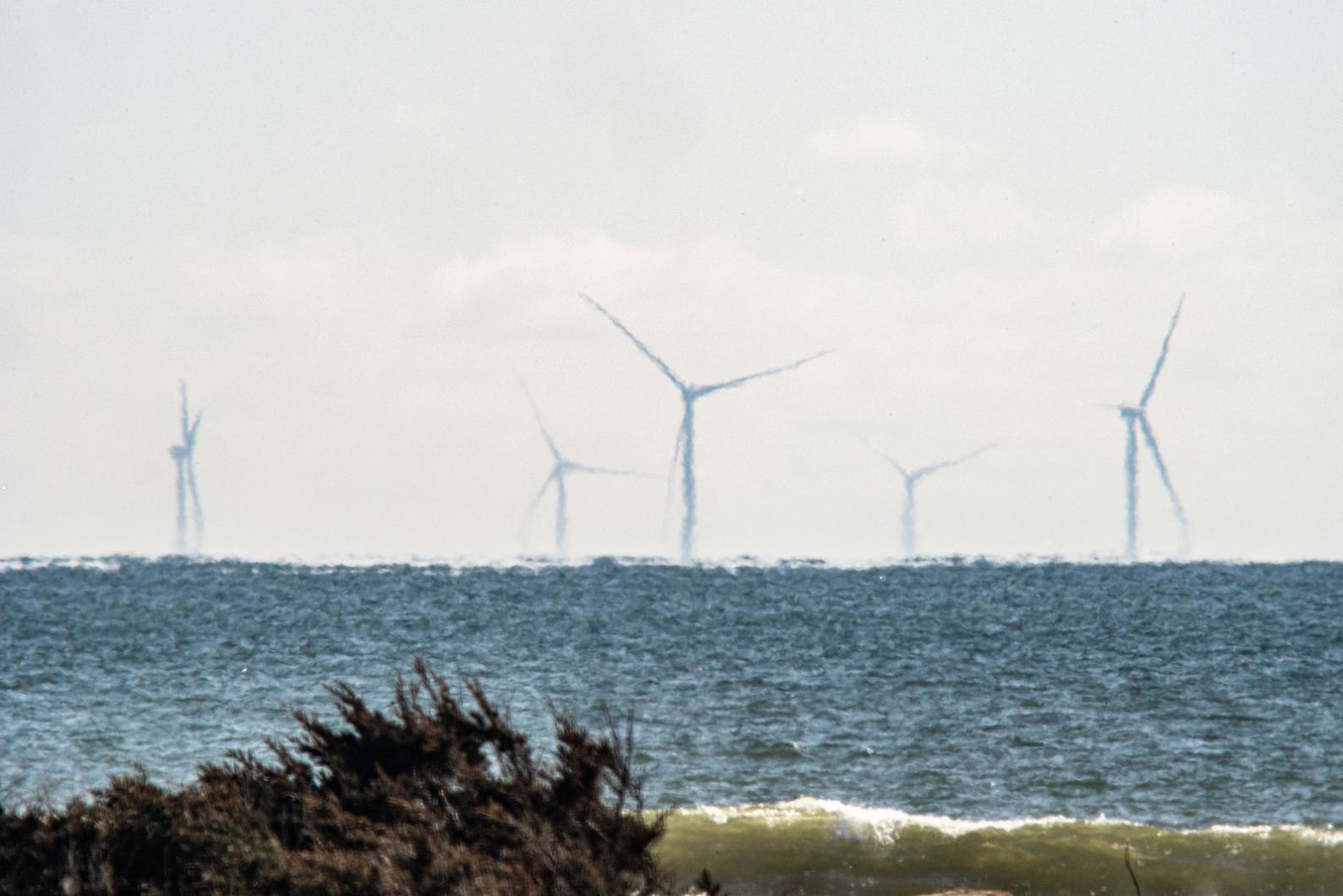
Cause is being investigated, meanwhile the wind farm has been shut down temporarily.
It could also be a blow to the nascent industry that has been setting its roots off the Vineyard and beyond in New England, but was already facing headwinds in a turbulent economy.
The Vineyard Wind incident started unfolding on Saturday, July 13. At around 7 p.m., the blade bent over about 20 meters from its base. The issue triggered alarms within Vineyard Wind, and the system automatically shut down.
According to Vineyard Wind, the company immediately contacted the U.S. Coast Guard and set up a 500-meter safety zone around the turbine.
The issue was isolated to a single turbine at the southernmost edge of the wind farm’s 167,000-acre lease – making it about as far away from the Vineyard as possible. The turbine was still in the commissioning phase and had been undergoing testing.
But with the turbine broken and flipped in the wrong direction, an unknown amount of fiberglass inside the blade began spilling out into the water.
In the days after the break, Vineyard Wind said it dispatched vessels to recover the large pieces of blade that had fallen into the water, but early this week Nantucketers began finding sharp shards of fiberglass washing on their shore.
Though Vineyard Wind said the debris was non-toxic, the town feared the pointy pieces posed a danger to beachgoers and closed the island’s south side beaches to swimming.
By Tuesday, a herculean effort to rid Nantucket’s sandy shores of the green and white fiberglass had begun. Vineyard Wind deployed its own teams and hired other workers to help with cleanup, but lifeguards, town staff and Nantucketers young and old pitched in.
The company urged people to leave the clean up to Vineyard Wind, which plans to collect the fragments for investigative purposes as well as dispose of them afterwards off-Island.
Due to the currents and wind, the Vineyard’s south shore seems to have been spared from the debris. Beach officials on Chappaquiddick, Edgartown and Chilmark reported Wednesday that there was no sign of fiberglass, though they were keeping their eyes peeled.
“We haven’t seen anything in the last two days,” said Andrew Kelly, an Edgartown parks commissioner.

Vineyard Wind CEO Klaus Moeller was grilled at the Nantucket select board meeting Wednesday evening.
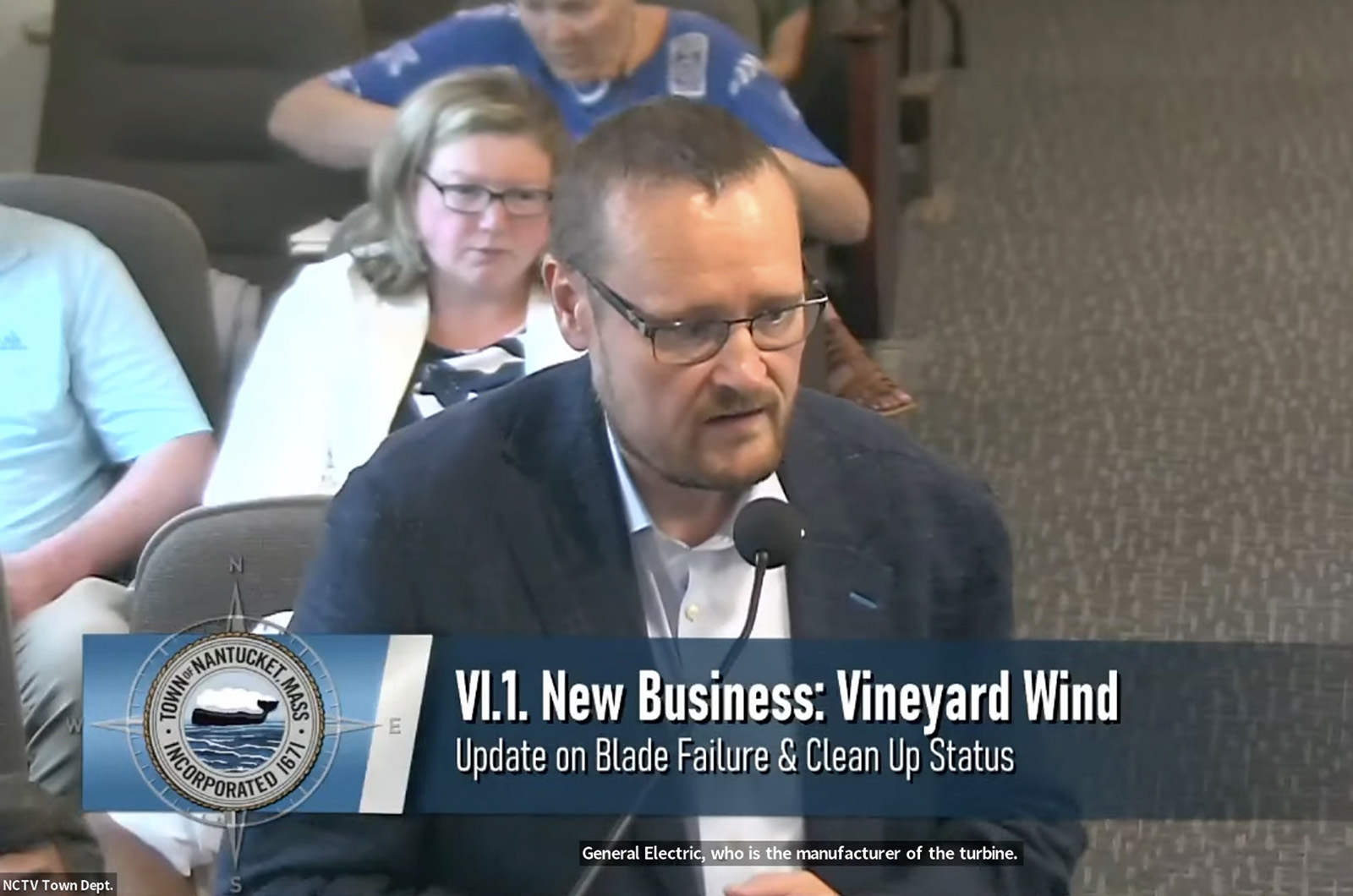
Vineyard Wind CEO Klaus Moeller was grilled at the Nantucket select board meeting Wednesday evening.
Vineyard Wind was also trying to ascertain how much, if any, debris had made it over to the small islands of Muskeget and Tuckernuck that sit between Nantucket and the Vineyard.
What went wrong with the blade isn’t clear. The company had installed three newly manufactured replacement blades on this particular turbine after one of the original blades was damaged during the lifting process and subsequently removed from the construction areas.
The one that broke was one of the replacement blades, officials said.
By Wednesday evening, Vineyard Wind worried the broken blade would detach completely from the turbine, and new debris had already fallen in the water. A boom to attempt to catch the litter was being set up.
On Thursday, Vineyard Wind confirmed that a signficant part of the blade broke off from the turbine and marine crews were onsite overnight to try and remove the new debris.
“We are staying apprised of GE Vernova’s efforts to manage the situation, including the removal and recovery of the remaining blade attached to the turbine,” Vineyard Wind said in a statement. “With public officials, we will continue to keep the Islands informed of developments as we work closely with state, federal, local, and tribal partners to respond to this evolving situation, with safety of our personnel, the public, and the environment as our highest priority.”
Though GE Vernova officials did not believe that the blade would damage the rest of the turbine if it fell, it raised more fear for beachgoers concerned they could be pierced by the floating debris.
News of the teetering blade came up as Vineyard Wind and GE Vernova leaders were being grilled by irate Nantucket residents at a town select board meeting. Vineyard Wind CEO Klaus Moeller had to leave what would eventually be a nearly four-hour meeting to deal with it.
A massive cleanup effort on Nantucket has been underway.
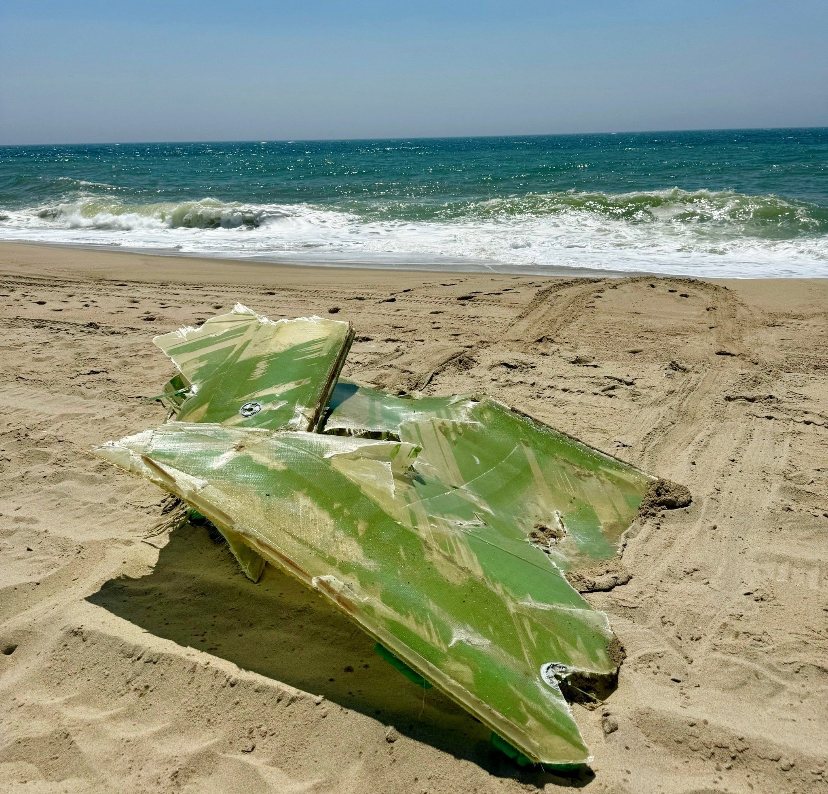
A massive cleanup effort on Nantucket has been underway.
After the initial damage over the weekend, the Bureau of Safety and Environmental Enforcement, which oversees offshore wind projects, issued a suspension order to Vineyard Wind to cease power production from all of its turbines until it could be determined whether the blade failure affects any other turbines.
The order also halted any further construction for the project – a prospect that could set the project back dramatically since the company had been hoping to take advantage of the calmer summer seas.
The bureau also called for a preservation order to safeguard any evidence that could be related to determining the cause of the incident.
“As of this date, there are no reported injuries or harm to any marine resources or mammals from the incident. BSEE is onsite with Vineyard Wind as investigations are underway,” a bureau spokesperson said. “BSEE will conduct an independent assessment to ensure the safety of future offshore renewable energy operations.”
During the select board meeting on Nantucket Wednesday, Vineyard Wind and GE Vernova officials said they planned to weigh all of the bits and pieces of fiberglass that were collected in the water and on Nantucket to determine how much is left.
As of Wednesday, about 17 cubic yards of debris – more than enough to fill six truckloads – had been removed. Renjith Viripullan, an engineer with GE Vernova, said the company would check the pieces for any indication of if they were hit by lighting, though he didn’t think that was the reason.
Vineyard Wind and GE Vernova officials vowed to scrutinize every detail of the blade’s production, but also acknowledged that this type of blade from a Haliade-X turbine had also been damaged in an incident off Dogger Bank in the United Kingdom.
Roger Martella, the chief sustainability officer at GE Vernova, downplayed that the incidents could be related.
“We don’t think there’s a connection between that installation issue and what we saw here in Vineyard Wind,” he said.
Each Vineyard Wind turbine – there were about 22 either entirely constructed or underway before the broken blade – is more than 800 feet tall, on par with the Eiffel Tower. The company previously said once assembled, the turbines would be “the largest turbine in the western world.”
Walt Musial, a chief engineer at the National Renewable Energy Laboratory, said this type of incident was not normal.

The red x shows where the broken turbine stands in the Vineyard Wind lease area.
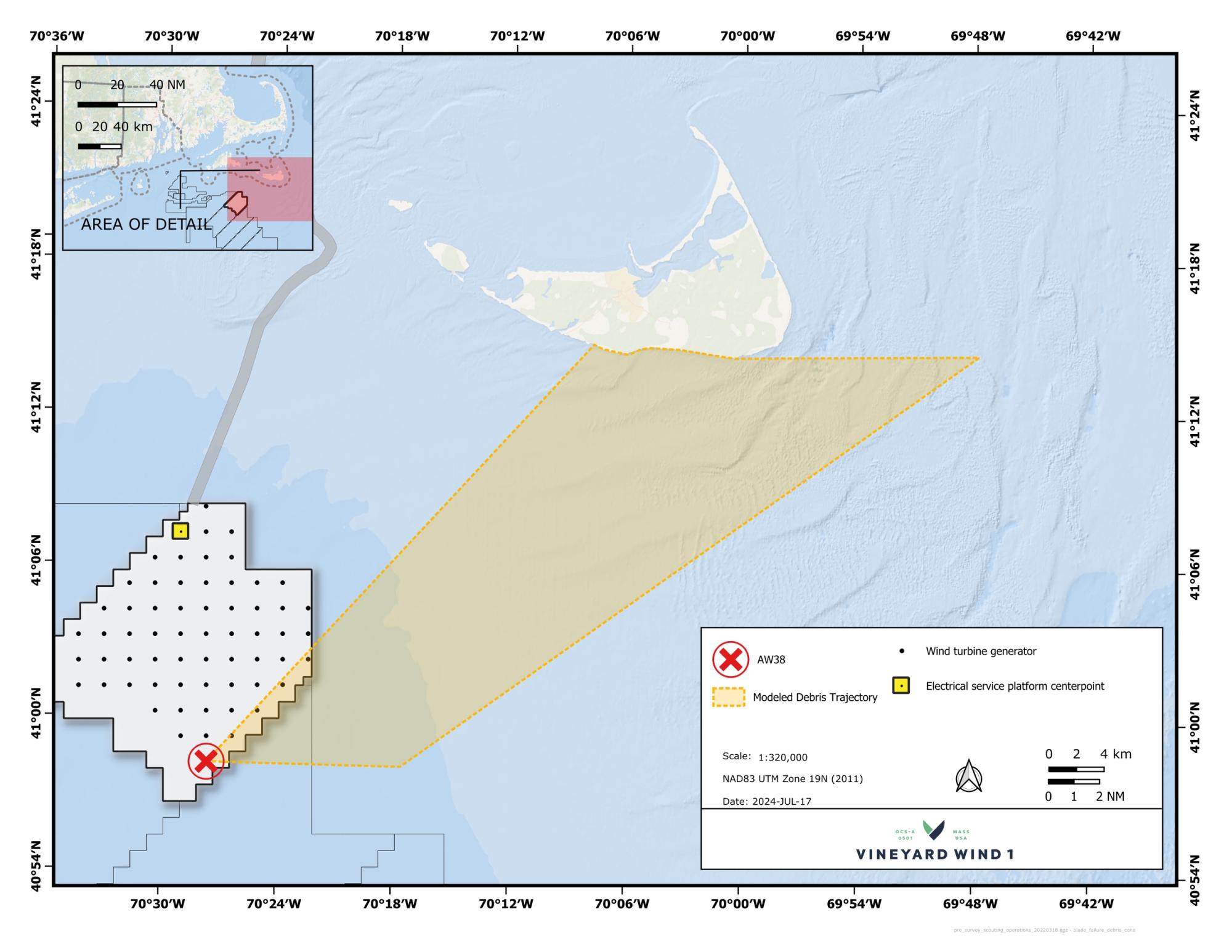
The red x shows where the broken turbine stands in the Vineyard Wind lease area.
“The loss of a blade is very rare and should be considered an anomaly,” he said.
Prior to serial production, each model has to be certified in a process that involves laboratory testing to prove the blades can withstand winds of more than 150 miles per hour.
“The laboratory testing also ensures that the blade design is suited to survive extreme turbulent loading for its expected life of up to 30-years, although not all blades are tested,” he said.
Nantucket charter boat captain Carl Bois was one of the first members of the public to see the fiberglass from the turbine in the water when he was out on his boat near the turbines on Sunday.
The pieces, some large and others small, looked like green styrofoam and they were bobbing up and down in the water, at times hardly visible.
“I’ve never seen anything on the water quite like that,” he said.
At Wednesday’s select board hearing, many Nantucket residents questioned why it took Vineyard Wind about 48 hours to tell the island that this debris was headed their way.
Vineyard Wind transports turbine blades to the construction site last year.
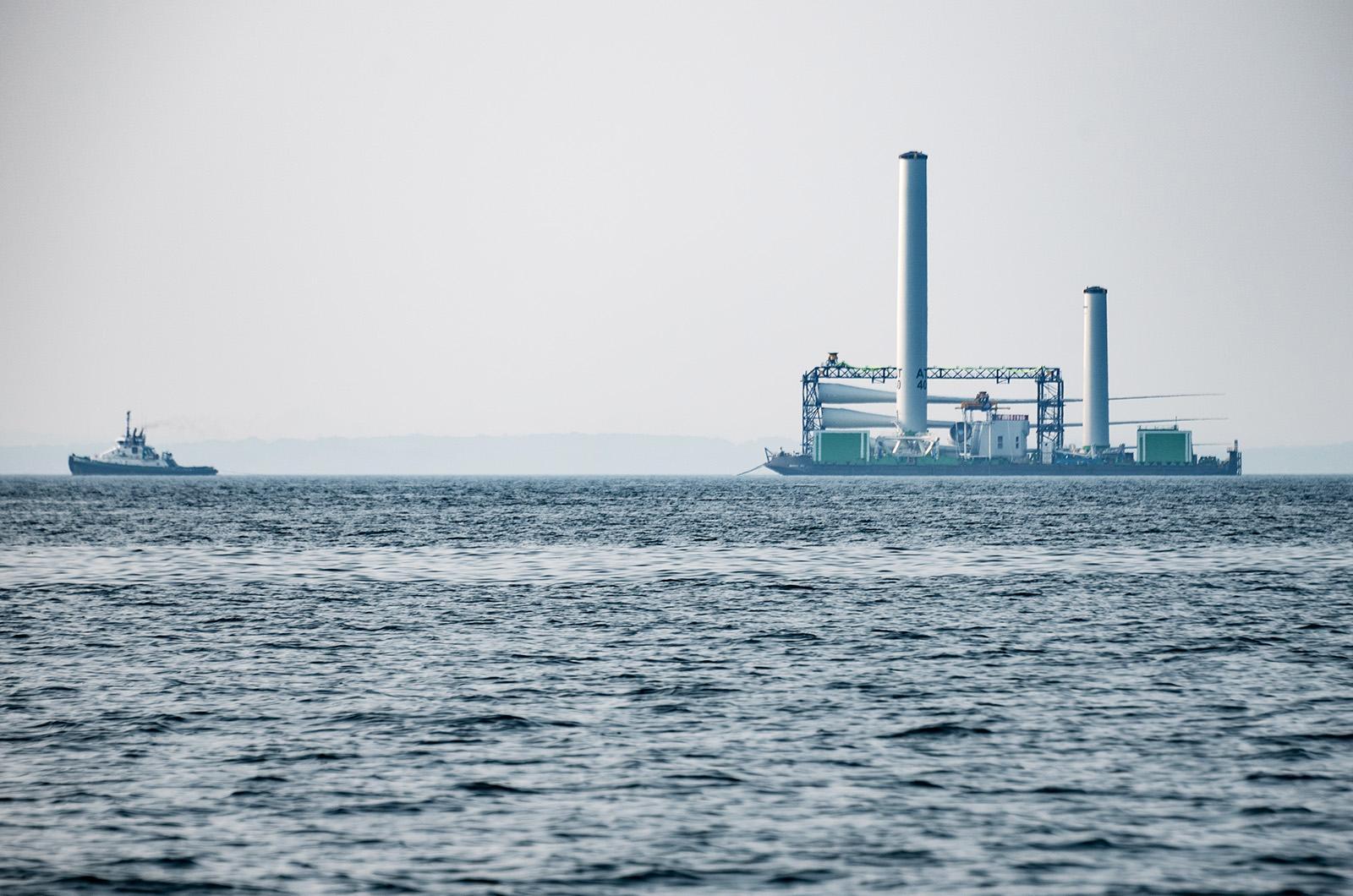
Vineyard Wind transports turbine blades to the construction site last year.
“This community would have been much better prepared in terms of communicating to our residents about the impending risk before it became an actual risk, with debris on our beaches,” said Brooke Mohr, the select board chair. “I just want to state for the record, it was inadequate for this community.”
Other residents called for water testing to protect marine life and swimmers, as well as resources dedicated to long-term cleaning and aid for businesses hurt by the beach closures.
“It’s ruining my business short-term right now,” said Gaven Norton, the head of a surfing school on Nobadeer Beach. “But who knows how long this is going to go on.”
Vineyard Wind and GE Vernova said it would listen to the communities affected by the broken turbine and it was undertaking a “root cause analysis” to find out how the project, once promised as a major step toward tackling climate change, had gone so wrong so early in the construction.
“I’m really sorry that it happened, but I’m also glad to know that the response seems to have worked and we have now gotten most of the debris out,” said Mr. Moeller with Vineyard Wind. “But rest assured, we will not just leave this as it is now. We will monitor it, we will keep the whole team here as long as needed.”
Comments
The towns on MV need to band
Leo N. WTThe towns on MV need to band together and immediately file suit to have the offshore wind projects shut down and the existing turbines removed. They have destroyed the south shore view and will destroy our beaches and tourist economy next.
I agree! Wait until we get a
Jim EdgartownI agree! Wait until we get a storm! This was a huge mistake!!
Who’s idea was this??
Well said Leo. Agreed.
Susan Desmarais Oak BluffsWell said Leo. Agreed.
I agree 100%
MM Lock Oak BluffsI agree 100%
Views? That’s ridiculous, you
BO EdgartownViews? That’s ridiculous, you can barely see them off the south shore. We need practical solutions to climate change. Yes this needs to be fixed but your views won’t matter when the beach is gone forever.
Still time to dismantle
Enough EdgartownStill time to dismantle turbines, convert their office building to illustrious affordable housing and turn their marine terminal / helipad into an alternative freight dock! : )
The waterfront work in VH is
TisAdult Vineyard HavenThe waterfront work in VH is for service boats and not a helipad.
The Helicopter operations occur at MV airport
Do we know if this is an
Milly OBDo we know if this is an isolated incident? Will blades on the other turbines also soon break? We should demand that all of the remaining blades be immediately removed to prevent further pollution of our waters and beaches by this failed experiment.
Please read the article.
Carol formerly ChilmarkPlease read the article.
What happens when we have a
Charles Martha's VineyardWhat happens when we have a major hurricane? All that debris... not to mention, how does it affect marine life?
And they tell us, "You won't be able to see them from the Vineyard", yet I could count 12 with my naked eye a few weeks ago.
Would be very curious to hear
MWG EDGWould be very curious to hear how Vineyard Wind would define the word "toxic"
According to the CDC,
Milly OBAccording to the CDC, fiberglass is a health hazardous: "Fibrous glass is a synthetic fiber made from tiny particles of glass. It can harm the eyes, skin, and the lungs." (https://www.cdc.gov/niosh/topics/fibrousglass/default.html).
Quite a few climate change
Carol formerly ChilmarkQuite a few climate change deniers in these comments, I see. Commenters who are almost hysterically worried about views, yet not at all about the ravages on the Island of accelerating sea level rise. Yes, there was a clearly some issue (manufacturing defect?) in one turbine blade, and it's right to shut down the others until the root cause analysis is complete, but -seriously - enough hyperventilating. I wish that's the only junk that washed up on our shores, but I don't hear that hysteria about the fishing industry, which produces most of the junk (plastic ropes and line) that washes up. Also - really, fears of being "pierced" by the debris? Do those people think that fiberglass is actual glass? Or do they not know that all those boats in Island marinas are made of fiberglass? Sheesh. Calm down.
Fiberglass is actual glass.
Milly OBFiberglass is actual glass. It’s glass fibers in a resin. Now the beaches of Nantucket are littered in it and the town is advising people to wear shoes when walking on the beach. Our anger has nothing to do with climate change or clean energy. It has to do with an ill conceived experiment right off our coast. We should let offshore wind be perfected somewhere else that isn’t dependent on a beach tourism economy.
Offshore wind energy began in
mike kelfer ChilmarkOffshore wind energy began in Scandinavia in 1991, and in the US in 2016.
This is not an "experiment".
The failure of a wind turbine needs to be evaluated and investigated, but the trashing of this energy source is just over-emotional and "over-blown".
No energy source is risk-free. Climate change is widely embraced. Let's not forget the damage incurred by our current energy sources.
Sand is glass, too.
Thomas S Hodgson West TisburySand is glass, too.
Vineyard Wind has shown
John Bleery VHVineyard Wind has shown nothing but disregard for the community. They hide under the guise of clean energy to steamroll over our island. I for one am all in favor of clean energy including wind power, but we still need to set boundaries and rules as we would with any other industrial project. Clean energy shouldn’t get a free pass.
Carol,
jason gale West tisburyCarol,
I don't see in the comments here anything that you could refer to the commenters as "climate deniers" , maybe it's your defense mechanism kicking in , thinking anyone that questions these projects are automatically a climate denier. I assure you, I have mostly found that not to be the case.
Yes in society there are "climate deniers" and there also are "climate panickers" , just like most things in life , the true reality is somewhere in the middle.
As for your fishing debris comment,it was far worse in the 70s than it is today.Very rarely do I pick up fishing debris while lobstering, it's mostly balloons, coffee cups , plastic bags.. trash discarded mostly on purpose.
And finally, fiberglass is extremely sharp when it's been compromised.It can slice like glass or splinter to the point of an ER visit and even the smallest shard can accomplish this.
I don't think people need to "Calm down" , if anything they should continue to ask questions and raise concerns about these projects.
It's 1 blade now what happens when the blades weaken from stress,sun and the harsh elements and 1 becomes 20,30,40.....
They are finding fiberglass particles in the bivalves in the UK. As these blades shed or come apart as we just witnessed, we too can look forward to fiberglass in our shellfish (and other species)
Wanna eat a fiberglass oyster?
I don't!
GE Vernova’s Haliade X is its
Salty Dog Wilmington, DEGE Vernova’s Haliade X is its biggest offshore wind turbine. It’s gone through rigorous testing for years. These GE WTGs began being installed for offshore wind farms in Fall 2023 for the Dogger Bank Wind Farm (UK) and Vineyard Wind (US).
Whether it’s a car, aircraft, power plant, kitchen refrigerator, computer or any of the latest tech, equipment or a component will break for any number of reasons. They’re all complex machinery and anything - even something so small as a seal, improperly threaded screw, bad batch of steel or fiberglass or hairline crack in material - can get exacerbated under operating conditions and lead to equipment failure.
This is to be expected in the real world, which is why OEMs provide warranties & manufacture spare parts, companies hire O&M folks to maintain equipment and owners, operators and service providers carry insurance.
Like the new car that’s a lemon the minute you drive it off the lot, the PC that never works quite right or has a keyboard that doesn’t work properly the first time you turn it on or the appliance that makes a weird sound from Day 1, there can be a faulty WTG. Stuff like this happens.
What everyone should want is for the root cause of the blade failure to be determined to fix any manufacturing process (if any) involved. Or, the blade could just be a “lemon” like the keyboard on my Dell PC that didn’t function properly out of the box. Dell sent a tech who swapped out the keyboard even though I wanted a whole new computer. After the keyboard replacement, my PC has worked fine ever since.
Like my PC, the broken blade will eventually get replaced and the WTG will once again produce electricity - by harnessing the power of the wind - for Massachusetts homes and businesses. End of story. Keep Calm. Carry on.
Shut it down! This really
Tim EdgartownShut it down! This really sounds like a half fast operation, with a lot of Government money..
Why the big ugly building in VH?
Is it that much bigger than
Albert GosnoldIs it that much bigger than the old fish house?
Uglier that Packer's tank farm?
The Shipyards tin sheds?
so let me get this correct. a
curt floridaso let me get this correct. a blade fell off requiring one tractor or bucketloader to clean up. and they want to shut it down? at least its not an oil spill killing all wildlife and fish in the area. what is wrong with people no kidding. are we this elementary?
As per the article and GE
MB Cormie VHAs per the article and GE itself......this was far more than one tractor or bucket loader....."As of Wednesday, about 17 cubic yards of debris – more than enough to fill six truckloads – had been removed. Renjith Viripullan, an engineer with GE Vernova,".
I agree with Green Energy if it is in fact "GREEN" and does not kill off the marine life. These ocean wind farms are successful in other areas....why? Because many of the other Ocean Windfarms in other parts of the world the oceans do not have the marine biodiversity that we have here off of our shores. There are no whales. Also Vineyard Wind is proving to be a company that does not care about the Vineyard or whom their projects effect.
I guess blade failures are a
jason gale West tisburyI guess blade failures are a common occurrence, unfortunately over water recovery isn't easy.
https://www.windpowermonthly.com/article/1878267/root-replacement-new-s…
Dispose of these misbegotten
Carl vR WTDispose of these misbegotten monstrosities asap. Correct a ridiculously expensive mistake.
I was frustrated with this
Wendy West TisburyI was frustrated with this situation to begin with but became infuriated when reading the spokesman’s statement that “As of this date, there are no reported injuries or harm to any marine resources or mammals from the incident.” This suggests that immediate injuries are the only concern, which is simply not true. The impact of this incident will be felt for years to come.
Take Norman’s Land, for example, where several cleanup attempts have left undetonated bombs. It’s foolish to think they will find every piece of material that polluted the ocean. The islands, the Cape, and every animal in the sound and the Atlantic will be dealing with this for years.
What’s more aggravating is seeing how Vineyard Wind seemed to dodge responsibility for the right whales and other sea mammals that end up dead along the island shores and the Cape.
I am horrified by this situation. It hasn’t even been a year. To think that we, as a species, feel entitled to attempt to reverse our environmental impact by extending our reach into the ocean, only to create another mess for the ecosystem, is heartbreaking.
This was a bad idea from the start. Almost every islander knew that. And Vineyard Wind just proved all the naysayers correct.
The impacts of climate change
Bob EdgartownThe impacts of climate change will also be felt for years to come. I'd rather attempt to find a solution for our dependence on fossil fuels, albeit imperfect, than let temperatures and sea levels continue to rise.
This is not an ‘imperfect’
Wendy West TisburyThis is not an ‘imperfect’ solution. This was long speculated as problematic and in less than one year has proven itself to be its own environmental disaster. Open water clean up is nearly impossible. We cannot extend our reach to the ocean to fix a problem we created here on land. VW has negatively contributed to climate change. It’s an unfortunate fact and we must pivot before anything gets worse.
Add new comment