

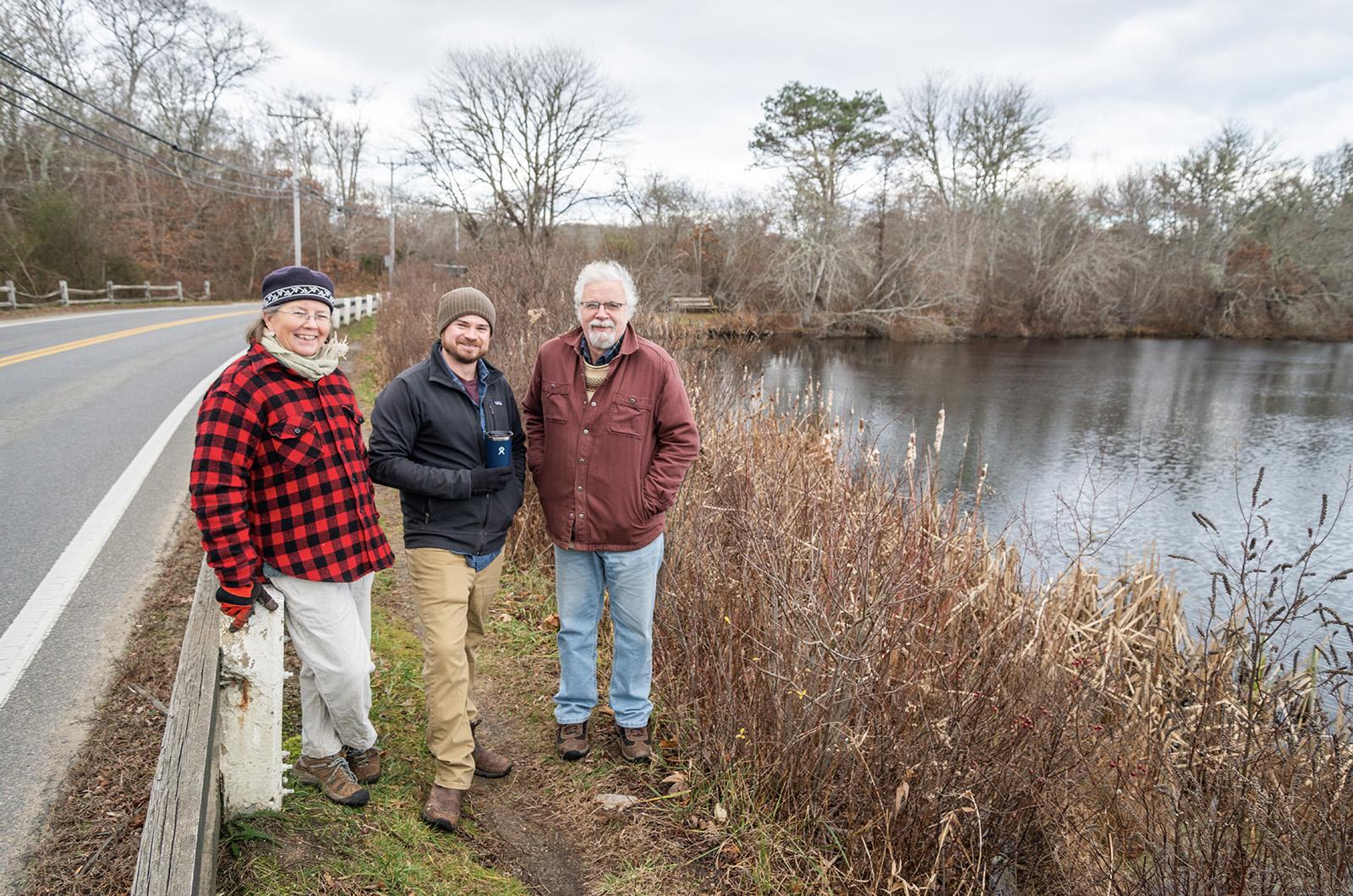
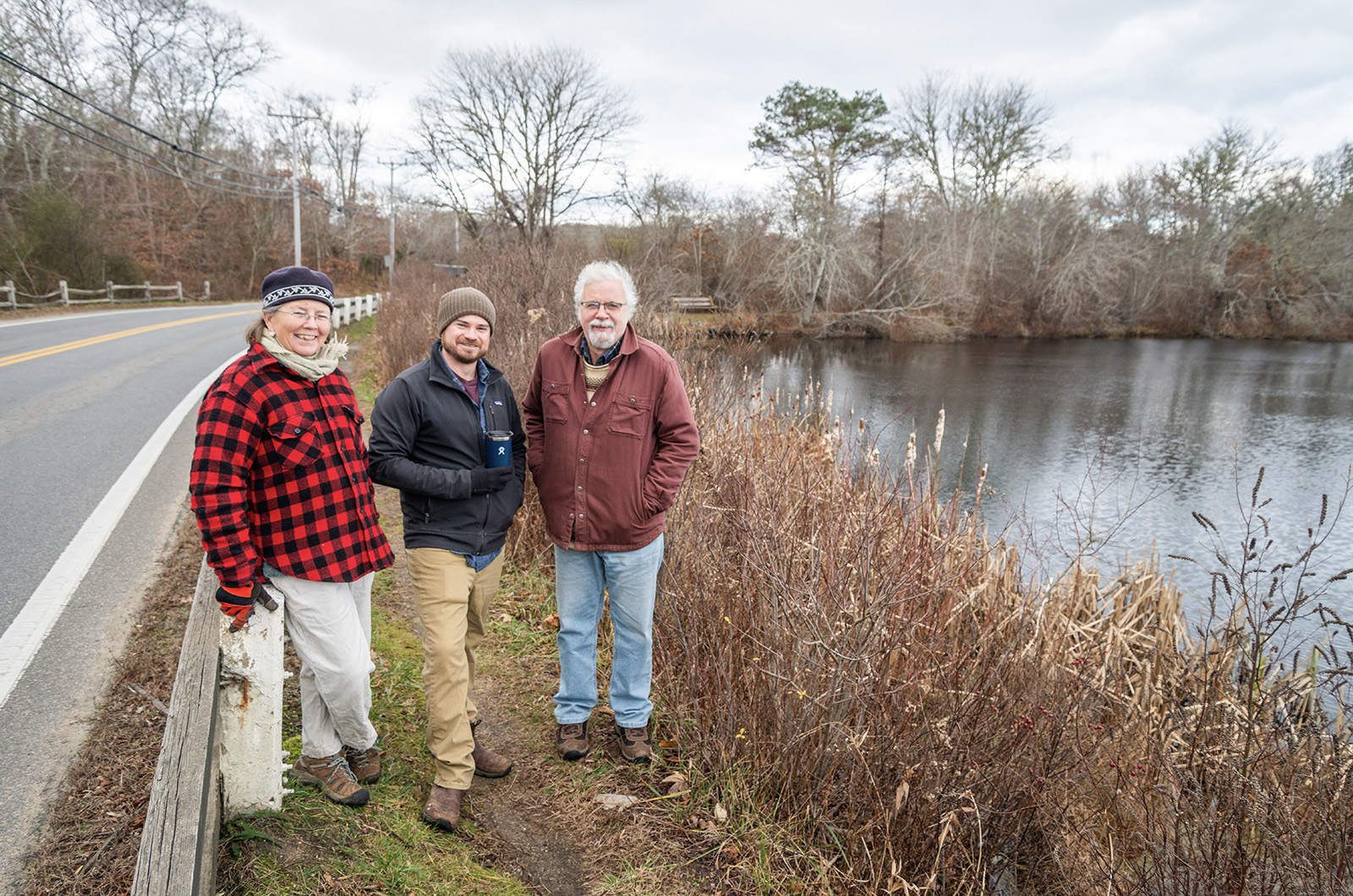
The discovery of the water-willow stem borer moth at Mill Pond in West Tisbury could have a big impact on brook conservation.
Straw yellow stems arch waterside from the muck around Mill Pond in West Tisbury, thin branches dipping into the water in search of fertile footing.
These spindly water willows have been slowly stretching further into the pond over the years, exploratory branches rooting in loose organic matter delivered by the ever-flowing Mill Brook.
But for members of the town’s Mill Brook watershed management committee, it is not the plant that is intriguing, but the rare water-willow stem borer moth that inhabits it.
The Mill Brook watershed management committee has been studying the area for years.
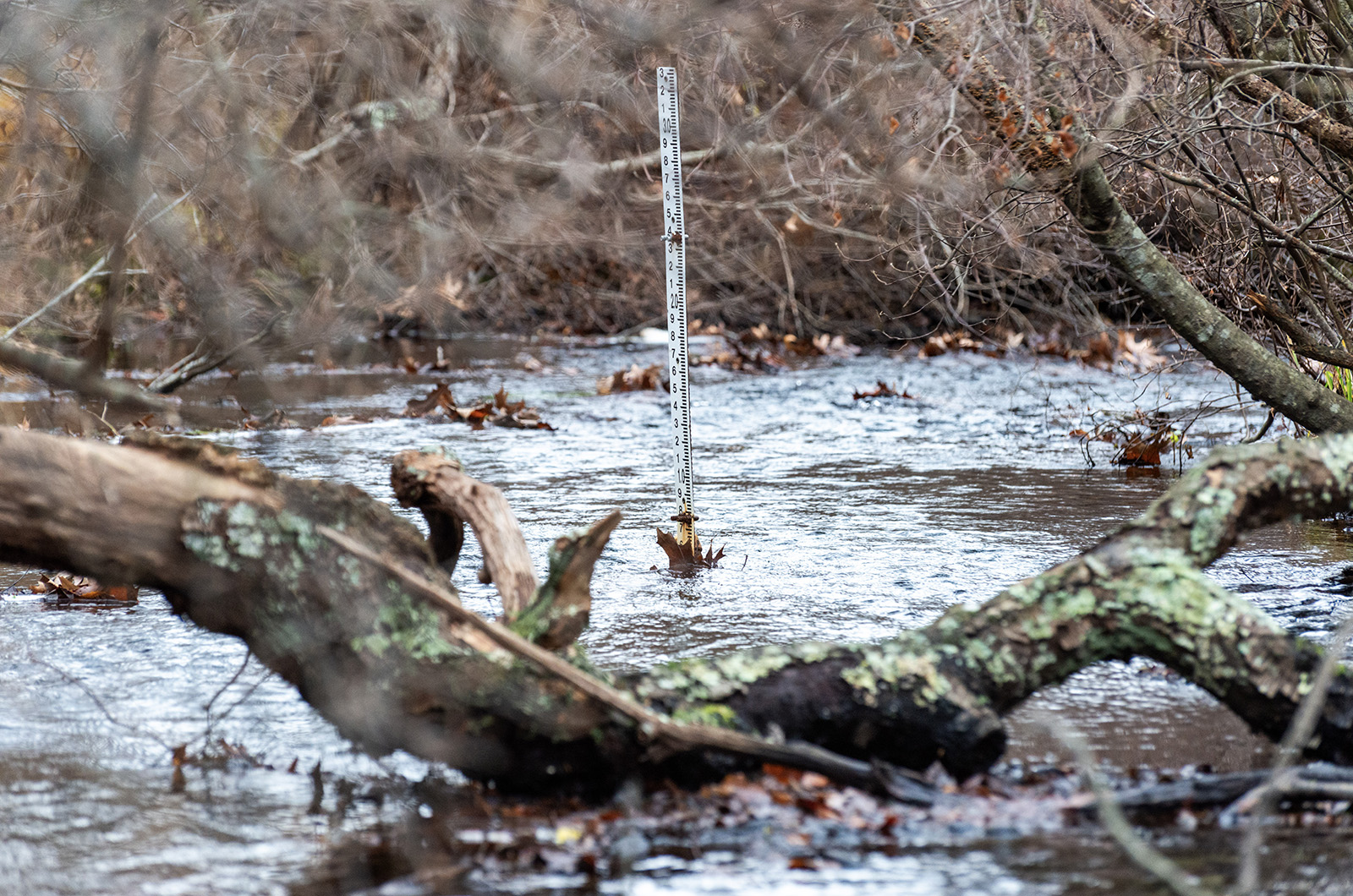
The Mill Brook watershed management committee has been studying the area for years.
The discovery of the moth, a state-threatened species, came during a multi-year watershed study put on by the committee. Its discovery, said committee chair Prudy Burt, could have a big impact for brook conservation.
“It’s an important consideration for vegetation management,” she said. “It means that any work will have to go before natural heritage.”
The moth, found in 2021 and announced by the committee this year, is threatened statewide. Now, any proposal to clear vegetation around the brook or to dredge Mill Pond – last done in the 1970s – will need approval from the Massachusetts Natural Heritage and Endangered Species Program, a potentially high hurdle.
The moth search was initiated by committee member Kristen Geagan, recalled committee member and former Martha’s Vineyard Commission water resources planner Bill Wilcox.
“We spent about an hour poking around here and finally found that, I guess it was the pupa skin,” he said of the innocuous brown pellet cast off during summertime moth metamorphosis.
Though willow plants have inched further into the pond in recent years, those plants may now be protected as home to threatened species, said Ms. Burt.
The committee has researched other parts of the Mill Brook, too.
One of the concerns that the committee set out to study when it was founded was a perception that the undredged pond might be filling up with sediment, allowing vegetation like the willow to creep in.
“There were a lot of claims, ‘Oh my god, it’s filling in, run for your lives,’” Ms Burt said, but data collected by the committee and the late Kent Healy haven’t borne out those worries.
Though the brook brings in small amounts of sediment, Mr. Wilcox said, most of it ends up in the nearby scrub marsh. Meanwhile, water willow has been able to spread faster than the sediment arrives in the pond, rooting in the loose, unsettled muck.
“It will tolerate a real wet feet kind of situation,” he said. “It doesn’t need solid ground.”
The moth and vegetation findings at the pond are only part of a herculean data collection effort undertaken by the committee, which completed its most recent phase this year.
“That was the whole basis when this committee was formed in 2015,” Ms Burt said. “It was, let’s not just look at the small Mill Pond. Let’s look at the whole watershed, the whole system.”
Fed by rain and groundwater, the Mill Brook rambles through miles of up-Island landscape, from its headwaters at the Roth Woodlands down to the Tisbury Great Pond.
One of the largest freshwater ecosystems on Island, the brook is home to rare aquatic species such as the brook trout, brook lamprey, American eel and herring.
The committee to study the watershed has grown in leaps and bounds over the years.
“It used to be just me and my mom,” Ms. Burt said.
Numerous local environmentalists have since joined the effort, including Mr. Wilcox and Great Pond Foundation science director David Bouck.
Each of the members has their own responsibilities when it comes to data collection.
Mr. Bouck, for instance, gets pressure and water level data from wireless equipment in the stream, while Mr. Wilcox hand measures the volume of flowing water. By combining their findings, Mr. Bouck said, they can use mathematical formulae to extrapolate more data than they could collect by hand.
“You get the whole curve, the continuous curve of flow,” he said. “And then you can start pairing that with other data.”
The committee has compiled numerous other metrics, including temperature, precipitation, dissolved oxygen levels, phosphorus and nitrogen concentrations, invertebrate and fish population samples and water velocity measurements.
With this phase of collection complete, the results are being handed to environmental consultant Neil Price to craft a final report. If each of the data streams were a thread, Mr. Bouck said, then “[Mr. Price] is the loom.”
Though they have come far since 2015, many questions remain a mystery to the committee, including the source of the brook’s unusually-high phosphorus content, and how much the stream contributes to groundwater levels on its southern stretch.
For now, the focus has shifted to parsing the mass of information members have collected, turning data into action, including on Ms. Burt’s long crusade to mitigate the environmental effects dams and other impoundments have on the watershed.
“There’s literally tens of thousands of data points,” Ms. Burt said, plenty to get started.
The Mill Brook watershed committee’s 2023 update can be found at the West Tisbury town website.
Editor's note: a previous version of this article misidentified the person who initiated the moth search. It has been corrected.
Comments
Yay Prudy and company! Flow
Elizabeth Bradley EdgartownYay Prudy and company! Flow (and/or stand) on Mill Brook.
We are so fortunate to have
Beatrice West TisburyWe are so fortunate to have these dedicated people paying attention to this important Brook and Pond system.
What a terrific find! GOOD
Jennifer EdgartownWhat a terrific find! GOOD FOR YOU! Good for us! Night time pollinators are crucial to our eco systems. The moth has been taken for granted too long! Thank you for doing this important work. Now if we could just turn down the lights at night and stop spraying everything with pesticides...the lighting bugs might come back too.
Prudy Burt has been
Nelson Sigelman Vineyard HavenPrudy Burt has been relentless and heroic in her efforts to heal Mill Brook. The real mystery is why a community known for its passion for protecting the environment tolerates and even protects obsolete dams that create impoundments where water temperatures rise above 80 degrees in the summer, which spell death for native brook trout. The science is precise: dams harm Mill Brook. For more, see www.marthasvineyardoutdoors.com/post/martha-s-vineyard-nonprofits-battl….
Nice article, thank you. One
William Wilcox West TisburyNice article, thank you. One small correction, it was Kristen Geagan, a member if the Committee, who initiated the water willow borer search.
Thank you Prudy for your
Ebba Rene Hierta EdgartownThank you Prudy for your tireless efforts to protect this stream and its watershed. Someday I hope there’s a plaque with your name on it expressing gratitude for this volunteer work you do that is so important to the entire island ecosystem.
West Tisbury loses the 300
Sean Conley West TisburyWest Tisbury loses the 300 year old Mill Pond and gains a Swamp.
Add new comment